Succulents are plants with thick leaves, stems, or roots that store water. They come in many shapes, colors, textures, and sizes, which makes them popular for indoor pots, gardens, windowsills, hanging baskets, and plant collections.
Many succulents are easy to recognize by their fleshy leaves, rosette shapes, trailing stems, stripes, spines, or unusual stone-like forms. This guide explains common succulent names, simple meanings, visual identification clues, beginner-friendly types, and picture metadata for a clear succulent plant guide.
In This Page
Common Types of Succulents
Succulents come in many popular types, from small indoor plants to large outdoor varieties. These common succulent names help beginners recognize familiar plants and understand basic succulent vocabulary.
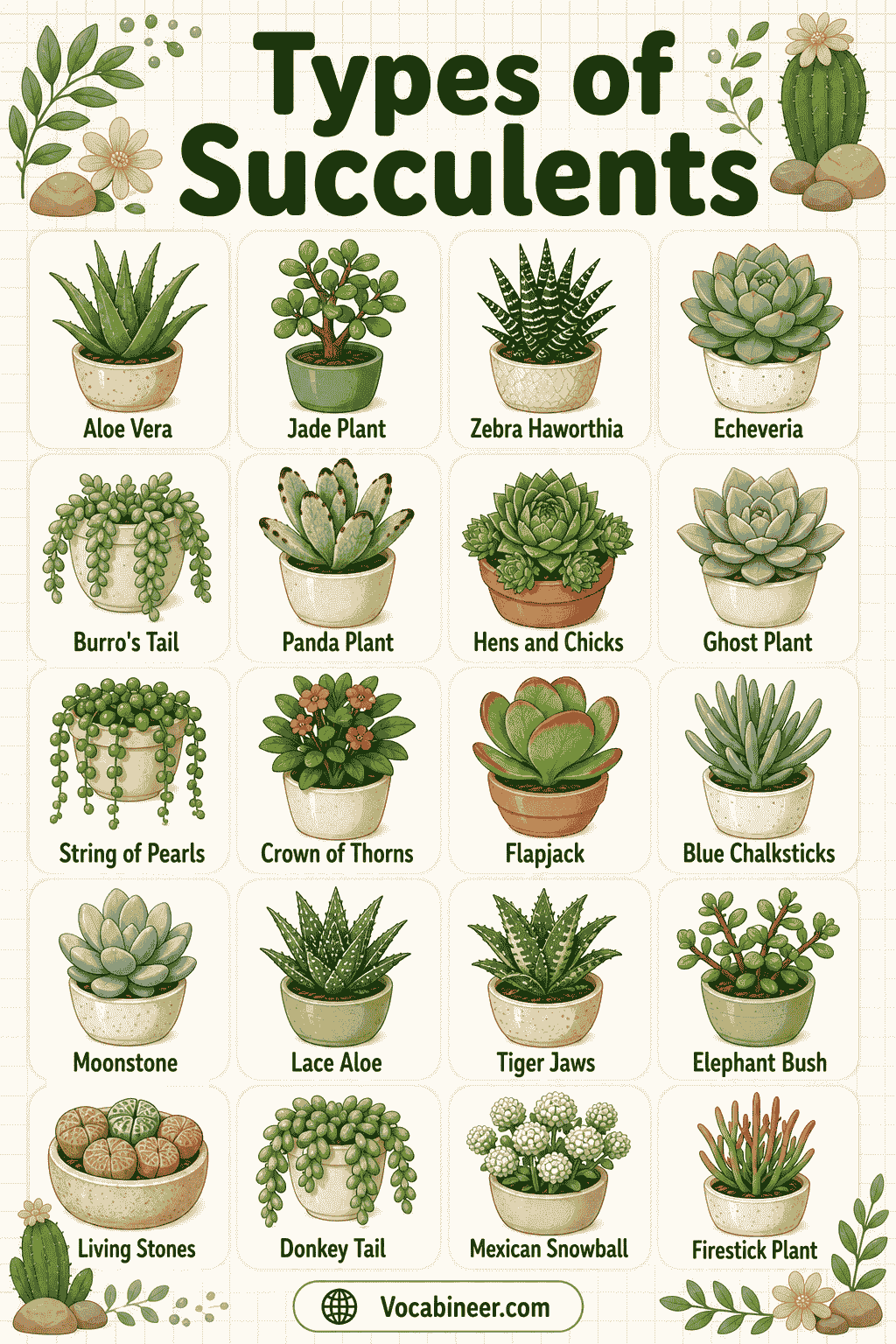
- Echeveria — a rosette-shaped succulent with thick leaves arranged like a flower.
- Aloe Vera — a fleshy-leaved succulent often grown indoors and in sunny spots.
- Jade Plant — a small tree-like succulent with thick oval green leaves.
- Haworthia — a small indoor succulent with compact leaves.
- Zebra Plant — a Haworthia type with dark leaves and white stripes.
- Sedum — a large group of succulents with many ground-cover and garden types.
- Agave — a spiky succulent with strong pointed leaves.
- Crassula — a succulent group that includes the jade plant.
- Kalanchoe — a succulent group known for colorful flowers and thick leaves.
- Aeonium — a rosette succulent that often grows on branching stems.
- String of Pearls — a trailing succulent with round bead-like leaves.
- Burro’s Tail — a trailing succulent with thick hanging stems.
- Panda Plant — a fuzzy succulent with soft gray-green leaves.
- Lithops — a small stone-like succulent also called living stones.
- Sempervivum — a cold-hardy rosette succulent often called hens and chicks.
Indoor Succulent Types
Indoor succulents are popular because many stay small and grow well in bright windows or pots. They usually need good light, careful watering, and soil that drains quickly.
- Aloe Vera — a useful indoor succulent with long fleshy leaves.
- Haworthia — a compact plant that fits well on desks and windowsills.
- Zebra Plant — a striped succulent that stays small indoors.
- Gasteria — a slow-growing succulent with thick tongue-like leaves.
- Snake Plant — an upright succulent with long sword-like leaves.
- Jade Plant — a tree-like succulent often grown in indoor pots.
- Panda Plant — a fuzzy indoor succulent with soft-looking leaves.
- String of Pearls — a trailing plant often grown near bright windows.
- Christmas Cactus — a flowering succulent that can grow well indoors.
- Burro’s Tail — a hanging succulent suited for bright indoor spaces.
Outdoor Succulent Types
Outdoor succulents are often used in gardens, rock beds, containers, and dry landscapes. Many outdoor types enjoy strong sunlight, warm weather, and well-draining soil.
- Agave — a bold outdoor succulent with sharp pointed leaves.
- Sedum — a hardy succulent often used as ground cover.
- Sempervivum — a cold-hardy rosette succulent for outdoor containers.
- Hens and Chicks — a Sempervivum type that forms small baby rosettes.
- Aeonium — a rosette succulent that grows well in mild outdoor climates.
- Prickly Pear Cactus — a cactus succulent with flat padded stems.
- Euphorbia — a large group with many outdoor succulent forms.
- Aloe — a sun-loving succulent with thick pointed leaves.
- Kalanchoe — a flowering succulent often grown in containers.
- Ice Plant — a low-growing succulent with colorful flowers.
Rosette Succulent Types
Rosette succulents have leaves arranged in a circular pattern that looks like a flower. These plants are popular in pots, arrangements, and picture guides because their shapes are easy to recognize.
- Echeveria — one of the most popular rosette succulents.
- Aeonium — a rosette succulent that often grows on stems.
- Sempervivum — a hardy rosette plant often grown outdoors.
- Hens and Chicks — a rosette succulent that produces small offsets.
- Graptopetalum — a rosette succulent with soft pastel leaves.
- Ghost Plant — a pale Graptopetalum succulent with powdery leaves.
- Dudleya — a rosette succulent often found in dry coastal areas.
- Pachyphytum — a rosette plant with thick rounded leaves.
- Graptoveria — a hybrid rosette succulent with colorful leaves.
- Sedeveria — a hybrid succulent with rosette and sedum-like features.
Hanging and Trailing Succulents
Hanging and trailing succulents have stems that spill over pots, shelves, or baskets. They are useful for hanging planters, tall pots, and decorative indoor displays.
- String of Pearls — a trailing succulent with round bead-like leaves.
- String of Bananas — a trailing succulent with curved banana-shaped leaves.
- String of Hearts — a trailing plant with small heart-shaped leaves.
- Burro’s Tail — a hanging succulent with thick overlapping leaves.
- Donkey Tail — another name often used for Burro’s Tail.
- Trailing Jade — a trailing succulent with small rounded leaves.
- Ruby Necklace — a trailing succulent with colorful reddish stems.
- Fishbone Cactus — a trailing cactus with zigzag-shaped stems.
- Dischidia — a trailing plant with small thick leaves.
- Rhipsalis — a trailing cactus-like succulent with thin stems.
Flowering Succulent Types
Flowering succulents produce colorful blooms while keeping their thick water-storing leaves or stems. Some flower indoors, while others bloom best outdoors in bright light.
- Kalanchoe — a popular flowering succulent with bright clusters of blooms.
- Christmas Cactus — an indoor succulent known for colorful holiday flowers.
- Crown of Thorns — a spiny succulent that can produce small bright flowers.
- Desert Rose — a thick-stemmed succulent with showy flowers.
- Aloe — some aloe plants produce tall flower spikes.
- Echeveria — rosette succulents that can grow small flower stalks.
- Sedum — many sedums produce star-shaped flowers.
- Ice Plant — a ground-cover succulent with bright daisy-like flowers.
- Stapelia — an unusual succulent known for star-shaped flowers.
- Orchid Cactus — a cactus-like succulent with large colorful blooms.
Cactus and Spiky Succulents
Cacti are a type of succulent, but not all succulents are cacti. Cactus and spiky succulents often have spines, pointed leaves, thick stems, or sharp edges.
- Prickly Pear Cactus — a cactus with flat pads and spines.
- Christmas Cactus — a cactus succulent often grown indoors for flowers.
- Fishbone Cactus — a cactus with zigzag stems.
- Barrel Cactus — a round cactus with ribs and spines.
- Bunny Ear Cactus — a cactus with flat pads shaped like ears.
- Euphorbia — a cactus-like succulent group with many spiny forms.
- Agave — a spiky succulent with sharp leaf tips.
- Aloe — a succulent with thick pointed leaves.
- Crown of Thorns — a spiny succulent with small colorful flowers.
- Stapelia — a cactus-like succulent with thick angular stems.
Colorful Succulent Types
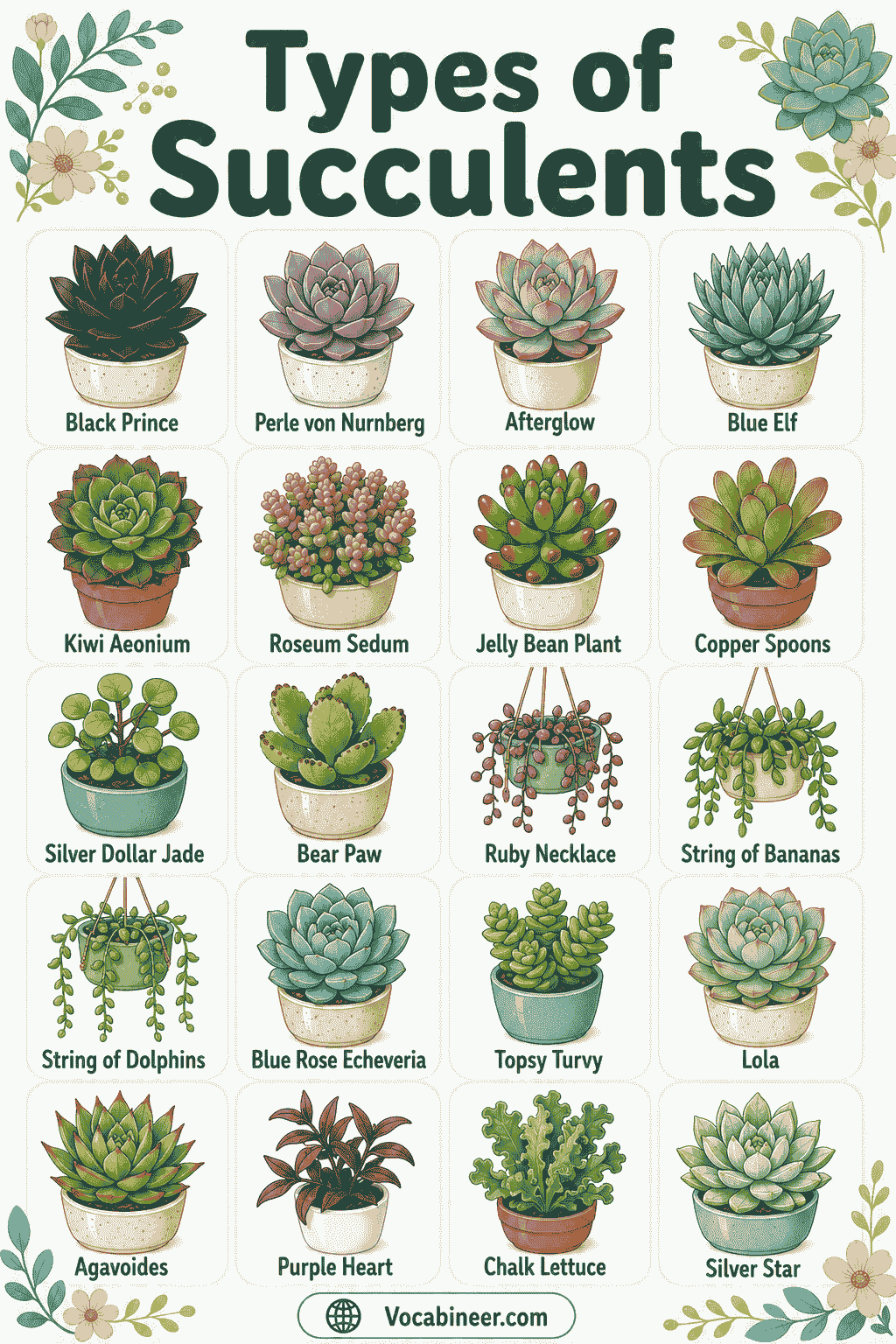
Colorful succulents are popular in picture guides because their leaves can show green, blue, purple, pink, red, orange, yellow, or silver tones. Color often changes with sunlight, season, and plant health.
- Echeveria — comes in many pastel shades, including blue, pink, and purple.
- Sedum — some types show yellow, red, green, or bronze colors.
- Kalanchoe — known for colorful flowers and thick green leaves.
- Aeonium — some types have dark purple or almost black rosettes.
- Graptoveria — a hybrid succulent with soft colorful rosettes.
- Crassula — some types show red edges or colorful leaf tips.
- Moon Cactus — a colorful grafted cactus often seen in red, yellow, orange, or pink.
- Purple Heart — a purple trailing plant with thick stems.
- Jelly Bean Plant — a sedum with small bean-like leaves that can turn red.
- Pachyphytum — a pastel succulent with thick rounded leaves.
Rare and Unusual Succulents
Rare and unusual succulents are interesting because they have strange shapes, special textures, or uncommon growth patterns. This section stays short so the article remains beginner-friendly.
- Lithops — stone-like succulents also called living stones.
- Split Rock — a small succulent that looks like a cracked rock.
- Stapelia — an unusual succulent with star-shaped flowers.
- Dolphin Succulent — a trailing succulent with leaves shaped like tiny dolphins.
- Baseball Plant — a round Euphorbia succulent shaped like a ball.
- Mermaid Tail Succulent — an unusual crested succulent with fan-like growth.
- Baby Toes — a small succulent with finger-like leaves.
- Tiger Jaws — a small succulent with triangular leaves that look like tiny jaws.
Easy Succulents for Beginners
Easy succulents are good for people who are new to plant care. These plants are usually forgiving, low maintenance, and better at handling dry soil than many other houseplants.
- Aloe Vera — easy to grow in bright light with careful watering.
- Jade Plant — a long-lasting succulent that grows slowly indoors.
- Snake Plant — a tough plant with upright leaves.
- Haworthia — a small indoor succulent that is easy to manage.
- Zebra Plant — compact and beginner-friendly for small pots.
- Sedum — many types grow easily outdoors or in containers.
- Echeveria — a popular rosette succulent for bright spots.
- Sempervivum — hardy and useful for outdoor beginners.
- Panda Plant — a fuzzy succulent that stays compact.
- Gasteria — a slow-growing plant that handles indoor pots well.
Succulent Shapes and Identification
Succulent identification often starts with shape, leaf texture, stem type, and growth habit. Looking at these visual clues can help beginners recognize a succulent before learning its exact name.
| Visual Clue | Common Example |
|---|---|
| Rosette Leaves | Echeveria, Aeonium, Sempervivum |
| Thick Oval Leaves | Jade Plant, Crassula |
| Bead-Like Leaves | String of Pearls |
| Trailing Stems | Burro’s Tail, String of Bananas |
| Fuzzy Leaves | Panda Plant |
| Striped Leaves | Zebra Plant, Haworthia |
| Spiky Leaves | Agave, Aloe |
| Stone-Like Leaves | Lithops, Split Rock |
| Sword-Like Leaves | Snake Plant |
| Paddle Leaves | Paddle Plant, some Kalanchoe types |
Confusing Succulent Types Explained
| Succulent Terms | Difference |
|---|---|
| Echeveria vs Sempervivum | Echeveria is usually grown in warmer conditions, while Sempervivum is often more cold-hardy. |
| Aloe vs Agave | Aloe usually has fleshy leaves and softer edges, while Agave often has sharper leaves and stronger tips. |
| Haworthia vs Gasteria | Haworthia is often compact and striped, while Gasteria usually has thicker tongue-like leaves. |
| Sedum vs Sempervivum | Sedum includes many spreading or trailing types, while Sempervivum usually forms rosettes. |
| Jade Plant vs Portulacaria Afra | Jade Plant has thicker oval leaves, while Portulacaria Afra has smaller leaves and thinner stems. |
| String of Pearls vs String of Bananas | String of Pearls has round bead-like leaves, while String of Bananas has curved banana-shaped leaves. |
| Burro’s Tail vs Donkey Tail | These names are often used for very similar trailing succulents with thick hanging stems. |
| Cactus vs Succulent | Cacti are succulents, but many succulents are not cacti. |
| Lithops vs Split Rock | Lithops usually look like small paired stones, while Split Rock has a wider cracked shape. |
| Kalanchoe vs Echeveria | Kalanchoe often has upright leaves or flowers, while Echeveria usually grows in rosette form. |
Types of Succulents Chart with Pictures
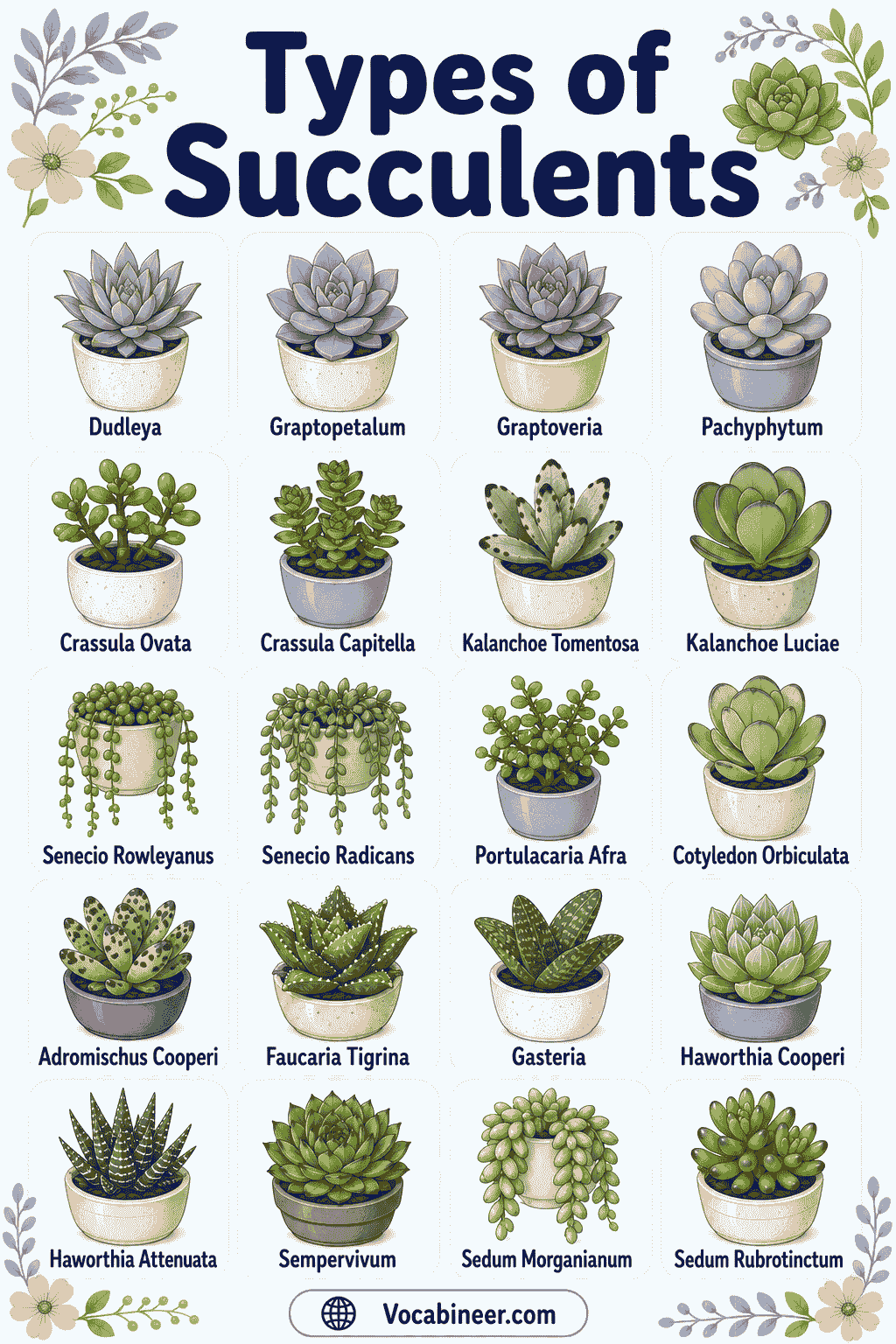
A succulent chart helps learners compare succulent groups quickly.
| Succulent Group | Details |
|---|---|
| Common Succulents | Best for: basic succulent vocabulary Examples: Echeveria, Aloe Vera, Jade Plant |
| Indoor Succulents | Best for: pots, desks, and windowsills Examples: Haworthia, Snake Plant, Zebra Plant |
| Outdoor Succulents | Best for: gardens and dry landscapes Examples: Agave, Sedum, Sempervivum |
| Rosette Succulents | Best for: flower-like shapes Examples: Echeveria, Aeonium, Graptopetalum |
| Hanging Succulents | Best for: baskets and shelves Examples: String of Pearls, Burro’s Tail, Rhipsalis |
| Flowering Succulents | Best for: colorful blooms Examples: Kalanchoe, Christmas Cactus, Desert Rose |
| Colorful and Unusual Succulents | Best for: picture guides and collections Examples: Moon Cactus, Lithops, Tiger Jaws |
Basic Succulent Care Tips
Succulents are usually easier to care for when they have bright light, well-draining soil, and pots with drainage holes. Most types prefer drying out between waterings because wet soil can damage their roots.
- Bright Light — many succulents grow best with bright natural light.
- Careful Watering — water only when the soil feels dry.
- Well-Draining Soil — use soil that does not stay wet for too long.
- Drainage Holes — choose pots that allow extra water to escape.
- Dry Soil — avoid keeping the soil constantly damp.
- Less Winter Water — many succulents need less water in cooler months.
- Good Airflow — airflow helps reduce moisture problems.
- Avoid Overwatering — too much water is one of the most common succulent problems.
FAQs
Common types of succulents include Echeveria, Aloe Vera, Jade Plant, Haworthia, Zebra Plant, Sedum, Agave, Kalanchoe, Aeonium, String of Pearls, Burro’s Tail, Panda Plant, Lithops, and Sempervivum.
Good indoor succulents include Aloe Vera, Haworthia, Zebra Plant, Gasteria, Snake Plant, Jade Plant, Panda Plant, String of Pearls, Christmas Cactus, and Burro’s Tail.
Easy succulents for beginners include Aloe Vera, Jade Plant, Snake Plant, Haworthia, Zebra Plant, Sedum, Echeveria, Sempervivum, Panda Plant, and Gasteria.
You can identify a succulent by looking at leaf shape, thickness, color, stem style, growth pattern, and texture. Rosettes, trailing stems, fuzzy leaves, striped leaves, spines, and stone-like leaves are useful clues.
Yes, cactus plants are succulents because they store water in their stems. However, not all succulents are cacti because many succulents do not have cactus features.
Read More