Makeup brushes are tools used to apply, blend, shape, and define makeup products on the face, eyes, brows, lashes, and lips. Different brush types have different shapes, bristle density, lengths, and angles, so each brush helps with a specific makeup step.
Some brushes are made for smooth foundation, while others are better for powder, blush, contour, eyeshadow, eyeliner, brows, or lipstick. This guide explains common makeup brush names, their uses, brush shapes, beginner essentials, sponge tools, care tips, and picture metadata for a clear visual makeup brush guide.
In This Page
Common Types of Makeup Brushes
Makeup brushes come in many shapes and sizes, but some brush names appear in almost every beginner brush guide, makeup kit, and beauty tutorial. These common makeup brush types help learners recognize the main tools and understand what each one is used for.
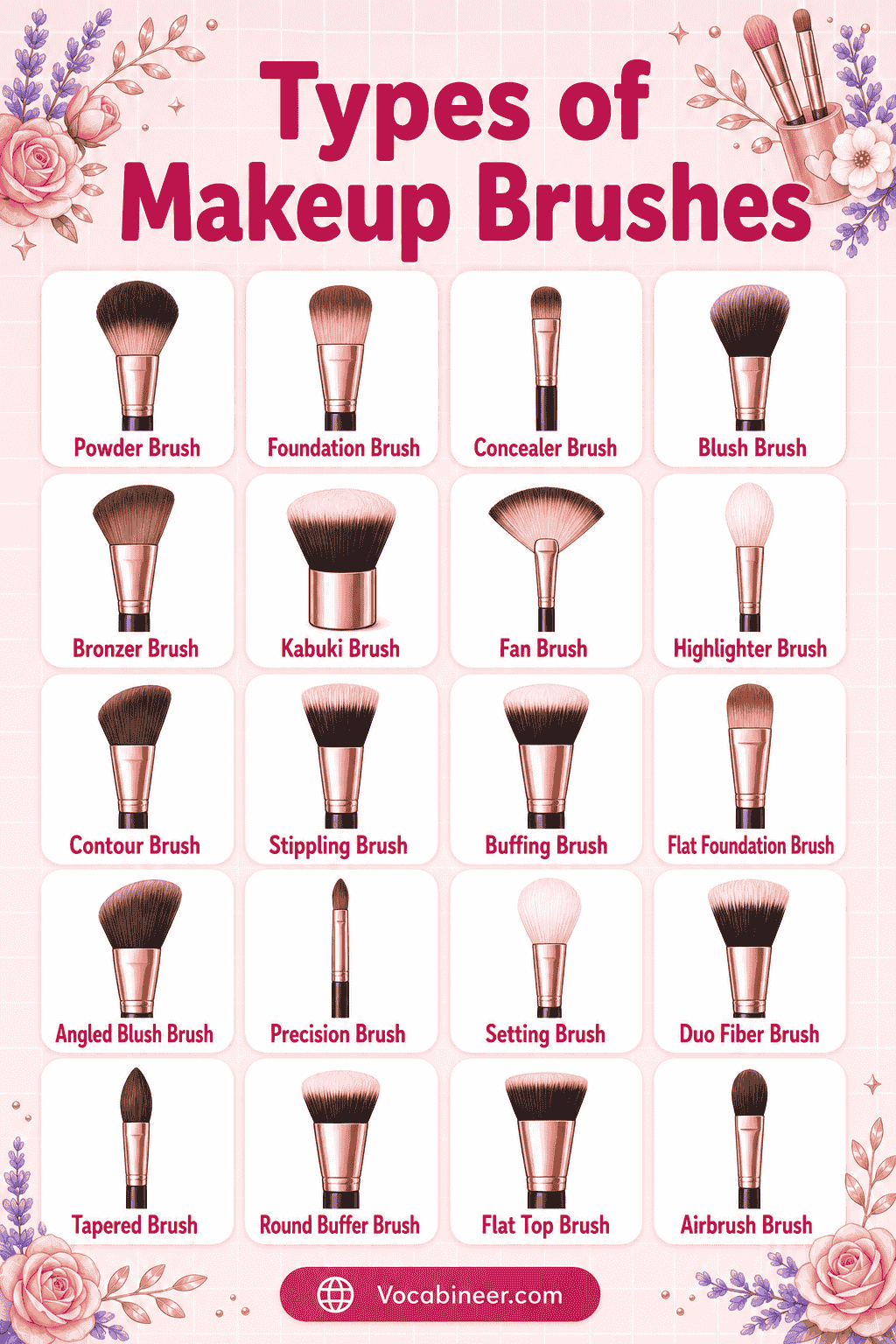
Foundation Brush
A foundation brush applies liquid or cream foundation evenly across the face and helps create a smooth, controlled base.
Powder Brush
A powder brush has a large, fluffy head that spreads loose or pressed powder lightly and evenly over the skin.
Blush Brush
A blush brush applies and blends blush across the cheeks for soft, natural-looking color.
Concealer Brush
A concealer brush has a small, precise head that applies concealer to spots, redness, blemishes, and under-eye areas.
Contour Brush
A contour brush places and blends contour products around the cheekbones, jawline, forehead, and other areas that need definition.
Bronzer Brush
A bronzer brush distributes bronzer across the face to add warmth and create soft definition.
Highlighter Brush
A highlighter brush applies highlighting products to areas such as the cheekbones, brow bones, and bridge of the nose.
Fan Brush
A fan brush has thin, spread-out bristles that apply light layers of highlighter or sweep away excess powder.
Kabuki Brush
A kabuki brush has dense bristles that buff powder, bronzer, mineral foundation, and other products smoothly into the skin.
Stippling Brush
A stippling brush uses bristles of different lengths to blend liquid or cream products into a light, even finish.
Flat Top Brush
A flat top brush has dense bristles with a level surface that buffs foundation or powder into the skin.
Dual Fiber Brush
A dual fiber brush combines different bristle lengths to apply and blend makeup with a soft, diffused finish.
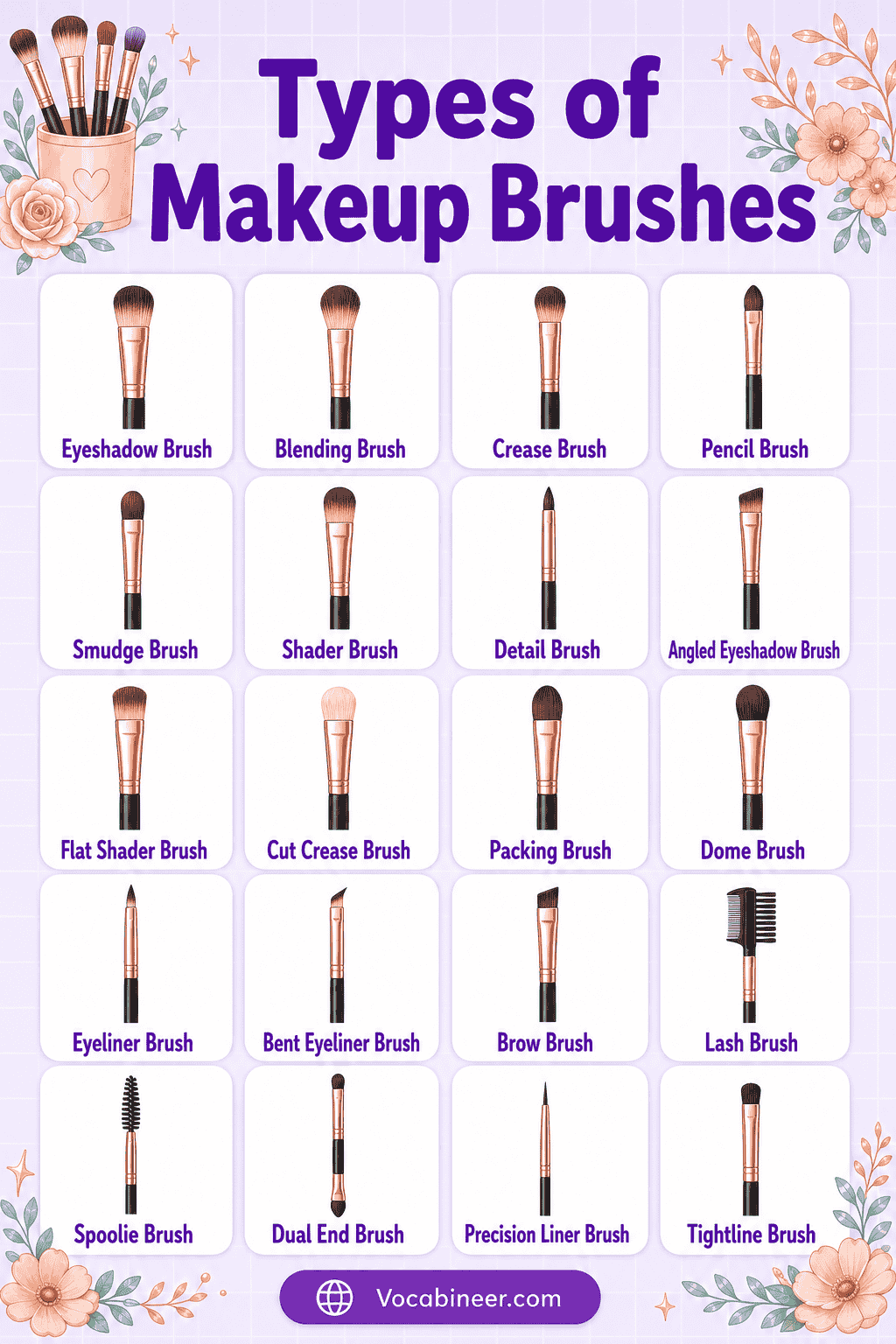
Flat Eyeshadow Brush
A flat eyeshadow brush packs eyeshadow directly onto the eyelid and helps build strong, even color.
Blending Brush
A blending brush has soft, fluffy bristles that smooth harsh eyeshadow edges and blend colors together.
Crease Brush
A crease brush places and blends eyeshadow into the eyelid crease to add depth and definition.
Pencil Brush
A pencil brush has a small pointed tip that handles precise eyeshadow placement, smudging, and detailed eye makeup.
Eyeliner Brush
An eyeliner brush uses a thin, precise tip to apply gel, cream, or powder eyeliner close to the lash line.
Angled Liner Brush
An angled liner brush has slanted bristles that create sharp eyeliner lines and precise eyebrow details.
Brow Brush
A brow brush applies and blends brow products to shape, fill, and define the eyebrows.
Spoolie Brush
A spoolie brush has spiral bristles that comb, shape, and separate eyebrow hairs or eyelashes.
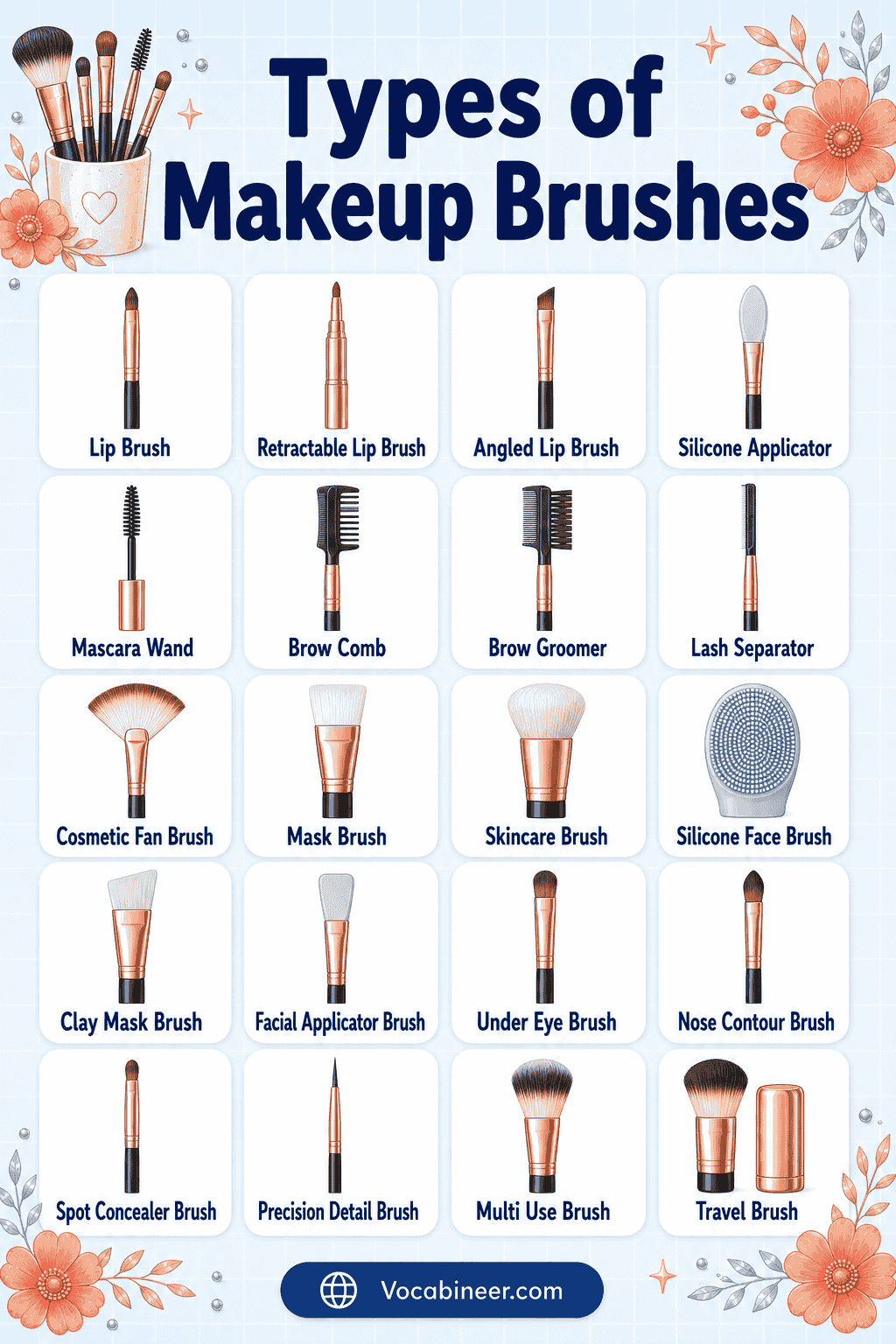
Mascara Wand
A mascara wand coats, lifts, and separates eyelashes while applying mascara evenly from root to tip.
Lip Brush
A lip brush applies lipstick or other lip color precisely and helps define the edges of the lips.
Beauty Sponge
A beauty sponge blends liquid and cream foundation, concealer, and other complexion products for a smooth finish.
Makeup Sponge
A makeup sponge applies or blends liquid, cream, and some powder products across the face.
Face Makeup Brushes
Face makeup brushes are used for foundation, concealer, powder, blush, bronzer, contour, and highlighter. These brushes usually have larger heads than eye brushes because they cover wider areas of the face.
- Foundation Brush — applies liquid or cream foundation across the face.
- Flat Foundation Brush — smooths foundation in thin even layers.
- Buffing Brush — blends foundation into the skin using circular motions.
- Stippling Brush — creates a soft airbrushed look with light tapping motions.
- Kabuki Brush — buffs powder, bronzer, or mineral makeup into the skin.
- Powder Brush — sets makeup with loose or pressed powder.
- Large Powder Brush — covers broad face areas quickly with powder.
- Setting Brush — applies powder to smaller areas such as under the eyes.
- Concealer Brush — places concealer on blemishes, redness, or dark areas.
- Blush Brush — applies blush softly to the cheeks.
- Angled Blush Brush — follows the cheek shape for controlled blush placement.
- Contour Brush — adds definition under cheekbones and along the jawline.
- Angled Contour Brush — fits face angles for sharper contour placement.
- Bronzer Brush — applies bronzer to warm up the face.
- Highlighter Brush — places highlighter on cheekbones, nose, and brow bone.
- Fan Brush — sweeps highlighter lightly or removes extra powder.
- Flat Top Brush — buffs foundation or powder with fuller coverage.
- Dual Fiber Brush — blends liquid, cream, or powder products softly.
Eye Makeup Brushes
Eye makeup brushes are smaller than face brushes because they work on detailed areas around the eyelids, crease, lash line, and inner corners. Different eye brushes help pack, blend, smudge, define, and soften eyeshadow or liner.
- Eyeshadow Brush — a general brush used to apply eyeshadow.
- Flat Eyeshadow Brush — packs color onto the eyelid.
- Shader Brush — applies eyeshadow with more color intensity.
- Blending Brush — softens harsh eyeshadow lines.
- Crease Brush — places color in the eyelid crease.
- Pencil Brush — adds detail to the outer corner, lower lash line, or inner corner.
- Smudge Brush — softens eyeliner or shadow along the lash line.
- Detail Brush — applies makeup to very small eye areas.
- Angled Eyeshadow Brush — places color at an angle or along the crease.
- Eyeliner Brush — applies gel, cream, or powder eyeliner.
- Angled Liner Brush — creates sharp lines or winged eyeliner.
- Winged Liner Brush — helps draw precise winged liner shapes.
- Small Detail Brush — works around inner corners or tiny areas.
- Under Eye Brush — applies or blends shadow under the lower lash line.
Brow and Lash Brushes
Brow and lash brushes are small tools used for shaping, grooming, separating, and defining brows or lashes. They help control tiny details that larger brushes cannot handle.
- Brow Brush — fills and shapes eyebrows with powder, cream, or pomade.
- Eyebrow Brush — another name for a brush used on the brows.
- Angled Brow Brush — a slanted brush used to create hair-like brow strokes.
- Spoolie Brush — combs brow hairs and blends brow product.
- Dual Ended Brow Brush — has an angled brush on one side and a spoolie on the other.
- Lash Brush — combs or separates lashes.
- Mascara Wand — applies mascara or separates lashes after product.
- Lash Comb — separates clumped lashes.
- Eyelash Separator — helps define lashes after mascara.
- Brow Grooming Brush — tidies brows before or after filling.
- Brow Defining Brush — creates sharper brow edges and details.
Lip Makeup Brushes
Lip brushes are small precision brushes used for lipstick, gloss, lip liner, and detailed lip work. They help apply color neatly, especially around the edges and corners of the mouth.
- Lip Brush — applies lipstick or lip color smoothly.
- Lip Liner Brush — defines the lip edges before filling in color.
- Retractable Lip Brush — a lip brush with a cover for storage or travel.
- Small Flat Lip Brush — places lip color evenly on the lips.
- Precision Lip Brush — works around corners, edges, and detailed areas.
- Lip Blending Brush — blends lip colors or softens harsh edges.
- Lip Color Brush — applies lipstick, stain, or gloss with control.
- Lip Detail Brush — helps fix small edges and clean lip lines.
Makeup Brushes and Sponges
Makeup sponges are not brushes, but they are common makeup tools used with many of the same products. Brushes often give more structure and precision, while sponges create a softer blended finish.
- Beauty Sponge — a soft sponge used to blend foundation, concealer, or cream makeup.
- Makeup Sponge — a general sponge tool used for liquid, cream, or powder products.
- Blending Sponge — blends base makeup for a smooth finish.
- Wedge Sponge — a triangular sponge used around small areas of the face.
- Powder Puff — a soft puff used to press powder into the skin.
- Foundation Sponge — applies and blends liquid or cream foundation.
- Beauty Blender — a rounded sponge commonly used for foundation and concealer.
- Silicone Applicator — spreads liquid or cream product without absorbing much makeup.
- Makeup Applicator — a general tool used to apply makeup products.
Essential Makeup Brushes for Beginners
A beginner does not need every makeup brush at once. A small starter kit can cover the main steps for face makeup, eye makeup, brows, and lips.
- Foundation Brush or Beauty Sponge — useful for blending base makeup.
- Powder Brush — helps set makeup with loose or pressed powder.
- Blush Brush — adds color to the cheeks.
- Concealer Brush — places coverage on small areas.
- Flat Eyeshadow Brush — applies eyeshadow to the eyelids.
- Blending Brush — softens eyeshadow and makes the look smoother.
- Brow Brush — fills and shapes eyebrows.
- Spoolie Brush — combs brows and blends brow product.
- Lip Brush — applies lip color neatly.
- Angled Liner Brush — works for eyeliner, brows, or small details.
Makeup Brush Shapes and Identification
Makeup brush identification often starts with shape, size, bristle density, and angle. Looking at these visual clues can help beginners recognize what a brush is meant to do.
| Brush Shape | Common Use |
|---|---|
| Flat Brush | Applies cream, liquid, or packed color. |
| Fluffy Brush | Blends powder or eyeshadow softly. |
| Angled Brush | Helps with contour, blush, brows, or liner. |
| Tapered Brush | Gives controlled placement in smaller areas. |
| Dense Brush | Gives fuller coverage and stronger blending. |
| Fan-Shaped Brush | Sweeps on highlighter or removes extra powder. |
| Dome-Shaped Brush | Applies blush, powder, or eyeshadow with soft edges. |
| Pencil Brush | Works on small eye areas and lower lash lines. |
| Small Detail Brush | Adds precise makeup to tiny areas. |
| Rounded Brush | Blends and softens product edges. |
| Slanted Brush | Creates angled lines for brows, liner, or contour. |
| Thin Liner Brush | Draws fine eyeliner lines. |
| Wide Powder Brush | Covers large face areas with powder. |
| Short Bristles | Give more control and stronger product placement. |
| Long Bristles | Blend lightly and softly. |
Confusing Makeup Brush Terms Explained
| Makeup Brush Terms | Difference |
|---|---|
| Foundation Brush vs Buffing Brush | A foundation brush spreads base makeup, while a buffing brush blends it in circular motions. |
| Powder Brush vs Kabuki Brush | A powder brush is large and fluffy, while a kabuki brush is shorter and denser. |
| Blush Brush vs Contour Brush | A blush brush adds cheek color, while a contour brush shapes the face. |
| Fan Brush vs Highlighter Brush | A fan brush sweeps product lightly, while a highlighter brush can place glow more directly. |
| Flat Eyeshadow Brush vs Blending Brush | A flat brush packs color, while a blending brush softens edges. |
| Crease Brush vs Pencil Brush | A crease brush blends in the eyelid fold, while a pencil brush works on small detail areas. |
| Eyeliner Brush vs Angled Liner Brush | An eyeliner brush may be thin or pointed, while an angled liner brush has slanted bristles. |
| Brow Brush vs Spoolie Brush | A brow brush fills brows, while a spoolie combs and blends brow hairs. |
| Makeup Brush vs Beauty Sponge | A brush gives more structure and control, while a sponge creates a softer blended finish. |
| Natural Bristles vs Synthetic Bristles | Natural bristles are usually made from animal hair and often used with powders, while synthetic bristles are man-made fibers and commonly used with liquids, creams, and powders. |
Types of Makeup Brushes Chart with Pictures
A makeup brush chart helps learners compare brush groups quickly.
| Brush Group | Details |
|---|---|
| Face Brushes | Best for: foundation, powder, blush, and contourExamples: foundation brush, powder brush, blush brush |
| Eye Brushes | Best for: eyeshadow, blending, crease work, and eyelinerExamples: flat eyeshadow brush, blending brush, eyeliner brush |
| Brow and Lash Brushes | Best for: brow shaping and lash separationExamples: angled brow brush, spoolie brush, lash comb |
| Lip Brushes | Best for: lipstick, lip liner, and clean lip edgesExamples: lip brush, precision lip brush, lip liner brush |
| Sponges and Puffs | Best for: soft blending and powder pressingExamples: beauty sponge, wedge sponge, powder puff |
| Beginner Brush Kit | Best for: simple everyday makeupExamples: foundation brush, powder brush, blending brush |
| Brush Shapes | Best for: identifying brush uses by appearanceExamples: flat brush, fluffy brush, angled brush |
Basic Makeup Brush Care Tips
Makeup brushes work better and last longer when they are cleaned and stored properly. Basic care also helps keep product buildup away from the bristles.
- Wash Brushes Regularly — clean frequently used brushes with gentle soap or brush cleanser.
- Rinse Bristles Well — remove leftover makeup and cleanser from the bristles.
- Avoid Soaking Handles — too much water near the handle can loosen glue.
- Dry Brushes Flat — lay brushes flat on a clean towel after washing.
- Reshape Bristles — gently shape the brush head while it dries.
- Store Brushes Upright — keep dry brushes in a holder or clean pouch.
- Avoid Sharing Brushes — personal brushes are better for hygiene.
- Replace Damaged Brushes — replace brushes when bristles shed, smell, or lose shape.
FAQs
The main types of makeup brushes include face brushes, eye brushes, brow brushes, lash brushes, lip brushes, and sponge tools. Each group is made for a different makeup step, such as applying foundation, blending eyeshadow, shaping brows, or applying lipstick.
Face makeup brushes include foundation brushes, powder brushes, blush brushes, contour brushes, bronzer brushes, highlighter brushes, fan brushes, kabuki brushes, stippling brushes, flat top brushes, and concealer brushes.
Eye makeup brushes include flat eyeshadow brushes, blending brushes, crease brushes, pencil brushes, smudge brushes, detail brushes, angled eyeshadow brushes, eyeliner brushes, and angled liner brushes.
A beginner can start with a foundation brush or beauty sponge, powder brush, blush brush, concealer brush, flat eyeshadow brush, blending brush, brow brush, spoolie brush, angled liner brush, and lip brush.
A makeup brush usually gives more control, structure, and precise placement. A sponge gives a softer blended finish, especially with liquid foundation, cream products, and concealer.
Read More