

Learning directions vocabulary in English helps you explain where places are, understand routes, follow maps, and move confidently from one location to another. These words appear in everyday conversations, road signs, GPS instructions, public transportation, and travel.
This guide covers 100 useful direction words and terms, including basic directions, compass points, road vocabulary, position words, movement terms, and navigation vocabulary. The categories make it easier to understand how each word is used in real situations.
In This Page
Basic Direction and Orientation Words
These words describe simple movement, orientation, and the position of something in relation to the person looking at it.
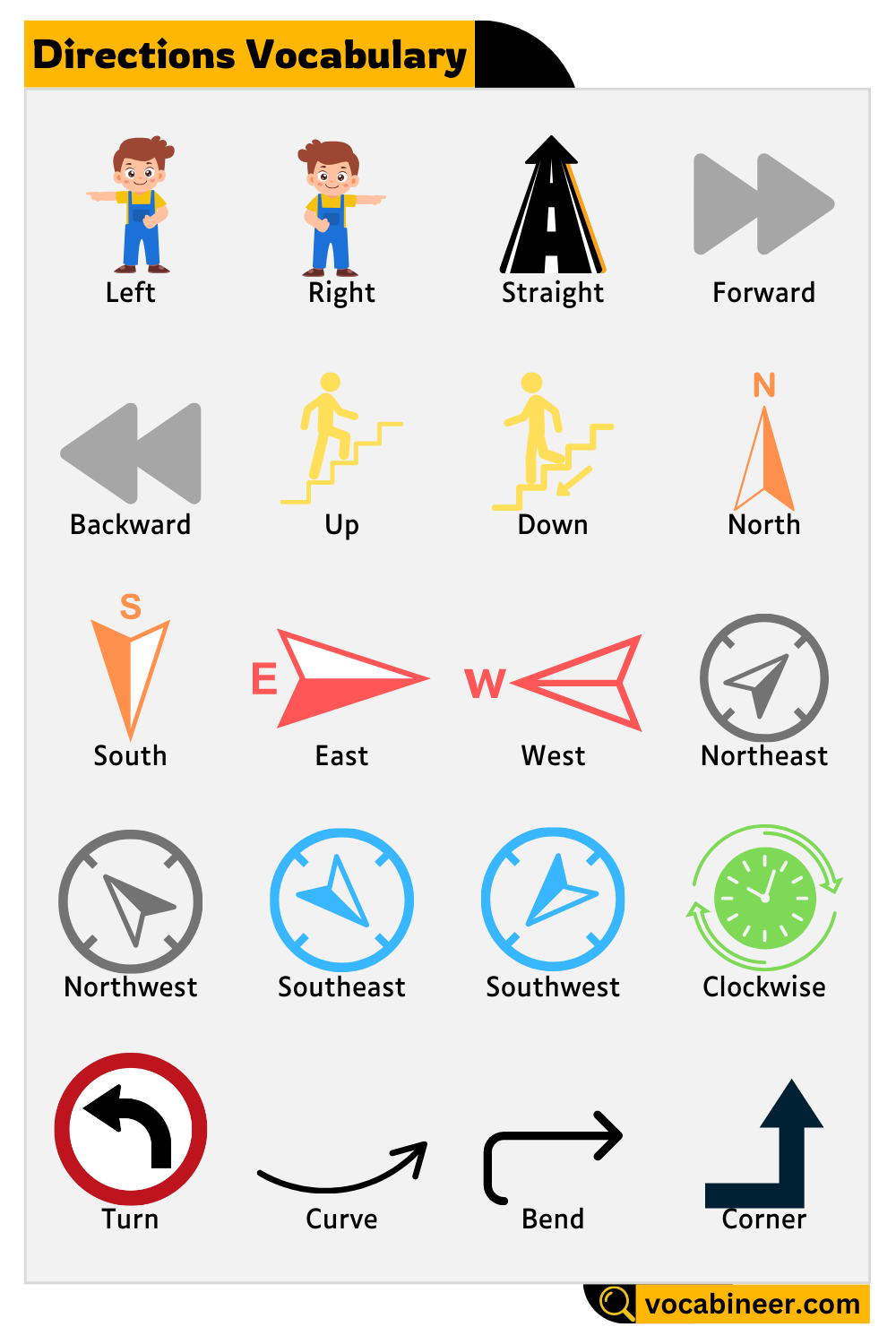
Left
The side opposite the right side.
Right
The side opposite the left side.
Straight
Continuing in the same direction without turning.
Ahead
In front or farther forward in the direction of travel.
Forward
Moving toward the direction you are facing.
Backward
Moving in the opposite direction from the way you are facing.
Upward
Moving toward a higher position or level.
Downward
Moving toward a lower position or level.
Front
The forward-facing part or position of something.
Back
The part or position behind something.
Side
A position to the left or right of something.
Center
The middle point or area of something.
Compass and Map Direction Words
Compass directions help describe geographical locations and movement on maps, navigation systems, and compasses.
North
One of the four main compass directions, usually shown at the top of a standard map.
South
The compass direction opposite north.
East
The compass direction opposite west and generally associated with sunrise.
West
The compass direction opposite east and generally associated with sunset.
Northeast
The direction between north and east.
Northwest
The direction between north and west.
Southeast
The direction between south and east.
Southwest
The direction between south and west.
Clockwise
Moving in the same direction as the hands of a clock.
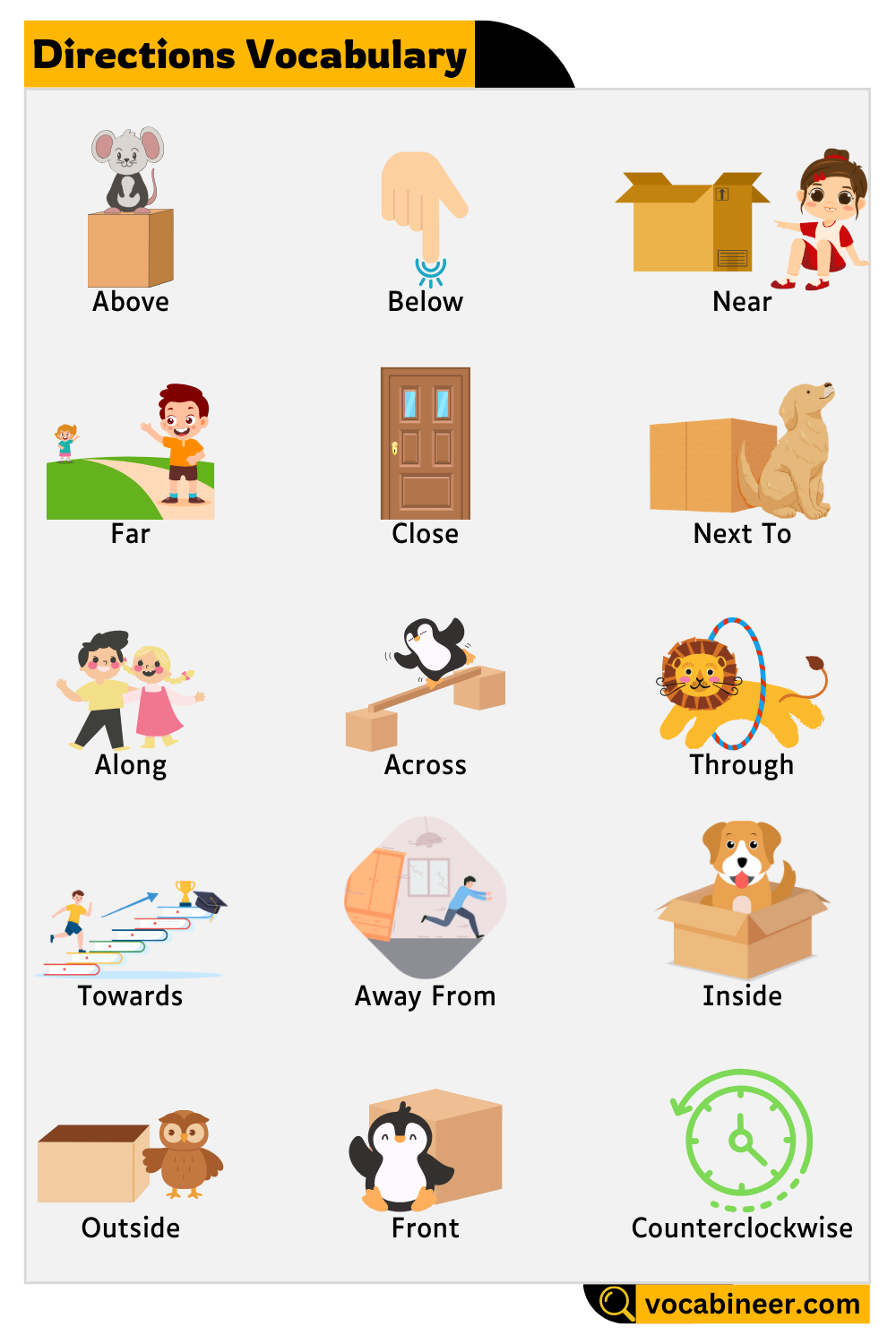
Counterclockwise
Moving in the opposite direction from the hands of a clock.
Horizontal
Extending from side to side rather than up and down.
Vertical
Extending upward and downward rather than from side to side.
Turning and Route Movement Words
These terms describe actions used when changing direction or following a route.
Turn
To change the direction in which you are moving.
Curve
A smooth change in the direction of a road or path.
Bend
A place where a road or path changes direction.
U-Turn
A turn that changes your direction to the opposite way.
Reverse
To move backward or travel in the opposite direction.
Continue
To keep moving in the same direction or along the same route.
Proceed
To continue moving forward toward a destination.
Follow
To travel along a particular road, route, sign, or path.
Pass
To move beyond a person, place, or object.
Cross
To move from one side of something to the other.
Enter
To move into a place, building, road, or area.
Exit
To leave a place, road, building, or enclosed area.
Roads, Streets, and Junctions Vocabulary
These words describe roads and other physical features commonly mentioned when giving or following directions.
Road
A route used for traveling between places.
Street
A road in a town or city, usually with buildings along it.
Avenue
A street, often broad, running through a town or city.
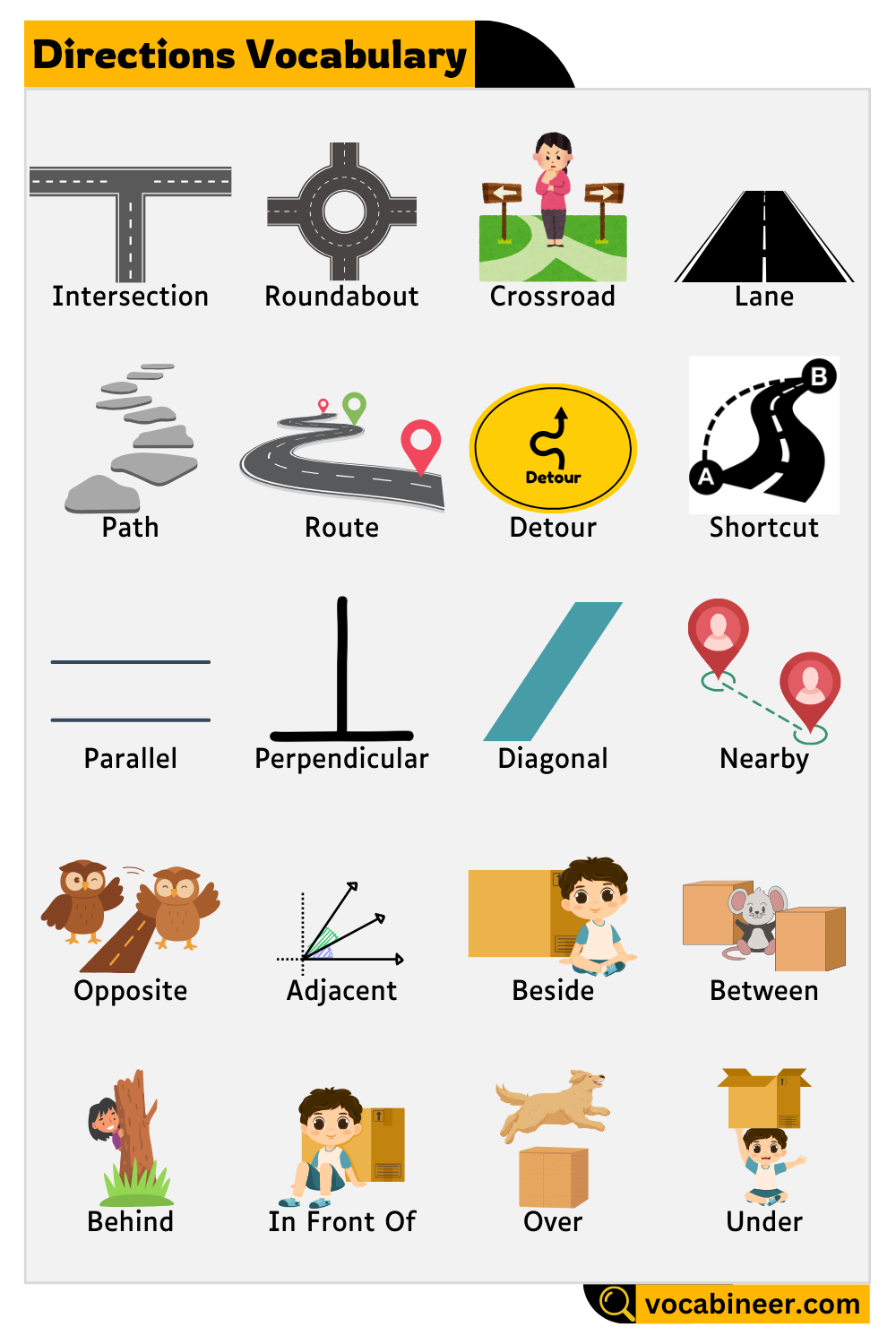
Lane
A narrow road or a marked section of a wider road used by traffic.
Highway
A major road designed for travel between towns, cities, or regions.
Freeway
A high-speed road with controlled entry and exit points.
Alley
A narrow passage or small street between buildings.
Sidewalk
A paved path beside a road for pedestrians.
Crosswalk
A marked part of a road where pedestrians can cross.
Intersection
A place where two or more roads meet or cross.
Junction
A point where roads or routes join or separate.
Crossroads
A place where roads cross and offer different directions of travel.
Roundabout
A circular road junction where traffic moves around a central area.
Bridge
A structure that carries a road or path over water, another road, or an obstacle.
Tunnel
A passage that runs through or under the ground, a hill, or another structure.
Overpass
A bridge that carries one road over another road.
Position and Location Words
These terms describe where one object, person, building, or place is located in relation to another.
Opposite
Directly across from something.
Beside
At the side of something.
Next To
Immediately beside another person, object, or place.
Adjacent
Directly next to or very close to something.
Between
In the middle of two people, objects, or places.
Behind
At the back of something.
In Front Of
Positioned before or facing the front of something.
Above
At a higher position or level.
Below
At a lower position or level.
Over
Above something, sometimes directly above it.
Under
Directly below something.
Inside
Within a building, object, area, or enclosed space.
Outside
Beyond the limits of a building, object, or enclosed area.
Near
At a short distance from something.
Nearby
Located not far away.
Far
Located at a long distance away.
Movement and Direction Prepositions
These words and short expressions explain how someone moves in relation to roads, buildings, landmarks, and other places.
Along
Moving beside or following the length of something.
Across
Moving from one side to the other.
Through
Moving into, within, and out of something.
Past
Moving beyond a place, person, or object.
Toward
Moving in the direction of something.
Away From
Moving farther from a person, place, or object.
Into
Moving from outside to inside.
Out Of
Moving from inside to outside.
Around
Moving along a curved route or surrounding something.
Onto
Moving to a position on a surface.
Off
Moving away from or leaving a surface, road, or route.
Beyond
Farther than or on the other side of something.
Around the Corner
Located or reached just beyond a nearby corner.
Across From
Located directly on the opposite side.
Toward the Left
Moving in the general direction of the left side.
Toward the Right
Moving in the general direction of the right side.
Navigation and Travel Vocabulary
These terms commonly appear on maps, GPS systems, road signs, transportation guides, and spoken directions.
Route
The path used to travel from one place to another.
Detour
An alternative route used when the normal route is unavailable.
Shortcut
A shorter or quicker way to reach a destination.
Destination
The place a person is traveling toward.
Direction
The course or way in which someone or something moves.
Distance
The amount of space between two places or objects.
Location
The particular place where something is situated.
Landmark
A recognizable building, structure, or feature used to identify a location.
Map
A visual representation showing places, roads, and geographical features.
Compass
An instrument used to identify directions such as north, south, east, and west.
Block
A section of a town or city surrounded by streets.
Traffic Light
A set of colored lights that controls road traffic.
Traffic Signal
A signal used to control or direct vehicles and pedestrians.
Bus Stop
A designated place where buses pick up and drop off passengers.
Station
A place where trains, buses, or other forms of public transportation stop.
Parking Lot
An area where vehicles can be parked.
Common Phrases for Asking for Directions
Knowing individual words is useful, but English speakers usually ask for directions with complete phrases.
How do I get to the station?
Use this when you want someone to explain a route.
Where is the nearest bus stop?
This asks for the closest bus stop.
Which way is the hospital?
Use this to ask which direction you should travel.
Can you show me the way to the market?
This is a polite way to ask for directions.
Is it far from here?
Use this to ask about distance.
How far is the airport?
This asks how much distance there is to a destination.
Is there a pharmacy nearby?
Use this to ask whether a place is close.
Am I going the right way?
This checks whether you are following the correct route.
Common Phrases for Giving Directions
These expressions combine direction vocabulary into instructions that people commonly use in real conversations.
Go straight.
Continue without turning.
Go straight ahead.
Keep moving forward in the same direction.
Turn left.
Change direction to the left.
Turn right.
Change direction to the right.
Take the first left.
Turn at the first available road on the left.
Take the second right.
Pass the first right turn and use the next one.
Go past the bank.
Continue moving beyond the bank.
Cross the street.
Move from one side of the street to the other.
Keep going.
Continue in the same direction.
Follow this road.
Continue traveling along the same road.
Take the next exit.
Leave the current road using the next available exit.
It is on your left.
The destination is located on the left side.
It is on your right.
The destination is located on the right side.
It is opposite the school.
The destination is directly across from the school.
It is next to the pharmacy.
The destination is immediately beside the pharmacy.
It is at the end of the road.
The destination is located where the road finishes.
Direction Words Used With Landmarks
Landmarks make directions easier to understand because they provide visible reference points. People commonly mention schools, hospitals, banks, parks, gas stations, pharmacies, supermarkets, bridges, traffic lights, bus stops, train stations, malls, restaurants, and public buildings when explaining a route.
For example, someone might say, “Turn left after the hospital,” “The bank is opposite the park,” or “Walk past the supermarket and continue to the traffic light.”
Direction Words Learners Often Confuse
Some direction words have similar meanings but are used differently depending on movement, position, or distance. This table shows the main differences between commonly confused direction terms.
| Words | Main Difference | Example |
|---|---|---|
| Straight vs. Forward | Straight means moving without turning, while forward means moving in the direction you are facing. | Go straight at the intersection. Step forward two steps. |
| Near vs. Next To | Near means a short distance away, while next to means immediately beside something. | The park is near the school. The bank is next to the pharmacy. |
| Above vs. Over | Above means at a higher position, while over can mean directly above or moving across something at a higher level. | The clock is above the door. The plane flew over the city. |
| Below vs. Under | Below means at a lower level, while under usually means directly beneath something. | The garage is below the apartment. The bag is under the table. |
| Across vs. Across From | Across describes movement from one side to another, while across from describes a position on the opposite side. | Walk across the road. The café is across from the bank. |
| Through vs. Across | Through means moving within something and coming out the other side, while across means moving from one side of an area or surface to another. | Drive through the tunnel. Walk across the bridge. |
| Beside vs. Nearby | Beside means directly at the side of something, while nearby means somewhere close but not necessarily beside it. | Sit beside me. There is a store nearby. |
| Into vs. Inside | Into describes movement from outside to inside, while inside describes a position within something. | Walk into the building. She is inside the building. |
| Out Of vs. Outside | Out of describes movement from inside to outside, while outside describes a position beyond an enclosed place. | Come out of the room. Wait outside the room. |
| Past vs. Beyond | Past usually describes movement farther than something, while beyond describes a position or distance farther than a particular point. | Walk past the bank. The village is beyond the hills. |
FAQs
The four main directions are north, south, east, and west. These are called cardinal directions and are commonly used on maps, compasses, GPS systems, and in geographical descriptions. North and south are opposite each other, while east and west form the other opposite pair.
Intercardinal directions are the four directions found between the main cardinal points. They are northeast, northwest, southeast, and southwest. These terms help describe locations more precisely when a place is not directly north, south, east, or west.
Common direction words include left, right, straight, ahead, forward, backward, above, below, near, far, opposite, beside, across, through, past, around, north, south, east, and west. These words describe movement, position, distance, and orientation in everyday situations.
Useful road-direction vocabulary includes intersection, junction, roundabout, lane, road, street, highway, bridge, tunnel, exit, route, detour, shortcut, crosswalk, and traffic light. These words are commonly combined with instructions such as “turn left,” “go straight,” “take the next exit,” and “walk past the bank.”
Directions vocabulary helps English learners ask where places are, understand road signs and maps, follow GPS instructions, and explain routes clearly to other people. It is especially useful while traveling, using public transportation, finding buildings, or describing where something is located.
Read More
