

Injuries are physical harms that happen to the body because of accidents, falls, cuts, burns, sports, pressure, or sudden impact. Common injury names in English include cut, bruise, burn, sprain, strain, fracture, wound, scratch, blister, and swelling.
Learning the types of injuries in English helps students, kids, ESL learners, and beginners understand health, safety, first aid, hospital, and emergency vocabulary. This guide includes common injury names with meanings, categories, common signs, example sentences, picture ideas, and useful comparison terms.
In This Page
Medical Disclaimer
This article is for English vocabulary learning only. It does not give medical advice, diagnosis, or treatment. For a real injury, serious pain, heavy bleeding, breathing trouble, head injury, burn, broken bone, or symptoms that get worse, contact a qualified doctor or emergency service.
What Are Injuries?
Injuries are damages or harms to the body. They can affect the skin, bones, muscles, joints, head, face, eyes, hands, legs, back, or internal body parts.
Some injuries are minor and heal quickly, such as small cuts, scratches, or bruises. Other injuries can be serious, such as fractures, deep wounds, head injuries, burns, or internal injuries.
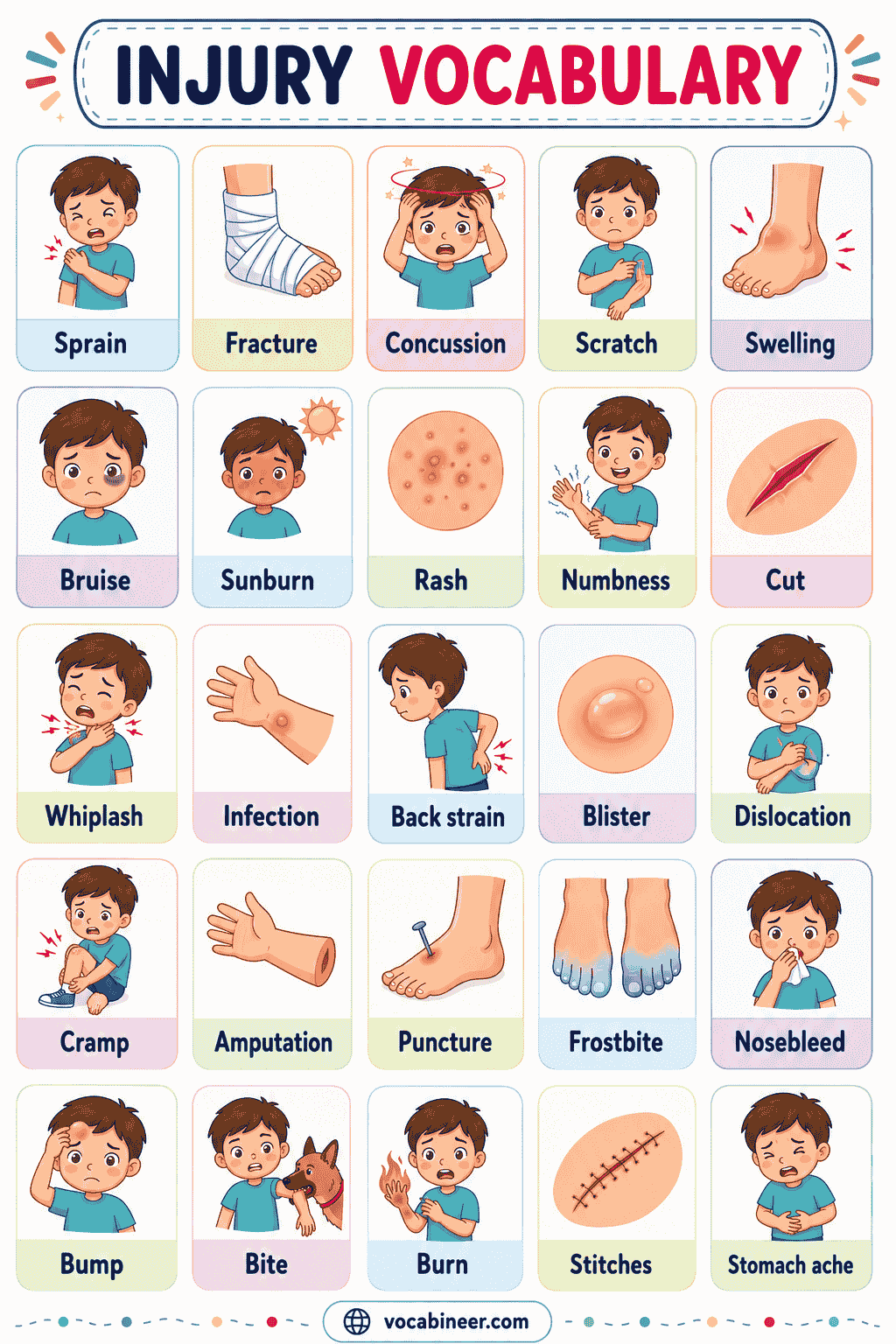
Common Types of Injuries
Injuries can affect the skin, muscles, bones, joints, or other parts of the body. Learning common injury names helps children and English learners understand basic health vocabulary and describe accidents or physical harm more clearly.
Cut
A cut is a break in the skin caused by a sharp object or rough surface. Small cuts may only affect the outer skin, while deeper cuts can damage tissue underneath.
Bruise
A bruise forms when small blood vessels under the skin break after a bump or impact. The area may look purple, blue, or dark and can feel sore.
Burn
A burn damages the skin or deeper tissue because of heat, chemicals, electricity, sunlight, or friction. Burns can range from mild redness to serious tissue damage.
Sprain
A sprain happens when a ligament stretches or tears around a joint. Ankles, wrists, and knees commonly experience this type of injury.
Strain
A strain affects a muscle or tendon after overstretching or excessive force. It can cause pain, weakness, swelling, or difficulty moving the area.
Fracture
A fracture is a crack or break in a bone. Falls, strong impacts, and sports accidents can cause different types of fractures.
Dislocation
A dislocation occurs when a bone moves out of its normal position in a joint. Shoulders, fingers, knees, and other joints can experience this injury.
Scrape
A scrape removes or damages the top layer of skin when it rubs against a rough surface. It often causes redness, soreness, and minor bleeding.
Puncture Wound
A puncture wound forms when a pointed object pierces the skin. The opening may look small even when the object reaches deeper tissue.
Laceration
A laceration is a deep cut or tear in the skin or soft tissue. Sharp objects, accidents, and strong impacts can cause this type of wound.
Concussion
A concussion is a mild traumatic brain injury caused by a blow or sudden movement of the head. It can lead to headache, dizziness, confusion, or problems with balance.
Whiplash
Whiplash affects the neck after a sudden back-and-forth movement of the head. Car accidents commonly cause this injury.
Muscle Tear
A muscle tear happens when muscle fibers stretch beyond their limit and partially or completely tear. It can cause sharp pain, swelling, and weakness.
Tendon Injury
A tendon injury affects the strong tissue that connects muscle to bone. Repetitive movement or sudden force can irritate or tear a tendon.
Ligament Tear
A ligament tear damages the tough tissue that connects bones around a joint. Sports injuries and twisting movements commonly cause this problem.
Blister
A blister is a small pocket of fluid that forms under the skin after friction, heat, or irritation. It commonly appears on the hands and feet.
Bite Wound
A bite wound happens when an animal or person breaks the skin with teeth. These wounds can cause bleeding, bruising, and infection.
Sting Injury
A sting injury occurs when an insect or other animal injects venom or irritates the skin with a stinger. It can cause pain, redness, swelling, or itching.
Crush Injury
A crush injury happens when strong pressure squeezes or compresses part of the body. Heavy objects, machinery, or accidents can damage skin, muscles, bones, and nerves.
Head Injury
A head injury affects the scalp, skull, brain, or other structures of the head. Its severity can range from a minor bump to a serious traumatic injury.
Main Categories of Injuries
Injury names are easier to learn when they are grouped by type. Here are the main categories of injuries:
- Skin and wound injuries: cut, scratch, wound, blister, abrasion, laceration
- Bone and joint injuries: fracture, broken bone, dislocation, sprain
- Muscle and soft tissue injuries: strain, muscle pull, cramp, contusion
- Head, face, and eye injuries: head injury, concussion, black eye, eye injury
- Burn and heat injuries: burn, sunburn, scald, heat rash
- Sports injuries: sprained ankle, runner’s knee, tennis elbow, shin splints
- Accident and emergency injuries: fall injury, road injury, electric shock, animal bite
100 Types of Injuries with Meanings
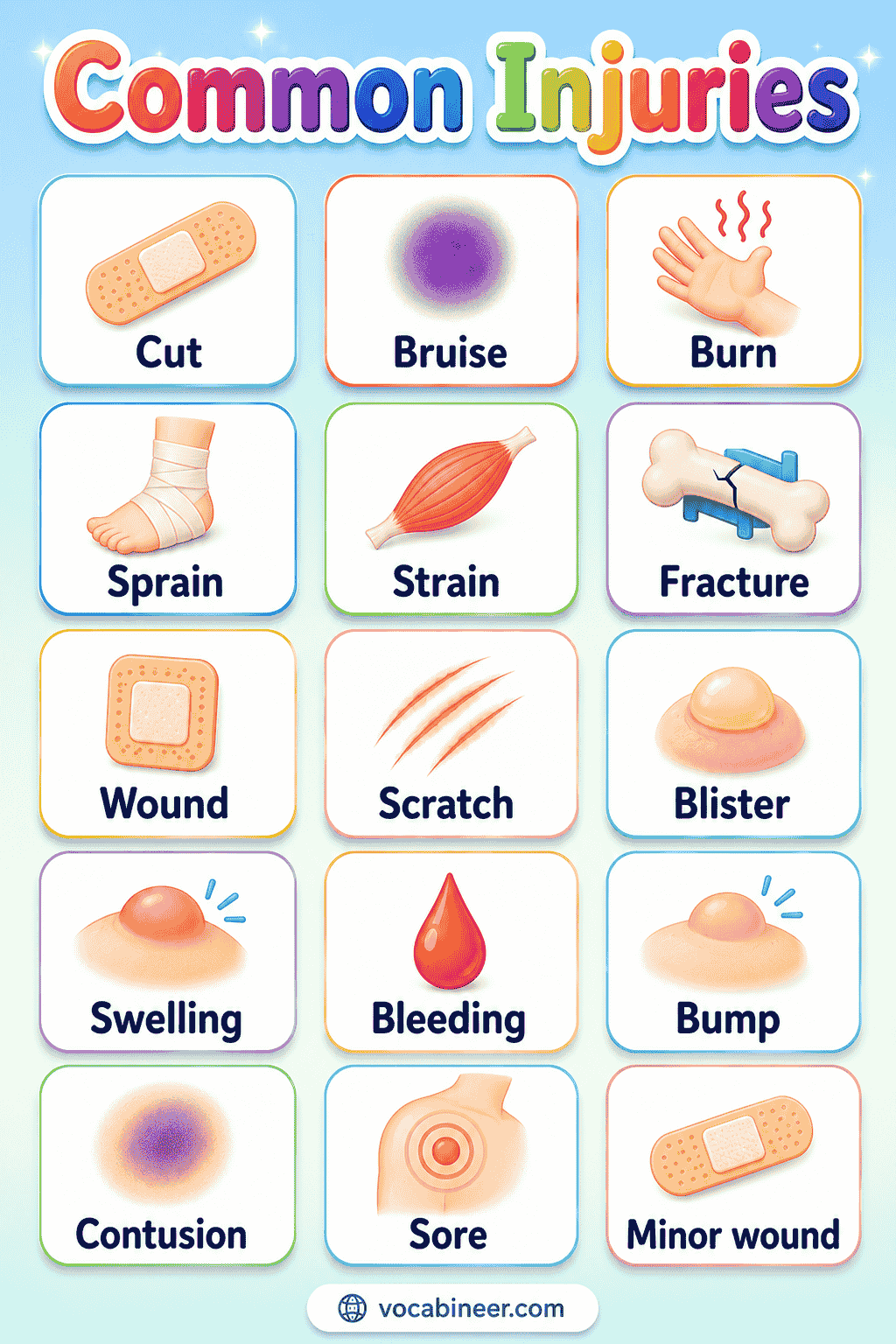
This list includes 100 injury names and related first aid words in English with simple meanings. Some words name direct injuries, while others are common injury-related terms used in health, safety, first aid, and emergency vocabulary.
Common Injury Names
These injury names are common in daily English and basic health vocabulary.
- Cut — an opening in the skin caused by something sharp
- Bruise — a dark mark under the skin caused by a hit
- Burn — skin damage caused by heat, chemicals, electricity, or fire
- Sprain — an injury to a ligament around a joint
- Strain — an injury to a muscle or tendon
- Fracture — a broken or cracked bone
- Wound — an injury that damages skin or body tissue
- Scratch — a small shallow mark on the skin
- Blister — a fluid-filled bubble on the skin
- Swelling — enlargement of an injured body part
- Bleeding — loss of blood from the body after injury
- Minor wound — a small injury to the skin or body tissue
- Bump — a raised swollen area after a hit
- Contusion — a medical word for a bruise
- Sore — a painful or tender area on the body
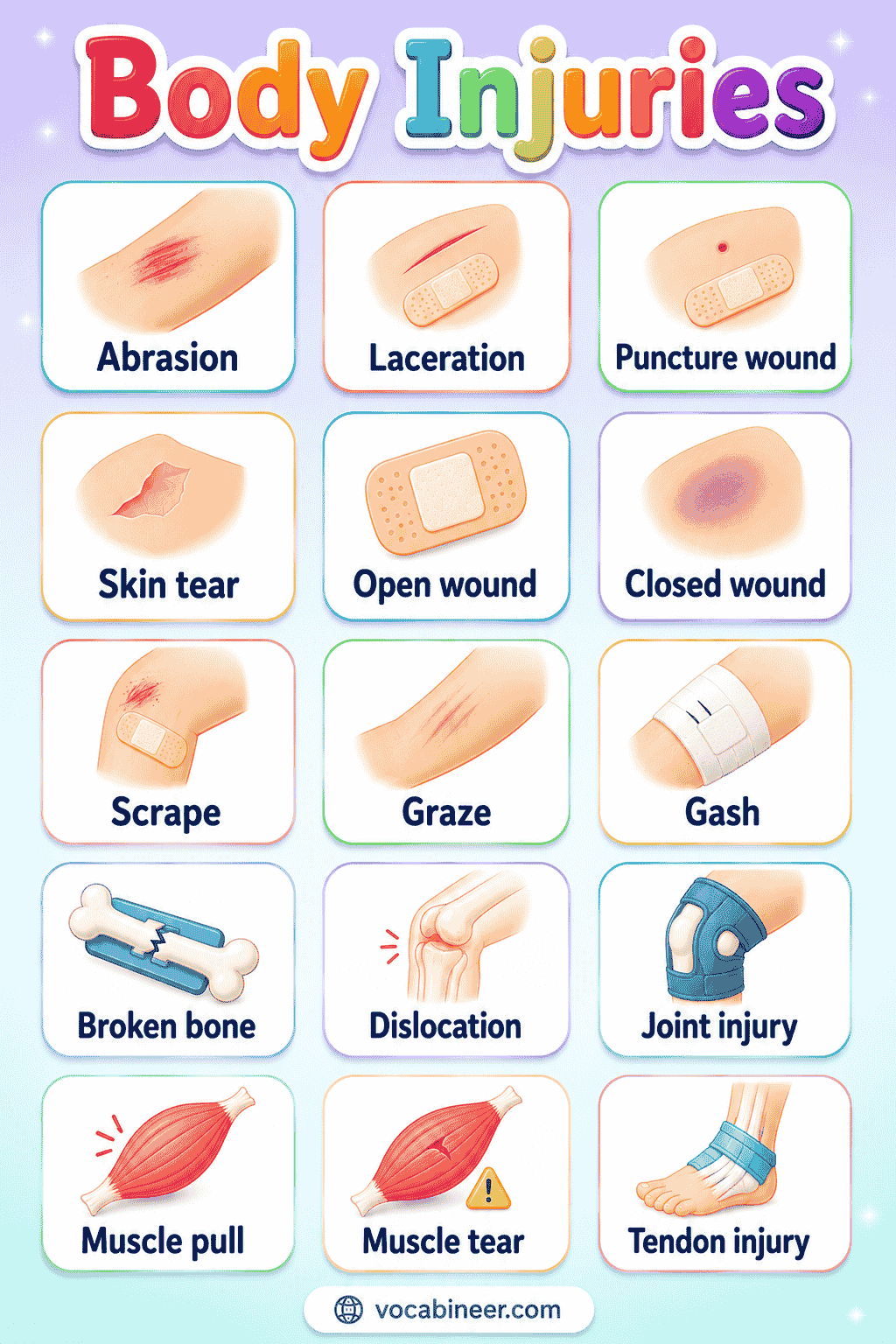
Skin and Wound Injuries
These injuries affect the skin or outer body tissue.
- Abrasion — a scrape caused by rubbing the skin
- Laceration — a deep cut or tear in the skin
- Puncture wound — a small deep hole made by a sharp object
- Skin tear — a tear in the skin, often from pulling or friction
- Open wound — a wound where the skin is broken
- Closed wound — an injury under the skin without an open cut
- Scrape — a rough scratch on the skin
- Graze — a light scrape, often from falling
- Gash — a long or deep cut
- Bite wound — an injury caused by a human or animal bite
- Insect sting — an injury caused by a stinging insect
- Needle injury — a puncture caused by a needle
- Splinter injury — an injury caused by a small piece of wood or glass in the skin
- Torn skin — skin that has been ripped or pulled open
- Friction burn — skin damage caused by rubbing against a surface
Bone and Joint Injuries
These injuries affect bones, joints, or the parts that connect them.
- Broken bone — a bone that has cracked or broken
- Hairline fracture — a small crack in a bone
- Compound fracture — a broken bone that breaks through the skin
- Dislocation — when a bone moves out of its joint
- Joint injury — damage to a joint
- Ankle sprain — a sprain around the ankle
- Wrist sprain — a sprain around the wrist
- Knee injury — damage to the knee area
- Shoulder injury — damage to the shoulder area
- Hip injury — damage to the hip area
- Elbow injury — damage to the elbow area
- Finger injury — damage to a finger
- Toe injury — damage to a toe
- Spinal injury — damage to the spine or back area
- Rib injury — damage to the ribs
Muscle and Soft Tissue Injuries
These injuries affect muscles, tendons, ligaments, or soft body tissues.
- Muscle pull — a stretched or injured muscle
- Muscle tear — a tear in muscle fibers
- Tendon injury — damage to a tendon
- Ligament injury — damage to a ligament
- Cramp — sudden tight pain in a muscle
- Soft tissue injury — injury to muscles, ligaments, tendons, or skin
- Overuse injury — an injury caused by repeated movement
- Tendonitis — inflammation of a tendon
- Tennis elbow — elbow pain caused by overuse
- Runner’s knee — knee pain often linked to running
- Hamstring strain — injury to the muscles at the back of the thigh
- Shoulder strain — injury to shoulder muscles or tendons
- Back strain — injury to back muscles
- Neck strain — injury to neck muscles
- Groin strain — injury to muscles near the inner thigh
Head, Face, and Eye Injuries
These injuries affect the head, face, mouth, ears, or eyes.
- Head injury — any injury to the head
- Concussion — a brain injury caused by a hit or sudden movement
- Black eye — bruising around the eye
- Eye injury — damage to the eye
- Nose injury — damage to the nose
- Mouth injury — damage inside or around the mouth
- Tooth injury — damage to a tooth
- Jaw injury — damage to the jaw
- Ear injury — damage to the ear
- Face injury — damage to the face
- Forehead bump — swelling on the forehead after a hit
- Lip injury — damage to the lip
- Cheek injury — damage to the cheek
- Skull fracture — a break in a bone of the skull
- Brain injury — damage to the brain
Burn and Heat Injuries
These injuries are caused by heat, fire, sun, chemicals, electricity, or hot liquids.
- Sunburn — skin damage caused by too much sun
- Scald — a burn caused by hot liquid or steam
- Heat rash — small red bumps caused by heat and sweating
- Heat exhaustion — illness caused by overheating
- Heatstroke — a serious heat-related emergency
- Chemical burn — a burn caused by chemicals
- Electrical burn — a burn caused by electricity
- First-degree burn — a mild burn affecting the outer skin
- Second-degree burn — a burn that may cause blisters
- Third-degree burn — a severe burn damaging deeper skin layers
- Fire burn — a burn caused by flame
- Steam burn — a burn caused by steam
- Frostbite — injury caused by freezing temperatures
- Smoke inhalation injury — injury from breathing smoke
- Hot surface burn — a burn caused by touching something hot
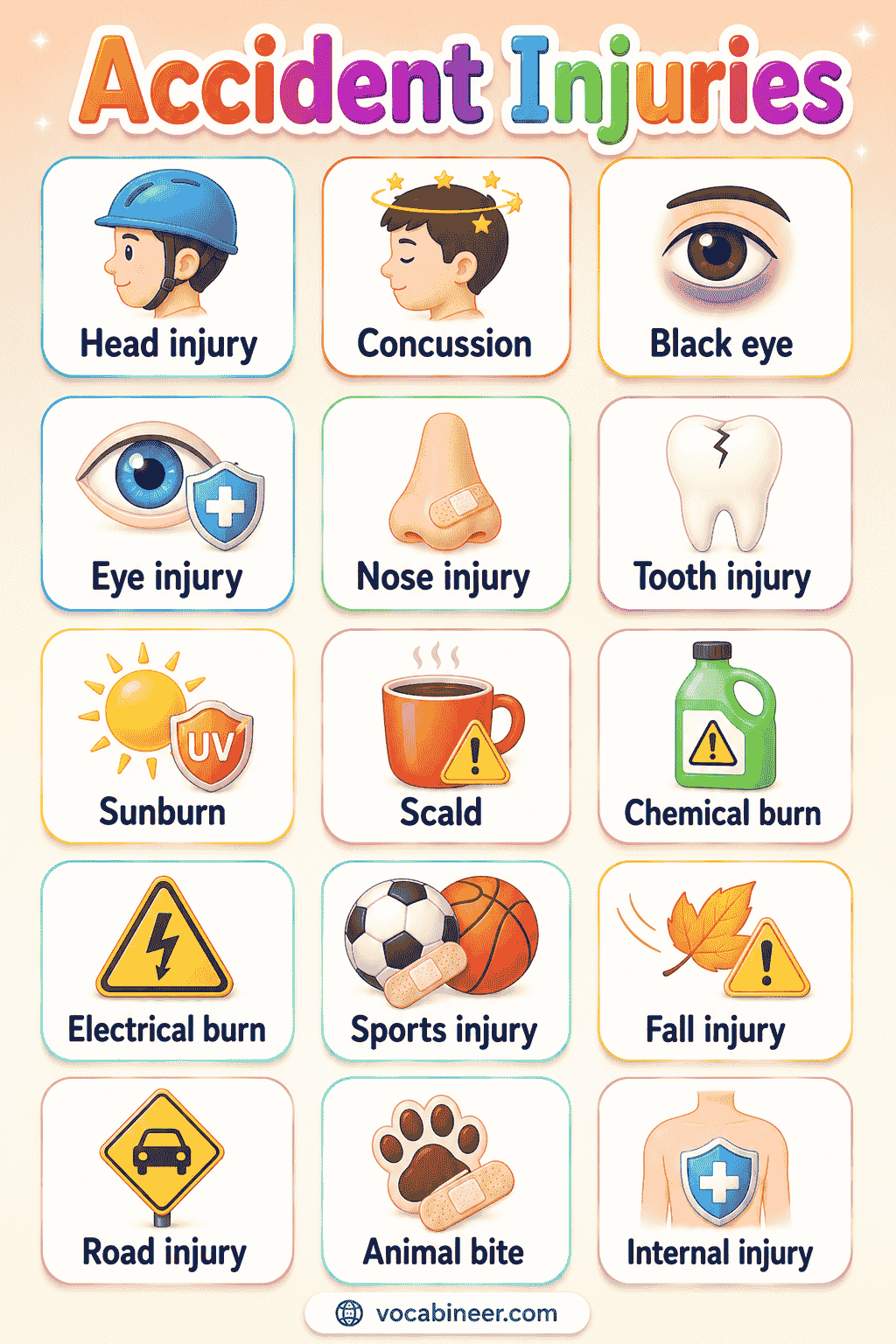
Sports, Accident, and Emergency Injuries
These injuries often happen during sports, falls, travel, work, or emergencies.
- Sports injury — an injury that happens during sports or exercise
- Fall injury — an injury caused by falling
- Road injury — an injury caused by a road accident
- Crush injury — injury caused by strong pressure or crushing
- Electric shock — injury caused by electricity passing through the body
- Internal bleeding — bleeding inside the body
- Animal bite — injury caused by an animal bite
- Neck injury — damage to the neck area
- Drowning injury — injury caused by being underwater without enough air
- Internal injury — injury inside the body that may not be visible outside
Injury Names by Body Area
Some injury names are connected to the body area where they happen. This makes injury vocabulary easier to understand.
- Head injuries: head injury, concussion, bump
- Face injuries: black eye, nose injury, jaw injury
- Skin injuries: cut, scratch, wound, burn
- Arm and hand injuries: wrist injury, finger injury, fracture
- Leg and foot injuries: knee injury, ankle sprain, toe injury
- Back injuries: back strain, spinal injury, muscle pain
Types of Injuries with Common Signs
This table shows common injury types with simple signs learners may hear or read in English.
| Injury Type | Common Signs |
|---|---|
| Cut | Bleeding, pain, open skin |
| Bruise | Blue or purple mark, pain, swelling |
| Burn | Red skin, pain, blistering |
| Sprain | Pain, swelling, trouble moving |
| Fracture | Severe pain, swelling, trouble using the area |
| Concussion | Headache, dizziness, confusion |
| Blister | Raised skin bubble, pain, fluid |
| Strain | Muscle pain, stiffness, weakness |
Injury Names with Example Sentences
Example sentences help learners use injury names correctly in English.
- He has a small cut on his finger.
- She got a bruise on her arm.
- The hot pan caused a burn.
- He has a sprain in his ankle.
- A strain can happen after heavy lifting.
- The doctor checked the fracture.
- The child had a scratch on his knee.
- The shoe caused a blister on her foot.
- A concussion can happen after a head hit.
- The player had a sports injury during the match.
Common Injuries for Kids
Kids often learn simple injury words because these words are common at home, school, playgrounds, and sports activities.
Common injuries for kids include:
- Cut
- Scratch
- Bruise
- Bump
- Burn
- Blister
- Nose injury
- Tooth injury
- Sprained ankle
- Knee injury
Injury Names Chart with Pictures
An injury names picture chart can help learners connect injury words with simple visual examples.
Picture chart ideas:
- Skin injuries: cut, scratch, wound, blister
- Bone and joint injuries: fracture, sprain, dislocation
- Burn injuries: burn, sunburn, scald
- Head and face injuries: bump, black eye, nose injury
- Sports injuries: sprained ankle, runner’s knee, muscle cramp
- Emergency injuries: electric shock, neck injury, animal bite
When to Get Medical Help
Some injuries need quick medical care. This section is only general safety guidance.
Get medical help if someone has:
- Heavy bleeding
- Trouble breathing
- Chest pain
- Severe pain
- Deep wound
- Serious burn
- Head injury
- Broken bone signs
- Confusion or fainting
- Injury that gets worse
Difference Between Common Injury Terms
Some injury words look similar, but they do not mean exactly the same thing.
| Comparison | Main Difference |
|---|---|
| Cut vs wound | A cut is a break in the skin; a wound is a broader term for an injury to body tissue. |
| Sprain vs strain | A sprain affects ligaments; a strain affects muscles or tendons. |
| Bruise vs swelling | A bruise is discoloration under the skin; swelling is enlargement of an injured area. |
| Fracture vs dislocation | A fracture is a broken bone; a dislocation is when a bone moves out of its joint. |
| Burn vs scald | A burn can come from heat, chemicals, or electricity; a scald is usually caused by hot liquid or steam. |
Common Mistakes When Learning Injury Names
Learners often confuse injury words because some injuries look similar or happen together.
Common mistakes include:
- Using sprain and strain as the same word
- Calling every injury a wound
- Confusing bruise and swelling
- Using fracture and dislocation incorrectly
- Calling a small scratch a serious cut
- Forgetting that some injuries can be internal and not visible
How to Learn Injury Names Easily
Injury vocabulary becomes easier when learners group words by type, body area, and common signs.
Helpful learning tips:
- Start with common injury names
- Group injuries by category
- Learn body part vocabulary with injury words
- Use pictures for visual memory
- Practice simple example sentences
- Compare similar injury terms
- Review first aid and emergency vocabulary
Related Injury and Health Vocabulary
Related vocabulary helps learners understand injury names in a wider health and safety context.
Useful related topics include:
- Body parts
- Disease names
- Symptoms names
- First aid vocabulary
- Hospital vocabulary
- Medical tools
- Emergency vocabulary
- Types of doctors
FAQ
Common types of injuries include cuts, bruises, burns, sprains, strains, fractures, wounds, scratches, blisters, and swelling.
A sprain affects ligaments around a joint, while a strain affects muscles or tendons.
Minor injuries are small or less serious injuries, such as light cuts, scratches, small bruises, mild burns, and small blisters.
Serious injuries may include deep wounds, heavy bleeding, fractures, head injuries, severe burns, internal injuries, or injuries that make breathing or movement difficult.
Students should learn injury names to build health vocabulary, understand safety lessons, read first aid words, and talk about common injuries in English.
Read More
- Types of Doctors in English
- Diseases Names in English
- 3 Letter Words in English
- 4 Letter Words in English
- 5 Letter Words in English
- 6 Letter Words in English
- Rhyming Words in English