

Some flowers are memorable not only for their colors and shapes but also for their unusually long names. Names such as Lily of the Valley, Lady’s Slipper Orchid, and Kiss-Me-Over-the-Garden-Gate often describe how a plant looks, when it blooms, or what its flowers resemble.
Learning long flower names in English can build nature vocabulary while making unfamiliar plants easier to recognize. This guide includes common multiword flower names, unusual examples, simple recognition clues, and explanations of how some of these distinctive names developed.
In This Page
Common Long Flower Names and Their Features
Long flower names often contain descriptive words that provide clues about a plant’s appearance or character. The following examples are useful for learning both flower vocabulary and visual identification.
Lily of the Valley
Small white, bell-shaped flowers hang along slender arching stems. Its familiar multiword name includes a reference to a natural landscape.
Lady’s Slipper Orchid
This orchid has a distinctive pouch-like floral structure that resembles a slipper. That unusual feature explains the descriptive common name.
Queen of the Night
This memorable name is used for more than one night-blooming plant, particularly certain cacti with large flowers that open after dark.
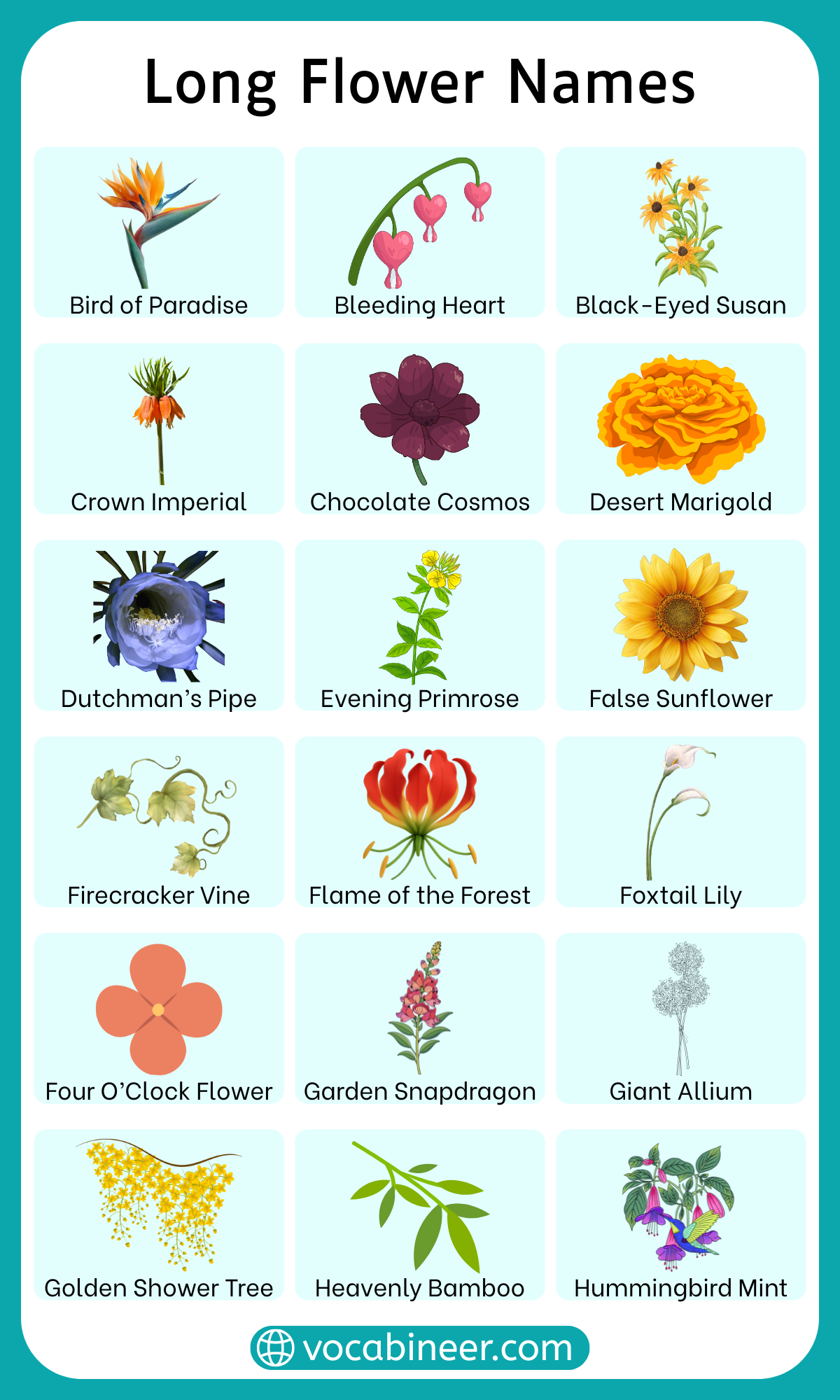
Bird of Paradise
Bright orange and blue floral parts create a shape often compared with the head and plumage of a colorful bird.
Bleeding Heart
The hanging pink or white flowers have a recognizable heart-like shape with a small lower section that appears to hang beneath them.
Passion Flower
Passion flowers have an intricate arrangement of petals, sepals, and thread-like structures around the center, giving them an elaborate appearance.
Black Bat Flower
Dark floral parts and long whisker-like structures create a dramatic shape that resembles a bat.
Chocolate Cosmos
These flowers are known for their deep reddish-brown color and distinctive dark appearance.
Snake’s Head Fritillary
Nodding bell-shaped flowers often display a checkered purple-and-white pattern. The unusual shape and markings make this flower easy to recognize.
Spider Chrysanthemum
Long, narrow petals curve outward from the flower head, creating an appearance similar to spider legs.
Love-in-a-Mist
Delicate flowers grow among finely divided foliage that creates a soft, mist-like appearance around the blooms.
Queen Anne’s Lace
Numerous tiny white flowers form broad, flat clusters with a delicate lace-like appearance.
Red Hot Poker
Tall flower spikes carry tubular blooms in fiery shades of red, orange, and yellow. Their shape and color inspired the vivid common name.
Glory of the Snow
This early-blooming plant produces star-shaped flowers and may appear while late-winter snow is still present.
Jack-in-the-Pulpit
Its unusual flower structure has a central spike surrounded by a hood-like sheath, creating the visual comparison behind the name.
Kiss-Me-Over-the-Garden-Gate
This exceptionally long common name belongs to Persicaria orientalis, a tall flowering plant with hanging clusters of pink flowers.
Star of Bethlehem
Star-shaped white flowers give this plant its familiar common name. The name can also be used for more than one related plant.
Bells of Ireland
Tall flower spikes carry prominent green, cup-like calyces surrounding tiny flowers. Despite its name, the plant is not native to Ireland.
Love-Lies-Bleeding
This unusually named amaranth produces long, drooping tassels of small flowers, commonly in deep red or gold.
Lily of the Nile
This common name is widely associated with Agapanthus, a southern African flowering plant that produces rounded clusters of flowers on tall stems.
Some of the Longest Flower Names in English
Some flower names stand out because they contain several words, hyphens, possessives, or phrase-like expressions. These longer names are especially memorable because they sound more descriptive than simple names such as rose, iris, or tulip.
Kiss-Me-Over-the-Garden-Gate
This is one of the most striking examples because the entire name forms a phrase rather than a simple plant label.
Snake’s Head Fritillary
The name combines an animal comparison with the plant-group name, giving it both a descriptive and botanical feel.
Lady’s Slipper Orchid
This name combines a visual comparison with the word “orchid,” clearly linking the flower’s shape with its plant group.
Lily of the Valley
Although familiar, this name is noticeably longer than simple one-word flower names.
Queen of the Night
The phrase-like name reflects the nighttime flowering associated with plants carrying this common name.
Glory of the Snow
Its name connects the flower with the cold season in which its early blooms may appear.
Star of Bethlehem
This multiword name combines the star-like shape of the flowers with a traditional reference.
Long Flower Names Inspired by Appearance
Many descriptive flower names become easier to understand once you see the plant. Their English names often compare flowers with animals, objects, clothing, or familiar shapes.
| Flower Name | Recognition Clue |
|---|---|
| Bird of Paradise | Resembles the head and plumage of a colorful bird |
| Lady’s Slipper Orchid | Has a pouch-like structure resembling a slipper |
| Black Bat Flower | Dark floral parts create a bat-like appearance |
| Bleeding Heart | Hanging flowers resemble small hearts |
| Spider Chrysanthemum | Narrow petals curve outward like spider legs |
| Red Hot Poker | Upright flower spikes resemble a glowing poker |
| Queen Anne’s Lace | Tiny white flowers form lace-like clusters |
| Jack-in-the-Pulpit | A central spike sits beneath a hood-like structure |
These visual comparisons make long flower names easier to remember because the words themselves provide clues to appearance.
Flower Names With Nature and Place References
Not every long flower name describes shape. Some refer to landscapes, seasons, places, or traditional associations.
Lily of the Valley
The name contains a landscape reference rather than describing the exact shape of the flower.
Glory of the Snow
This name connects the plant with its early flowering period, when snow may still be present.
Lily of the Nile
Although the name refers to the Nile, Agapanthus is native to southern Africa. Therefore, common names should not always be read as literal statements of origin.
Bells of Ireland
The name includes a geographical reference, but the plant itself is not native to Ireland. Its green appearance is associated with the familiar English name.
These examples show why common flower names can reflect tradition or association rather than exact botanical geography.
Unusual Long Flower Names Worth Knowing
Some long flower names are especially memorable because their wording sounds imaginative, dramatic, or unexpected.
Kiss-Me-Over-the-Garden-Gate
This phrase-like name belongs to a tall flowering plant with drooping pink clusters.
Love-Lies-Bleeding
The dramatic name refers to Amaranthus caudatus, which produces long hanging flower tassels.
Love-in-a-Mist
Its delicate flowers appear among fine foliage that creates the mist-like effect behind the name.
Snake’s Head Fritillary
The unusual wording matches the flower’s nodding shape and distinctive patterned appearance.
Black Bat Flower
Its dark coloration and long projections make this one of the more visually dramatic English flower names.
These examples show how imaginative English plant vocabulary can be compared with more formal botanical terminology.
Common Flower Names vs Botanical Names
A long English flower name is not the same as a scientific botanical name. Common names are often descriptive or traditional, while botanical names provide more precise scientific identification.
| Common English Name | Botanical Name | Main Difference |
|---|---|---|
| Love-in-a-Mist | Nigella damascena | Descriptive everyday name vs scientific species name |
| Queen Anne’s Lace | Daucus carota | Traditional common name vs standardized botanical name |
| Red Hot Poker | Kniphofia uvaria and related plants | Common name may apply to more than one plant |
| Jack-in-the-Pulpit | Arisaema triphyllum | Descriptive English name vs scientific identification |
| Kiss-Me-Over-the-Garden-Gate | Persicaria orientalis | Long common phrase vs botanical species name |
| Bells of Ireland | Moluccella laevis | Familiar common name vs scientific species name |
Botanical names are useful because a single English common name can sometimes refer to more than one plant. For example, Star of Bethlehem and Lily of the Nile may each be applied to different plants depending on context.
Why Do Some Flowers Have Long Names?
Long flower names develop for several reasons. Many combine descriptive words that explain a flower’s appearance, blooming behavior, natural association, or resemblance to something familiar.
Some names use animals, including Bird of Paradise, Black Bat Flower, Snake’s Head Fritillary, and Spider Chrysanthemum.
Others use objects or visual comparisons, such as Lady’s Slipper Orchid, Red Hot Poker, and Jack-in-the-Pulpit.
A few sound like complete phrases or expressions, including Love-in-a-Mist, Love-Lies-Bleeding, and Kiss-Me-Over-the-Garden-Gate.
Other names contain nature or place references, such as Lily of the Valley, Lily of the Nile, Bells of Ireland, and Glory of the Snow.
Because these names create clear mental pictures, they can be easier to remember than unfamiliar botanical terminology.
FAQs
Examples include lily of the valley, lady’s slipper orchid, snake’s head fritillary, forget-me-not, and love-in-a-mist.
Many long flower names come from their shape, origin, or cultural symbolism. Others are derived from old traditions or scientific naming.
Yes. Some like forget-me-not or bleeding heart are well known, while others such as franklin tree flower are rare.
Popular choices for weddings include lily of the valley, lady’s slipper orchid, forget-me-not, bleeding heart, and passion flower.
Not always. Some long-named flowers are rare, like the ghost orchid, but many, like crown imperial, are common in gardens.
Read More