

School buildings come in different types based on the age group, subjects, activities, or services they support. Some are designed for early learning and general education, while others focus on science, arts, sports, technical training, or specialized programs.
Learning different types of school buildings with names and pictures helps students and readers understand how educational spaces are organized and used. These terms are useful in school-related conversations, campus planning, architecture, and education vocabulary.
In This Page
Different Types of School Buildings in English
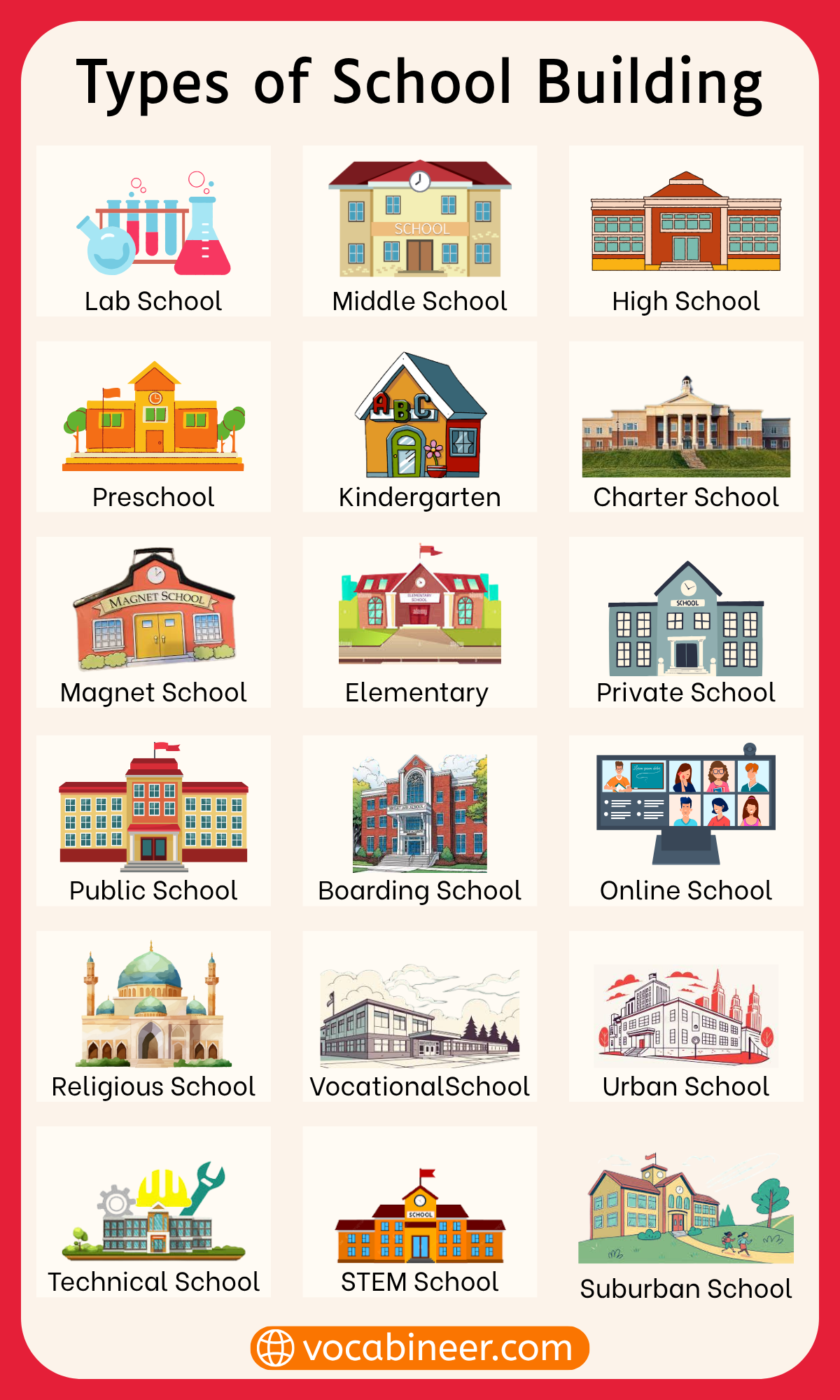
School buildings come in different forms based on age group, subjects, facilities, and teaching purpose. Learning these names helps children and English learners build education vocabulary and recognize common school-related places more easily.
Preschool
A preschool provides early learning spaces for very young children before primary school.
Primary School
A primary school teaches younger students basic subjects such as reading, writing, mathematics, and science.
Elementary School
An elementary school serves young learners during the early years of formal education.
Middle School
A middle school teaches students between elementary and high school levels.
Secondary School
A secondary school provides education for older students after primary or middle school.
High School
A high school serves teenage students and prepares them for higher education, work, or vocational training.
Boarding School
A boarding school provides classrooms, dormitories, dining areas, and other facilities for students who live on campus.
Vocational School
A vocational school teaches practical skills for trades, technical careers, and specific professions.
Technical School
A technical school focuses on subjects such as engineering, mechanics, electronics, computing, and applied technology.
Special Education School
A special education school provides learning support and facilities for students with different educational needs.
Montessori School
A Montessori school uses activity-based learning spaces that encourage independence and hands-on exploration.
International School
An international school often follows an international curriculum and may teach students from different countries.
Language School
A language school provides classrooms and learning facilities for studying foreign or additional languages.
Music School
A music school includes teaching rooms, practice spaces, and performance areas for learning instruments, singing, and music theory.
Art School
An art school provides studios, classrooms, and workshops for drawing, painting, design, sculpture, and other creative subjects.
Science School
A science-focused school includes classrooms and laboratories for subjects such as biology, chemistry, and physics.
Religious School
A religious school combines general education with instruction based on a particular religious tradition.
Community School
A community school serves local students and may also provide shared spaces for community programs and activities.
Private School
A private school operates independently from direct government management and provides classrooms and other educational facilities.
Public School
A public school provides education through a government-funded school system and serves students from the surrounding community.
Classroom and Learning Spaces in Schools
These are the places where students study subjects during the school day. Each room supports a different kind of learning experience.
- Classroom
- Science Lab
- Art Room
- Computer Lab
- Language Lab
- Music Room
- Smart Room
- Library
- Maker Space
Administrative Areas in a School Building
These rooms support school leadership and staff operations. They’re used for meetings, records, exams, and communication.
- Principal’s Office
- Reception
- Staff Room
- Conference Room
- Exam Hall
- Admin Office
Sports and Recreational Building Spaces
These spaces allow students to exercise, compete, perform, or gather for school events. They’re built to support physical and creative activities.
- Sports Hall
- Gymnasium
- Playground
- Assembly Area
- Auditorium
- Swimming Pool
- Dance Room
School Facilities and Service Units
These are support areas that help keep the school running. Some are used daily, others for special functions.
- Cafeteria
- Toilet Block
- Maintenance Room
- Storage Room
- Laundry Room
- Pantry
- IT Server Room
Residential Spaces in Boarding Schools
Residential schools have buildings for living and relaxing. These spaces help students and staff stay on campus for longer periods.
- Dormitory
- Staff Housing
- Dining Hall
- Hostel
- Common Room
Medical and Safety Facilities in Schools
Health and safety buildings help schools manage emergencies, illnesses, and day-to-day medical needs.
- Medical Room
- Sick Bay
- Security Cabin
- Fire Point
- Isolation Room
FAQs
The most common school building types include primary, secondary, vocational, boarding, and international schools. Each type supports a specific level or focus of education.
A vocational school building is often called a technical school, career training center, or skills-based education facility, built for hands-on learning in trades or specific professions.
A portable classroom is a temporary structure used when permanent space is limited. It’s also known as a trailer, bungalow, or modular classroom in many school systems.
A laboratory school building is connected to a university or teacher training institute. It’s designed for research, experimental teaching, and educator preparation.
A magnet school focuses on specific subjects like arts, science, or technology. Its building includes special spaces such as labs, studios, or tech rooms that match the school’s theme.
Read More
