
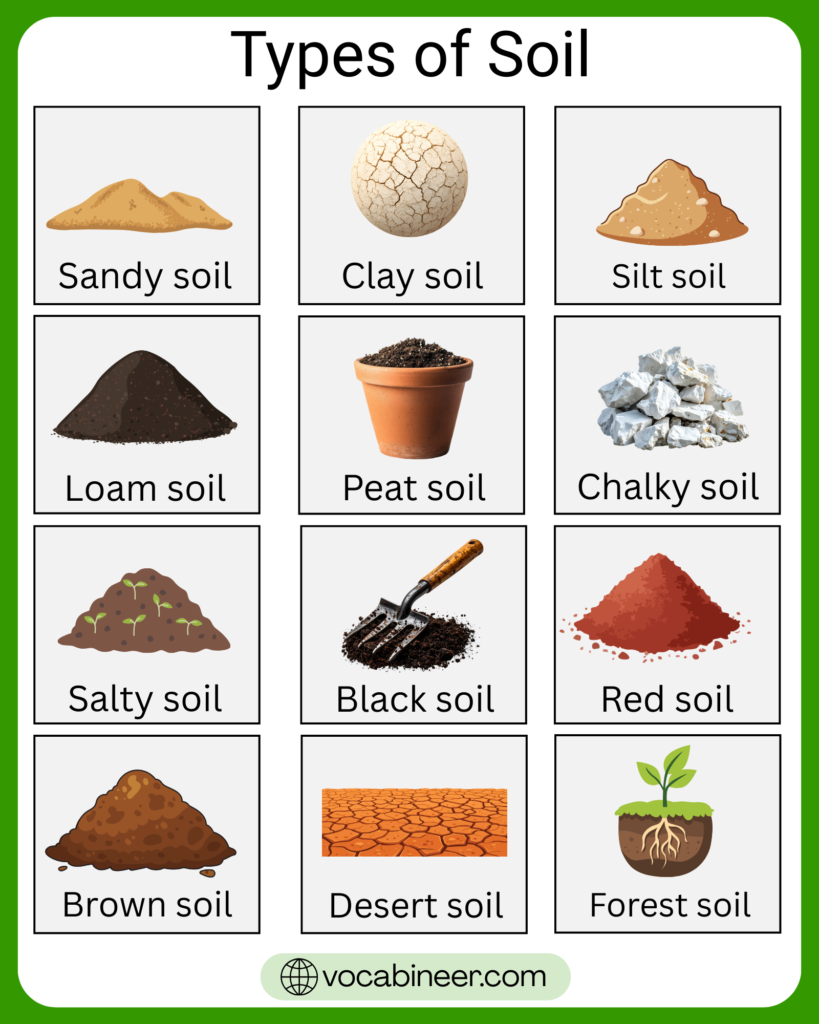
Types of soil are grouped by texture, particle size, drainage, moisture retention, and mineral or organic content. Current learning and gardening sources commonly explain six main soil types—sandy, clay, silty, loamy, peaty, and chalky soil—while geography-based sources also describe broader types such as alluvial, black, red, and laterite soil.
This article covers types of soil with names and pictures in a simple and organized way. You will learn the main soil names, understand their basic characteristics, and see how different soil types are grouped for easier learning and identification.
In This Page
Main Types of Soil
The main types of soil are the most commonly taught and identified groups. These soils are usually explained through their texture, water movement, nutrient-holding ability, and overall feel.
Sandy Soil
Sandy soil is easy to recognize because it feels loose, dry, and grainy. Its large particles leave more space between them, so water drains through it quickly. Because of that, sandy soil often dries out faster and usually contains fewer nutrients than loamy or silty soil.
Clay Soil
Clay soil has very small particles, which makes it dense and compact. When it is wet, it often feels sticky, and when it dries, it can become hard. This soil holds water and nutrients well, although it may be harder to dig and manage than lighter soils.
Silty Soil
Silty soil has finer particles than sandy soil, so it feels smooth and soft to the touch. It can hold more water than sandy soil and is often more fertile. At the same time, it may become compact if too much pressure is placed on it.
Loamy Soil
Loamy soil is a balanced mixture of sand, silt, and clay. It combines good drainage with good moisture retention, and it usually contains a useful amount of nutrients. That balance makes it one of the most widely recommended soils for plant growth.
Peaty Soil
Peaty soil forms from partly decomposed organic material. It is usually dark in color, soft in feel, and able to hold a large amount of moisture. Its rich organic content makes it easy to distinguish from dry and mineral-heavy soils.
Chalky Soil
Chalky soil contains lime or chalk and often includes small stones. It is usually free-draining and alkaline, so it behaves differently from heavier and more moisture-retentive soils. Its pale, stony look often makes it easy to identify.
Other Types of Soil
Besides the six main soil types, some other soil names are commonly used in geography, farming, and land classification. These soils are often grouped by color, origin, region, or special surface condition rather than only by texture.
Alluvial Soil
Alluvial soil forms from river deposits. It is commonly found in plains and river valleys, and it is important in farming because deposited material often makes it fertile.
Black Soil
Black soil is dark in color and is often discussed in agriculture because of its fertility. It is commonly treated as a geography- and farming-based soil type rather than a basic texture group.
Red Soil
Red soil has a reddish color because of iron content. It is another widely recognized geography-based soil type.
Laterite Soil
Laterite soil is commonly found in hot and wet regions. It is often included in geography-based soil classification and is known more by regional formation than by simple classroom texture grouping.
Desert Soil
Desert soil is usually dry, sandy, and low in organic matter. It is linked with arid regions where moisture is limited.
Mountain Soil
Mountain soil is found in hilly and mountainous areas. Its depth, texture, and fertility can vary depending on slope, climate, and vegetation.
Forest Soil
Forest soil develops under forest cover and often contains organic matter from leaves and plant material. Its features can differ depending on the type of forest and climate.
Saline Soil
Saline soil contains a higher level of salts than normal soil. This can affect plant growth and soil use.
Rocky Soil
Rocky soil has many rocks and hard fragments mixed into it. It is easy to identify because of its rough and stony surface.
Gravelly Soil
Gravelly soil contains many small stones and coarse particles. It usually drains water quickly and feels rough and loose.
Soil Types and Their Characteristics
Different soil types can be compared by texture, drainage, moisture retention, fertility, and overall feel. This makes it easier to understand how one soil type differs from another without repeating the same explanation again and again.
Sandy Soil
Sandy soil has a loose and gritty texture. It drains water quickly, holds less moisture, and is usually lower in nutrients than richer soils.
Clay Soil
Clay soil feels heavy and sticky because its particles are very fine. It holds a lot of water and nutrients, but it drains slowly.
Silty Soil
Silty soil feels smooth and soft. It keeps more moisture than sandy soil and is often fertile, although it may compact more easily.
Loamy Soil
Loamy soil has a crumbly and balanced texture. It gives a good mix of drainage, moisture retention, and fertility, which is why many sources describe it as an ideal soil type.
Peaty Soil
Peaty soil feels rich and organic. It usually holds a lot of moisture and contains a high amount of decomposed plant material.
Chalky Soil
Chalky soil often feels stony and dry. It drains freely and is usually alkaline because it contains lime or chalk.
Alluvial Soil
Alluvial soil is formed by deposited material from rivers. It is often fertile and important in farming regions.
Black Soil
Black soil is dark, rich-looking, and commonly associated with fertile agricultural land.
Red Soil
Red soil is known for its reddish color, which comes from iron content. It is commonly discussed in geography and land classification.
Laterite Soil
Laterite soil develops in hot and wet climates. It is more often explained in geography than in simple classroom texture-based soil lists.
Difference Between Sandy, Clay, Silty, and Loamy Soil
Sandy, clay, silty, and loamy soil are the four most commonly compared soil types in basic science and gardening topics. They differ in texture, particle size, drainage, moisture retention, and fertility.
Here is a simple table showing the difference between sandy, clay, silty, and loamy soil.
| Soil Type | Texture | Particle Size | Water Drainage | Moisture Holding | Fertility | Common Feature |
|---|---|---|---|---|---|---|
| Sandy Soil | Loose and gritty | Large | Fast | Low | Low | Dries quickly |
| Clay Soil | Heavy and sticky | Very small | Slow | High | High | Holds water well |
| Silty Soil | Smooth and soft | Fine | Moderate | Moderate to high | High | Feels soft and fertile |
| Loamy Soil | Crumbly and balanced | Mixed | Good | Good | High | Best balance for plants |
How to Identify Different Soil Types
Different soil types can often be identified by looking at their texture, color, drainage, and how they feel when dry or wet. Loose and gritty soil is usually sandy, while heavy and sticky soil is often clay. Smooth and soft soil is commonly silty, and crumbly balanced soil is usually loamy. Dark organic-rich soil may be peaty, while pale stony alkaline soil may be chalky.
Best Soil Type for Plants and Farming
Loamy soil is often seen as the best soil type for many plants and farming uses because it balances drainage, moisture, and nutrients well. Other soil types can still support plant growth, but loamy soil is usually the most balanced and easy to work with.
Most Common Soil Types
Some soil types are discussed more often than others in school learning, gardening, and general science. The most common names are usually sandy soil, clay soil, silty soil, and loamy soil, while peaty and chalky soil are often included in fuller classification systems.
Sandy Soil
Sandy soil is commonly mentioned because it is easy to recognize by its loose, gritty texture and fast drainage.
Clay Soil
Clay soil is also very common in soil lessons because of its heavy texture and strong water-holding ability.
Silty Soil
Silty soil is often included because of its smooth feel and fertile nature.
Loamy Soil
Loamy soil is one of the most common and important soil types because it is balanced and widely known for supporting plant growth well.
FAQs
The main types of soil are sandy soil, clay soil, silty soil, loamy soil, peaty soil, and chalky soil. These are the most commonly explained groups in current educational and gardening sources.
Loamy soil is often considered one of the best soils for many plants because it balances drainage, moisture retention, and nutrients better than many other soil types.
Sandy soil feels loose and gritty and drains water quickly, while clay soil feels heavy and sticky and holds more water because of its very fine particles.
Loamy soil is important because it combines the useful qualities of sand, silt, and clay. This balance makes it fertile, workable, and suitable for many plants.
Chalky soil is a soil type that contains lime or chalk and often has a stony texture. It usually drains freely and is often alkaline.
Conclusion
Types of soil include several main groups, and each one has its own texture, drainage, moisture-holding ability, and fertility level. Some soils feel loose and dry, while others feel heavy, smooth, rich, or stony. Current sources commonly describe sandy, clay, silty, loamy, peaty, and chalky soil as the main types to know, while geography-based sources add other types such as alluvial, black, red, and laterite soil.
Learning the names and characteristics of different soil types makes it easier to understand basic earth science, gardening, farming, and land classification. With pictures, these soil types become even easier to identify and compare.
Read More