
Verbs that start with D are useful in daily English because they can describe actions, choices, movement, communication, and change. Some of these words are very common in simple speaking and writing, while others are more useful in formal, academic, or descriptive English.
In this article, you’ll find a clear list of verbs that start with D with meanings and examples. You’ll also explore common D verbs, action verbs starting with D, positive verbs, and more, so the article stays easy to scan and simple to use.
In This Page
Common Verbs That Begin With D
This section includes common verbs that begin with D. These D verbs are useful because they appear often in everyday English.
- Dance: to move to music
- Dare: to be brave enough to do something
- Deal: to handle something
- Decide: to make a choice
- Decorate: to make something look nice
- Delay: to make something late
- Deliver: to take something to a place
- Demand: to ask strongly
- Deny: to say something is not true
- Depend: to need support from someone or something
- Describe: to tell what something is like
- Design: to plan how something will look or work
- Destroy: to damage something badly
- Develop: to grow or improve
- Die: to stop living
- Dig: to make a hole in the ground
- Direct: to guide or control
- Disappear: to go out of sight
- Discover: to find something
- Discuss: to talk about something
- Dislike: to not like something
- Divide: to separate into parts
- Do: to perform an action
- Doubt: to feel unsure
- Drag: to pull something along the ground
- Draw: to make a picture
- Dream: to see images in sleep or imagine
- Dress: to put clothes on
- Drink: to take in liquid
- Drive: to control a vehicle
- Drop: to let something fall
- Dry: to make something not wet
- Dump: to throw away
- Damage: to harm something
- Decorate: to add beauty to something
- Defend: to protect
- Delay: to put off until later
- Detect: to notice or discover
- Devote: to give time or effort to something
- Double: to become twice as much
Action Verbs Starting With D
Action verbs starting with D show what someone or something does. These verbs are useful because they describe clear actions in simple and direct English.
- Dance: to move to music
- Dare: to be brave enough to do something
- Deal: to handle something
- Decide: to make a choice
- Decorate: to make something look nice
- Delay: to make something late
- Deliver: to take something to a place
- Demand: to ask strongly
- Deny: to say something is not true
- Describe: to tell what something is like
- Design: to plan how something will look or work
- Destroy: to damage something badly
- Develop: to grow or improve
- Dig: to make a hole in the ground
- Direct: to guide or control
- Discover: to find something
- Discuss: to talk about something
- Divide: to separate into parts
- Do: to perform an action
- Drag: to pull something along the ground
- Draw: to make a picture
- Dream: to imagine or see images in sleep
- Dress: to put clothes on
- Drink: to take in liquid
- Drive: to control a vehicle
- Drop: to let something fall
- Dry: to make something not wet
- Dump: to throw away
- Defend: to protect
- Detect: to notice or discover
- Devote: to give time or effort to something
- Double: to become twice as much
- Drill: to make a hole or practice again and again
- Drift: to move slowly
- Drill: to train or bore into something
- Drown: to die under water or cover with liquid
- Dwell: to live in a place
- Decorate: to add beauty to something
- Debate: to discuss different ideas
- Deliver: to bring or hand over
Positive Verbs That Start With D
Positive verbs that start with D are useful when you want to show growth, kindness, support, progress, or success. These verbs work well in writing, speaking, and daily English.
- Delight: to give great pleasure
- Develop: to grow or improve
- Devote: to give time or care fully
- Discover: to find something new
- Dream: to imagine something good
- Deliver: to provide or bring successfully
- Defend: to protect
- Decorate: to make something more beautiful
- Design: to plan something useful or creative
- Dedicate: to give yourself fully to something
- Deepen: to make stronger or greater
- Demonstrate: to show clearly
- Depend on: to trust or rely on
- Direct: to guide in the right way
- Distinguish: to recognize clearly
- Diversify: to make more varied
- Donate: to give something to help others
- Do good: to act in a kind or helpful way
- Drive: to push forward toward success
- Dazzle: to impress strongly
- Dominate: to lead strongly
- Defy: to resist with courage
- Distribute: to give out fairly
- Draw together: to bring closer
- Delight in: to enjoy greatly
D Verbs for Everyday English
These D verbs are useful in daily speaking and writing. They are simple, practical, and easy to use in common sentences.
- Dance: to move to music
- Deal: to handle something
- Decide: to make a choice
- Deliver: to take something to a place
- Demand: to ask strongly
- Deny: to say something is not true
- Depend: to need support from someone or something
- Describe: to tell what something is like
- Design: to plan how something will look or work
- Develop: to grow or improve
- Dig: to make a hole in the ground
- Direct: to guide or control
- Discover: to find something
- Discuss: to talk about something
- Dislike: to not like something
- Divide: to separate into parts
- Do: to perform an action
- Doubt: to feel unsure
- Drag: to pull something along the ground
- Draw: to make a picture
- Dream: to imagine
- Dress: to put clothes on
- Drink: to take in liquid
- Drive: to control a vehicle
- Drop: to let something fall
- Dry: to make something not wet
- Dump: to throw away
- Damage: to harm something
- Defend: to protect
- Detect: to notice or discover
Easy Verbs That Start With D for Kids and Beginners
These D verbs are simple and easy to learn. They are useful for kids, students, and beginners because the meanings are clear and easy to remember.
- Dance: to move to music
- Draw: to make a picture
- Drink: to take in liquid
- Drop: to let something fall
- Dig: to make a hole
- Dress: to put clothes on
- Drive: to control a car
- Dry: to make not wet
- Do: to perform an action
- Dare: to be brave enough
- Deal: to handle something
- Decide: to make a choice
- Deliver: to bring something
- Describe: to tell what something is like
- Design: to plan something
- Discover: to find something
- Discuss: to talk about something
- Divide: to separate into parts
- Drag: to pull along
- Dream: to imagine or see in sleep
Phrasal Verbs That Start With D
Phrasal verbs that start with D are verb phrases made with a main verb and another word. They are common in daily English and often appear in speaking.
- Deal with: to handle something
- Die away: to become weaker and disappear
- Die down: to become less strong
- Die out: to disappear completely
- Dig in: to start eating or work hard
- Dig into: to investigate or start eating eagerly
- Do away with: to remove or end
- Do in: to make very tired or kill
- Do over: to do again
- Do up: to fasten, improve, or wrap
- Do without: to live without something
- Double back: to return along the same way
- Drag on: to continue too long
- Draw back: to move away
- Draw in: to attract or pull inward
- Draw on: to use something or come near
- Draw out: to make longer or pull out
- Dress up: to wear nice or special clothes
- Drift apart: to become less close
- Drop by: to visit for a short time
- Drop in: to visit without planning much
- Drop off: to fall asleep or deliver something
- Drop out: to leave school or a group
- Drum up: to increase support or interest
- Dumb down: to make something too simple
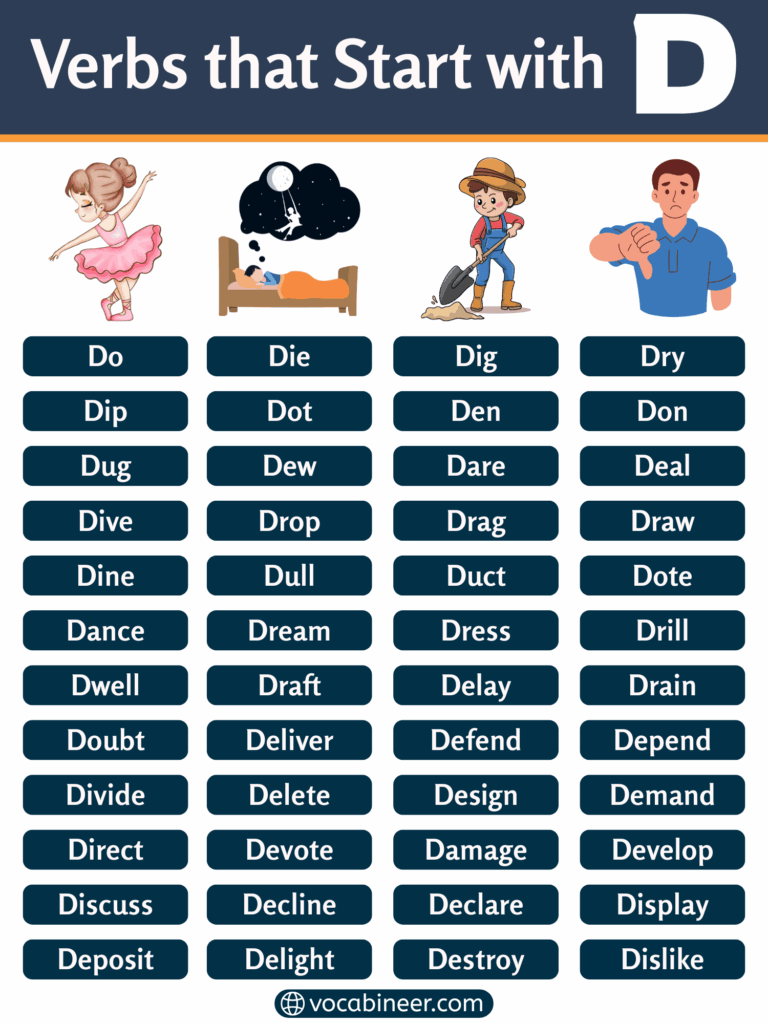
Complete List of Verbs That Start With D
This section includes a longer list of verbs that start with D. These D verbs are useful for building vocabulary and making the article more complete.
- Dab
- Damage
- Dance
- Dare
- Dash
- Deal
- Debate
- Decide
- Declare
- Decorate
- Decrease
- Dedicate
- Delay
- Deliver
- Demand
- Demonstrate
- Deny
- Depend
- Describe
- Design
- Desire
- Destroy
- Detect
- Develop
- Devote
- Diagnose
- Dictate
- Die
- Differ
- Digest
- Dig
- Diminish
- Dip
- Direct
- Disagree
- Disappear
- Disappoint
- Discover
- Discuss
- Dislike
- Dismiss
- Display
- Distinguish
- Distribute
- Disturb
- Dive
- Divide
- Do
- Dock
- Dodge
- Dominate
- Donate
- Double
- Doubt
- Download
- Drag
- Drain
- Draw
- Dream
- Dress
- Drift
- Drill
- Drink
- Drive
- Drop
- Drown
- Drum
- Dry
- Dump
- Dwell
FAQs
Verbs that start with D are verbs that begin with the letter D. These words can show an action, a state, or something that happens. Examples include dance, decide, deliver, describe, and develop.
Some common verbs that start with D are dance, deal, decide, deliver, depend, describe, design, develop, discuss, and drive. These verbs appear often in daily English, so they are useful for speaking, writing, and vocabulary building.
No, not all verbs that start with D are action verbs. Many D verbs show clear actions, such as dig, draw, and drive, while others can be used in different ways depending on the sentence and meaning.
Some positive verbs that start with D are delight, develop, devote, discover, defend, dedicate, and donate. These verbs often show support, growth, kindness, or progress.
You can learn them by starting with the most common D verbs first. Then, read short lists, use them in simple sentences, and practice them often in speaking and writing. This helps you remember them more naturally.
Summary
Verbs that start with D are useful in daily English because they help describe actions, choices, movement, communication, and change. In this article, you explored common D verbs, action verbs starting with D, positive verbs, everyday verbs, easy verbs for beginners, phrasal verbs, and a complete list of verbs that start with D.
Learning these D verbs step by step can help you grow your vocabulary and use English more clearly in speaking and writing.
Read More