
Verbs that start with P are useful in English because they can describe actions, movement, feelings, progress, and daily activities. Some of these words are common in simple speaking and writing, while others are more useful in formal, descriptive, or academic English.
In this article, you’ll find a complete list of verbs that start with P with meanings and examples. You’ll also explore popular P verbs, daily-use verbs, action verbs, powerful verbs, and more in a clear and easy-to-scan format.
In This Page
Popular Verbs That Start With P
This section includes popular verbs that start with P. These words are useful because they appear often in daily English and simple writing.
- Pack: to put things together for carrying
- Paint: to put color on a surface
- Park: to leave a vehicle in a place
- Pass: to move by or give something
- Pay: to give money for something
- Perform: to do something
- Pick: to choose or take
- Place: to put something somewhere
- Plan: to decide what to do
- Plant: to put a seed or plant into the ground
- Play: to enjoy a game or activity
- Point: to show with a finger
- Post: to publish or send
- Pour: to make liquid flow
- Practice: to do something again to improve
- Pray: to speak to God
- Prefer: to like one thing more than another
- Prepare: to make ready
- Present: to show or give formally
- Press: to push down
- Pretend: to act as if something is true
- Prevent: to stop something from happening
- Print: to produce words or images on paper
- Protect: to keep safe
- Prove: to show something is true
- Provide: to give what is needed
- Publish: to prepare and issue for people to read
- Pull: to bring closer
- Punish: to give a penalty
- Push: to move something away
- Pause: to stop for a short time
- Promise: to say that you will do something
- Produce: to make or create
- Promote: to help something grow or move forward
- Progress: to move ahead or improve
- Praise: to say something good about someone
- Prevent: to stop before it happens
- Persuade: to make someone agree
- Polish: to make smooth and shiny
- Preserve: to keep safe or unchanged
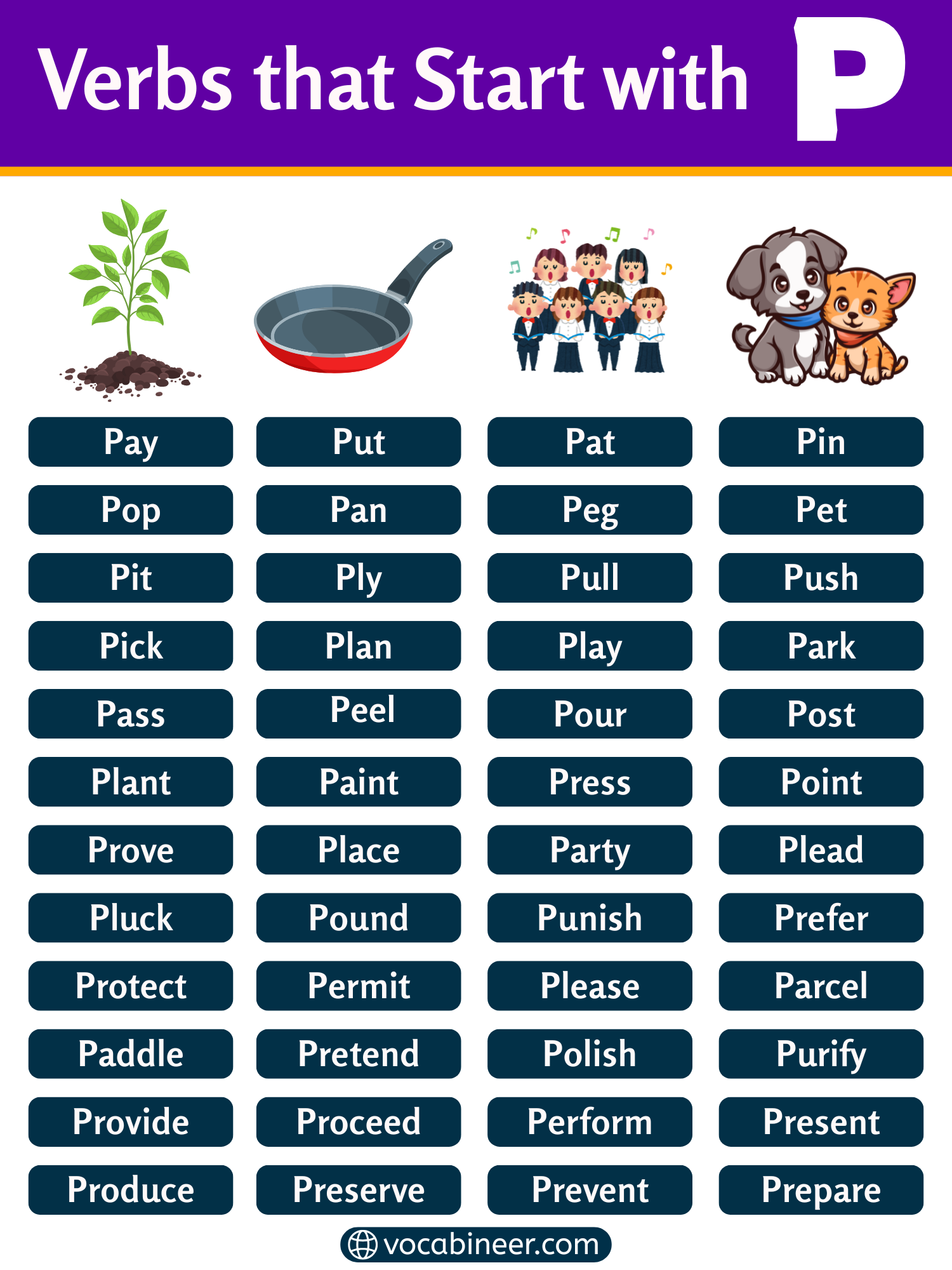
Daily Use Verbs That Begin With P
These P verbs are useful in daily speaking and writing. They are simple, practical, and easy to use in common sentences.
- Pack: to put things together for carrying
- Paint: to put color on a surface
- Park: to leave a vehicle in a place
- Pass: to move by or give something
- Pay: to give money for something
- Pick: to choose or take
- Place: to put something somewhere
- Plan: to decide what to do
- Plant: to put a seed or plant into the ground
- Play: to enjoy a game or activity
- Point: to show with a finger
- Post: to publish or send
- Pour: to make liquid flow
- Practice: to do something again to improve
- Prefer: to like one thing more than another
- Prepare: to make ready
- Press: to push down
- Print: to produce words or images on paper
- Protect: to keep safe
- Provide: to give what is needed
- Pull: to bring closer
- Push: to move something away
- Pause: to stop for a short time
- Promise: to say that you will do something
- Produce: to make or create
- Promote: to help something grow or move forward
- Progress: to move ahead or improve
- Praise: to say something good about someone
- Polish: to make smooth and shiny
- Preserve: to keep safe or unchanged
Action Verbs Starting With P
Action verbs starting with P show what someone or something does. These verbs are useful because they describe clear actions in simple and direct English.
- Pack: to put things together for carrying
- Paint: to put color on a surface
- Park: to leave a vehicle in a place
- Pass: to move by or give something
- Pay: to give money for something
- Perform: to do something
- Pick: to choose or take
- Place: to put something somewhere
- Plan: to decide what to do
- Plant: to put a seed or plant into the ground
- Play: to enjoy a game or activity
- Point: to show with a finger
- Post: to publish or send
- Pour: to make liquid flow
- Practice: to do something again to improve
- Pray: to speak to God
- Prepare: to make ready
- Present: to show or give formally
- Press: to push down
- Pretend: to act as if something is true
- Prevent: to stop something from happening
- Print: to produce words or images on paper
- Protect: to keep safe
- Prove: to show something is true
- Provide: to give what is needed
- Publish: to prepare and issue for people to read
- Pull: to bring closer
- Punish: to give a penalty
- Push: to move something away
- Pause: to stop for a short time
- Promise: to say that you will do something
- Produce: to make or create
- Promote: to help something grow or move forward
- Progress: to move ahead or improve
- Praise: to say something good about someone
- Persuade: to make someone agree
- Polish: to make smooth and shiny
- Preserve: to keep safe or unchanged
- Punch: to hit with the fist
- Pursue: to follow or continue trying to achieve something
Positive and Powerful Verbs That Start With P
This section includes positive and powerful verbs that start with P. These verbs can show growth, support, care, progress, or helpful action in speaking and writing.
- Perform: to do something well
- Plan: to decide carefully what to do
- Plant: to put something in place so it can grow
- Practice: to improve through repeated effort
- Prepare: to get ready in a good way
- Present: to show or give clearly
- Prevent: to stop something harmful from happening
- Protect: to keep safe
- Prove: to show something clearly
- Provide: to give what is needed
- Promote: to help something move forward
- Progress: to improve or move ahead
- Praise: to say something good about someone
- Preserve: to keep safe or unchanged
- Persuade: to help someone agree
- Polish: to improve or make smoother
- Perfect: to make as good as possible
- Persist: to continue strongly
- Prosper: to do well and grow
- Prioritize: to choose what is most important
- Partner: to work together with someone
- Peace-build: to help create peace
- Pick up: to improve or increase
- Pull through: to succeed or recover
- Push forward: to continue making progress
Easy P Verbs for Kids and Beginners
These P verbs are simple and easy to learn. They are useful for kids, students, and beginners because the meanings are short and clear.
- Pack: to put things together
- Paint: to put color on something
- Park: to leave a vehicle in a place
- Pass: to give or move by
- Pay: to give money
- Pick: to choose or take
- Place: to put something somewhere
- Plan: to decide what to do
- Plant: to put a seed in the ground
- Play: to enjoy a game or activity
- Point: to show with a finger
- Post: to send or publish
- Pour: to make liquid flow
- Practice: to do something again to improve
- Prepare: to make ready
- Press: to push down
- Print: to produce words or pictures
- Pull: to bring closer
- Push: to move away
- Pause: to stop for a short time
Phrasal Verbs with P
Phrasal verbs with P are useful in speaking and everyday English. These verb phrases often appear in common conversations and simple writing.
- Pack away: to put something back in its place
- Pack up: to put things together or stop working
- Pass away: to die
- Pass by: to go past
- Pass on: to give something to another person
- Pay back: to return money
- Pay for: to give money for something
- Pay off: to finish paying or have a good result
- Pick out: to choose
- Pick up: to lift, collect, or improve
- Point out: to show or mention something
- Pull away: to move away
- Pull back: to move back
- Pull off: to succeed in doing something difficult
- Pull out: to remove or leave
- Pull through: to recover or succeed
- Push ahead: to continue forward
- Push back: to delay or resist
- Push for: to strongly support something
- Put off: to delay
Complete List of Verbs That Start With P
This section includes a longer list of verbs that start with P. These P verbs help make the article more complete and useful for vocabulary building.
- Pack
- Paint
- Park
- Pass
- Pay
- Perform
- Pick
- Place
- Plan
- Plant
- Play
- Point
- Post
- Pour
- Practice
- Pray
- Prefer
- Prepare
- Present
- Press
- Pretend
- Prevent
- Protect
- Prove
- Provide
- Publish
- Pull
- Punish
- Push
- Pause
- Promise
- Produce
- Promote
- Progress
- Praise
- Persuade
- Polish
- Preserve
- Punch
- Pursue
- Perfect
- Persist
- Prosper
- Prioritize
- Partner
- Pack away
- Pack up
- Pass away
- Pass by
- Pass on
- Pay back
- Pay for
- Pay off
- Pick out
- Pick up
- Point out
- Pull away
- Pull back
- Pull off
- Pull out
- Pull through
- Push ahead
- Push back
- Push for
- Put off
FAQs
Verbs that start with P are verbs that begin with the letter P. These words can show an action, a state, or something that happens. Examples include play, pick, push, plan, and protect.
Some common verbs that start with P are pack, pass, pay, pick, place, plan, play, prepare, protect, and provide. These verbs are useful in daily English because they appear often in simple speaking and writing.
No, not all verbs that start with P are used in the same way. Many P verbs show clear actions, such as pick, pull, and push, while others may show a different meaning depending on the sentence.
Some positive verbs that start with P are perform, prepare, protect, provide, promote, progress, praise, and prosper. These verbs can show support, care, progress, growth, or helpful action.
You can learn them by starting with the most common P verbs first. Then, read short lists, use the verbs in simple sentences, and practice them often in speaking and writing. This makes them easier to remember and use naturally.
Summary
Verbs that start with P are useful in English because they help describe actions, movement, feelings, progress, and daily activities. In this article, you explored popular P verbs, daily-use verbs, action verbs, positive and powerful verbs, easy verbs for kids and beginners, phrasal verbs, and a complete list of verbs that start with P.
By learning these P verbs step by step, you can improve your vocabulary and use English more clearly in speaking and writing.
Read More