

Who’s vs Whose often creates confusion because the words sound identical but serve different grammar roles. One is a contraction, while the other shows possession. Their spelling reflects verb contraction versus possessive pronoun contrast.
Understanding Who’s vs Whose helps you choose the correct form in structured writing, academic questions, and daily communication. This article explains their meaning, grammar roles, usage patterns, sentence structure, and common mistakes so you can apply them accurately.
In This Page
Who’s vs Whose: Quick Definition
Who’s is a contraction of who is or who has.
Whose shows possession and means belonging to whom.
The key difference in Who’s vs Whose is contraction versus ownership.
Who’s vs Whose Difference in One Sentence
Who’s means who is or who has.
Whose shows ownership.
Why Who’s and Whose Are Often Confused?
Who’s and Whose are often confused because they are homophones. They sound exactly the same in speech. Therefore, writers sometimes choose the wrong spelling when typing quickly.
However, their grammar roles are different. Who’s combines a pronoun and a verb. Whose shows possession. As a result, confusion usually happens in writing rather than pronunciation.
Word Origin and Etymology
The history of Who’s vs Whose reflects separate grammatical developments. Who’s formed as a contraction combining who and is or has. Whose developed as a possessive form related to who.
Although both words share the same base word who, their functions in sentences are different. Therefore, spelling determines meaning.
What Does Who’s Mean?
Who’s is a contraction. It stands for who is or who has.
Definition of Who’s
Who’s is a shortened form of who is or who has.
It functions as a contraction.
Who’s as a Contraction
Because Who’s means who is or who has, you can expand it in the sentence to check if it makes sense.
Examples using Who’s:
- Who’s coming to the meeting?
- Who’s ready to start?
- Do you know who’s at the door?
- Who’s responsible for this?
- Who’s been here before?
- Who’s your teacher?
- Who’s calling me?
- Tell me who’s next.
- Who’s finished already?
- Who’s going to speak?
- Who’s online right now?
- Who’s available today?
- Do you know who’s right?
- Who’s waiting outside?
- Who’s driving tonight?
- Who’s interested?
- Who’s been working late?
- Ask who’s in charge.
- Who’s planning the event?
- Who’s prepared?
If you replace Who’s with who is or who has and the sentence still makes sense, then Who’s is correct.
Common Uses and Collocations of Who’s
- Who’s there
- Who’s coming
- Who’s ready
- Who’s next
- Who’s right
- Who’s responsible
- Who’s calling
- Who’s speaking
- Who’s in charge
- Who’s available
- Who’s interested
- Who’s online
- Who’s driving
- Who’s waiting
- Who’s planning
What Does Whose Mean?
Whose shows possession. In the Who’s vs Whose contrast, Whose does not mean who is. Instead, it asks or states ownership. It connects a person to something that belongs to them.
Unlike Who’s, which can expand to who is or who has, Whose cannot expand to those forms.
Definition of Whose
Whose is a possessive determiner or pronoun that means belonging to whom.
It shows ownership.
Whose as a Possessive Determiner
Because Whose shows possession, it usually appears before a noun.
Examples using Whose:
- Whose book is this?
- Do you know whose car that is?
- Whose idea was this?
- Tell me whose bag this is.
- Whose phone is ringing?
- Do you know whose house this is?
- Whose responsibility is this?
- I wonder whose jacket that is.
- Whose turn is it?
- Can you guess whose keys these are?
- Whose name is on the list?
- Do you know whose seat that is?
- Whose opinion matters most?
- Tell me whose pen this is.
- Whose fault was it?
- Do you remember whose birthday it is?
- Whose decision was final?
- I forgot whose notebook this is.
- Whose signature is on the form?
- Can you tell whose umbrella that is?
Notice something important. Whose must be followed by a noun because it shows ownership.
Common Uses and Collocations of Whose
- Whose book
- Whose car
- Whose idea
- Whose responsibility
- Whose fault
- Whose turn
- Whose decision
- Whose name
- Whose seat
- Whose opinion
- Whose phone
- Whose jacket
- Whose house
- Whose keys
- Whose signature
Each phrase shows possession or belonging.
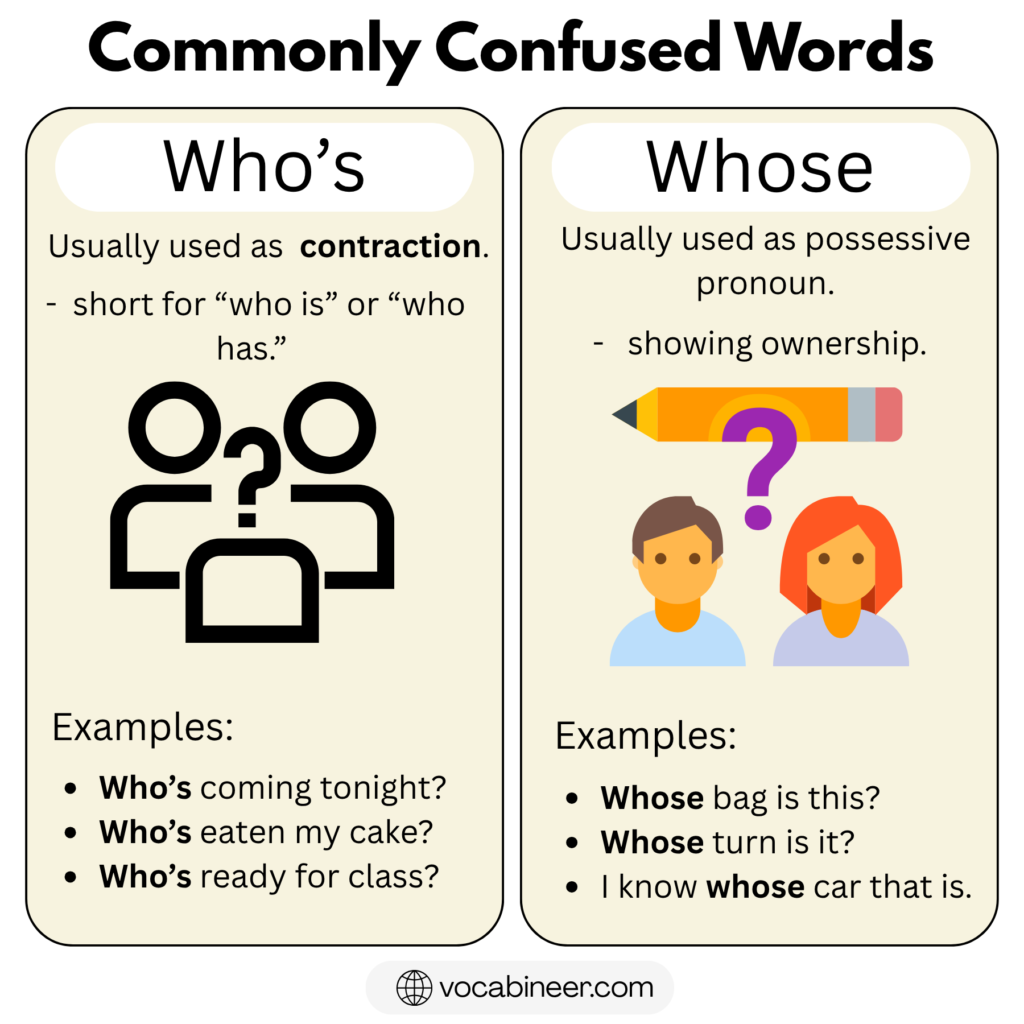
Who’s vs Whose: Key Difference Explained
The main difference in Who’s vs Whose depends on grammar role. Who’s is a contraction that means who is or who has. Whose shows possession and must be followed by a noun.
If the sentence expands to who is or who has, use Who’s.
If the sentence asks or shows ownership, use Whose.
Here is the difference in one sentence:
Who’s means who is or who has.
Whose shows ownership.
Who’s vs Whose: Difference in One Look
| Feature | Who’s | Whose |
|---|---|---|
| Part of Speech | Contraction | Possessive determiner |
| Meaning | Who is / who has | Belonging to whom |
| Expandable | Yes | No |
| Followed By | Adjective, noun, or verb phrase | Noun |
| Shows Ownership | No | Yes |
Notice something important. If you can replace the word with who is, then the correct choice is Who’s.
Who’s vs Whose: Side by Side Sentence Contrast
- Who’s coming to the meeting?
- Whose car is parked outside?
- Do you know who’s ready?
- Do you know whose bag this is?
- Who’s been working late?
- Whose responsibility is this?
In each pair, Who’s forms who is or who has. Whose shows ownership.
Who’s vs Whose: Sentence Structure Comparison
Understanding structure makes the difference easier.
| Structure Type | Who’s Pattern | Whose Pattern |
|---|---|---|
| Contraction | Who’s + adjective | Not used |
| With Verb | Who’s + verb-ing | Not used |
| Possession | Not used | Whose + noun |
| Question | Who’s ready | Whose book |
| Statement | I know who’s right | I know whose car |
If the word is followed by a noun showing ownership, use Whose. If it forms a contraction like who is coming, use Who’s.
When to Use Who’s and When to Use Whose
Choosing between Who’s vs Whose becomes easy when you check whether the sentence needs a contraction or a possessive form.
Use Who’s when the sentence refers to:
- Who is
- Who has
- A present action
- A description of someone
Examples:
- Who’s at the door?
- Who’s ready to begin?
- Do you know who’s calling?
- Who’s been here before?
- Who’s going to speak?
- Tell me who’s next.
- Who’s in charge today?
- Who’s coming with us?
- I wonder who’s responsible.
- Who’s finished already?
Use Whose when the sentence refers to:
- Ownership
- Belonging
- Something connected to someone
Examples:
- Whose book is this?
- Do you know whose car that is?
- Whose idea was it?
- Tell me whose bag this is.
- Whose phone is ringing?
- Whose turn is it?
- Can you guess whose keys these are?
- Whose responsibility is this?
- Do you remember whose birthday it is?
- Whose decision was final?
If the word expands to who is or who has, choose Who’s. If the word is followed by a noun showing ownership, choose Whose.
Context Based Usage Guide
Context provides strong clues in Who’s vs Whose decisions.
Who’s frequently appears:
- At the beginning of questions
- Before verbs ending in ing
- In short conversational questions
Examples:
- Who’s coming?
- Who’s speaking?
- Who’s online?
- Who’s available?
Whose frequently appears:
- Before nouns
- In ownership questions
- In formal writing
Examples:
- Whose car
- Whose idea
- Whose responsibility
- Whose signature
A helpful test is substitution. Replace the word with who is. If the sentence still makes sense, use Who’s.
Grammar Difference Between Who’s and Whose
The grammar difference between Who’s vs Whose is clear.
Who’s is a contraction.
Whose is a possessive determiner or pronoun.
Who’s expands to who is or who has:
- Who’s ready?
- Who’s been waiting?
Whose must be followed by a noun:
- Whose car is this?
- Whose book did you take?
If the sentence forms who is, use Who’s. If it shows ownership, use Whose.
Pronunciation Difference Between Who’s and Whose
In spoken English, Who’s vs Whose are pronounced exactly the same. Both words sound like “hooz.” Because there is no sound difference, pronunciation does not help you choose the correct spelling.
Below is a quick comparison:
| Feature | Who’s | Whose |
|---|---|---|
| Pronunciation | Hooz | Hooz |
| Sound Difference | None | None |
| Meaning | Who is / who has | Belonging to whom |
| Grammar Role | Contraction | Possessive determiner |
Since both words are homophones, grammar and sentence structure must guide your choice.
Common Mistakes With Who’s and Whose
Most mistakes in Who’s vs Whose happen because writers rely on sound instead of structure. Since the words are pronounced the same, spelling errors are common.
Below are frequent mistakes with corrections.
- Incorrect: Whose coming to the meeting?
Correct: Who’s coming to the meeting? - Incorrect: Do you know who’s car this is?
Correct: Do you know whose car this is? - Incorrect: Whose ready to start?
Correct: Who’s ready to start? - Incorrect: Tell me who’s bag this is.
Correct: Tell me whose bag this is. - Incorrect: Whose been here before?
Correct: Who’s been here before? - Incorrect: I wonder who’s responsibility this is.
Correct: I wonder whose responsibility this is. - Incorrect: Whose in charge today?
Correct: Who’s in charge today? - Incorrect: Can you guess who’s phone this is?
Correct: Can you guess whose phone this is? - Incorrect: Whose going to speak?
Correct: Who’s going to speak? - Incorrect: Do you remember who’s idea it was?
Correct: Do you remember whose idea it was?
Notice the consistent pattern. If the word expands to who is or who has, use Who’s. If it shows ownership before a noun, use Whose.
FAQs
The main difference in Who’s vs Whose is grammar role. Who’s is a contraction that means who is or who has. Whose shows possession and means belonging to whom.
Replace the word with who is or who has. If the sentence still makes sense, then Who’s is correct.
Use Whose when the word is followed by a noun and shows ownership, such as whose book or whose idea.
No. Who’s cannot show ownership because it only stands for who is or who has.
Both words are pronounced the same. Therefore, writers often rely on sound instead of checking sentence structure and grammar.
Final Summary
Who’s vs Whose may sound identical, but their grammar roles are different. Who’s is a contraction that means who is or who has. Whose shows ownership and must be followed by a noun. If the sentence expands to who is, choose Who’s. If it asks about possession, choose Whose. Understanding this distinction prevents common spelling errors and improves sentence accuracy.
Read More
