

Your vs You’re often creates confusion because the words sound identical but have completely different grammar roles. One shows possession, while the other is a contraction of two words. Their spelling reflects possessive determiner versus verb contraction contrast.
Understanding Your vs You’re helps you choose the correct form in structured writing, academic sentences, and daily communication. This article explains their meaning, grammar roles, usage patterns, sentence structure, and common mistakes so you can apply them accurately.
In This Page
Your vs You’re: Quick Definition
Your shows possession and means belonging to you.
You’re is a contraction of you are.
The key difference in Your vs You’re is ownership versus shortened verb form.
Your vs You’re Difference in One Sentence
Your shows ownership.
You’re means you are.
Why Your and You’re Are Often Confused?
Your and You’re are often confused because they are homophones. They sound exactly the same in speech. Therefore, writers sometimes choose the wrong spelling when typing quickly.
However, their meanings are completely different. Your shows possession. You’re combines you and are into a contraction. As a result, confusion usually happens in writing rather than in pronunciation.
Word Origin and Etymology
The history of Your vs You’re reflects different grammatical developments. Your developed as a possessive determiner in English to show ownership. You’re developed later as a contraction of you are, combining a pronoun and a verb.
Although they sound identical, their functions and origins are separate. Therefore, spelling determines meaning.
What Does Your Mean?
Your shows possession or ownership by the person being addressed.
Definition of Your
Your is a possessive determiner that means belonging to you.
It always appears before a noun.
Your as a Possessive Determiner
Because Your shows ownership, it must be followed by a noun.
Examples using Your:
- Is this your book?
- I like your idea.
- Finish your homework.
- Where is your phone?
- Bring your bag.
- I appreciate your help.
- Check your answers.
- Clean your room.
- This is your seat.
- Respect your teachers.
- Follow your plan.
- I admire your effort.
- Take your time.
- Share your opinion.
- Protect your belongings.
- Update your profile.
- Keep your promise.
- Watch your step.
- Complete your task.
- Remember your goal.
Notice something important. Your must be followed by a noun because it shows ownership.
Common Uses and Collocations of Your
- Your idea
- Your responsibility
- Your decision
- Your car
- Your house
- Your plan
- Your opinion
- Your success
- Your future
- Your team
- Your family
- Your choice
- Your account
- Your password
- Your answer
What Does You’re Mean?
You’re is a contraction. In the Your vs You’re contrast, You’re always stands for two words: you are. It combines a subject pronoun and a verb into a shorter written form.
Unlike Your, which shows ownership, You’re expresses a statement about the person being addressed.
Definition of You’re
You’re is a contraction of you are.
It functions as a subject plus verb combination.
You’re as a Contraction
Because You’re means you are, you can expand it in the sentence to check if it makes sense.
Examples using You’re:
- You’re late today.
- You’re very kind.
- I think you’re right.
- You’re doing well.
- You’re ready now.
- You’re my best friend.
- You’re not alone.
- You’re going to succeed.
- You’re the winner.
- I know you’re busy.
- You’re welcome here.
- You’re improving quickly.
- I’m glad you’re here.
- You’re learning fast.
- You’re invited.
- You’re the reason.
- You’re stronger than you think.
- You’re responsible for this.
- I believe you’re honest.
- You’re almost finished.
If you replace You’re with you are and the sentence still makes sense, then You’re is correct.
Common Uses and Collocations of You’re
- You’re right
- You’re wrong
- You’re welcome
- You’re late
- You’re early
- You’re ready
- You’re invited
- You’re correct
- You’re responsible
- You’re amazing
- You’re helpful
- You’re kind
- You’re busy
- You’re serious
- You’re honest
Each phrase expands naturally to you are.
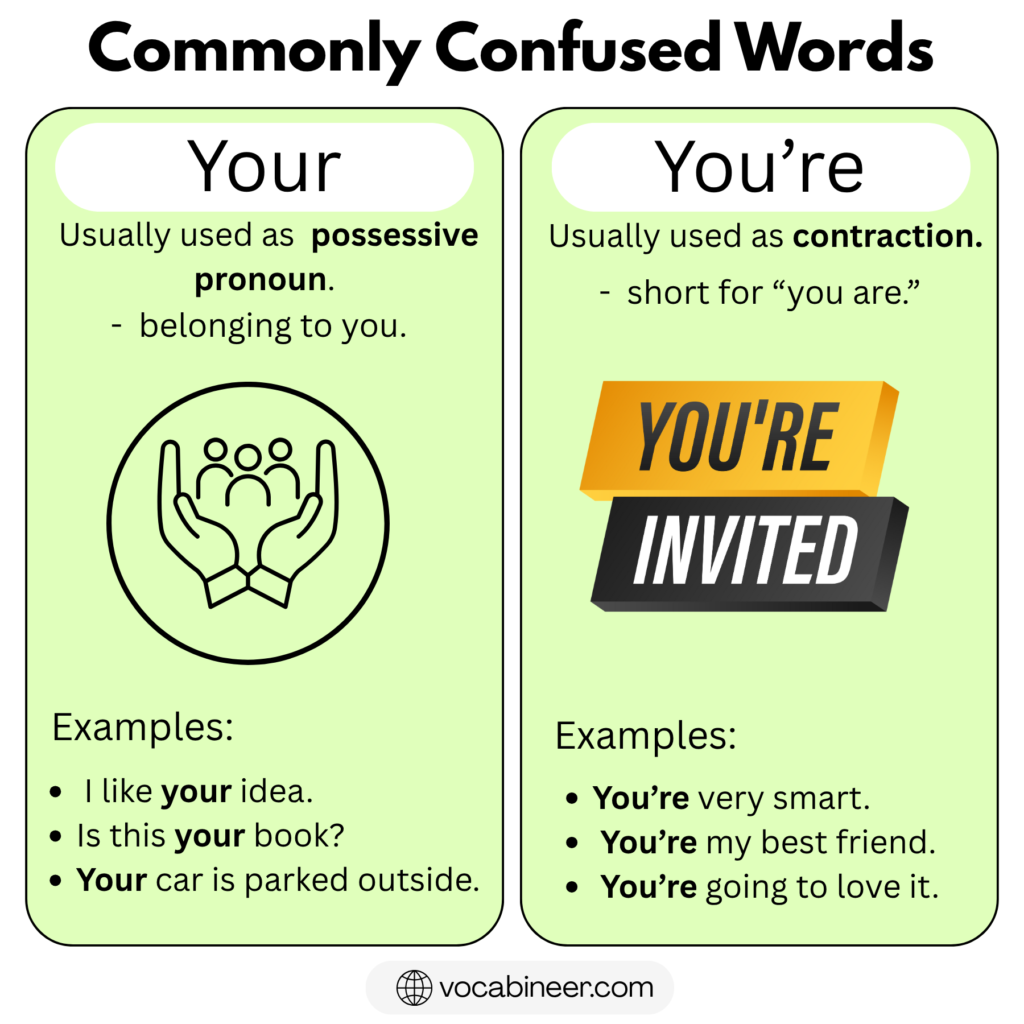
Your vs You’re: Key Difference Explained
The main difference in Your vs You’re depends on grammar role. Your shows possession and must be followed by a noun. You’re is a contraction of you are and functions as a subject plus verb.
If the sentence shows ownership, use Your.
If the sentence can expand to you are, use You’re.
Here is the difference in one sentence:
Your shows ownership.
You’re means you are.
Your vs You’re: Difference in One Look
| Feature | Your | You’re |
|---|---|---|
| Part of Speech | Possessive determiner | Contraction |
| Meaning | Belonging to you | You are |
| Followed By | Noun | Adjective, noun, or verb phrase |
| Shows Ownership | Yes | No |
| Expandable | No | Yes, to you are |
Notice something important. If you can replace the word with you are, the correct choice is You’re.
Your vs You’re: Side by Side Sentence Contrast
- I like your idea.
- I think you’re right.
- Where is your phone?
- You’re using my phone.
- Finish your work.
- You’re working hard.
In each pair, Your shows possession. You’re expresses you are.
Your vs You’re: Sentence Structure Comparison
Understanding structure makes the difference easier.
| Structure Type | Your Pattern | You’re Pattern |
|---|---|---|
| Possession | Your + noun | Not used |
| Statement | Not used | You’re + adjective |
| With Verb | Not used | You’re + verb-ing |
| Question | Is this your book | Why you’re late |
| Negative | Not used | You’re not ready |
If the word is directly followed by a noun, it must be Your. If it forms a statement like you are happy or you are going, it must be You’re.
When to Use Your and When to Use You’re
Choosing between Your vs You’re becomes simple when you check whether the sentence shows ownership or forms the phrase you are.
Use Your when the sentence refers to:
- Ownership
- Something belonging to you
- A noun following the word
Examples:
- This is your seat.
- I like your idea.
- Finish your homework.
- Where is your bag?
- I appreciate your help.
- Protect your belongings.
- Update your account.
- Check your answers.
- Respect your teachers.
- Follow your plan.
Use You’re when the sentence refers to:
- You are
- A description of the person
- A present action
- A statement about someone
Examples:
- You’re late today.
- You’re very kind.
- I think you’re correct.
- You’re doing well.
- You’re ready now.
- You’re improving quickly.
- I’m glad you’re here.
- You’re learning fast.
- You’re responsible.
- You’re invited.
If the word can expand to you are, choose You’re. If it is followed by a noun showing ownership, choose Your.
Context Based Usage Guide
Context gives strong clues in Your vs You’re decisions.
Your frequently appears:
- Before nouns
- In possessive phrases
- In instructions
Examples:
- Your decision
- Your responsibility
- Your family
- Your success
You’re frequently appears:
- Before adjectives
- Before verbs ending in ing
- In statements
Examples:
- You’re happy
- You’re going
- You’re correct
- You’re amazing
A helpful test is substitution. Replace the word with you are. If the sentence still makes sense, use You’re.
Grammar Difference Between Your and You’re
The grammar difference between Your vs You’re is clear.
Your is a possessive determiner.
You’re is a contraction of you are.
Your must be followed by a noun:
- Your phone is ringing.
- Your answer is correct.
You’re must expand to you are:
- You’re late.
- You’re studying hard.
If the sentence shows ownership, use Your. If it forms you are, use You’re.
Pronunciation Difference Between Your and You’re
In spoken English, Your vs You’re are homophones. That means they are pronounced exactly the same. Both words sound like “yor” or “yur,” depending on accent.
Because there is no pronunciation difference, spelling becomes the only reliable clue in writing. Therefore, you must rely on grammar and sentence structure rather than sound.
Below is a quick comparison:
| Feature | Your | You’re |
|---|---|---|
| Pronunciation | Yor | Yor |
| Sound Difference | None | None |
| Meaning | Belonging to you | You are |
| Grammar Role | Possessive determiner | Contraction |
Since both words sound identical, careful attention to structure prevents confusion.
Common Mistakes With Your and You’re
Most mistakes in Your vs You’re happen when writers choose spelling based on sound. Because pronunciation offers no difference, grammar must guide the choice.
Below are frequent mistakes with corrections.
- Incorrect: Your late today.
Correct: You’re late today. - Incorrect: I like you’re idea.
Correct: I like your idea. - Incorrect: Your going to be fine.
Correct: You’re going to be fine. - Incorrect: Where is you’re bag?
Correct: Where is your bag? - Incorrect: Your very kind.
Correct: You’re very kind. - Incorrect: I respect you’re decision.
Correct: I respect your decision. - Incorrect: Your not ready yet.
Correct: You’re not ready yet. - Incorrect: This is you’re seat.
Correct: This is your seat. - Incorrect: Your doing great.
Correct: You’re doing great. - Incorrect: I appreciate you’re help.
Correct: I appreciate your help.
Notice the consistent pattern. If the sentence expands to you are, use You’re. If the word shows ownership, use Your.
FAQs
The main difference in Your vs You’re is grammar role. Your shows possession and means belonging to you. You’re is a contraction that means you are.
Replace the word with you are. If the sentence still makes sense, then You’re is correct. If it does not, you likely need Your.
Use Your when the word is followed by a noun that shows ownership, such as your book, your idea, or your responsibility.
No. You’re cannot show ownership. It only stands for you are.
Both words sound exactly the same in speech. Therefore, writers often rely on sound instead of checking the grammar structure.
Final Summary
Your vs You’re may sound the same, but their meanings and grammar roles are completely different. Your is a possessive determiner that shows ownership. You’re is a contraction of you are. If the sentence shows belonging, choose Your. If it expands to you are, choose You’re. Understanding this distinction prevents common spelling errors and improves sentence accuracy.
Read More
