

Among vs Amongst often confuses learners because both words have the same meaning. However, the difference lies in style and regional preference rather than definition.
Understanding Among vs Amongst helps you write clearly in formal and informal contexts. Therefore, this guide explains their meaning, grammar role, usage patterns, and stylistic differences so you can choose the correct form confidently.
In This Page
Among vs Amongst: Quick Definition
Among means in the middle of or surrounded by.
Amongst also means in the middle of or surrounded by.
In simple terms, both words describe being part of a group or within something.
Among vs Amongst Difference in One Sentence
Among and Amongst have the same meaning.
The difference lies mainly in style and regional usage.
Why Among and Amongst Are Often Confused?
Among and Amongst are often confused because both spellings are correct and both carry the same meaning. In addition, they are pronounced almost the same in everyday speech. As a result, many learners think one form must be incorrect, even though both are accepted.
However, the difference depends mainly on style and region. Among is more common in modern English, especially in American usage. In contrast, Amongst appears more frequently in British English and in formal or literary writing. Therefore, confusion usually arises from exposure to different writing styles rather than meaning differences.
Word Origin and Etymology
Among developed from Old English roots meaning “in the company of” or “in the middle of.” Over time, it became the standard and more common form in modern English. Therefore, it is widely used in both spoken and written communication.
Amongst evolved as a variant form with an added “-st,” similar to words like whilst and whilst. This ending became common in British English and in older forms of writing. Although both words share the same origin and meaning, their usage developed differently based on style preference.
Meaning of Among
Among means in the middle of, surrounded by, or included within a group. It is commonly used when referring to more than two people, objects, or ideas. Therefore, it appears frequently in everyday speech and writing.
In addition, Among functions as a preposition. As a result, it is followed by a noun or pronoun.
Definition of Among
Among means being part of a group or surrounded by several things.
In simple terms, it shows inclusion within a group.
Among as Part of Speech
Among functions as a preposition.
Examples:
- She stood among her friends.
- The secret was shared among the team.
- The teacher walked among the students.
- The prize was divided among the winners.
- He felt comfortable among colleagues.
- The village lies among the hills.
- They distributed food among the children.
- She found her name among the list.
- Trust grows among good friends.
- The idea spread among the group.
- He lived among artists.
- The responsibility was shared among members.
- The path winds among the trees.
- News traveled quickly among employees.
- She felt respected among peers.
- The funds were divided among departments.
- Laughter echoed among the crowd.
- He searched among old papers.
- Cooperation improved among workers.
- The message circulated among staff.
Common Uses and Collocations of Among
Common patterns include:
- Among friends
- Among colleagues
- Among the crowd
- Among the trees
- Among members
- Among students
- Among people
- Among the group
These patterns show that Among is the more common modern form in both American and British English.
Meaning of Amongst
Amongst means in the middle of, surrounded by, or included within a group. It carries the same meaning as Among. However, it is less common in modern usage and appears more often in British English or in formal writing.
In addition, Amongst functions as a preposition. Therefore, it is followed by a noun or pronoun, just like Among.
Definition of Amongst
Amongst means being part of a group or surrounded by several people or things.
In simple terms, it shows inclusion within a group.
Amongst as Part of Speech
Amongst functions as a preposition.
Examples:
- She stood amongst her friends.
- The secret was shared amongst the team.
- The teacher walked amongst the students.
- The prize was divided amongst the winners.
- He felt relaxed amongst colleagues.
- The cottage sits amongst the hills.
- They distributed supplies amongst the children.
- She found her name amongst the list.
- Trust grew amongst neighbors.
- The idea spread amongst the group.
- He lived amongst artists.
- Responsibility was shared amongst members.
- The path winds amongst the trees.
- News traveled quickly amongst employees.
- She felt welcomed amongst peers.
- The funds were divided amongst departments.
- Laughter echoed amongst the crowd.
- He searched amongst old documents.
- Cooperation improved amongst workers.
- The discussion continued amongst participants.
Common Uses and Collocations of Amongst
Common patterns include:
- Amongst friends
- Amongst colleagues
- Amongst the crowd
- Amongst the trees
- Amongst members
- Amongst students
- Amongst people
- Amongst the group
These patterns show that Amongst functions exactly like Among but appears more formal or literary in tone.
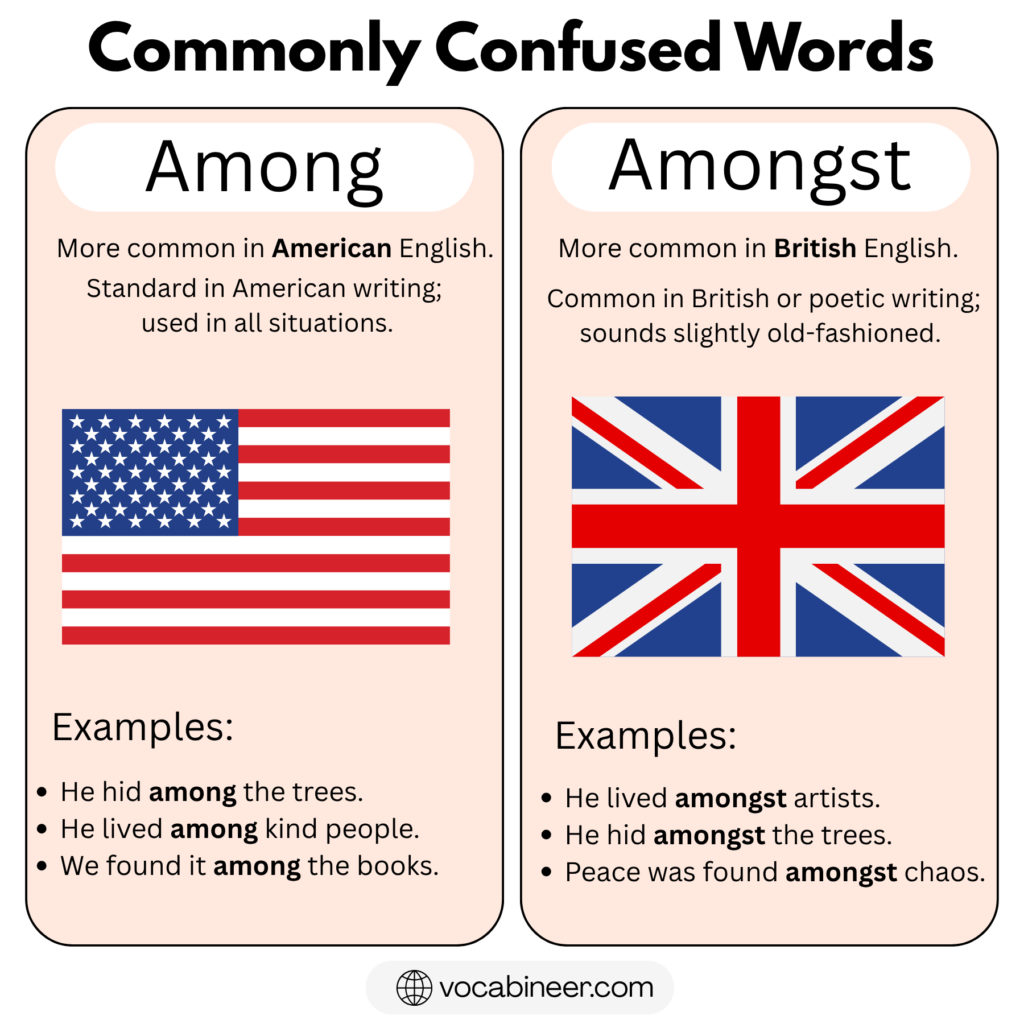
Among vs Amongst: Key Difference Explained
Although Among and Amongst share the same meaning, their difference lies in usage style rather than definition. The word Among is more common in modern English and is widely used in both American and British writing. In contrast, Amongst sounds slightly more formal or traditional and appears more often in British English.
Usage trends clarify this distinction further. In everyday conversation and contemporary writing, Among is generally preferred. However, in formal speeches, literary works, or British contexts, Amongst may be chosen for stylistic effect. In short, the meaning remains the same, yet tone and regional preference influence the choice.
Among vs Amongst: Difference in One Look
| Feature | Among | Amongst |
|---|---|---|
| Meaning | In the middle of / Surrounded by | In the middle of / Surrounded by |
| Part of Speech | Preposition | Preposition |
| Usage Frequency | More common | Less common |
| Tone | Neutral / Modern | Slightly formal / Traditional |
| Regional Preference | American & British English | More common in British English |
| Interchangeable in Meaning? | Yes | Yes |
This comparison shows that the difference is stylistic rather than grammatical.
Among vs Amongst: Side by Side Sentence Contrast
Since both words carry the same meaning, the difference appears only in tone and frequency of use. Therefore, comparing similar sentences shows that the meaning does not change.
- She stood among her friends.
- She stood amongst her friends.
- The prize was divided among the winners.
- The prize was divided amongst the winners.
- The cottage sits among the hills.
- The cottage sits amongst the hills.
- News spread quickly among employees.
- News spread quickly amongst employees.
In each pair, the meaning remains identical. Only the style and level of formality differ slightly.
Among vs Amongst: Sentence Structure Comparison
Because both words function as prepositions, their sentence structure is exactly the same.
Common patterns:
- Among/Amongst friends
- Among/Amongst colleagues
- Among/Amongst the crowd
- Divided among/amongst members
- Hidden among/amongst the trees
Therefore, both words appear in the same grammatical positions. The difference lies only in usage preference, not in structure.
When to Use Among and Amongst
Choosing between Among and Amongst depends mainly on style and tone. In modern writing and everyday speech, Among is more common and generally preferred. Therefore, it is the safer choice in academic, business, and casual contexts.
However, Amongst may be used in more formal, literary, or traditional writing. It appears more frequently in British English and older texts. Thus, the decision often depends on audience, tone, and personal style rather than meaning.
In short, use Among for neutral modern writing, and choose Amongst if you want a slightly formal or traditional tone.
Context Based Usage Guide
If you are writing in American English or in contemporary style, use Among. For example:
- She felt comfortable among friends.
- The funds were shared among departments.
- Trust builds among team members.
- The village lies among the hills.
- He searched among old papers.
On the other hand, if you are writing in British English or aiming for a formal tone, you may use Amongst. For instance:
- She felt welcomed amongst colleagues.
- The prize was divided amongst the winners.
- The path winds amongst the trees.
- Cooperation improved amongst staff.
- The discussion continued amongst participants.
Therefore, once you choose one form, maintain consistency throughout your writing.
Grammar Difference Between Among and Amongst
Although Among and Amongst look slightly different, their grammatical function is identical. Both words are prepositions and both are followed by a noun or pronoun. Therefore, the difference is stylistic, not grammatical.
| Grammar Feature | Among | Amongst |
|---|---|---|
| Part of Speech | Preposition | Preposition |
| Meaning | In the middle of / Surrounded by | In the middle of / Surrounded by |
| Followed By | Noun / Pronoun | Noun / Pronoun |
| Used In Phrases | Among friends | Amongst friends |
| Sentence Position | Before noun phrase | Before noun phrase |
| Tone | Neutral / Modern | Slightly formal / Traditional |
| Regional Preference | Common worldwide | More common in British English |
| Interchangeable in Meaning? | Yes | Yes |
This table shows that both words behave exactly the same in sentences. The only difference lies in tone and usage preference.
Pronunciation Difference Between Among and Amongst
Among and Amongst are pronounced almost the same in natural speech. The only difference is the added “st” sound at the end of Amongst. However, this difference is minor and does not affect meaning.
As a result, the choice between the two words depends on writing style rather than pronunciation.
Common Mistakes With Among and Amongst
Among vs Amongst mistakes usually involve overuse or inconsistency rather than incorrect meaning. Since both words mean the same thing, the main issue is tone and style.
- Incorrect: She stood amongst her friends in a casual American blog post.
Better: She stood among her friends. - Incorrect: The funds were divided amongst the winners (in a modern business report).
Better: The funds were divided among the winners. - Incorrect: She stood among the trees in a highly formal British speech that consistently uses older forms.
Better: She stood amongst the trees (if maintaining a formal British tone). - Incorrect: Mixing both forms in the same paragraph without stylistic reason.
Correct: Choose either among or amongst and use it consistently. - Incorrect: Using either word for only two items.
Better: Use “between” for two items instead of among/amongst.
Therefore, the main rule is consistency and awareness of tone. In modern writing, Among is usually the safer choice.
FAQs
Both words are correct and accepted in standard English. They function as prepositions and share the same meaning. The difference is stylistic.
Among is more common in modern English, especially in everyday writing and speech. It appears frequently in academic, business, and informal contexts.
Yes, Amongst often sounds slightly more formal or traditional. It appears more frequently in British English and older or literary writing styles.
No, Among and Amongst mean exactly the same thing. Both describe being surrounded by or included within a group of people.
Avoid mixing both forms in one document. Choose either Among or Amongst based on tone and audience, then use it consistently throughout.
Final Summary
Among and Amongst share the same meaning and grammatical role. Both function as prepositions and describe being surrounded by or included within a group. However, Among is more common in modern writing, while Amongst carries a slightly formal or traditional tone. Therefore, select the form that matches your style and maintain consistency throughout your writing.
Read More
- Confusing Words in English
- American vs British Words
- Ensure vs Insure in English
- Ageing vs Aging in English
