
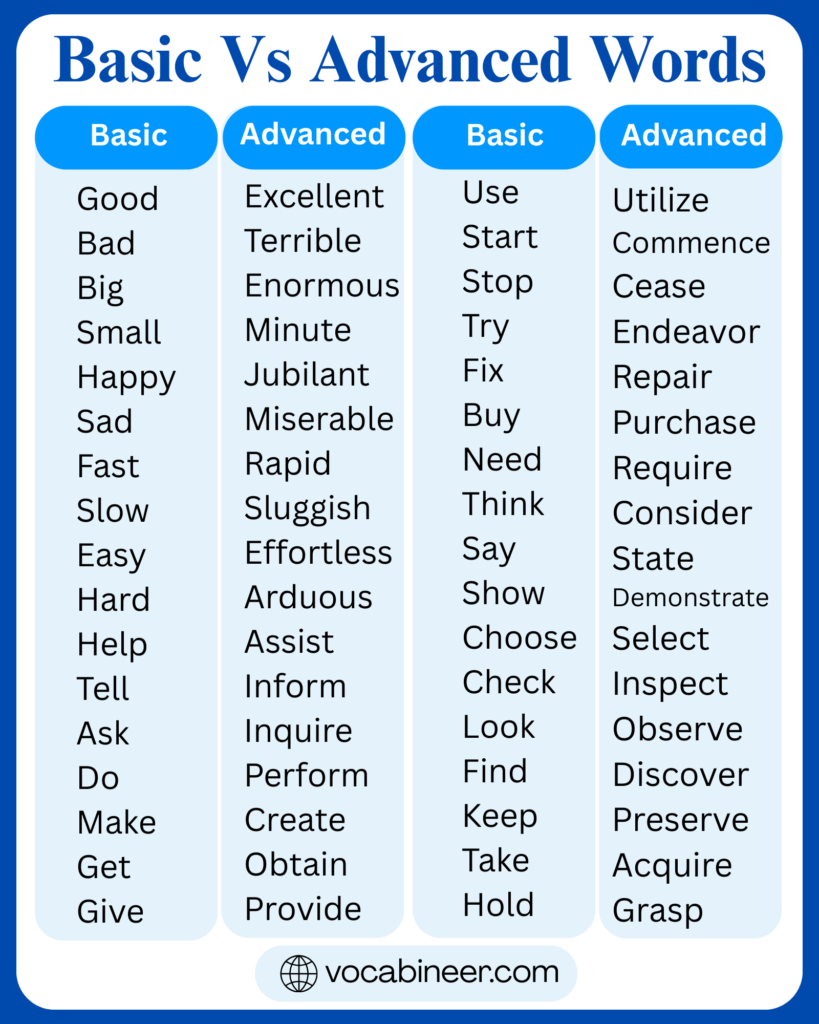
Learning basic and advanced English words together helps learners see how meaning stays the same while word choice changes. Basic vs Advanced English Words appear in reading passages, textbooks, notices, and daily communication, where simple words and formal words describe the same idea in different ways. Knowing both forms helps readers understand familiar ideas even when the wording looks different.
This post helps readers learn Basic vs Advanced English Words and understand how word choice works in conversations, school tasks, written sentences, and formal situations.
In This Page
What Makes English Words Basic or Advanced?
English words are considered basic or advanced based on how often they appear and where they are used. Basic words are shorter, common, and learned early, while advanced words are more specific and appear more often in writing, exams, and formal communication. The meaning usually stays similar, but tone and clarity change.
Understanding this difference helps learners recognize familiar ideas even when the wording looks unfamiliar in reading or written content.
Basic vs Advanced English Words for Actions
Action words change a lot between speaking and writing. In daily talk, people prefer short and familiar verbs. In books, exams, or formal writing, the same actions are expressed with more precise words. Knowing both forms helps learners understand sentences that describe the same action using different word levels. Below is a list of basic and advanced English words used for actions, shown with clear meaning and sentence use.
- Help: Used when giving support or assistance in daily situations.
Assist: Used in formal or written situations when helping someone with a task.
Can you help me finish this work?
Can you assist me in completing this task? - Start: Used when something begins in everyday speech.
Begin: Used in writing or formal instructions for the same action.
Let’s start the class now.
Let’s begin the class now. - End: Used to stop or finish something in simple language.
Conclude: Used in formal writing or speeches to finish something officially.
We will end the meeting early.
We will conclude the meeting early. - Ask: Used when requesting information in conversation.
Inquire: Used in formal situations when asking for information politely.
I want to ask about the exam date.
I want to inquire about the exam date. - Tell: Used to give information in daily speech.
Inform: Used in notices, emails, or formal communication.
Please tell me the result.
Please inform me of the result. - Fix: Used when repairing something in casual talk.
Repair: Used in written or technical contexts for the same action.
I need to fix my phone today.
I need to repair my phone today. - Use: Used for applying or operating something in simple language.
Utilize: Used in formal writing to sound more precise.
You can use this tool safely.
You can utilize this tool safely. - Show: Used when presenting something informally.
Demonstrate: Used in teaching, writing, or formal explanation.
Please show me how it works.
Please demonstrate how it works. - Get: Used when receiving or obtaining something casually.
Obtain: Used in writing or official language for receiving something.
I need to get permission first.
I need to obtain permission first. - Change: Used when something becomes different in everyday speech.
Modify: Used in formal or technical contexts.
We need to change the plan.
We need to modify the plan.
Basic vs Advanced English Words for Common Things
Everyday objects often have two names in English. A basic word is used in daily speech, while an advanced word appears in books, notices, instructions, or formal writing. The object stays the same, but the wording changes based on context. Learning both names helps readers understand written English without guessing meanings. Below is a list of basic and advanced English words for common things, grouped by where they are usually seen.
Objects Used at Home
- Chair: A common word for something people sit on at home.
Furniture item: A formal phrase used in written descriptions.
That chair looks uncomfortable.
That furniture item looks uncomfortable. - Fridge: A daily word for keeping food cold.
Refrigerator: A formal word used in manuals and product details.
Put the milk in the fridge.
Put the milk in the refrigerator. - Light: A simple word for lamps or ceiling lights.
Lighting fixture: A formal term used in descriptions or plans.
Turn off the light before sleeping.
Turn off the lighting fixture before sleeping. - Fan: A common word for an air-moving device.
Ventilation device: A technical or formal term.
The fan is very noisy.
The ventilation device is very noisy. - Bed: A basic word for sleeping furniture.
Sleeping unit: A formal phrase used in descriptions.
The bed is too small.
The sleeping unit is too small. - TV: A casual word for watching programs.
Television set: A formal phrase used in writing.
The TV is broken.
The television set is broken. - Door: A simple word for an entry or exit.
Entrance structure: A formal phrase used in descriptions.
Close the door quietly.
Close the entrance structure quietly.
Objects Used at School and Work
- Desk: A common word for a work table.
Workstation: A formal word used in offices.
My desk is near the window.
My workstation is near the window. - Book: A basic word used for reading material.
Textbook: A formal word used in education.
I forgot my book at home.
I forgot my textbook at home. - Pen: A simple word for writing tools.
Writing instrument: A formal term used in documents.
I need a pen to write.
I need a writing instrument to write. - Paper: A daily word for sheets used for writing.
Document: A formal word used in school or office work.
Please submit the paper tomorrow.
Please submit the document tomorrow. - Room: A basic word for an enclosed space.
Office: A formal word used for work areas.
The room is locked.
The office is locked. - Bag: A common word for carrying items.
Briefcase: A formal word used at work.
He carried a bag to school.
He carried a briefcase to work.
Basic vs Advanced English Words for Describing People
English uses different words to describe people depending on how formal the situation is. In daily conversation, speakers prefer short and familiar words. In writing, exams, or formal descriptions, more specific words are used. The meaning stays similar, but the tone becomes more precise and detailed. Below is a list of basic and advanced English words used to describe people, grouped by appearance and behavior.
Words for Appearance
- Tall: A common word used to describe height in daily speech.
Statured: A formal word used in written or descriptive contexts.
He is very tall.
He is highly statured. - Thin: A simple word used to describe a slim body shape.
Slender: A softer and more formal word used in writing.
She looks thin.
She looks slender. - Fat: A basic word used casually to describe body size.
Overweight: A formal and polite word used in writing.
He is getting fat.
He is becoming overweight. - Old: A common word used to describe age.
Elderly: A respectful and formal word used in written English.
That man is old.
That man is elderly. - Young: A simple word used for age.
Youthful: A descriptive word used in writing.
She looks young.
She looks youthful. - Pretty: A casual word used to describe appearance.
Attractive: A neutral and formal word used in descriptions.
She is pretty.
She is attractive.
Words for Personality and Behavior
- Kind: A basic word for someone who is caring.
Compassionate: A formal word used in writing or reports.
She is very kind.
She is very compassionate. - Lazy: A common word for someone who avoids work.
Unmotivated: A formal word used in descriptions.
He is lazy at school.
He is unmotivated at school. - Smart: A basic word used for intelligence.
Intelligent: A formal word used in writing and exams.
She is smart.
She is intelligent. - Angry: A common word for feeling upset.
Irritated: A formal word used in writing.
He looks angry.
He looks irritated. - Quiet: A simple word used for someone who speaks little.
Reserved: A formal word used in descriptions.
She is very quiet.
She is very reserved. - Brave: A common word for courage.
Courageous: A formal word often used in writing.
He is brave.
He is courageous.
Basic vs Advanced English Words for Feelings
Feelings are often expressed with simple words in conversation, but writing and formal language use more precise terms. The emotion usually stays the same, while the word choice changes to match tone and context. Learning both forms helps readers understand stories, essays, and formal sentences without confusion. Below is a list of basic and advanced English words used for feelings, grouped by everyday use and formal writing.
Common Emotion Words
- Happy: A basic word used to show joy or pleasure.
Pleased: A slightly formal word used in polite situations.
I feel happy today.
I feel pleased today. - Sad: A simple word used when feeling unhappy.
Upset: A more neutral word often used in writing.
She feels sad about the news.
She feels upset about the news. - Angry: A common word used when feeling mad.
Annoyed: A softer word used in calmer situations.
He is angry right now.
He is annoyed right now. - Scared: A basic word used to show fear.
Afraid: A neutral word often used in writing.
She is scared of dogs.
She is afraid of dogs. - Excited: A common word for strong happiness.
Eager: A word used when looking forward to something.
I am excited about the trip.
I am eager for the trip. - Tired: A simple word used for low energy.
Exhausted: A stronger word used in writing.
I am tired after school.
I am exhausted after school.
Strong Emotion Words in Writing
- Very happy: A phrase used in daily speech.
Delighted: A formal word used in writing.
She is very happy with the result.
She is delighted with the result. - Very sad: A common phrase in conversation.
Heartbroken: A strong word used in writing.
He feels very sad about leaving.
He feels heartbroken about leaving. - Very angry: A casual phrase used in speech.
Furious: A strong word used in written English.
She is very angry right now.
She is furious right now. - Very scared: A daily phrase used in conversation.
Terrified: A strong word used in stories and writing.
The child was very scared.
The child was terrified. - Very calm: A simple phrase used in speech.
Composed: A formal word used in writing.
He stayed very calm.
He stayed composed.
Basic vs Advanced English Words in Daily Conversations
Daily conversations usually rely on short and familiar words that sound natural and direct. However, the same ideas can be expressed with more formal words when speaking politely or carefully. Learning both forms helps readers understand conversations, dialogues, and spoken sentences that shift in tone without changing meaning. Below is a list of basic and advanced English words commonly used in daily conversations.
- Say: A basic word used when speaking casually.
State: A formal word used when speaking clearly or officially.
Please say your name.
Please state your name. - Ask: A simple word used in everyday questions.
Request: A polite and formal word used in careful speech.
I want to ask for help.
I want to request assistance. - Talk: A common word for speaking with others.
Discuss: A formal word used for serious conversation.
We need to talk about this.
We need to discuss this. - Tell: A basic word for giving information.
Explain: A clearer and more formal word used in speech.
Please tell me the problem.
Please explain the problem. - Sure: A casual word used to agree.
Certainly: A polite word used in careful conversation.
Sure, I can help you.
Certainly, I can help you. - No: A simple word used to refuse.
Decline: A polite word used in formal speech.
I must say no today.
I must decline today. - Thanks: A common word used to show gratitude.
Appreciate: A formal word used in polite conversation.
Thanks for your time.
I appreciate your time. - Sorry: A basic word used to apologize.
Apologize: A formal word used in careful speech.
I am sorry for being late.
I apologize for being late.
Basic vs Advanced English Words in School and Exams
Schoolwork and exams often use clearer and more formal wording than daily speech. Students may hear simple words in class, but exam papers, instructions, and textbooks prefer precise language. Learning both basic and advanced forms helps readers understand questions, directions, and written answers without confusion. Below is a list of basic and advanced English words commonly used in school and exam settings.
- Test: A basic word used for checking knowledge.
Examination: A formal word used in official school contexts.
We have a math test today.
We have a math examination today. - Question: A simple word used when asking something.
Inquiry: A formal word used in written or official contexts.
Read the first question carefully.
Read the first inquiry carefully. - Answer: A basic word used for a response.
Response: A formal word used in exams or writing.
Write your answer clearly.
Write your response clearly. - Marks: A common word used for scores.
Grades: A formal word used in reports and records.
She got high marks in science.
She received high grades in science. - Teacher: A basic word used in classrooms.
Instructor: A formal word used in academic settings.
The teacher explained the lesson.
The instructor explained the lesson. - Student: A common word for a learner.
Candidate: A formal word used in exams.
Each student must sign here.
Each candidate must sign here. - Homework: A simple word for school tasks.
Assignment: A formal word used in written instructions.
Finish your homework tonight.
Finish your assignment tonight. - Study: A basic word for learning.
Prepare: A formal word used before exams.
I will study for the test.
I will prepare for the test.
Basic vs Advanced English Words in Work and Emails
Workplace communication often sounds more careful and formal than daily conversation. In offices and emails, basic words are still understood, but advanced words are preferred because they sound clear, polite, and professional. Learning both forms helps readers understand messages, instructions, and written communication at work. Below is a list of basic and advanced English words commonly used in work settings and emails.
- Job: A basic word used for work or employment.
Position: A formal word used in professional communication.
She applied for a new job.
She applied for a new position. - Boss: A common word used in conversation.
Manager: A formal word used in workplace writing.
My boss called me today.
My manager called me today. - Meeting: A basic word for people gathering to talk.
Conference: A formal word used in office communication.
We have a meeting at noon.
We have a conference at noon. - Help: A simple word used when offering assistance.
Support: A formal word used in emails and reports.
Thank you for your help.
Thank you for your support. - Fix: A basic word used for solving a problem.
Resolve: A formal word used in professional writing.
We will fix the issue soon.
We will resolve the issue soon. - Buy: A common word for purchasing something.
Purchase: A formal word used in documents.
We need to buy new equipment.
We need to purchase new equipment. - Ask: A simple word used when requesting something.
Request: A formal word used in emails.
Please ask for approval.
Please request approval. - Send: A basic word used in daily communication.
Submit: A formal word used in work emails.
Send the report today.
Submit the report today.
Different Words Change Sentence Meaning
Using different words can change how a sentence sounds, even when the main idea stays the same. Some words feel casual and direct, while others feel careful or formal. Readers who notice these changes can understand tone, purpose, and context more easily in reading and writing. Below is a list showing how changing one word can slightly or strongly change sentence meaning.
- Big / Large
The room is big.
The room is large. - Small / Tiny
The box is small.
The box is tiny. - Fast / Quick
He runs fast.
He runs quick. - Slow / Gradual
The change was slow.
The change was gradual. - Bad / Poor
The service was bad.
The service was poor. - Good / Excellent
She did a good job.
She did an excellent job. - Hard / Difficult
This lesson is hard.
This lesson is difficult. - Easy / Simple
The task is easy.
The task is simple. - Get / Receive
I got your message.
I received your message. - Give / Provide
They give help to students.
They provide help to students. - Say / State
Please say your name.
Please state your name. - Ask / Request
She asked for more time.
She requested more time. - Help / Assist
He helped the teacher.
He assisted the teacher. - Fix / Repair
They fixed the machine.
They repaired the machine. - End / Finish
The class will end soon.
The class will finish soon.
Example Sentences Using Basic vs Advanced English Words
Seeing basic and advanced words inside full sentences makes the difference easier to understand. The meaning usually stays the same, but the tone or formality changes. Reading both versions together helps learners recognize familiar ideas even when the wording becomes more formal or precise. Below is a list of example sentences showing basic and advanced English words used for the same idea.
- Help / Assist
Please help me with this work.
Please assist me with this work. - Start / Begin
The class will start at nine.
The class will begin at nine. - End / Conclude
The meeting will end soon.
The meeting will conclude soon. - Ask / Inquire
I want to ask about the schedule.
I want to inquire about the schedule. - Tell / Inform
Please tell him the news.
Please inform him of the news. - Fix / Repair
They will fix the machine today.
They will repair the machine today. - Buy / Purchase
We plan to buy new supplies.
We plan to purchase new supplies. - Use / Utilize
You can use this form.
You can utilize this form. - Big / Large
She lives in a big apartment.
She lives in a large apartment. - Happy / Pleased
I am happy with the result.
I am pleased with the result.
FAQs about Basic vs Advanced English Words
Basic English words are commonly used in daily speaking and are easy to understand. Advanced English words express the same ideas but sound more formal or precise and are often used in writing, exams, or professional communication.
No. Basic words are correct and natural in conversations and informal situations. Advanced words are better when the situation requires formality, such as school writing, emails, or official instructions. Choosing the right word depends on context.
Not usually. Native speakers understand both basic and advanced English words. However, in casual conversation, advanced words may sound unnatural or too formal, even though they are correct.
In most cases, yes. The main idea stays the same, but advanced words often sound more precise, polite, or official. The difference is usually in tone, not meaning.
The best way is to see both words used in sentences. Reading examples from conversations, school texts, and work emails helps learners understand how word choice changes based on situation.
Conclusion
Understanding basic and advanced English words helps readers recognize the same ideas expressed in different ways. Simple words often appear in daily speech, while advanced words are used more often in school texts, exams, and formal writing. Knowing both forms makes reading easier and reduces confusion when familiar meanings appear with unfamiliar wording.
By learning basic vs advanced English words through examples and lists, readers can follow conversations, written instructions, and academic sentences with more confidence in different situations.
Read More
- Normal vs Advanced English Words
- 100+ Examples of Homophones
- 1000 Daily Use English Words
- Rhyming Words in English