

Many common English words have more advanced alternatives with similar meanings. Learning these differences helps learners understand how simple everyday vocabulary can change into clearer, more precise, and more polished language.
When learners compare normal and advanced English words, they begin to improve both speaking and writing. This helps them express ideas more clearly while keeping their English natural and easy to understand. It is especially useful for schoolwork, conversation, reading, and written responses.
In this article, readers will explore normal and advanced English words with meaning and see how they are used in natural sentences. This will help learners build stronger vocabulary, choose better words with more confidence, and communicate more effectively in everyday English.
In This Page
What Are Normal and Advanced English Words?
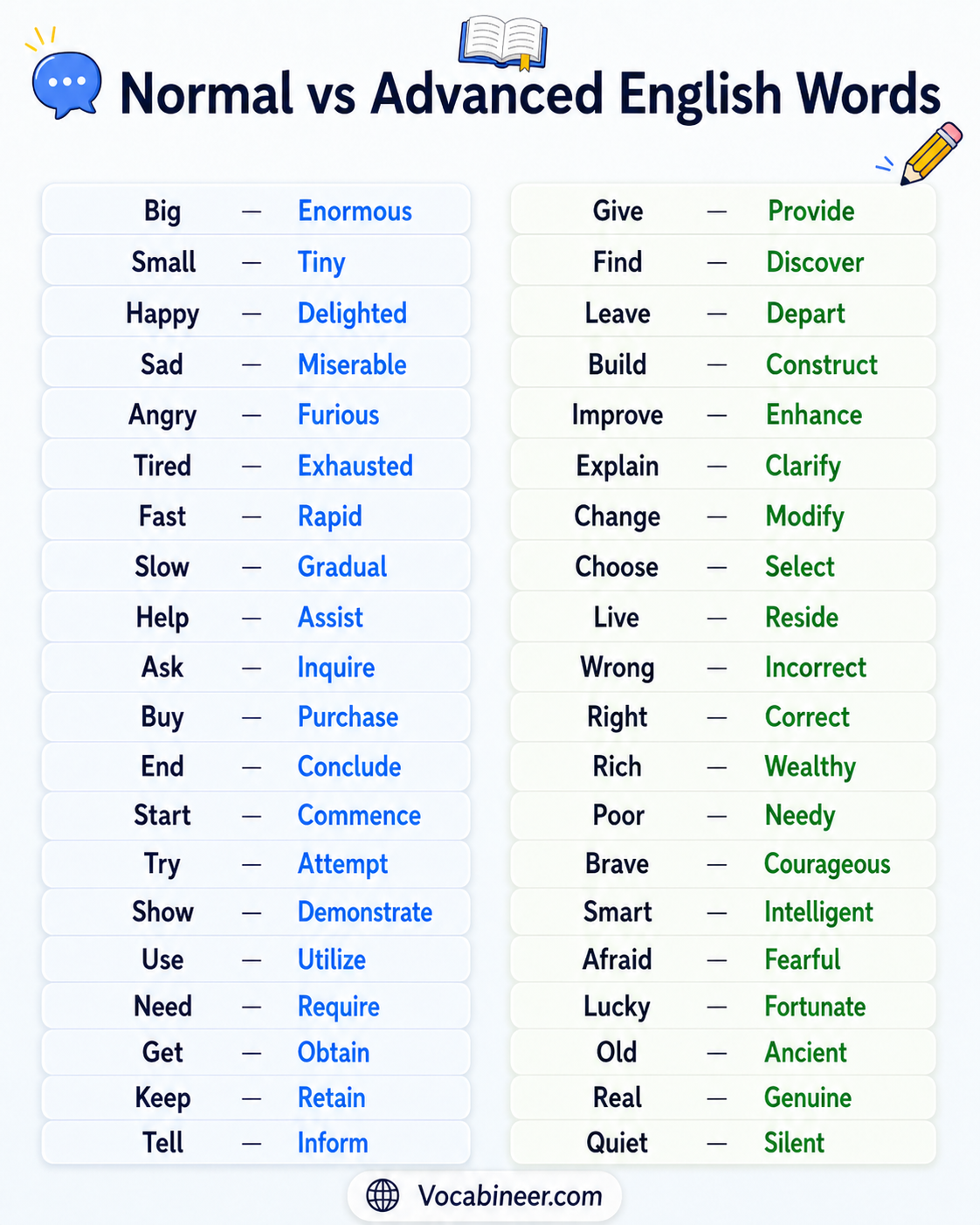
Normal words are commonly used in everyday conversation, while advanced words express similar ideas with greater precision or tone. Both types describe the same actions, emotions, and thoughts, but advanced forms often sound more formal, specific, or expressive. Below is a comparison table showing how basic words change into more developed expressions.
Below is a comparison table of common examples:
| Normal Word | Advanced Word |
|---|---|
| Big | Enormous |
| Small | Tiny |
| Happy | Delighted |
| Sad | Miserable |
| Fast | Rapid |
| Slow | Sluggish |
| Easy | Effortless |
| Hard | Difficult |
| Start | Begin |
| End | Conclude |

Difference Between Normal and Advanced English Words
Normal words are simple and common, while advanced words are more precise and expressive. Understanding this difference helps learners choose better words for speaking and writing.
| Feature | Normal Words | Advanced Words |
|---|---|---|
| Definition | Simple and common words | More precise and stronger words |
| Use | Everyday conversation and easy writing | Formal, academic, or descriptive writing |
| Tone | Casual and natural | Polished and more expressive |
| Meaning | Basic meaning | More detailed or exact meaning |
| Understanding | Easy for all learners | May need stronger vocabulary knowledge |
| Examples | big, happy, sad, fast, help | enormous, delighted, miserable, rapid, assist |
600 Normal vs Advanced English Word Pairs
Everyday Actions and Daily Use Words
These word pairs describe common actions people use in daily life. Their advanced forms help learners express routine activities in a clearer and more polished way.
- help — assist — to give support
- buy — purchase — to get something by paying
- ask — inquire — to ask formally
- show — demonstrate — to show clearly
- use — utilize — to use something effectively
- need — require — to need something
- get — obtain — to receive or get
- keep — retain — to continue to have
- tell — inform — to tell officially
- give — provide — to supply something
- find — discover — to find something new
- leave — depart — to go away
- build — construct — to make by putting parts together
- improve — enhance — to make better
- change — modify — to alter slightly
- choose — select — to pick carefully
- live — reside — to live in a place
- start — commence — to begin formally
- end — conclude — to finish formally
- try — attempt — to make an effort
- bring — deliver — to take something to a place
- send — dispatch — to send off
- open — unseal — to open something closed
- close — shut — to close firmly
- hold — grasp — to hold tightly
- drop — release — to let go
- fix — repair — to make something work again
- break — damage — to harm or destroy
- make — create — to produce something
- clean — sanitize — to clean thoroughly
- wash — rinse — to clean with water
- cut — slice — to cut into thin pieces
- mix — blend — to combine smoothly
- cook — prepare — to make food ready
- bake — roast — to cook with dry heat
- carry — transport — to move from one place to another
- save — preserve — to keep safe
- spend — expend — to use money, time, or effort
- move — relocate — to move to another place
- stay — remain — to continue to be in a place
- travel — journey — to go from one place to another
- visit — tour — to go around and see places
- return — revisit — to go back again
- stop — cease — to come to an end
- add — insert — to put in
- remove — eliminate — to take away
- hide — conceal — to keep out of sight
- look for — search for — to try to find
- pick up — collect — to gather or take
- throw away — discard — to get rid of
Speaking, Communication, and Expression Words
These words are useful in conversation, classroom speaking, and written communication. Learning their advanced forms helps learners speak and write with more clarity and confidence.
- say — state — to express clearly
- talk — discuss — to talk in detail
- speak — address — to speak to someone formally
- answer — respond — to reply
- explain — clarify — to make clear
- warn — alert — to warn about danger
- whisper — murmur — to speak very softly
- shout — yell — to speak loudly
- write — compose — to write carefully
- read — examine — to look at closely
- teach — instruct — to teach formally
- learn — acquire — to gain knowledge
- study — review — to go over for learning
- show — reveal — to make known
- guide — direct — to lead or show the way
- advise — counsel — to give guidance
- think — consider — to think carefully
- know — recognize — to know by identifying
- guess — estimate — to judge roughly
- decide — determine — to make a firm choice
- plan — arrange — to organize ahead
- remember — recall — to bring back to mind
- forget — overlook — to fail to notice or remember
- understand — comprehend — to understand fully
- believe — trust — to accept as true
- doubt — question — to be uncertain about
- check — verify — to confirm truth or accuracy
- record — document — to write down officially
- repeat — restate — to say again in another way
- mention — refer to — to speak about briefly
- announce — declare — to say publicly
- suggest — propose — to put forward an idea
- order — command — to tell firmly
- request — appeal for — to ask politely or formally
- thank — appreciate — to show gratitude
- apologize — regret — to say sorry formally
- forgive — pardon — to excuse a wrong
- share — distribute — to give out among others
- describe — depict — to represent in words
- announce — proclaim — to announce openly
- tell secretly — confide — to tell in trust
- speak clearly — articulate — to express clearly
- speak formally — orate — to speak publicly and formally
- reply quickly — respond promptly — to answer without delay
- explain deeply — elaborate — to explain in more detail
- argue — dispute — to disagree strongly
- talk kindly — reassure — to comfort with words
- speak again — reiterate — to say again for emphasis
- report — notify — to inform officially
- call attention to — highlight — to emphasize
Emotions and Feelings
These word pairs show how simple emotional words can become stronger and more expressive. They help learners describe feelings with better tone and more exact meaning.
- happy — delighted — very pleased
- sad — miserable — very unhappy
- angry — furious — extremely angry
- afraid — terrified — very frightened
- tired — exhausted — extremely tired
- calm — serene — peaceful and calm
- nervous — anxious — worried and uneasy
- glad — pleased — happy and satisfied
- scared — frightened — feeling fear
- lonely — isolated — alone and separated
- excited — thrilled — very excited
- bored — uninterested — not interested
- proud — confident — sure of yourself
- ashamed — embarrassed — feeling awkward or sorry
- worried — concerned — thinking seriously about a problem
- shocked — astonished — very surprised
- relaxed — peaceful — calm and restful
- upset — distressed — emotionally troubled
- content — satisfied — pleased with what you have
- fear — dread — strong fear
- love — adore — love deeply
- hate — detest — dislike intensely
- like — admire — respect or like greatly
- hope — anticipate — look forward to
- jealous — envious — wanting what another has
- kind — compassionate — showing kindness and care
- mean — cruel — deliberately unkind
- brave — courageous — showing bravery
- shy — bashful — quietly shy
- lazy — indolent — avoiding effort
- friendly — amiable — pleasant and friendly
- rude — impolite — not polite
- honest — truthful — telling the truth
- dishonest — deceptive — likely to mislead
- fair — just — morally right and fair
- unfair — biased — showing unfair preference
- gentle — tender — soft and kind
- rough — harsh — severe or rough
- confused — perplexed — very confused
- curious — inquisitive — eager to know
- surprised — amazed — greatly surprised
- hopeful — optimistic — expecting good results
- hopeless — despairing — without hope
- sensitive — delicate — easily affected
- cheerful — joyful — full of happiness
- gloomy — downcast — sad and discouraged
- fearful — apprehensive — uneasy about something
- serious — grave — very serious
- funny — hilarious — extremely funny
- quiet — reserved — not speaking much
Thinking, Learning, and Mental Activity
These words are often used in study, communication, and academic writing. Their advanced forms help learners express ideas, understanding, and thought processes more accurately.
- think — reflect — think deeply
- think carefully — evaluate — judge carefully
- guess — predict — say what may happen
- learn fully — master — learn completely
- know well — grasp fully — understand deeply
- explain clearly — elucidate — explain thoroughly
- discuss deeply — deliberate — discuss carefully before deciding
- ask formally — inquire — ask politely or officially
- answer briefly — reply — answer in words
- teach formally — educate — teach in a developed way
- understand clearly — grasp — understand well
- think again — reconsider — think about again
- plan carefully — strategize — make a careful plan
- choose wisely — discriminate — distinguish and choose carefully
- judge — assess — evaluate
- record — register — record officially
- explain simply — simplify — make easier to understand
- think ahead — anticipate — expect in advance
- believe strongly — be convinced — believe firmly
- tell officially — announce — make known publicly
- ask politely — entreat — ask earnestly
- suggest — recommend — advise as suitable
- warn early — forewarn — warn in advance
- ask again — repeat the question — ask once more
- tell secretly — disclose privately — reveal in confidence
- write carefully — draft — write a first formal version
- read carefully — scrutinize — examine closely
- learn deeply — internalize — absorb fully
- think calmly — contemplate — think quietly and deeply
- share ideas — exchange views — discuss ideas mutually
- answer fully — elaborate — provide more detail
- explain fully — expound — explain in detail
- learn properly — comprehend — understand thoroughly
- think slowly — ponder — think carefully for a long time
- know surely — ascertain — find out for certain
- speak openly — declare — say clearly and publicly
- think carefully — deliberate — think with care
- explain again — rephrase — say in different words
- ask strongly — insist — demand firmly
- write fully — detail — give full written information
- read aloud — recite — say from memory or aloud
- speak strongly — assert — state with confidence
- ask formally — petition — ask officially in writing
- learn quickly — assimilate — absorb information quickly
- think clearly — reason — think logically
- decide firmly — resolve — decide with determination
- teach patiently — mentor — guide and teach
- learn actively — engage — take part actively
- think freely — imagine — form ideas mentally
- understand deeply — internalize — accept and understand fully
Movement, Position, and Physical Action
These word pairs describe movement and physical actions in simple and advanced ways. Learning them helps learners improve both daily vocabulary and descriptive language.
- move — shift — change position
- walk — roam — walk around freely
- run — dash — run very quickly
- jump — vault — jump over something
- sit — settle — sit down and become comfortable
- stand — remain upright — stay standing
- lift — hoist — raise something heavy
- carry — bear — carry a weight
- push — thrust — push forcefully
- pull — drag — pull with effort
- throw — cast — throw something
- catch — seize — take hold suddenly
- drop — let fall — allow to fall
- hold — clutch — hold tightly
- drive — operate — control a vehicle or machine
- ride — mount — get on and ride
- travel — venture — travel, often boldly
- visit — call on — visit someone
- stay — lodge — stay temporarily
- leave — withdraw — move away or leave formally
- enter — proceed into — go inside
- exit — step out — go out
- stop — halt — stop moving
- start — initiate — begin officially
- finish — complete — bring to an end
- wait — linger — stay longer than expected
- hurry — rush — move quickly
- slow down — decelerate — reduce speed
- speed up — accelerate — increase speed
- fall — collapse — fall down suddenly
- rise — ascend — move upward
- rest — pause — stop briefly
- act — perform — do an action formally
- go up — climb — move upward by effort
- go down — descend — move downward
- turn — rotate — move around a center
- bend — stoop — bend the body downward
- look around — survey — examine an area
- follow — pursue — go after
- lead — guide — show the way
- reach — arrive at — get to a place
- cross — traverse — go across
- climb — scale — climb with difficulty
- float — drift — move gently on air or water
- shake — tremble — move with small quick motions
- turn back — retreat — go back from danger or defeat
- go forward — advance — move ahead
- spread out — extend — stretch over an area
- come close — approach — move nearer
- move away — retreat — move back or away
Work, Business, and Professional Use
These words are useful for formal writing, workplace communication, and professional situations. Their advanced forms often sound more suitable in reports, tasks, and official contexts.
- work — labor — do physical or hard work
- manage — administer — control and organize
- control — regulate — manage according to rules
- check — inspect — examine carefully
- test — evaluate — judge quality or performance
- measure — gauge — estimate or measure
- compare — contrast — compare by differences
- join — unite — come together
- separate — divide — split into parts
- send — forward — send onward
- receive — accept — take what is given
- buy — acquire — obtain by effort or purchase
- sell — market — sell or promote for sale
- pay — remit — send payment officially
- save — store — keep for future use
- spend — disburse — pay out money
- earn — generate — produce income
- win — succeed — achieve a favorable result
- lose — suffer loss — fail to keep or win
- improve — upgrade — improve to a higher level
- change — transform — change completely
- grow — expand — become larger
- reduce — cut back — make less
- increase — boost — raise or improve
- fill — occupy — take up space
- empty — vacate — leave empty
- hide — withhold — keep back deliberately
- search — investigate — look into carefully
- keep — maintain — continue in the same state
- remove — withdraw — take away formally
- add — append — add to the end
- build again — reconstruct — build once more
- break down — dismantle — take apart
- set up — establish — create or found
- shut down — terminate — bring to an end
- pack — compress — press together tightly
- unpack — unload — remove contents
- store — preserve — keep in good condition
- move away — relocate — move to another place
- clean up — tidy — make neat
- fix again — restore — return to good condition
- work hard — toil — work with great effort
- relax — unwind — become less tense
- focus — concentrate — direct attention fully
- try again — retry — attempt once more
- carry out — execute — do formally or exactly
- settle — resolve — solve a problem
- handle — manage — deal with successfully
- lead a team — supervise — direct the work of others
- make a plan — formulate — develop systematically
Size, Quality, Condition, and Description
These word pairs help learners describe things more clearly and more precisely. Advanced words in this group are especially useful in descriptive writing and formal expression.
- big — gigantic — extremely large
- small — minute — very tiny
- large — vast — very large in area or size
- little — petite — attractively small
- long — extended — stretched out or lasting longer
- short — compact — small and neatly arranged
- high — towering — very high
- low — subtle — low in amount or level
- wide — expansive — covering a wide area
- narrow — restricted — limited in width or scope
- heavy — burdensome — difficult to carry or bear
- light — slight — small in amount or weight
- thick — substantial — thick or solid
- thin — slender — thin in an attractive way
- deep — intense — very strong or deep
- full — abundant — more than enough
- empty — devoid — completely lacking
- good — superb — excellent in quality
- bad — inferior — lower in quality
- clean — immaculate — perfectly clean
- dirty — contaminated — made dirty or unsafe
- easy — straightforward — simple and direct
- hard — challenging — difficult but manageable
- strong — robust — strong and healthy
- weak — fragile — easily broken or harmed
- safe — protected — kept from harm
- dangerous — hazardous — involving danger
- bright — luminous — giving off much light
- dark — shadowy — dim or full of shadow
- warm — mild — pleasantly warm
- cold — chilly — slightly cold
- fresh — newly made — recently prepared or produced
- old — aged — old with years
- new — modern — recently made or current
- smooth — polished — smooth and refined
- rough — uneven — not smooth
- sharp — precise — exact and clear
- soft — delicate — soft and fine
- fast — swift — moving quickly
- slow — sluggish — moving slowly and heavily
- quick — prompt — done without delay
- hurry — expedite — make faster
- early — timely — happening at the right time
- late — overdue — later than expected
- soon — imminent — about to happen
- now — presently — at the present time
- then — afterward — later
- always — invariably — in every case
- often — regularly — at frequent times
- sometimes — periodically — from time to time
Time, Speed, and Frequency Words
These words describe when, how fast, or how often something happens. Their advanced forms help learners express timing and pace more accurately.
- never — seldom — almost never
- quickly — promptly — without delay
- slowly — steadily — at a regular slow pace
- suddenly — unexpectedly — without warning
- immediately — instantly — at once
- finally — ultimately — in the end
- huge — colossal — extremely large
- tiny — microscopic — extremely small
- tall — lofty — very tall
- short — brief — lasting little time
- clear — transparent — easy to see through or understand
- hidden — obscure — difficult to notice or understand
- calm — tranquil — peacefully calm
- noisy — deafening — extremely loud
- quiet — hushed — very quiet
- busy — hectic — very busy and stressful
- free — vacant — empty or available
- strong — forceful — having strong effect
- weak — faint — lacking strength or intensity
- bright — vivid — bright and intense
- dark — bleak — dark and gloomy
- smooth — refined — smooth and well finished
- rough — rugged — rough and uneven
- clean — pure — not mixed or dirty
- dirty — unclean — not clean
- hot — burning — very hot
- cold — frosty — very cold
- fresh — crisp — pleasantly fresh
- new — recent — not old
- old — ancient — extremely old
- timely — punctual — happening on time
- late — tardy — arriving after the expected time
- quick — speedy — very fast
- slow — leisurely — not hurried
- briefly — momentarily — for a short time
- forever — permanently — for all time
- regularly — consistently — in a steady way
- usually — typically — in most cases
- rarely — infrequently — not often
- instantly — immediately — without any delay
- eventually — ultimately — after some time
- before — previously — earlier
- after — subsequently — later
- again — repeatedly — many times
- forever — endlessly — without end
- shortly — soon afterward — after a short time
- early — prematurely — before the proper time
- late — belatedly — after the proper time
- always — continually — over and over
- sometimes — sporadically — at irregular times
Social Behavior and Personality
These word pairs describe behavior, attitude, and personality. Learning them helps learners speak about people in a clearer, more expressive, and more natural way.
- friend — companion — close associate
- enemy — opponent — person on the other side
- kind — benevolent — showing goodwill
- mean — malicious — wishing to harm
- brave — valiant — bravely bold
- cowardly — timid — lacking courage
- honest — upright — morally honest
- liar — deceitful person — one who misleads
- friendly — cordial — warm and polite
- rude — discourteous — lacking good manners
- polite — respectful — showing respect
- proud — self-assured — confident and proud
- humble — meek — modest and not proud
- calm — collected — self-controlled
- angry — hostile — showing strong dislike
- gentle — mild — soft and not harsh
- harsh — severe — very strict or rough
- lazy — idle — not willing to work
- busy — engaged — occupied with activity
- smart — intellectual — highly intelligent
- silly — absurd — very foolish
- serious — solemn — very serious and formal
- funny — witty — cleverly funny
- quiet — withdrawn — not socially outgoing
- loud — boisterous — noisy and energetic
- careful — prudent — wise and careful
- careless — negligent — failing to take proper care
- fair — impartial — not favoring one side
- unfair — prejudiced — unfairly biased
- helpful — cooperative — willing to help
- talkative — verbose — using too many words
- silent — mute — not speaking
- shy — timorous — lacking confidence
- confident — assured — showing confidence
- nervous — tense — unable to relax
- jealous — resentful — upset about others’ advantage
- loving — devoted — showing deep love
- hateful — spiteful — full of hate
- respect — esteem — hold in high regard
- trust — rely on — depend on confidently
- doubt — suspect — think something may be untrue
- agree — consent — give approval
- disagree — object — express opposition
- accept — embrace — accept willingly
- refuse — reject — say no firmly
- welcome — receive warmly — greet with pleasure
- thank — express gratitude — show thanks
- apologize — seek forgiveness — ask to be excused
- forgive — absolve — free from blame
- invite — extend an invitation — ask someone to attend
Formal Writing and Academic Vocabulary
These words are especially useful in essays, assignments, reports, and formal English. Their advanced forms help writing sound clearer, more professional, and more developed.
- help — facilitate — make easier
- show — indicate — point out clearly
- say — assert — state strongly
- think — presume — suppose to be true
- idea — concept — general thought or notion
- result — outcome — final effect
- reason — justification — valid explanation
- problem — issue — matter needing attention
- answer — solution — way to solve a problem
- part — portion — a section of something
- whole — entirety — complete whole
- about — regarding — concerning
- useful — beneficial — producing a good result
- important — significant — having great importance
- main — primary — first in importance
- enough — sufficient — as much as needed
- almost — nearly — very close to
- maybe — perhaps — possibly
- also — furthermore — in addition
- but — however — yet or nevertheless
- so — therefore — for that reason
- because — since — for the reason that
- still — nevertheless — in spite of that
- if — provided that — only if
- many — numerous — many in number
- few — scant — very few
- good — favorable — positive or helpful
- bad — adverse — harmful or negative
- clear — evident — easy to see or understand
- wrong — inaccurate — not correct
- right — accurate — correct and exact
- change — alteration — the act of changing
- growth — development — progress over time
- helpful — advantageous — beneficial
- careful — meticulous — very careful and exact
- simple — elementary — basic and simple
- complex — intricate — complicated in detail
- use — application — practical use
- study — analysis — detailed examination
- beginning — introduction — opening section
- middle — body — main part of writing
- ending — conclusion — final section
- idea — theory — organized explanation
- example — illustration — clarifying instance
- talk about — address — deal with in speech or writing
- look at — examine — inspect carefully
- show clearly — illustrate — explain by example
- write about — discuss — explain in writing
- point out — emphasize — give special importance
- sum up — summarize — give the main points briefly
Travel, Places, Daily Life, and Situational Words
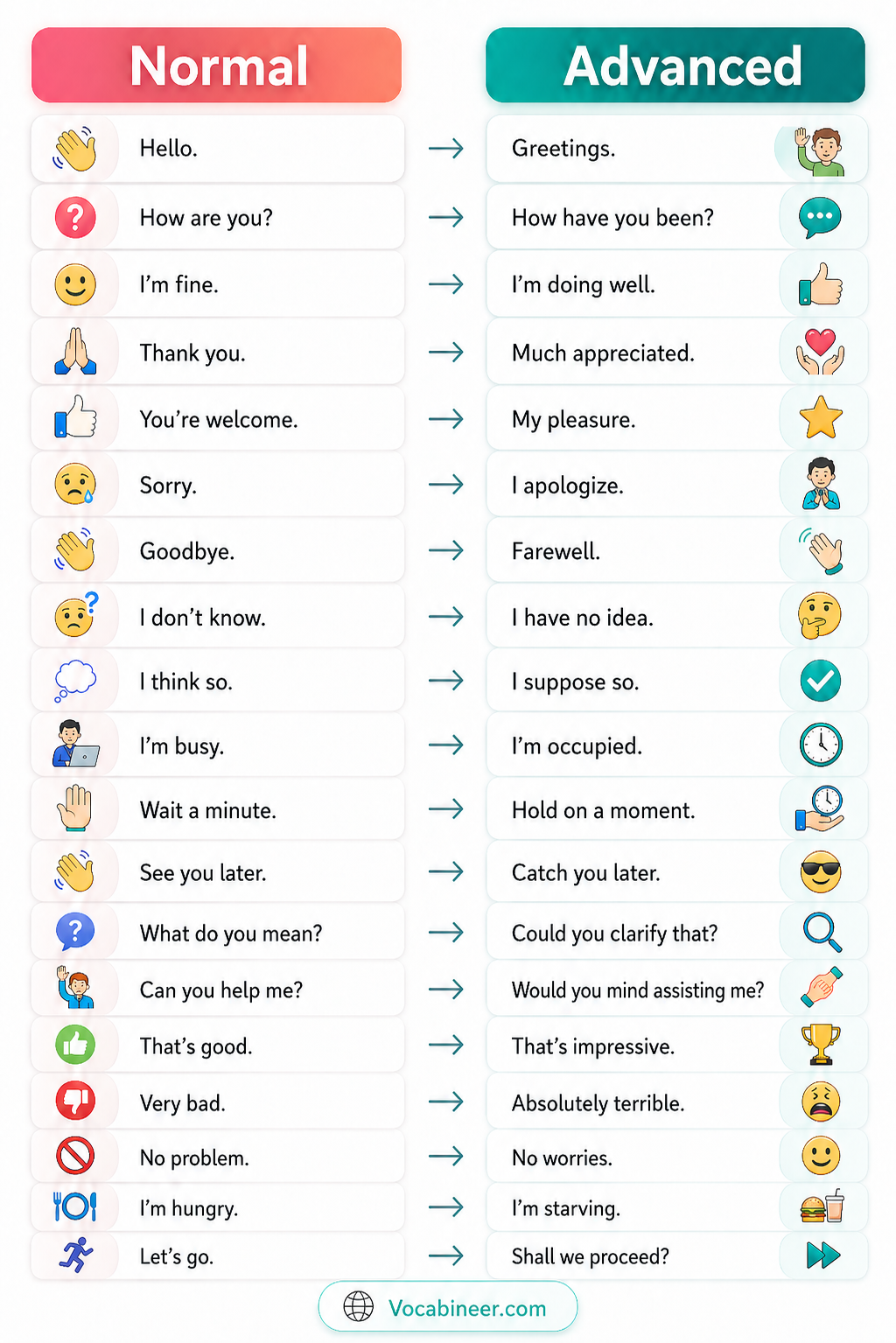
These words are common in daily life, travel, and real-world situations. Their advanced forms help learners understand and use more polished vocabulary in practical contexts.
- trip — excursion — short journey
- travel — expedition — organized journey
- road — route — way from one place to another
- city — metropolis — very large city
- village — settlement — small place where people live
- house — residence — place where someone lives
- shop — store — place where goods are sold
- hotel — accommodation — place to stay
- car — vehicle — means of transport
- bus — coach — long-distance bus
- train — locomotive — railway engine or train
- plane — aircraft — flying vehicle
- ticket — pass — document for entry or travel
- bag — luggage — bags for travel
- food — cuisine — style of cooking or food
- drink — beverage — drink of any kind
- job — occupation — regular work
- boss — supervisor — person in charge
- worker — employee — person who works for pay
- student — pupil — person learning in school
- teacher — educator — person who teaches
- doctor — physician — medical doctor
- lawyer — attorney — legal professional
- police — law enforcement — official system of policing
- money — funds — available money
- price — cost — amount to pay
- bill — invoice — formal statement of payment
- gift — present — something given
- holiday — vacation — time away from work or school
- meeting — conference — formal gathering
- party — celebration — festive event
- story — narrative — account of events
- news — report — account of recent events
- picture — image — visual representation
- sound — noise — sound, often unwanted
- light — illumination — light produced
- air — atmosphere — surrounding air
- water — liquid — fluid substance
- fire — flame — burning gas or fire
- earth — soil — ground or dirt
- rain — downpour — heavy rain
- wind — breeze — gentle moving air
- storm — tempest — violent storm
- snow — snowfall — falling snow
- sunny — bright — full of sunlight
- cloudy — overcast — covered with clouds
- foggy — misty — full of mist
- safe place — secure location — protected area
- dangerous place — hazard zone — risky area
- crowd — gathering — large group of people
Extra High-Value Word Pairs for Vocabulary Building
These extra word pairs are useful for improving general vocabulary and expression. They help learners move beyond basic English and use stronger word choices in speaking and writing.
- big — immense — extremely large
- small — compact — small but efficiently arranged
- good — remarkable — unusually good
- bad — dreadful — very bad
- happy — ecstatic — extremely happy
- sad — heartbroken — deeply sad
- angry — irritated — somewhat angry
- tired — fatigued — physically tired
- fast — speedy — moving quickly
- slow — delayed — happening later or slower
- easy — manageable — not difficult to deal with
- hard — demanding — requiring effort
- strong — resilient — strong and able to recover
- weak — vulnerable — easily harmed
- clear — distinct — easy to notice
- dark — murky — dark and unclear
- bright — glowing — shining softly
- clean — orderly — neat and arranged
- dirty — muddy — covered with dirt or mud
- hot — sizzling — very hot
- cold — icy — extremely cold
- old — elderly — old in age
- new — brand-new — completely new
- rich — prosperous — successful and wealthy
- poor — deprived — lacking necessities
- brave — fearless — without fear
- afraid — startled — suddenly frightened
- quiet — still — without sound or movement
- loud — piercing — very sharp and loud
- beautiful — stunning — extremely attractive
- ugly — unsightly — unpleasant to look at
- smart — bright-minded — mentally quick
- funny — comical — amusing in a funny way
- kind — generous — willing to give and help
- mean — unkind — lacking kindness
- friendly — welcoming — making others feel comfortable
- rude — offensive — causing upset through bad manners
- helpful — resourceful — able to help effectively
- careful — attentive — paying close attention
- careless — thoughtless — not considering the result
- busy — occupied — engaged in activity
- free — unrestricted — free without limits
- important — vital — absolutely necessary
- common — standard — usual or typical
- strange — unusual — different from normal
- real — legitimate — genuine and valid
- wrong — faulty — not working or not correct
- right — appropriate — suitable or correct
- help again — reinforce — strengthen with support
- learn better — advance — move forward in knowledge
Example Sentences Using Normal and Advanced Words
These examples show how normal and advanced words fit naturally into everyday sentences. Compare how advanced words add depth, strength, and clarity to meaning while keeping the sentence structure simple and easy to understand.
- The house is big. The hall is enormous.
- She feels happy. She feels delighted.
- He looks sad. He looks miserable.
- My father is angry. My teacher is furious.
- I am tired. I am exhausted.
- The car is fast. The train is rapid.
- Please help me. Please assist me.
- She wants to buy a bag. She wants to purchase a bag.
- I want to ask something. I want to inquire about it.
- Please show me the answer. Please demonstrate the answer.
- We will start now. We will commence now.
- The class will end soon. The meeting will conclude soon.
- I will try again. I will attempt again.
- You can use this book. You can utilize this book.
- I need more time. I require more time.
- He wants to get a job. He wants to obtain a job.
- Please keep this paper. Please retain this paper.
- He did not tell me. He did not inform me.
- I found my pen. I discovered my pen.
- They will leave now. They will depart now.
FAQs
Normal words are simple and common, while advanced words express the same ideas with more precision, strength, or formality. For example, big → enormous and happy → delighted.
Advanced words improve clarity, sentence quality, and understanding. They help learners read better, write more clearly, and express ideas accurately in school tasks and formal writing.
Normal words fit everyday conversation and casual writing. They sound natural and friendly, while advanced words suit formal situations and stronger expression.
Practice with sentences, reading, writing, and picture-based learning helps build memory and improves correct word usage.
No. Advanced words are also used in speaking when clarity, emotion, or respect is needed. The situation decides which word fits best.
Conclusion
Normal and advanced English words often share similar meanings, but they differ in tone, strength, and precision. Normal words are simple and common, while advanced words are more expressive and refined.
By learning these word pairs, learners can improve vocabulary, write more clearly, and speak with more confidence. Understanding normal vs advanced English words with meaning is a useful step toward stronger and more effective English communication.
Read More
- Basic vs Advanced English Words
- 1000 Daily Use English Words
- Rhyming Words in English
- 100+ Examples of Homophones