

Burned vs Burnt often confuses learners because both words describe the past tense of “burn.” However, the difference depends mainly on regional usage and context rather than meaning.
Understanding Burned vs Burnt helps you write accurately in both American and British English. Therefore, this guide explains their definitions, grammar roles, usage patterns, and regional preferences so you can choose the correct form confidently.
In This Page
Burned vs Burnt: Quick Definition
Burned is the past tense and past participle of burn (American English).
Burnt is also the past tense and past participle of burn (British English).
In simple terms, both words describe something that has been damaged or affected by fire.
Burned vs Burnt Difference in One Sentence
Burned is more common in American English.
Burnt is more common in British English.
Why Burned and Burnt Are Often Confused?
Burned and Burnt are often confused because both forms are correct and both come from the verb “burn.” In addition, they share the same meaning and are used as past tense and past participle forms. As a result, many learners are unsure which one is standard.
However, the difference mainly depends on regional preference. Burned is more common in American English, especially in formal writing. In contrast, Burnt appears more frequently in British English and informal contexts. Therefore, confusion usually arises from exposure to different spelling systems rather than grammar errors.
Word Origin and Etymology
Burn comes from Old English roots related to fire and heat. Over time, English developed two past tense forms: Burned and Burnt. This pattern is common with some verbs, such as learned/learnt and dreamed/dreamt.
American English gradually preferred the “-ed” form, making Burned more common. Meanwhile, British English continued to use both forms, with Burnt remaining popular in everyday speech. Although both forms share the same origin, usage patterns differ by region.
Meaning of Burned
Burned is the past tense and past participle of the verb “burn” in American English. It describes something damaged, injured, or affected by fire, heat, or strong emotion. Therefore, it commonly appears in both literal and figurative contexts.
In addition, Burned functions as a verb and sometimes as an adjective.
Definition of Burned
Burned means damaged or affected by fire or heat.
In simple terms, it describes something that has been harmed by burning.
Burned as Part of Speech
Burned functions mainly as a verb (past tense and past participle).
As a verb:
- He burned the toast.
- The house burned last night.
- She burned her hand.
- They burned old papers.
- The fire burned quickly.
- He burned the letter.
- The campfire burned brightly.
- She burned the cake accidentally.
- The sun burned his skin.
- The building burned for hours.
- He burned his finger.
- The oil burned slowly.
- She burned the food again.
- The candles burned steadily.
- He burned the evidence.
- The trash burned completely.
- She burned calories during exercise.
- The logs burned overnight.
- The bridge burned in the storm.
- He burned the wood for warmth.
As an adjective (less common in American English):
- Burned toast
- Burned skin
Common Uses and Collocations of Burned
Common patterns include:
- Burned toast
- Burned down
- Burned alive
- Burned calories
- Burned out
- Burned by the sun
- Burned paper
- Burned house
These patterns show that Burned is widely used in American English in both formal and everyday writing.
Meaning of Burnt
Burnt is also the past tense and past participle of the verb “burn,” especially in British English. It describes something damaged or affected by fire, heat, or strong emotion. Therefore, it appears frequently in British writing and speech.
In addition, Burnt often functions as both a verb form and an adjective, particularly when describing objects.
Definition of Burnt
Burnt means damaged or affected by fire or heat.
In simple terms, it describes something that has been burned.
Burnt as Part of Speech
Burnt functions as a verb (past tense and past participle) and commonly as an adjective.
As a verb:
- He burnt the toast.
- The house burnt last night.
- She burnt her hand.
- They burnt old letters.
- The fire burnt rapidly.
- He burnt the document.
- The logs burnt overnight.
- She burnt the dinner again.
- The paper burnt quickly.
- The forest burnt for days.
As an adjective (very common in British English):
- Burnt toast
- Burnt sugar
- Burnt wood
- Burnt edges
- Burnt skin
- Burnt fabric
- Burnt paper
- Burnt smell
- Burnt remains
- Burnt offering
Common Uses and Collocations of Burnt
Common patterns include:
- Burnt toast
- Burnt sugar
- Burnt out
- Burnt down
- Burnt offering
- Burnt remains
- Burnt smell
- Burnt edges
These patterns show that Burnt is especially common in British English and is often used as an adjective.
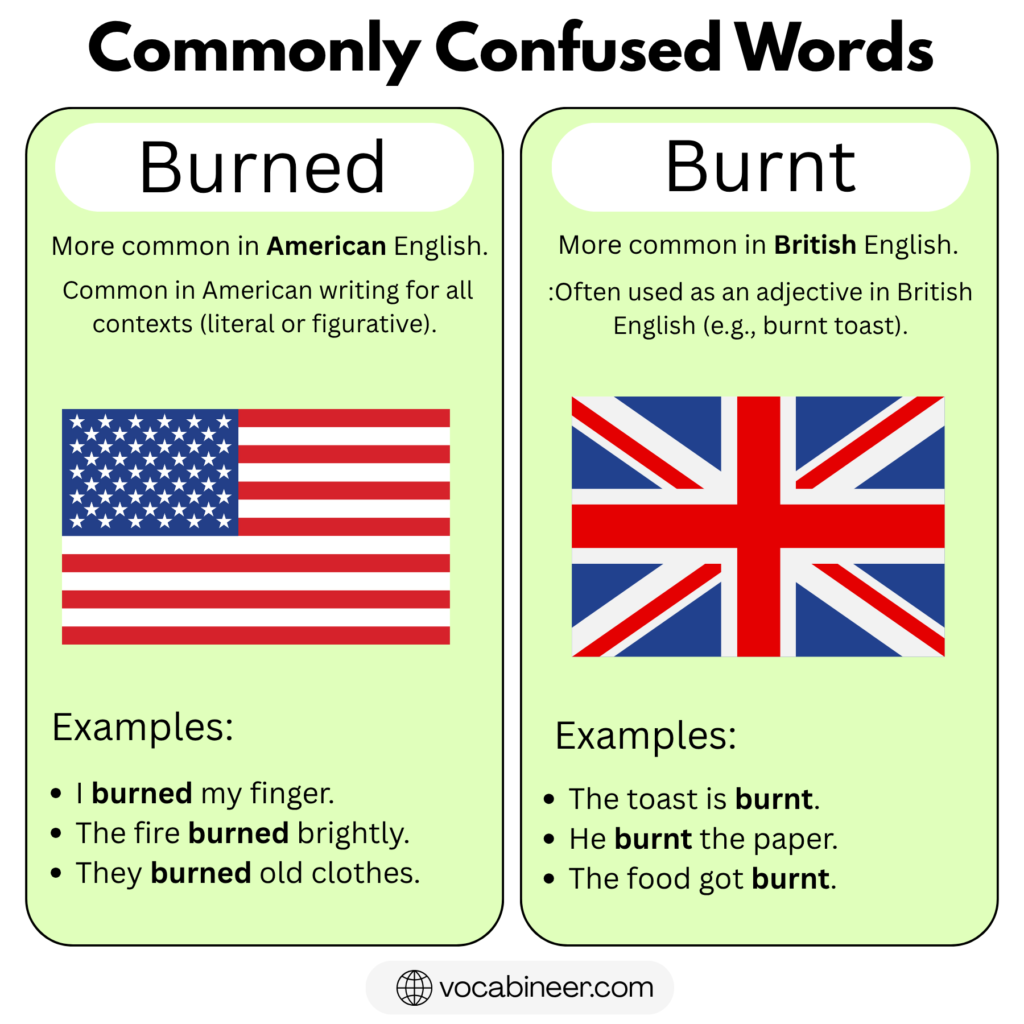
Burned vs Burnt: Key Difference Explained
Although Burned and Burnt share the same meaning, their difference lies mainly in regional preference and usage style. In American English, Burned is the standard past tense and past participle form. By contrast, British English commonly uses Burnt, especially in everyday speech.
Usage patterns also show a slight distinction. In American writing, Burned is preferred in both verb and adjective forms. However, in British English, Burnt is frequently used as an adjective, such as in “burnt toast” or “burnt sugar.” In short, both forms are correct, but the choice depends on region and tone.
Burned vs Burnt: Difference in One Look (Table)
| Feature | Burned | Burnt |
|---|---|---|
| Meaning | Past tense of burn | Past tense of burn |
| Part of Speech | Verb / Adjective | Verb / Adjective |
| Regional Preference | American English | British English |
| Common as Adjective | Less common | Very common |
| Example | Burned the toast | Burnt the toast |
| Interchangeable in Meaning? | Yes | Yes |
This table shows that the difference is stylistic and regional rather than grammatical.
Burned vs Burnt: Side by Side Sentence Contrast
Since both words describe the same action, the difference appears mainly in regional preference. Therefore, comparing similar sentences helps clarify usage.
- He burned the toast.
- He burnt the toast.
- The house burned down.
- The house burnt down.
- She burned her hand on the stove.
- She burnt her hand on the stove.
- The sugar was burned.
- The sugar was burnt.
In each pair, the meaning remains identical. The variation depends on whether the writing follows American or British English.
Burned vs Burnt: Sentence Structure Comparison
Because both forms function as past tense and past participle verbs, their structure is the same.
Common patterns:
- Verb (past tense): He burned/burnt the paper.
- Past participle: The paper has burned/burnt.
- Adjective use: Burned/Burnt toast
- Phrasal verbs: Burned/Burnt down
- Figurative use: Burned/Burnt out
Therefore, both forms appear in the same grammatical positions. The only distinction lies in regional spelling preference and stylistic choice.
When to Use Burned and Burnt
Choosing between Burned and Burnt depends mainly on regional usage. If you are writing in American English, Burned is the standard and more commonly accepted form. Therefore, it appears frequently in American textbooks, news articles, and formal writing.
However, in British English, Burnt is widely used, especially in everyday speech and descriptive writing. Thus, British publications often prefer Burnt in both verb and adjective forms.
In short, use Burned for American English contexts and Burnt for British English contexts. Consistency is more important than the specific form.
Context Based Usage Guide
If your writing follows American English, use Burned:
- He burned the toast.
- The house burned down.
- She burned her hand.
- The building was burned last night.
- The paper has burned completely.
If your writing follows British English, use Burnt:
- He burnt the toast.
- The house burnt down.
- She burnt her hand.
- The building was burnt last night.
- The paper has burnt completely.
Therefore, once you select the form that matches your regional style, use it consistently throughout your document.
Grammar Difference Between Burned and Burnt
Although Burned and Burnt share the same meaning, their grammatical usage varies slightly by region. Both forms can function as the past tense and past participle of “burn.” However, American English strongly prefers Burned, while British English commonly uses Burnt, especially as an adjective.
| Grammar Feature | Burned | Burnt |
|---|---|---|
| Part of Speech | Verb / Adjective | Verb / Adjective |
| Past Tense | He burned the toast | He burnt the toast |
| Past Participle | The house has burned | The house has burnt |
| Adjective Use | Burned toast (less common in UK) | Burnt toast (very common in UK) |
| Regional Preference | American English | British English |
| Formal Writing | Standard in US | Accepted in UK |
| Interchangeable in Meaning? | Yes | Yes |
This table shows that the structure remains the same. The difference depends on regional preference and adjective usage.
Pronunciation Difference Between Burned and Burnt
Burned and Burnt are pronounced slightly differently. Burned ends with a clear “-ed” sound, while Burnt ends with a “-t” sound. However, this difference does not affect meaning.
In speech, both forms are easily understood. The choice depends more on writing style and regional convention than on pronunciation.
Common Mistakes With Burned and Burnt
Burned vs Burnt mistakes usually happen because writers mix regional forms or assume one is incorrect. However, both forms are correct. The key issue is consistency and regional style.
- Incorrect: The house burned down, and the kitchen was burnt (in the same American report).
Better: Use burned consistently in American English. - Incorrect: The toast was burned (in a British recipe using “burnt” elsewhere).
Better: Use burnt consistently in British English. - Incorrect: He has burn the paper.
Correct: He has burned/burnt the paper. - Incorrect: The building was burn last night.
Correct: The building was burned/burnt last night. - Incorrect: Burnt is wrong.
Correct: Burnt is correct in British English.
Therefore, choose the form that matches your regional writing style and use it consistently.
FAQs
Burned vs Burnt often creates confusion because both forms are correct. However, usage depends mainly on region and writing style. Below are the five most common questions.
Both are correct. They are past tense and past participle forms of “burn,” used in different regional varieties of English.
Burned is the standard form in American English and appears in most formal and academic writing.
Burnt is commonly used in British English, especially in everyday speech and descriptive writing.
No, both words share the same meaning and describe something affected by fire or heat.
No. Choose one form based on your regional style guide and use it consistently throughout your writing.
Final Summary
Burned and Burnt are both correct past forms of “burn.” The difference lies mainly in regional preference. Burned is standard in American English, while Burnt is more common in British English. Therefore, select the form that matches your audience and maintain consistency throughout your writing.
Read More
- Confusing Words in English
- American vs British Words
- Ageing vs Aging in English
- Among vs Amongst in English
