

Canceled vs Cancelled often confuses writers because both spellings are correct. However, the difference depends mainly on regional spelling rules rather than meaning.
Understanding Canceled vs Cancelled helps you write accurately in academic, professional, and everyday contexts. Therefore, this guide explains their definitions, grammar roles, usage patterns, and regional preferences so you can choose the correct form confidently.
In This Page
Canceled vs Cancelled: Quick Definition
Canceled is the American English spelling of the past tense of “cancel.”
Cancelled is the British English spelling of the same word.
In simple terms, both words mean that something has been called off or stopped.
Canceled vs Cancelled Difference in One Sentence
Canceled is standard in American English.
Cancelled is standard in British English.
Why Canceled and Cancelled Are Often Confused?
Canceled and Cancelled are often confused because both spellings are correct and both mean the same thing. In addition, they look very similar, which makes the difference easy to overlook. As a result, many writers assume one form must be incorrect.
However, the variation follows regional spelling rules. American English typically uses a single “l” in Canceled, while British English doubles the “l,” forming Cancelled. Therefore, confusion usually arises from differences between American and British spelling systems rather than grammar mistakes.
Word Origin and Etymology
Cancel comes from Latin roots meaning “to cross out” or “to make void.” Over time, English adopted the verb and formed its past tense by adding “-ed.” However, spelling conventions developed differently across regions.
American English simplified many double consonants before adding “-ed,” resulting in Canceled. In contrast, British English often retains the doubled consonant, forming Cancelled. Although both spellings share the same origin and meaning, regional rules created two accepted forms.
Meaning of Canceled
Canceled is the past tense and past participle of “cancel” in American English. It describes something that has been stopped, ended, or called off. Therefore, it commonly appears in formal writing, news reports, and everyday communication in the United States.
In addition, Canceled functions as both a verb form and an adjective.
Definition of Canceled
Canceled means stopped or made invalid.
In simple terms, it describes something that will no longer happen.
Canceled as Part of Speech
Canceled functions mainly as a verb (past tense and past participle).
As a verb:
- The event was canceled due to rain.
- She canceled the meeting.
- They canceled the trip.
- The airline canceled the flight.
- He canceled his appointment.
- The show was canceled last week.
- The company canceled the contract.
- She canceled her subscription.
- The match was canceled unexpectedly.
- He canceled the order.
- The class was canceled today.
- They canceled the reservation.
- The service was canceled immediately.
- She canceled the interview.
- The program was canceled permanently.
- He canceled the agreement.
- The concert was canceled at the last minute.
- They canceled the project.
- The appointment was canceled online.
- She canceled the booking.
As an adjective:
- A canceled flight
- A canceled event
- A canceled order
Common Uses and Collocations of Canceled
Common patterns include:
- Canceled flight
- Canceled meeting
- Canceled order
- Canceled appointment
- Canceled subscription
- Canceled show
- Canceled contract
- Canceled reservation
These patterns show that Canceled is the preferred spelling in American English.
Meaning of Cancelled
Cancelled is the past tense and past participle of “cancel” in British English. It describes something that has been stopped, ended, or called off. Therefore, it appears frequently in British publications, official notices, and everyday communication in the UK and other Commonwealth countries.
In addition, Cancelled functions as both a verb form and an adjective.
Definition of Cancelled
Cancelled means stopped or made invalid.
In simple terms, it describes something that will no longer take place.
Cancelled as Part of Speech
Cancelled functions mainly as a verb (past tense and past participle).
As a verb:
- The match was cancelled due to rain.
- She cancelled the meeting.
- They cancelled the trip.
- The airline cancelled the flight.
- He cancelled his appointment.
- The show was cancelled last week.
- The company cancelled the contract.
- She cancelled her subscription.
- The service was cancelled immediately.
- He cancelled the order.
- The class was cancelled today.
- They cancelled the reservation.
- The concert was cancelled at the last minute.
- She cancelled the interview.
- The program was cancelled permanently.
- He cancelled the agreement.
- The booking was cancelled online.
- They cancelled the project.
- The appointment was cancelled unexpectedly.
- She cancelled the booking.
As an adjective:
- A cancelled flight
- A cancelled event
- A cancelled order
Common Uses and Collocations of Cancelled
Common patterns include:
- Cancelled flight
- Cancelled meeting
- Cancelled order
- Cancelled appointment
- Cancelled subscription
- Cancelled show
- Cancelled contract
- Cancelled reservation
These patterns show that Cancelled is the preferred spelling in British English.
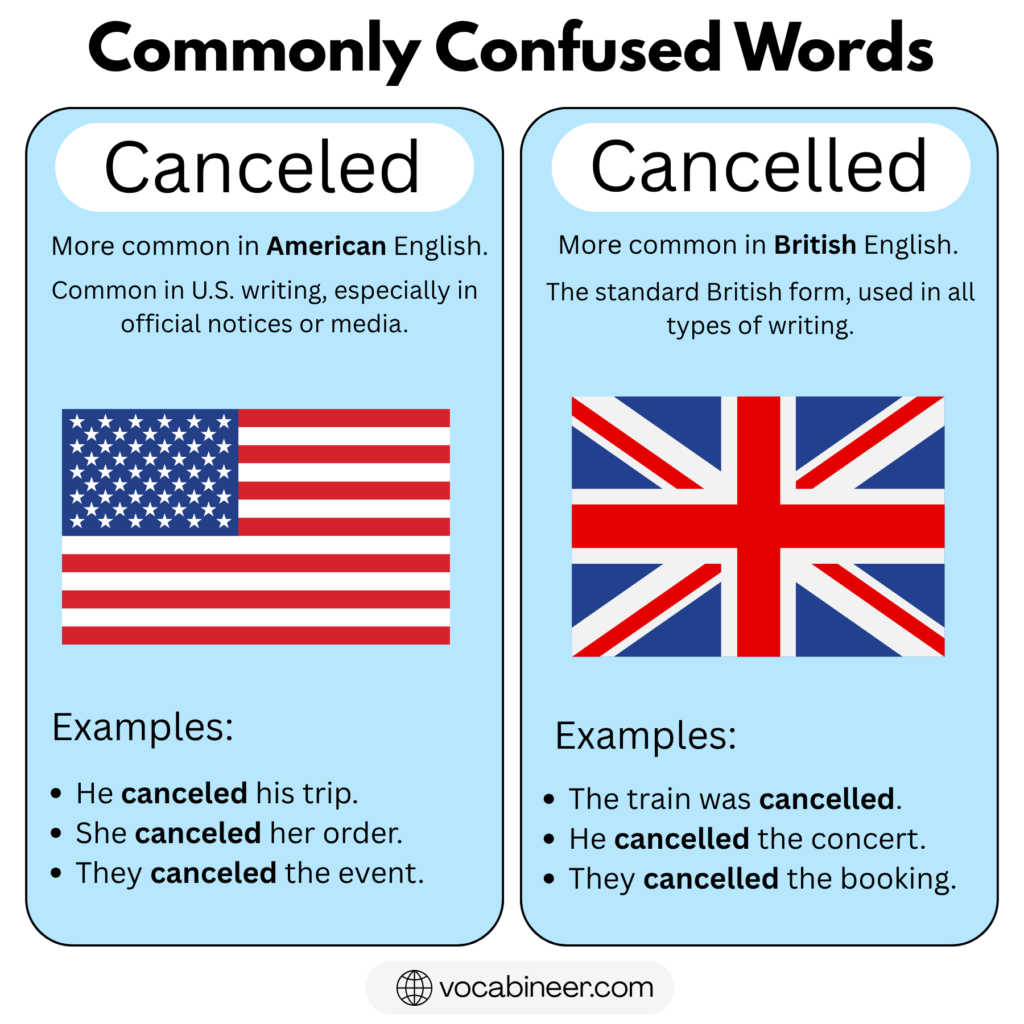
Canceled vs Cancelled: Key Difference Explained
Although Canceled and Cancelled have the same meaning, the difference lies in regional spelling rules. American English prefers Canceled with one “l,” while British English uses Cancelled with two “l’s.”
The distinction follows a broader spelling pattern. In American English, verbs ending in a single vowel plus “l” often keep one “l” before adding “-ed.” However, British English usually doubles the “l” before adding “-ed.” In short, the meaning does not change; only the spelling reflects regional convention.
Canceled vs Cancelled: Difference in One Look
| Feature | Canceled | Cancelled |
|---|---|---|
| Meaning | Stopped / Called off | Stopped / Called off |
| Part of Speech | Verb / Adjective | Verb / Adjective |
| Regional Preference | American English | British English |
| Spelling Rule | Single “l” before -ed | Double “l” before -ed |
| Used In | US publications | UK and Commonwealth publications |
| Interchangeable in Meaning? | Yes | Yes |
This table shows that the difference is regional rather than grammatical.
Canceled vs Cancelled: Side by Side Sentence Contrast
Since both spellings carry the same meaning, the difference appears only in regional usage. Therefore, comparing similar sentences makes the variation clear.
- The flight was canceled due to weather.
- The flight was cancelled due to weather.
- She canceled the meeting yesterday.
- She cancelled the meeting yesterday.
- The show was canceled at the last minute.
- The show was cancelled at the last minute.
- He canceled his appointment online.
- He cancelled his appointment online.
In each pair, the meaning remains identical. Only the spelling changes based on whether the writing follows American or British English.
Canceled vs Cancelled: Sentence Structure Comparison
Because both forms function as past tense and past participle verbs, their grammatical structure is exactly the same.
Common patterns:
- Verb (past tense): They canceled/cancelled the trip.
- Passive voice: The event was canceled/cancelled.
- Present perfect: The order has been canceled/cancelled.
- Adjective use: A canceled/cancelled flight
- Formal notice: Services are canceled/cancelled today.
Therefore, both forms appear in the same grammatical positions. The only distinction lies in spelling convention, not structure.
When to Use Canceled and When to Use Cancelled
Choosing between Canceled and Cancelled depends mainly on regional spelling conventions. If you are writing in American English, Canceled with one “l” is the standard form. Therefore, U.S. newspapers, academic writing, and official documents typically use Canceled.
However, if you are writing in British English, Cancelled with two “l’s” is the preferred spelling. Thus, UK publications, Commonwealth countries, and many international organizations follow this form.
In short, both spellings mean the same thing, but the correct choice depends on your audience and style guide.
Context Based Usage Guide
If your document follows American English, use Canceled:
- The flight was canceled due to weather.
- She canceled her appointment.
- The event was canceled unexpectedly.
- They canceled the meeting.
- The order was canceled online.
If your writing follows British English, use Cancelled:
- The flight was cancelled due to weather.
- She cancelled her appointment.
- The event was cancelled unexpectedly.
- They cancelled the meeting.
- The order was cancelled online.
Therefore, once you choose the form that matches your regional style, maintain consistency throughout your document.
Grammar Difference Between Canceled and Cancelled
Although Canceled and Cancelled have different spellings, their grammatical function is identical. Both words serve as the past tense and past participle of “cancel.” Therefore, the difference is not grammatical but regional.
| Grammar Feature | Canceled | Cancelled |
|---|---|---|
| Part of Speech | Verb / Adjective | Verb / Adjective |
| Past Tense | She canceled the trip | She cancelled the trip |
| Past Participle | The flight has been canceled | The flight has been cancelled |
| Adjective Use | A canceled meeting | A cancelled meeting |
| Regional Preference | American English | British English |
| Spelling Pattern | Single “l” + -ed | Double “l” + -ed |
| Interchangeable in Meaning? | Yes | Yes |
This table shows that both forms appear in the same grammatical positions. The only distinction lies in spelling rules.
Pronunciation Difference Between Canceled and Cancelled
Canceled and Cancelled are pronounced the same in standard English. Therefore, pronunciation does not help distinguish between them. The difference appears only in writing.
As a result, correct usage depends on regional spelling conventions rather than sound.
Common Mistakes With Canceled and Cancelled
Canceled vs Cancelled mistakes usually happen when writers mix spelling styles or misunderstand regional rules. However, both forms are correct. The main issue is consistency and audience awareness.
- Incorrect: The flight was canceled, and the meeting was cancelled (in the same American report).
Better: Use canceled consistently in American English. - Incorrect: The concert was canceled (in a British academic paper using UK spelling elsewhere).
Better: Use cancelled consistently in British English. - Incorrect: She cancel the appointment yesterday.
Correct: She canceled/cancelled the appointment yesterday. - Incorrect: The event has been cancel.
Correct: The event has been canceled/cancelled. - Incorrect: Cancelled is wrong.
Correct: Cancelled is correct in British English.
Therefore, always match the spelling to your regional style guide and maintain consistency throughout your writing.
FAQs
Canceled vs Cancelled often causes confusion because both spellings are correct. The difference depends mainly on regional spelling rules. Below are the five most common questions.
Both are correct. They are regional spelling variations of the same word and have the same meaning.
Canceled with one “l” is the standard spelling in American English writing.
Cancelled with two “l’s” is the standard spelling in British English.
No, both mean stopped, ended, or called off.
No. Choose one spelling based on your regional style guide and use it consistently throughout your writing.
Final Summary
Canceled and Cancelled have the same meaning and grammatical function. The difference lies only in regional spelling rules. Canceled is used in American English, while Cancelled is used in British English. Therefore, select the form that matches your audience and remain consistent throughout your writing.
Read More
- Confusing Words in English
- American vs British Words
- Ageing vs Aging in English
- Blond vs Blonde in English
