

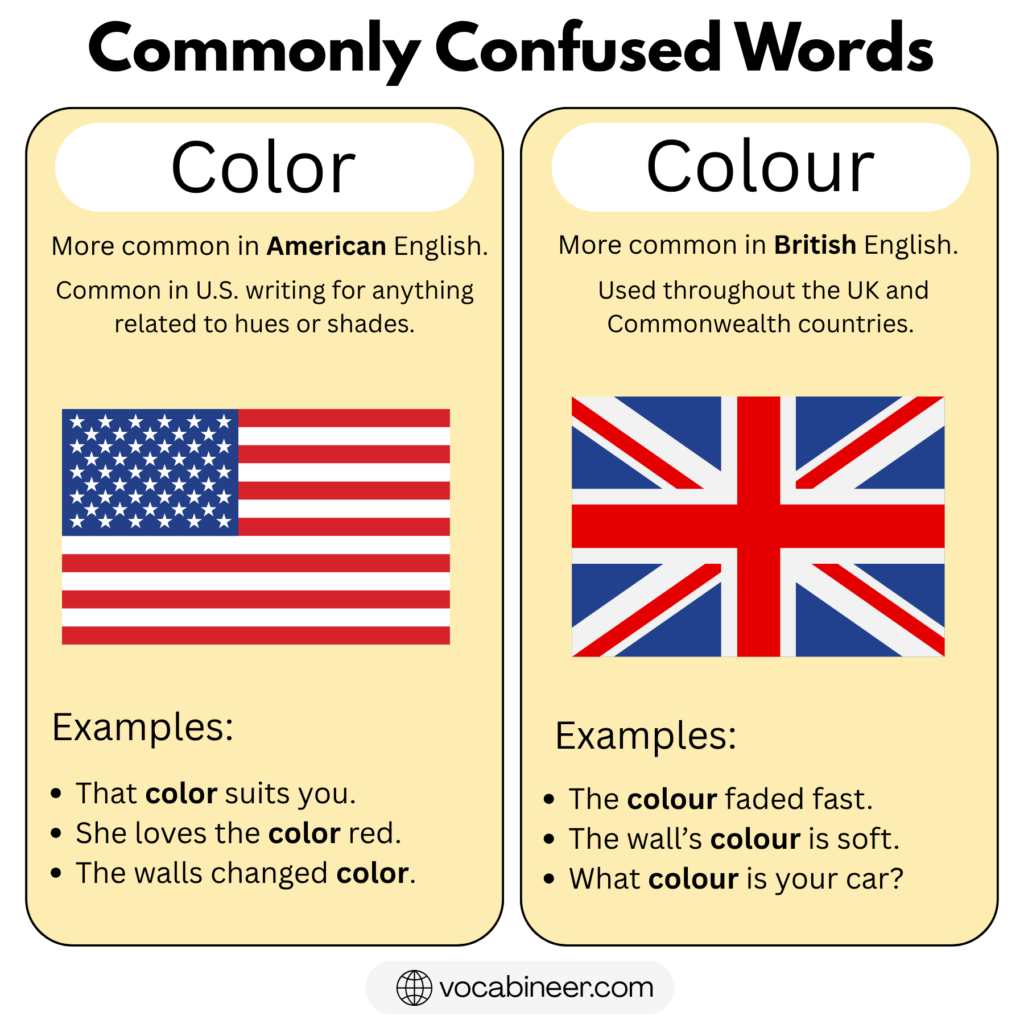
Color vs colour is one of the most common spelling differences between American English and British English. Both words have the same meaning and pronunciation. However, the spelling changes depending on the region.
Many learners feel confused because they see both versions online. Therefore, understanding the regional rule helps you write correctly and confidently. In this guide, you will learn the definitions, differences, grammar rules, usage contexts, pronunciation, and common mistakes related to color and colour.
In This Page
Color vs Colour: Quick Definition
Color is the American English spelling of the word.
Colour is the British English spelling of the same word.
Color vs Colour Difference in One Sentence
Color is used in American English writing.
Colour is used in British English writing.
Why Color and Colour Are Often Confused?
Color and colour are often confused because both spellings are correct. Therefore, learners cannot depend on meaning to choose the right one.
First, both words have the same pronunciation. So, speaking does not show any difference. Second, the internet mixes American English spelling and British English spelling everywhere. As a result, students regularly see both forms in books, blogs, software, and advertisements.
Moreover, spell-check tools sometimes create confusion. If your device is set to American English, it may underline colour. However, if it is set to British English, it may mark color instead.
In addition, many other words follow the same pattern:
- color / colour
- favor / favour
- honor / honour
- labor / labour
Because this double l rule and single l rule appear repeatedly, learners often mix the spellings. So, the confusion is not about meaning. Instead, it is about regional usage.
Word Origin and Etymology
The word “color” has a long history. It comes from the Latin word color. Later, it entered Old French as colour. From there, it became part of Middle English.
Originally, English used the spelling “colour.” However, in the early 1800s, American English began simplifying spellings.
Noah Webster, an American lexicographer, believed spelling should be simpler and more logical. Therefore, he removed the silent “u” from many words. As a result:
- colour became color
- honour became honor
- favour became favor
Meanwhile, British English kept the older French-influenced spelling with “ou.”
So today, both spellings are historically correct. However, the spelling difference depends on whether you follow American English spelling or British English spelling.
Meaning of Color
Color refers to the visual appearance of something based on how it reflects light. For example, red, blue, green, and blue are different types of color. It helps describe how objects look to our eyes.
In American English, color is the standard spelling. However, it has the same meaning as the British English spelling “colour.”
Definition of Color
Color refers to the appearance of something based on how it reflects light. For example, red, blue, green, and yellow are types of color. It describes how objects look to our eyes.
In American English spelling, “color” follows the single l rule. However, the meaning remains the same in all regions.
Color as Part of Speech
Color commonly functions as a noun and a verb.
As a noun, color names a shade or visual quality.
- The color of the sky changed at sunset.
- She loves the bright color of this dress.
- That paint has a soft color.
- The logo uses a bold color.
- His eyes are a rare color.
- The wall needs more color.
- The printer produces clear color.
- The color of the leaves turned red.
- This room lacks warm color.
- The artist studied color theory carefully.
As a verb, color means to add or apply color to something.
- Please color the picture neatly.
- The child likes to color animals.
- She will color her hair brown.
- He decided to color the design digitally.
- They used pencils to color the map.
- I will color the chart for clarity.
- She learned how to color professionally.
- The teacher asked students to color the shapes.
- He plans to color the sketch tomorrow.
- The designer will color the layout later.
Common Uses and Collocations of Color
Color appears in many common word combinations in American English.
- color scheme
- color palette
- color blindness
- color code
- color correction
- color printer
- color contrast
- bright color
- dark color
- primary color
- natural color
- skin color
- hair color
- water color
- food color
These collocations show how widely color is used in everyday writing and conversation.
Meaning of Colour
Colour refers to the visual appearance of something based on the way it reflects light. For example, red, blue, green, and yellow are different types of colour. It helps describe how objects look to our eyes.
In British English, colour is the standard spelling. However, it has the same meaning as the American English spelling “color.”
Definition of Colour
Colour refers to the appearance of something based on the way it reflects light. For example, red, blue, green, and yellow are types of colour. It describes how objects look to our eyes.
In British English spelling, “colour” follows the double l rule. However, the meaning is exactly the same as “color.”
Colour as Part of Speech
Colour also functions as a noun and a verb.
As a noun, colour names a shade or visual quality.
- The colour of the sky changed at sunset.
- She loves the soft colour of this fabric.
- That wall needs a brighter colour.
- The artist mixed the colour carefully.
- His eyes are a unique colour.
- The printer supports full colour printing.
- The colour of the leaves turned orange.
- This room lacks warm colour tones.
- She studied colour theory in art school.
- The flag has three colour stripes.
As a verb, colour means to add or apply colour.
- Please colour the picture neatly.
- The child likes to colour animals.
- She will colour her hair red.
- He decided to colour the design digitally.
- They used crayons to colour the map.
- I will colour the chart for clarity.
- She learned how to colour professionally.
- The teacher asked students to colour the shapes.
- He plans to colour the sketch tomorrow.
- The designer will colour the layout later.
Common Uses and Collocations of Colour
Colour appears in many common word combinations in British English.
- colour scheme
- colour palette
- colour blindness
- colour code
- colour correction
- colour printer
- colour contrast
- bright colour
- dark colour
- primary colour
- natural colour
- skin colour
- hair colour
- water colour
- food colour
These collocations show how widely colour is used in British English writing and communication.
Color vs Colour: Key Difference Explained
Color and colour have the same meaning and pronunciation. However, the spelling difference depends entirely on regional English usage.
In American English spelling, the correct form is color. It follows the single l rule, which removes the silent “u” from many words. Therefore, American writing prefers shorter spellings.
In contrast, British English spelling keeps the traditional “ou” pattern. So, colour follows the double l rule used in British English, Canadian English, and Australian English.
Importantly, neither spelling is wrong. The key difference is consistency. If you are writing for a U.S. audience, use color throughout. However, if you are writing for a UK audience, use colour consistently.
Mixing both spellings in one document can look unprofessional. So, choose one version and stick to it.
Color vs Colour: Difference in One Look
| Feature | Color | Colour |
|---|---|---|
| English Variant | American English | British English |
| Spelling Pattern | Single l rule | Double l rule |
| Contains “u” | No | Yes |
| Meaning | Appearance based on light | Appearance based on light |
| Pronunciation | Same | Same |
| Used In | USA | UK, Canada, Australia |
| Adjective Form | colorful | colourful |
| Noun Form | coloring | colouring |
This table clearly shows that the only real difference is spelling style, not meaning or grammar.
Color vs Colour: Side by Side Sentence Contrast
Both spellings work in the same sentence structure. However, the spelling changes based on region. Below, you can see direct contrasts between American English and British English usage.
American English:
- The walls need more color.
- Please color the chart carefully.
- This printer supports full color.
- She studied color theory in college.
- The leaves changed color in fall.
- He prefers neutral color tones.
- The brand updated its logo color.
- The artist adjusted the color balance.
British English:
- The walls need more colour.
- Please colour the chart carefully.
- This printer supports full colour.
- She studied colour theory in college.
- The leaves changed colour in autumn.
- He prefers neutral colour tones.
- The brand updated its logo colour.
- The artist adjusted the colour balance.
As you can see, the sentence meaning stays exactly the same. Only the spelling changes.
Color vs Colour: Sentence Structure Comparison
Both words follow identical grammar patterns. Therefore, their sentence structure does not change.
Noun structure:
Subject + verb + color/colour
- The color is bright.
- The colour is bright.
Verb structure:
Subject + color/colour + object
- She will color the page.
- She will colour the page.
Adjective forms:
- The design looks colorful.
- The design looks colourful.
Gerund forms:
- She enjoys coloring.
- She enjoys colouring.
So, grammatically, both words behave the same way. The only difference remains the regional spelling preference.
When to Use Color and When to Use Colour
Choosing between color and colour depends on your audience and writing style. Therefore, you should first identify which English variant you are using.
Use color if you are writing in American English. This spelling is standard in the United States. It follows the single l rule and does not include the letter “u.”
Use colour if you are writing in British English. This spelling is standard in the United Kingdom, Canada, Australia, and many other countries. It follows the traditional double l rule and keeps the “ou” pattern.
If you are writing for school, follow your teacher’s required style. However, if you are writing professionally, match your company’s language standard.
Most importantly, stay consistent. Do not mix color and colour in the same article unless you are explaining the difference.
Context Based Usage Guide
Use the following practical guide to decide which spelling fits your context.
or a U.S. website, choose:
- color
- colorful
- coloring
When publishing in the UK or Canada, select:
- colour
- colourful
- colouring
In academic writing, check the required style guide first. Then, remain consistent throughout the document.
If your content targets global readers, pick one spelling version at the beginning. After that, keep it consistent in all headings and examples.
During exams, follow the English variant mentioned in the instructions. Most importantly, do not mix American English spelling and British English spelling in the same answer.
Grammar Difference Between Color and Colour
Color and colour follow the same grammar rules. The only difference is regional spelling. Therefore, their sentence structure, parts of speech, and word forms remain identical.
Both words can act as nouns and verbs. In addition, their adjective and gerund forms follow the same pattern. However, the spelling changes depending on American English spelling or British English spelling.
Below is a clear comparison table to show the grammar difference.
| Grammar Feature | Color (American English) | Colour (British English) |
|---|---|---|
| Noun | The color is bright. | The colour is bright. |
| Verb | Please color the map. | Please colour the map. |
| Adjective Form | colorful | colourful |
| Gerund Form | coloring | colouring |
| Past Tense | colored | coloured |
| Past Participle | colored | coloured |
As shown above, grammar stays the same. Only the spelling changes.
Pronunciation Difference Between Color and Colour
There is no pronunciation difference between color and colour.
Both are pronounced:
/ˈkʌlər/
The stress is on the first syllable. Therefore, the words sound exactly the same in both American English and British English.
So, although the spelling difference is visible in writing, the spoken form remains identical.
Common Mistakes With Color and Colour
Even though the spelling difference is simple, many learners still make small mistakes. Therefore, it is important to understand what to avoid.
One common mistake is mixing both spellings in the same document. For example, writing color in one paragraph and colour in another looks inconsistent.
Another mistake is using the wrong spelling for your audience. If you are writing for an American company, you should use color, not colour. However, if you are writing for a British audience, use colour consistently.
Some learners also forget related word forms. For example:
- colorful vs colourful
- coloring vs colouring
- colored vs coloured
Using American English spelling in British exams, or British English spelling in American exams, can also lead to confusion.
So, the key rule is simple: choose one regional standard and stay consistent throughout your writing.
FAQs
Both are correct. Color is American English spelling, while colour is British English spelling. The meaning and pronunciation are the same.
American English simplified many spellings in the 1800s. Noah Webster preferred shorter forms like color instead of colour.
No, they have exactly the same meaning. The difference is only in spelling style.
Canada mostly follows British English spelling. Therefore, colour is more common in Canadian writing.
Colorful is American English spelling. Colourful is British English spelling. The meaning is identical.
Final Summary
Color vs colour shows a clear spelling difference between American English and British English. Both words have the same meaning and pronunciation. However, the spelling changes based on regional usage.
If you are writing in American English, use color and related forms like colorful and coloring. On the other hand, if you are writing in British English, use colour, colourful, and colouring.
Most importantly, stay consistent throughout your document. Mixing American English spelling and British English spelling can make your writing look careless. So, choose one style and follow it carefully.
Read More
- Confusing Words in English
- American vs British Words
- Ageing vs Aging in English
- Blond vs Blonde in English
