

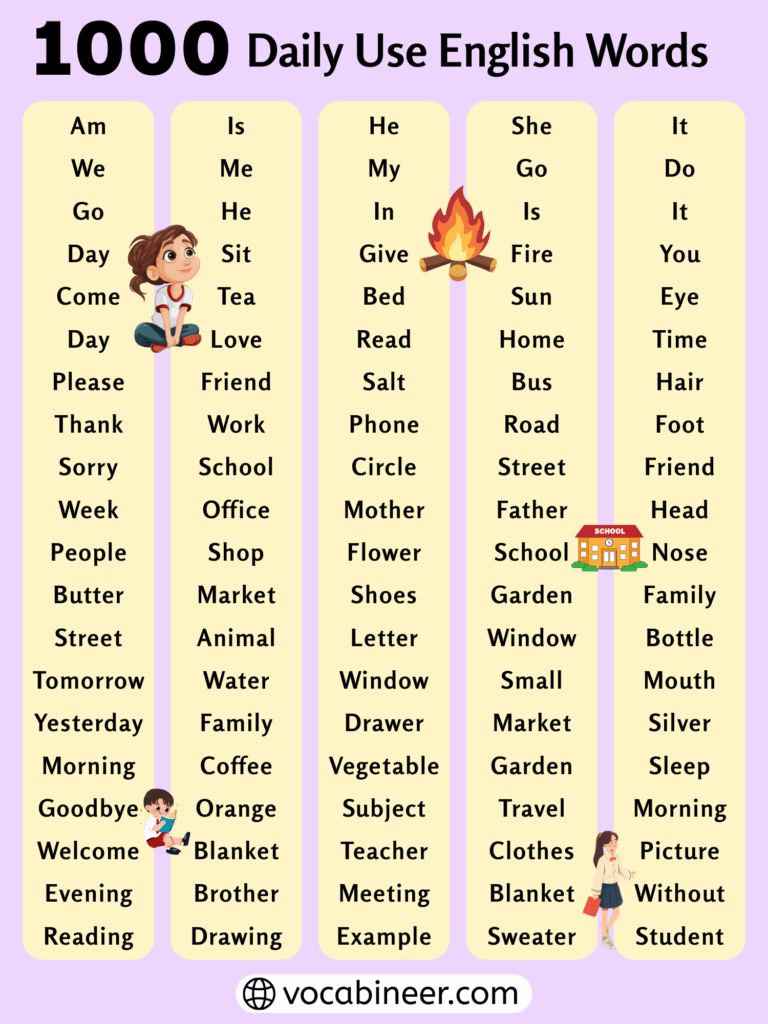
Daily use English words shape how people understand, express, and respond during everyday communication. These words appear naturally in conversations, instructions, questions, emotions, social interaction, learning environments, and workplace discussions, helping speakers share ideas clearly and confidently. Knowing common daily use English words with meaning improves understanding of spoken messages, strengthens sentence clarity, and supports smoother communication across different situations and social settings.
This post helps readers learn 1000 daily use English words with meaning through pictures, simple explanations, and clear usage context, making it easier to recognize, remember, and apply these words naturally in everyday communication, classroom learning, social conversations, and professional interaction.
In This Page
Common Nouns Used in Daily English
These are common English nouns you’ll hear in conversations, classrooms, and daily communication. Each word names a person, place, or thing — helping you speak clearly and naturally in everyday life.
- Ambition – a strong desire to achieve something
- Decision – a choice made after thinking carefully
- Effort – the energy used to do something
- Journey – travel from one place to another
- Knowledge – information and understanding gained through learning
- Opinion – a personal view or belief about something
- Advice – guidance given to help someone decide
- Benefit – something that improves your situation
- Challenge – something difficult that needs effort to do
- Choice – the act of selecting between options
- Communication – sharing information or ideas
- Community – a group of people living in the same place
- Competition – a contest between people or groups
- Confidence – belief in one’s abilities
- Courage – the ability to face fear or difficulty
- Culture – customs, art, and traditions of a group
- Customer – a person who buys goods or services
- Damage – harm or injury caused to something
- Education – learning and gaining knowledge
- Emotion – a strong feeling such as joy or anger
- Energy – power used to do work or move
- Environment – the natural world around us
- Event – something that happens, especially important
- Experience – knowledge gained from doing something
- Freedom – the right to act or speak as you wish
- Friendship – a relationship between friends
- Goal – something you want to achieve
- Growth – the process of becoming larger or stronger
- Health – the condition of your body and mind
- History – study or record of past events
- Idea – a thought or plan about something
- Importance – the state of being valuable or necessary
- Improvement – the act of making something better
- Information – facts or details about something
- Invention – a new tool or method created by someone
- Language – a system of words used to communicate
- Leader – a person who guides or directs others
- Lesson – something taught or learned
- Moment – a very short period of time
- Nature – everything in the physical world not made by people
- Opinion – a thought or belief about something
- Opportunity – a chance to do something
- Organization – a group formed for a purpose
- Partnership – working relationship between people or groups
- Performance – how well someone does a task
- Planet – a large body like Earth moving around the sun
- Pleasure – a feeling of happiness or enjoyment
- Population – number of people in a place
- Position – a place or role in something
- Possibility – something that might happen
- Practice – the act of doing something to improve
- Problem – something that needs to be solved
- Process – a series of steps to reach a goal
- Product – something made or sold
- Progress – movement toward a better state
- Project – planned work to achieve a goal
- Purpose – the reason for doing something
- Quality – how good or bad something is
- Question – something asked to get information
- Reason – explanation for an action or idea
- Relationship – connection between people or things
- Religion – belief system about life and God
- Result – outcome of an action or event
- Safety – condition of being protected from harm
- Schedule – a plan of activities or times
- Service – work done to help others
- Situation – set of conditions or events at a time
- Society – people living together with laws and culture
- Solution – a way to fix a problem
- Speech – spoken expression of ideas
- Strength – physical or mental power
- Success – reaching a desired goal
- System – organized group of parts working together
- Talent – natural ability or skill
- Technology – machines and tools that help people
- Thought – an idea formed in the mind
- Tradition – custom passed through generations
- Trust – belief that someone is honest or reliable
- Value – importance or worth of something
- Vision – idea of what the future could be
- Wealth – large amount of money or possessions
- Wisdom – good judgment based on experience
- Worker – person who does a job
- Writer – person who creates books or articles
- Audience – people who watch or listen to something
- Author – person who writes books or stories
- Balance – state of stability or equality
- Behavior – the way someone acts
- Budget – a plan for spending money
- Career – long-term job or profession
- Choice – option or selection between things
- Climate – usual weather of a place
- Company – business that sells goods or services
- Conflict – disagreement or fight between people
- Connection – link between people or things
- Conversation – talk between two or more people
- Decision – conclusion after thinking
- Development – process of growth or progress
- Direction – course along which something moves
- Discipline – control or training that improves behavior
Useful Action Verbs for Daily English Conversations
These verbs are often used in daily English to describe actions, plans, and emotions. Learning them helps you speak more clearly and naturally in any situation.
- Accept – to agree to take or receive something
- Achieve – to successfully reach a goal
- Admire – to respect or look up to someone
- Advise – to suggest what someone should do
- Agree – to have the same opinion
- Announce – to share news publicly
- Apologize – to say sorry for a mistake
- Apply – to make a formal request for something
- Appreciate – to value or be thankful for something
- Argue – to express disagreement with someone
- Arrange – to organize or plan something
- Arrive – to reach a place
- Assume – to think something is true without proof
- Avoid – to stay away from something
- Behave – to act in a certain way
- Believe – to think something is true
- Borrow – to take something for a short time and return it
- Break – to damage or destroy something
- Build – to make or construct something
- Buy – to get something by paying money
- Call – to phone or shout to someone
- Care – to feel concern or interest
- Carry – to hold and move something
- Change – to make something different
- Choose – to pick one option from many
- Clean – to remove dirt from something
- Climb – to go up something like a hill or ladder
- Collect – to gather things together
- Complain – to express unhappiness about something
- Complete – to finish doing something
- Confirm – to make sure something is true
- Connect – to join or link things
- Consider – to think carefully about something
- Continue – to keep doing something
- Contribute – to give help, money, or ideas
- Control – to have power over something
- Cook – to prepare food for eating
- Correct – to make something right
- Count – to find the total number
- Create – to make something new
- Cut – to divide with a sharp tool
- Decide – to choose what to do
- Deliver – to bring something to someone
- Depend – to rely on someone or something
- Describe – to explain what something looks or feels like
- Develop – to grow or make better
- Discuss – to talk about something
- Discover – to find something new
- Display – to show something to others
- Drive – to operate a car or vehicle
- Earn – to receive money for work
- Encourage – to give someone support or hope
- Enjoy – to take pleasure in something
- Enter – to go into a place
- Escape – to get away from danger
- Explain – to make something clear
- Express – to show thoughts or feelings
- Fail – to not succeed
- Fall – to move downward by gravity
- Feed – to give food to someone or an animal
- Feel – to experience an emotion or physical touch
- Fight – to use force or argue strongly
- Find – to discover something
- Fix – to repair something broken
- Follow – to go behind or obey rules
- Forget – to not remember something
- Forgive – to stop feeling angry about something
- Get – to receive or obtain something
- Give – to hand something to someone
- Go – to move or travel somewhere
- Grow – to become larger or older
- Guess – to form an opinion without knowing everything
- Happen – to take place or occur
- Hear – to notice sound with your ears
- Help – to make it easier for someone
- Hold – to carry or keep something in your hand
- Hope – to want something good to happen
- Improve – to make something better
- Include – to have something as part of a group
- Invite – to ask someone to join or come
- Join – to become part of a group or activity
- Keep – to continue having something
- Know – to have information or understanding
- Laugh – to show happiness with sound
- Learn – to get knowledge or skill
- Leave – to go away from a place
- Lend – to give something for a short time
- Lie – to not tell the truth
- Listen – to pay attention to sound
- Live – to have life or stay somewhere
- Look – to direct your eyes at something
- Lose – to fail to keep or win something
- Love – to feel deep affection for someone
- Make – to create or produce something
- Manage – to control or organize work
- Move – to change place or position
- Need – to require something
- Offer – to give or suggest something
- Open – to move something to let in or out
- Organize – to arrange things neatly or plan them
Descriptive Adjectives to Improve Your English Vocabulary
Adjectives make your English more colorful and expressive. These words describe how people, places, and things look, feel, or behave — helping you communicate with more detail and emotion.
- Accurate – free from mistakes or errors
- Active – always moving or busy doing something
- Adventurous – willing to take risks or try new things
- Ambitious – having a strong desire to achieve success
- Ancient – very old or from a long time ago
- Angry – feeling strong dislike or irritation
- Anxious – worried or nervous about something
- Attractive – pleasing to look at
- Available – ready to be used or obtained
- Aware – knowing or realizing something
- Beautiful – very pleasing to the eye or senses
- Bitter – having a sharp, unpleasant taste or feeling
- Brave – not afraid to face danger
- Bright – full of light or intelligent
- Broad – wide or large in size
- Calm – relaxed and not upset
- Careful – taking caution to avoid mistakes
- Certain – sure or confident about something
- Charming – pleasant and attractive
- Cheerful – happy and positive in mood
- Clean – free from dirt or mess
- Clear – easy to understand or see through
- Clever – quick to understand or learn things
- Cold – having a low temperature
- Comfortable – giving a sense of ease or relaxation
- Common – usual or seen often
- Complex – made up of many connected parts
- Confident – feeling sure of oneself
- Confusing – not easy to understand
- Cool – slightly cold or stylish
- Correct – true or right
- Creative – able to think of new ideas
- Cruel – causing pain or suffering intentionally
- Curious – wanting to know more about something
- Dangerous – likely to cause harm
- Delicious – very tasty or pleasant to eat
- Dependent – needing help from someone else
- Difficult – hard to do or understand
- Dirty – not clean or messy
- Distant – far away in space or time
- Diverse – showing variety or differences
- Double – twice as much or many
- Dramatic – very emotional or exciting
- Eager – very interested or excited about something
- Easy – not hard to do
- Educated – having a good level of knowledge
- Effective – producing the desired result
- Efficient – working well without wasting time or energy
- Emotional – full of strong feelings
- Empty – having nothing inside
- Equal – being the same in amount or value
- Essential – very important or necessary
- Excellent – extremely good
- Expensive – costing a lot of money
- Famous – known by many people
- Fantastic – very good or amazing
- Fast – moving quickly
- Fearless – without fear or brave
- Fine – of high quality or acceptable
- Flat – having a smooth, even surface
- Flexible – able to bend easily or change ideas
- Friendly – kind and pleasant toward others
- Funny – causing laughter or amusement
- Generous – willing to give or share
- Gentle – kind and careful in action
- Glad – happy or pleased about something
- Global – relating to the whole world
- Great – very good or large in size
- Happy – feeling or showing joy
- Healthy – in good physical condition
- Helpful – ready to give help
- Honest – telling the truth
- Hopeful – feeling positive about the future
- Hot – having a high temperature
- Huge – very large in size
- Hungry – wanting food
- Important – having great value or meaning
- Independent – not depending on others
- Interesting – catching attention or curiosity
- Kind – caring and considerate
- Lazy – not willing to work or act
- Light – not heavy or bright
- Lonely – feeling alone and sad
- Lucky – having good fortune
- Modern – relating to the present or recent times
- Narrow – not wide
- Natural – existing in nature, not made by humans
- Neat – tidy and well-organized
- Nervous – worried or uneasy
- Noisy – full of loud sounds
- Normal – typical or expected
- Open – not closed or locked
- Patient – able to wait calmly
- Peaceful – calm and quiet
- Polite – showing good manners
- Poor – having little money or resources
- Powerful – having great strength or influence
- Proud – feeling pleased about achievement
- Quick – moving fast
- Quiet – making little or no noise
Adverbs and Prepositions for Everyday English Use
Adverbs and prepositions help you describe how, where, and when something happens. They make your sentences smoother and more specific in daily English communication.
- Above – higher than something else
- Across – from one side to the other
- After – later in time
- Again – once more or another time
- Almost – nearly or not quite
- Along – moving in a line beside something
- Already – before now or earlier than expected
- Although – despite the fact that
- Among – surrounded by or within a group
- Around – in a circular direction or nearby
- Aside – to one side
- At – showing position or time
- Away – to or at a distance from a place
- Back – toward the rear or return
- Before – earlier than a time or event
- Behind – at the back of something
- Below – lower than something else
- Besides – in addition to
- Between – in the space separating two things
- Beyond – farther than or outside of something
- Carefully – with attention and caution
- Clearly – in an easy-to-understand way
- Completely – totally or fully
- Constantly – happening all the time
- Correctly – in the right or proper way
- Currently – happening at the present time
- Deeply – to a great depth or degree
- Down – toward a lower position
- During – through the whole period of time
- Easily – without difficulty
- Elsewhere – in another place
- Especially – more than others or particularly
- Even – used to emphasize something surprising
- Ever – at any time
- Everywhere – in all places
- Exactly – just as described or precisely
- Far – at a great distance
- Fast – quickly or at high speed
- Finally – after a long time or at the end
- Forward – toward the front or future
- Frequently – happening often
- Fully – completely or entirely
- Generally – usually or in most cases
- Gently – softly or carefully
- Hardly – almost not
- Here – in this place
- However – used to introduce contrast
- Immediately – without delay
- Inside – within something
- Instead – in place of something
- Just – exactly or recently
- Late – after the expected time
- Lately – in recent times
- Likely – probably going to happen
- Near – close to something
- Nearly – almost but not completely
- Never – not at any time
- Next – coming after the present one
- Now – at the present time
- Often – many times or frequently
- Once – one single time
- Only – no more than or just one
- Outside – on or to the outer side
- Over – above or across something
- Perhaps – possibly but not certain
- Quickly – at a fast speed
- Quite – to a certain or complete degree
- Rarely – not happening often
- Recently – a short time ago
- Really – truly or actually
- Right – correctly or on the right side
- Since – from a time in the past until now
- Slowly – not fast
- Sometimes – at certain times but not always
- Soon – in a short time
- Still – continuing without change
- Suddenly – happening quickly and unexpectedly
- Then – at that time or next
- There – in that place
- Though – despite that or even if
- Through – from one side to the other
- Throughout – in every part or during the whole time
- Today – the present day
- Together – with each other
- Tomorrow – the day after today
- Too – also or more than enough
- Toward – in the direction of
- Under – below or beneath something
- Until – up to a certain time
- Up – toward a higher position
- Usually – most of the time
- Very – to a high degree
- Well – in a good or proper way
- When – at what time
- Where – in what place
- While – during the time that
- Within – inside or not beyond
- Without – not having something
- Yet – up to now or still not happened
- Above – used again for emphasis on position or level
Daily Life English Words for Common Situations
These words help you describe everyday activities, places, and experiences. They’re used in real-life situations like working, studying, or spending time with friends and family.
- Alarm – a sound that wakes you up or warns you
- Apartment – a set of rooms to live in, part of a building
- Appointment – a planned meeting at a specific time
- Bakery – a shop that sells bread and cakes
- Bank – a place where money is kept and managed
- Bathroom – a room with a toilet and a shower or bath
- Bed – furniture used for sleeping
- Bill – a statement of money owed for goods or services
- Breakfast – the first meal of the day
- Bus – a large vehicle for carrying many passengers
- Calendar – chart showing days, weeks, and months
- Camera – device used to take photos or videos
- Chair – furniture used for sitting
- Classroom – a room where students learn
- Clock – instrument for measuring and showing time
- Clothes – garments people wear on their bodies
- Coffee – a hot drink made from roasted beans
- Computer – electronic device for work or study
- Conversation – talk between two or more people
- Cooking – preparing food to eat
- Customer – someone who buys goods or services
- Desk – table used for writing or working
- Dinner – the main meal of the day
- Door – movable barrier that opens and closes an entrance
- Electricity – energy used to power machines and lights
- Elevator – machine that moves people between floors
- Email – digital message sent electronically
- Exercise – physical activity to stay fit
- Factory – building where products are made
- Family – group of people related by blood or marriage
- Food – something people and animals eat for energy
- Friend – a person you know well and trust
- Gas – fuel used for cars or heating
- Grocery – food or goods bought from a store
- Gym – place for physical training or exercise
- Hospital – place where sick or injured people are treated
- Hotel – building providing rooms for travelers
- Internet – global network for communication and information
- Journey – trip from one place to another
- Kitchen – room for cooking and preparing food
- Laptop – portable personal computer
- Library – place where books are kept for reading or borrowing
- Lunch – meal eaten in the middle of the day
- Market – place where goods are bought and sold
- Meeting – gathering for discussion or decision-making
- Mobile – portable phone for calling and messaging
- Money – medium used for buying and selling
- Movie – story shown on screen for entertainment
- Museum – building for displaying art or history items
- Office – place where people work at desks
- Park – public area with trees, grass, and benches
- Passport – document for international travel
- Payment – act of giving money for something
- Phone – device for voice communication
- Photograph – image taken with a camera
- Plan – detailed arrangement for future actions
- Restaurant – place where meals are served to customers
- Room – part of a building separated by walls
- School – place for learning and education
- Shopping – activity of buying things
- Station – place where trains or buses stop
- Street – public road in a city or town
- Store – place where goods are sold
- Student – person who studies at a school or university
- Study – act of learning about a subject
- Teacher – person who helps others learn
- Ticket – paper or card for travel or events
- Toothbrush – tool used to clean teeth
- Traffic – movement of vehicles on roads
- Train – transport vehicle running on rails
- Trip – short journey for pleasure or business
- Vacation – time spent away from work or study for rest
- Visitor – person who comes to see someone or something
- Wallet – small case for holding money and cards
- Water – clear liquid needed for life
- Weekend – days of rest, usually Saturday and Sunday
- Window – opening in a wall for light and air
- Workplace – location where a person does their job
- Airport – place where airplanes take off and land
- Appointment – planned meeting or event
- ATM – machine used to withdraw or deposit cash
- Barber – person who cuts hair
- Boss – person who manages workers
- Cleaner – person who removes dirt or dust
- Delivery – bringing goods to someone’s place
- Doctor – person trained to treat illness
- Driver – person who operates a vehicle
- Engineer – person who designs or builds machines
- Flight – act of flying in an aircraft
- Job – regular work done for payment
- Laundry – clothes that need washing
- Mechanic – person who repairs machines
- Meeting – formal gathering for discussion
- Neighbor – person living nearby
- Nurse – person trained to care for patients
- Plumber – person who fixes water pipes
- Police – people who enforce laws and maintain order
- Postman – person who delivers letters and parcels
- Receptionist – person who greets visitors in an office
- Waiter – person who serves food in a restaurant
Common Pronouns and Conjunctions in Daily English
Pronouns replace nouns to make speech smoother, and conjunctions join ideas to form complete thoughts. These are the most common connecting words in daily English.
- I – refers to oneself
- You – the person being spoken to
- He – used for a male person
- She – used for a female person
- It – used for an object or animal
- We – refers to the speaker and others
- They – refers to more than one person or thing
- Me – object form of “I”
- Him – object form of “he”
- Her – object form of “she”
- Us – object form of “we”
- Them – object form of “they”
- My – belonging to me
- Your – belonging to you
- His – belonging to him
- Her – belonging to her
- Our – belonging to us
- Their – belonging to them
- Mine – something that belongs to me
- Yours – something that belongs to you
- Hers – something that belongs to her
- Ours – something that belongs to us
- Theirs – something that belongs to them
- This – refers to something nearby
- That – refers to something farther away
- These – plural of “this”
- Those – plural of “that”
- Who – used to ask about people
- Whom – object form of “who”
- Whose – asking about possession
- Which – asking about choices
- What – asking about things or ideas
- Where – asking about place
- When – asking about time
- Why – asking for a reason
- Because – shows reason or cause
- Although – shows contrast
- And – joins similar ideas
- But – shows contrast between ideas
- Or – gives an option or choice
- So – shows result or consequence
- Yet – shows contrast with expectation
- While – shows time or contrast
- Unless – means “if not”
- Until – shows time up to a point
- Since – shows time or reason
- If – shows a condition
- Because – gives a reason for something
- Though – expresses contrast softly
- Therefore – shows logical result or conclusion
Time and Number Words Used in Daily English
Time and number words help you talk about schedules, dates, and quantities in everyday English. These are important for daily life, business, and study situations.
- Annual – happening once every year
- Century – a period of one hundred years
- Decade – a period of ten years
- Moment – a very short period of time
- Instant – a very quick moment
- Minute – sixty seconds in time
- Hour – sixty minutes in time
- Day – a period of twenty-four hours
- Week – a period of seven days
- Month – around four weeks in time
- Year – twelve months together
- Quarter – one-fourth part of something
- Half – one of two equal parts
- Twice – two times
- Once – one time
- Daily – happening every day
- Weekly – happening every week
- Monthly – happening every month
- Yearly – happening every year
- Before – earlier than a time or event
- After – later than a time or event
- Now – at the present moment
- Soon – in a short time
- Later – after a short time
- Early – before the expected time
- Late – after the expected time
- Tomorrow – the day after today
- Yesterday – the day before today
- Today – the current day
- Morning – early part of the day
- Afternoon – time after midday
- Evening – time before night
- Night – time between sunset and sunrise
- Midnight – twelve o’clock at night
- Noon – twelve o’clock in the day
- Future – time that has not yet come
- Past – time that has already happened
- Present – the current time
- Clock – instrument that shows time
- Calendar – chart of days, months, and years
- Date – a particular day of the month or year
- Number – a symbol showing quantity or order
- Digit – single number from 0 to 9
- Dozen – a group of twelve things
- Pair – two similar things together
- Hundred – one hundred in number
- Thousand – ten hundreds
- Million – one thousand thousands
- Billion – one thousand millions
- Zero – no quantity or nothing
Common Food and Drink Words in English
Food and drink words are used every day when eating, shopping, or cooking. These common English words help you describe meals, ingredients, and beverages naturally.
- Appetite – desire to eat food
- Bakery – place where bread and cakes are made
- Beverage – any drink, especially not water
- Breakfast – the first meal of the day
- Lunch – meal eaten in the middle of the day
- Dinner – the main meal eaten in the evening
- Snack – small meal eaten between main meals
- Dessert – sweet food eaten after a meal
- Fruit – sweet food that grows on plants or trees
- Vegetable – edible plant used in meals
- Meat – food from animals
- Seafood – fish and shellfish eaten as food
- Spice – plant substance used for flavor
- Herb – plant used for flavor or medicine
- Ingredient – part of a recipe or mixture
- Recipe – instructions for preparing a dish
- Sauce – liquid added to food for flavor
- Soup – hot liquid food made from meat or vegetables
- Salad – mixture of raw vegetables or fruits
- Bread – food made by baking dough
- Cheese – dairy product made from milk
- Butter – yellow dairy spread made from cream
- Yogurt – thick, sour milk product
- Rice – small white grain eaten with meals
- Pasta – Italian food made from flour and water
- Pizza – round baked bread with toppings
- Burger – sandwich with meat or vegetables
- Sandwich – two slices of bread with filling
- Egg – oval food laid by birds
- Chicken – meat from a bird
- Beef – meat from a cow
- Pork – meat from a pig
- Fish – animal that lives in water, eaten as food
- Shrimp – small shellfish used in seafood dishes
- Crab – sea creature with claws, used as food
- Lobster – large sea creature with claws, eaten as seafood
- Juice – liquid from fruits or vegetables
- Tea – hot drink made from dried leaves
- Coffee – drink made from roasted beans
- Milk – white drink produced by cows or goats
- Water – clear liquid needed for life
- Wine – alcoholic drink made from grapes
- Beer – alcoholic drink made from grains
- Honey – sweet substance made by bees
- Sugar – sweet substance from plants
- Salt – white mineral used to season food
- Oil – liquid fat used for cooking
- Vinegar – sour liquid used in cooking
- Flour – powder made from ground grains
- Cake – sweet baked food for dessert
Body Parts and Health-Related English Words
These words help you describe the body, talk about health, and explain symptoms. Knowing them makes it easier to communicate with doctors or discuss physical activities in English.
- Ankle – joint connecting the leg and foot
- Arm – upper limb used for lifting and holding
- Back – rear part of the body between neck and waist
- Blood – red liquid that circulates in the body
- Bone – hard structure forming the skeleton
- Brain – organ that controls thoughts and actions
- Chest – front part of the body below the neck
- Chin – lower part of the face below the mouth
- Ear – body part used for hearing
- Elbow – joint between upper and lower arm
- Eye – organ used for seeing
- Eyelash – small hair on the edge of the eyelid
- Eyebrow – line of hair above the eyes
- Face – front part of the head with eyes, nose, and mouth
- Finger – one of the five parts on each hand
- Foot – lower part of the leg used for standing
- Forehead – upper part of the face above the eyes
- Hand – body part used for holding or touching
- Head – top part of the body containing the brain
- Heart – organ that pumps blood
- Hip – part of the body between the waist and thigh
- Knee – joint between the thigh and lower leg
- Leg – limb used for walking and running
- Lips – soft edges of the mouth
- Mouth – opening used for eating and speaking
- Neck – part that connects the head to the body
- Nose – organ used for breathing and smelling
- Shoulder – upper joint connecting arm and body
- Skin – outer covering of the body
- Stomach – organ that digests food
- Teeth – hard structures used for chewing food
- Throat – inside part of the neck used for swallowing
- Toe – one of the small parts on each foot
- Tongue – muscle in the mouth used for speaking and tasting
- Waist – part between the chest and hips
- Wrist – joint connecting the hand and forearm
- Doctor – medical professional who treats illness
- Nurse – person who helps doctors care for patients
- Patient – person receiving medical treatment
- Hospital – building where sick people are treated
- Clinic – small medical center for basic care
- Medicine – substance used to treat or prevent illness
- Tablet – small solid medicine
- Syrup – liquid form of medicine
- Vaccine – injection that protects against disease
- Operation – surgical procedure on the body
- Pain – feeling of discomfort or injury
- Cough – sound made when air leaves the lungs suddenly
- Cold – common illness causing sneezing and sore throat
- Fever – condition when body temperature is high
Family and Relationship Words Used in Daily English
These words help you talk about family, relatives, and relationships in everyday life. They’re used often in personal conversations, stories, and introductions.
- Father – male parent of a child
- Mother – female parent of a child
- Parent – person who raises a child
- Son – male child of parents
- Daughter – female child of parents
- Brother – male sibling
- Sister – female sibling
- Sibling – brother or sister
- Grandfather – father of your father or mother
- Grandmother – mother of your father or mother
- Grandparent – parent of one’s parent
- Uncle – brother of your parent
- Aunt – sister of your parent
- Cousin – child of your uncle or aunt
- Nephew – son of your brother or sister
- Niece – daughter of your brother or sister
- Husband – married man in a relationship
- Wife – married woman in a relationship
- Spouse – husband or wife
- In-laws – relatives of your spouse
- Father-in-law – father of your spouse
- Mother-in-law – mother of your spouse
- Son-in-law – husband of your daughter
- Daughter-in-law – wife of your son
- Brother-in-law – brother of your spouse
- Sister-in-law – sister of your spouse
- Child – young person not yet an adult
- Baby – very young child or infant
- Teenager – person between 13 and 19 years old
- Adult – person who is fully grown
- Family – group of related people
- Relative – person connected by blood or marriage
- Relationship – connection between people
- Marriage – legal union between two people
- Divorce – end of a marriage
- Engagement – promise to marry
- Couple – two people in a romantic relationship
- Boyfriend – male partner in a relationship
- Girlfriend – female partner in a relationship
- Friend – person you know and like
- Best friend – closest and most trusted friend
- Neighbor – person living next door or nearby
- Roommate – person sharing your living space
- Classmate – person in the same class
- Teammate – person in the same team
- Colleague – person you work with
- Boss – person in charge at work
- Partner – person you share work or life with
- Companion – person you spend time with
- Caretaker – person who looks after someone or something
Clothing and Accessories Words in English
These words help you describe what people wear in different situations. You can use them when shopping, packing, or talking about style and fashion in English.
- Shirt – clothing worn on the upper body with sleeves and buttons
- T-shirt – casual short-sleeved top without buttons
- Blouse – light top worn by women
- Dress – one-piece clothing for women
- Skirt – garment that hangs from the waist
- Jeans – casual pants made from denim
- Pants – clothing worn on the legs
- Trousers – another word for pants
- Shorts – pants that end above the knees
- Suit – formal jacket and pants or skirt set
- Coat – outer clothing worn in cold weather
- Jacket – short coat worn over other clothes
- Sweater – knitted warm top worn in winter
- Hoodie – sweatshirt with a hood
- Cardigan – knitted sweater that opens at the front
- Scarf – cloth worn around the neck for warmth
- Gloves – clothing for hands with separate fingers
- Mittens – hand covering with a thumb and one section for fingers
- Socks – worn on feet inside shoes
- Shoes – footwear that covers the feet
- Boots – shoes that cover the ankle or higher
- Sandals – open shoes for warm weather
- Slippers – soft indoor shoes
- Hat – headwear for shade or style
- Cap – soft headwear with a visor
- Belt – band worn around the waist
- Tie – cloth worn around the neck with a suit
- Bow tie – small tied ribbon worn with formal clothes
- Watch – device worn on the wrist to tell time
- Ring – jewelry worn on the finger
- Necklace – jewelry worn around the neck
- Bracelet – jewelry worn around the wrist
- Earrings – jewelry worn on the ears
- Sunglasses – dark glasses worn to protect eyes from sunlight
- Wallet – small case for holding money and cards
- Handbag – small bag carried by women for personal items
- Backpack – bag carried on the back
- Purse – small bag for carrying money
- Umbrella – tool used to protect from rain or sun
- Raincoat – waterproof coat worn during rain
- Uniform – specific clothing worn for school or work
- Costume – special outfit for performance or event
- Apron – cloth worn while cooking to protect clothes
- Glasses – lenses worn to improve vision
- Helmet – hard hat that protects the head
- Mask – covering worn over the face for safety or disguise
- Jewel – precious stone used in jewelry
- Fabric – material used for making clothes
- Thread – thin fiber used for sewing
- Button – small fastener used to close clothing
Weather and Nature Words for Everyday English
These words help you describe the weather, natural elements, and different features of the Earth. They’re often used in daily talks, news, and environmental studies.
- Weather – condition of the air, such as rain or sunshine
- Climate – general weather pattern of a place over time
- Rain – water that falls from clouds
- Snow – frozen white flakes falling from the sky
- Hail – small balls of ice that fall during storms
- Wind – moving air in the atmosphere
- Storm – violent weather with wind and rain
- Thunder – loud sound after lightning
- Lightning – bright flash of light in a storm
- Cloud – white or gray mass in the sky that holds water
- Sunshine – light and warmth from the sun
- Fog – thick mist that makes it hard to see
- Mist – light fog that covers the ground
- Breeze – gentle flow of air
- Hurricane – strong storm with fast winds
- Tornado – spinning column of air that destroys things
- Temperature – how hot or cold something is
- Heat – high temperature or warmth
- Cold – low temperature
- Frost – thin ice layer forming on cold surfaces
- Ice – frozen water
- Snowflake – small piece of frozen snow
- Drizzle – light rain
- Flood – overflow of water on land
- Drought – long period without rain
- Rainbow – colorful arc seen after rain
- Season – one of four parts of the year
- Spring – season when plants grow and flowers bloom
- Summer – hot season with long days
- Autumn – season when leaves fall from trees
- Winter – coldest season of the year
- Nature – everything not made by humans
- Mountain – very high natural hill
- Hill – smaller rise of land than a mountain
- Valley – low land between hills or mountains
- River – natural stream of water flowing to the sea
- Lake – large body of water surrounded by land
- Ocean – very large body of salt water
- Sea – large body of salt water smaller than an ocean
- Island – land completely surrounded by water
- Forest – large area covered with trees
- Tree – tall plant with a trunk and branches
- Bush – short, thick plant
- Grass – green plant covering the ground
- Flower – colorful part of a plant that blooms
- Leaf – flat green part of a plant
- Root – part of a plant that grows underground
- Soil – top layer of earth where plants grow
- Rock – solid part of the earth
- Sand – tiny grains found on beaches and deserts
Transportation and Travel Vocabulary in English
These words are helpful when you talk about transportation, vehicles, and travel. You’ll use them while giving directions, booking tickets, or planning a trip.
- Travel – act of going from one place to another
- Journey – trip from one location to another
- Trip – short travel for a purpose or pleasure
- Tour – travel to visit several places
- Vacation – time for rest or travel away from work
- Luggage – bags or suitcases used for travel
- Suitcase – box-shaped bag for carrying clothes
- Passport – document allowing travel between countries
- Ticket – printed or digital pass for travel or entry
- Map – drawing that shows areas and routes
- Route – path or way to reach a destination
- Direction – information on how to reach a place
- Destination – place where someone is going
- Airport – place where airplanes take off and land
- Airplane – flying vehicle used for long travel
- Pilot – person who flies an airplane
- Flight – trip made by an airplane
- Train – vehicle that runs on rails to carry people
- Railway – system of tracks for trains
- Station – place where trains or buses stop
- Bus – large vehicle that carries many passengers
- Taxi – car used for public transport with a driver
- Car – road vehicle with four wheels
- Truck – large vehicle used to carry goods
- Motorcycle – two-wheeled vehicle powered by an engine
- Bicycle – vehicle with two wheels powered by pedaling
- Scooter – small two-wheeled motor vehicle
- Boat – small water vehicle
- Ship – large water vehicle for long-distance travel
- Ferry – boat used to carry people or cars across water
- Submarine – underwater ship
- Helicopter – flying vehicle that moves up and down vertically
- Traffic – movement of vehicles on roads
- Road – path made for cars and other vehicles
- Highway – main road for fast travel between cities
- Bridge – structure built to cross water or a valley
- Tunnel – passage built through a hill or under the ground
- Lane – narrow part of a road for one line of vehicles
- Signal – light that controls traffic movement
- Crosswalk – place where people cross the road safely
- Driver – person who operates a vehicle
- Passenger – person traveling in a vehicle
- Speed – how fast something moves
- Stop – to bring movement to an end
- Turn – to change direction
- Fuel – substance used to power vehicles
- Engine – machine that makes vehicles move
- Seatbelt – strap used for safety in vehicles
- Parking – space where vehicles can be left temporarily
- License – official permission to drive a vehicle
Jobs and Occupations Names in English
These words describe different jobs people do in daily life. Learning them helps you talk about careers, workplaces, and responsibilities in English.
- Teacher – person who educates students in school
- Doctor – person who treats sick people
- Nurse – person who helps doctors care for patients
- Engineer – person who designs or builds machines and structures
- Architect – person who plans and designs buildings
- Lawyer – professional who practices law and gives legal advice
- Judge – person who makes decisions in court
- Police officer – person who maintains law and order
- Firefighter – person who puts out fires and rescues people
- Pilot – person who flies an aircraft
- Flight attendant – person who serves passengers on planes
- Chef – professional cook in a restaurant or hotel
- Waiter – person who serves food at restaurants
- Cashier – person who handles money at stores
- Shopkeeper – person who owns or runs a store
- Farmer – person who grows crops or raises animals
- Fisherman – person who catches fish for a living
- Carpenter – person who makes or repairs wooden objects
- Plumber – person who installs and repairs water pipes
- Electrician – person who fixes electrical systems
- Mechanic – person who repairs machines or vehicles
- Driver – person who operates a vehicle
- Cleaner – person who keeps buildings or homes clean
- Tailor – person who makes or repairs clothes
- Hairdresser – person who cuts or styles hair
- Artist – person who creates art such as paintings or sculptures
- Musician – person who plays or composes music
- Actor – person who performs in movies or plays
- Photographer – person who takes pictures professionally
- Writer – person who writes books or articles
- Journalist – person who reports or writes news
- Editor – person who reviews and corrects written work
- Scientist – person who studies or researches science
- Biologist – scientist who studies living things
- Chemist – scientist who studies substances and reactions
- Physicist – scientist who studies matter and energy
- Astronomer – scientist who studies stars and planets
- Veterinarian – doctor who treats animals
- Dentist – doctor who takes care of teeth
- Pharmacist – person who prepares and gives medicine
- Banker – person who works in a bank
- Accountant – person who manages financial records
- Businessperson – person who runs or manages a business
- Receptionist – person who greets visitors and answers calls
- Secretary – person who helps with office tasks
- Manager – person who leads and organizes a team
- CEO – top executive of a company
- Software developer – person who creates computer programs
- Web designer – person who designs websites
- Graphic designer – person who creates digital or printed visuals
A to Z List of Daily Use English Words with Meaning
These A to Z words include common and useful English terms you’ll often read, hear, or use in daily communication. Learning them improves understanding and fluency.
- Ability – skill or power to do something
- Advice – suggestion about what someone should do
- Ambition – strong desire to achieve something
- Benefit – advantage or positive result
- Belief – strong feeling that something is true
- Calm – peaceful and relaxed state
- Career – job or profession over a long period
- Choice – act of selecting between options
- Comfort – feeling of physical or mental ease
- Courage – ability to face fear or challenges
- Decision – act of choosing something after thinking
- Desire – strong wish or want for something
- Dream – series of thoughts or goals in sleep or life
- Effort – physical or mental energy used to do something
- Energy – power that helps movement or activity
- Example – something that shows how other things are like
- Experience – knowledge gained from doing things
- Failure – lack of success in doing something
- Fame – being known by many people
- Fear – feeling of being afraid
- Freedom – ability to act or speak without control
- Friendship – relationship of trust and affection
- Goal – something you want to achieve
- Growth – process of developing or increasing
- Happiness – state of feeling joy and satisfaction
- Health – condition of being well or free from illness
- Hope – feeling that good things will happen
- Idea – thought or plan in the mind
- Journey – act of traveling from one place to another
- Joy – great happiness or pleasure
- Knowledge – understanding from learning or experience
- Kindness – quality of being friendly and helpful
- Language – system of words for communication
- Lesson – part of learning or teaching something
- Love – deep affection or strong liking
- Luck – chance that brings good or bad results
- Memory – ability to remember things
- Moment – very short period of time
- Nature – world of living things and environment
- Need – something required or essential
- Opportunity – chance to do something
- Peace – state of quiet or calmness
- Plan – detailed idea for achieving something
- Power – ability to control or influence things
- Promise – statement that something will be done
- Respect – admiration for someone or something
- Success – achievement of a goal or aim
- Talent – natural skill or ability
- Trust – belief that someone is honest or reliable
- Wisdom – ability to make good decisions using knowledge
How to Practice and Remember Daily Use English Words?
Learning words is easy but remembering them takes practice. To make daily use English words stay in your mind, use them in short sentences while speaking and writing. Try to repeat them in daily situations such as at school, home, or during conversations.
Keep a small notebook for new words, label things around you, or use flashcards. Watching English shows, reading short stories, and talking with friends also help you remember naturally. The more you use these words, the faster your fluency improves.
FAQs 1000 Daily Use English Words
You can memorize them faster by studying in small groups of 20–30 words daily. Use flashcards, speak the words in sentences, and revise regularly for long-term memory.
Yes, these words cover most of the vocabulary used in daily life. They help you start conversations, describe things, and understand common topics easily.
Learning 10 to 20 new words daily is effective. Focus on understanding meanings and using them in real sentences rather than just memorizing lists.
Use them while speaking with others, writing short notes, or reading English stories. The more you use them in context, the faster they become natural to you.
Yes, this list is perfect for beginners and intermediate learners. It starts with simple, common words and gradually introduces more practical vocabulary used in everyday English.
Conclusion
Learning daily use English words helps you speak and understand English more confidently in school, work, and everyday life. These 1,000 useful words cover everything from family and food to jobs and travel, giving you a strong foundation to express ideas clearly. Practice using a few new words each day — soon, your vocabulary will grow, and so will your fluency and confidence.
Read More
