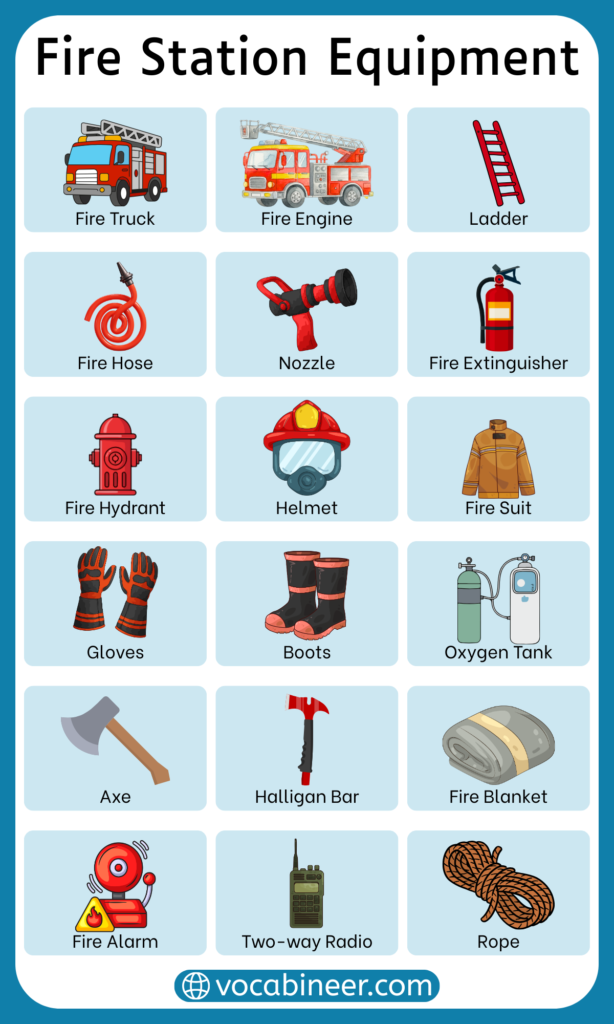
Fire station equipment includes the tools, protective gear, vehicles, and support systems used by firefighters to respond to emergencies. These items are essential for firefighting, rescue operations, medical assistance, and hazard control. Understanding fire station equipment names helps readers recognize how fire stations function, identify equipment correctly, and understand the role each item plays during emergencies in homes, buildings, roads, and industrial areas.
In This Page
Firefighting Equipment Used By Firefighters
Firefighting equipment is designed specifically to extinguish fires, control heat, reduce smoke, and prevent fire spread. These tools vary based on fire type, environment, and scale of the emergency.
Fire Extinguishing Equipment
- Fire extinguishers
Portable devices containing fire-suppressing agents used to control small fires quickly before they spread. - Water extinguishers
Used on fires involving solid materials such as wood, paper, and cloth. - Foam extinguishers
Create a thick foam layer that cools and smothers flammable liquid fires. - Dry powder extinguishers
Effective on electrical fires and gas-related flames due to their non-conductive nature. - Carbon dioxide extinguishers
Displace oxygen around the fire, making them suitable for electrical and machinery fires. - Fire suppression systems
Fixed systems installed in buildings that automatically activate when fire is detected.
Fire Hose And Water Delivery Equipment
- Fire hoses
Durable, high-pressure hoses used to deliver water or foam directly to the fire source. - Hose reels
Mounted hose units designed for quick deployment during emergencies. - Nozzles
Control the direction, pressure, and spray pattern of water flow. - Hose couplings
Secure connectors that join hoses to pumps or hydrants. - Hydrants
External water outlets connected to municipal water supply systems. - Standpipe systems
Fixed piping systems inside large buildings for firefighting access.
Fire Suppression Tools
- Fire blankets
Used to smother small fires or protect individuals whose clothing is on fire. - Sprinkler control tools
Allow firefighters to activate or shut down sprinkler systems. - Portable water pumps
Supply water in areas without hydrants. - Foam generators
Mix water and foam concentrate to create fire-suppressing foam.
Fire Station Protective Equipment
Protective equipment safeguards firefighters from extreme heat, falling debris, toxic gases, and physical injuries during operations.
Firefighter Protective Clothing
- Firefighter turnout gear
Multi-layered suits designed to resist heat, flames, and water. - Fire-resistant jackets
Protect the torso from burns and radiant heat. - Fire-resistant trousers
Shield legs from sparks, heat, and sharp debris. - Fire helmets
Protect the head from impact and falling objects. - Fire boots
Provide insulation, grip, and foot protection. - Fire gloves
Protect hands while maintaining grip and flexibility.
Breathing And Respiratory Equipment
- Self-contained breathing apparatus
Provides clean air in smoke-filled or oxygen-deficient environments. - Oxygen cylinders
Store compressed air for breathing support. - Air masks
Seal the face to prevent smoke inhalation. - Face masks
Filter airborne particles and fumes. - Respirators
Protect against toxic gases and chemicals.
Heat And Smoke Protection Gear
- Heat-resistant suits
Used in extremely high-temperature zones such as industrial fires. - Smoke hoods
Protect head and neck from smoke inhalation. - Fire-resistant balaclavas
Cover exposed skin under helmets.
Fire Rescue Equipment
Rescue equipment enables firefighters to locate, reach, and safely remove victims from dangerous situations.
Search And Rescue Tools
- Thermal imaging cameras
Detect body heat through smoke and darkness. - Search cameras
Inspect confined or collapsed spaces. - Listening devices
Pick up sounds made by trapped individuals. - Flashlights
Provide focused light in low-visibility conditions. - Rescue ropes
Used for climbing, lowering, and securing people.
Victim Evacuation Equipment
- Stretchers
Transport injured individuals safely. - Rescue baskets
Lift victims from heights or confined spaces. - Evacuation chairs
Move people down staircases during building evacuations. - Spine boards
Stabilize patients with suspected spinal injuries.
Confined Space Rescue Equipment
- Tripods
Provide overhead support for vertical rescues. - Winches
Raise or lower personnel and equipment. - Safety harnesses
Secure firefighters and victims during rescue. - Lifelines
Prevent falls in hazardous environments.
Fire Station Vehicles And Transport Equipment
Vehicles allow firefighters to arrive quickly with all necessary tools and water supplies.
Fire Engines And Fire Trucks
- Fire engines
Carry water, pumps, hoses, and firefighters. - Ladder trucks
Provide access to high-rise structures. - Aerial platforms
Lift firefighters to elevated rescue points. - Pumpers
Supply pressurized water to firefighting hoses.
Rescue Vehicles
- Rescue vans
Transport rescue tools and medical equipment. - Ambulances
Provide medical transport for injured victims. - Quick response vehicles
Reach emergency scenes faster in urban areas.
Water Tankers And Support Vehicles
- Water tankers
Deliver large quantities of water to fire scenes. - Command vehicles
Serve as mobile control centers. - Utility trucks
Carry additional tools and supplies.
Fire Station Communication Equipment
Communication equipment ensures coordination and information flow during emergencies.
Emergency Communication Devices
- Two-way radios
Enable constant team communication. - Walkie-talkies
Provide portable short-range communication. - Headsets
Allow hands-free communication in noisy environments.
Alarm And Alert Systems
- Fire alarm panels
Trigger station alerts. - Station alert systems
Notify firefighters inside stations. - Emergency sirens
Warn surrounding communities.
Dispatch And Control Equipment
- Dispatch consoles
Receive emergency calls and coordinate response. - Computer systems
Track incident details. - Monitoring screens
Display live data and maps.
Fire Detection And Monitoring Equipment
Detection equipment helps identify fire risks early.
Smoke And Heat Detection Devices
- Smoke detectors
Sense smoke particles. - Heat detectors
Detect rapid temperature increases. - Flame detectors
Identify open flames.
Fire Alarm Systems
- Manual alarm pull stations
Allow manual alarm activation. - Automatic alarm systems
Trigger alarms automatically.
Monitoring And Control Panels
- Fire control panels
Manage alarm and detection systems. - Monitoring dashboards
Display system status.
Fire Station Medical And First Aid Equipment
Medical equipment allows firefighters to provide immediate care.
Emergency Medical Response Tools
- Oxygen kits
Assist breathing. - Automated external defibrillators
Restore heart rhythm. - Medical bags
Store emergency medical supplies.
First Aid And Trauma Equipment
- Bandages
Cover wounds. - Splints
Support injured limbs. - Trauma kits
Treat severe injuries. - Burn treatment supplies
Relieve burn damage.
FAQs About Fire Station Equipment
Fire station equipment refers to the complete set of tools, machines, vehicles, and protective gear used by firefighters to control fires, rescue people, provide medical aid, and manage emergency situations safely.
Some of the most important fire station equipment includes fire engines, fire extinguishers, fire hoses, breathing apparatus, protective clothing, rescue tools, communication devices, and medical equipment.
Firefighters wear protective gear to shield themselves from extreme heat, flames, smoke, toxic gases, sharp debris, and physical injuries during firefighting and rescue operations.
Fire stations commonly have fire engines, ladder trucks, rescue vehicles, water tankers, ambulances, and command vehicles to handle different types of emergencies.
Fire station equipment is regularly inspected, cleaned, tested, and repaired to ensure it works properly during emergencies. Proper maintenance helps prevent equipment failure and improves firefighter safety.
Conclusion
Fire station equipment forms the backbone of emergency response operations. From firefighting and rescue tools to medical, communication, and protective gear, each piece plays a vital role in saving lives and property. A well-equipped fire station ensures firefighters can act quickly, safely, and effectively in any emergency situation.
Read More