First person pronouns are words we use when we talk about ourselves or a group that includes us. These pronouns help you avoid repeating names and make your sentences sound natural and clear.
We use them in sentences like I am learning, She helped me, This book is mine, and We are ready. In this guide, you will learn the complete list of first person pronouns, their uses, clear examples, common mistakes, and simple differences like I vs me, my vs mine, and we vs us.
In This Page
What Are First Person Pronouns?
First person pronouns are pronouns that refer to the speaker or writer. They show that a person is talking about himself, herself, or a group that includes the speaker. First person pronouns are also called first person personal pronouns in grammar.
Examples:
- I am learning English.
- Please help me.
- This is my notebook.
- The red bag is mine.
- We are ready.
- The teacher called us.
- Our team played well.
- This classroom is ours.
In simple words, first person pronouns are used when someone says something about themselves or their own group.
Complete List of First Person Pronouns
Here is the complete list of first person pronouns in English:
- I
- Me
- My
- Mine
- Myself
- We
- Us
- Our
- Ours
- Ourselves
These words may look small, but they are used very often in English. For example, they appear in daily conversations, stories, emails, essays, personal opinions, and classroom sentences.
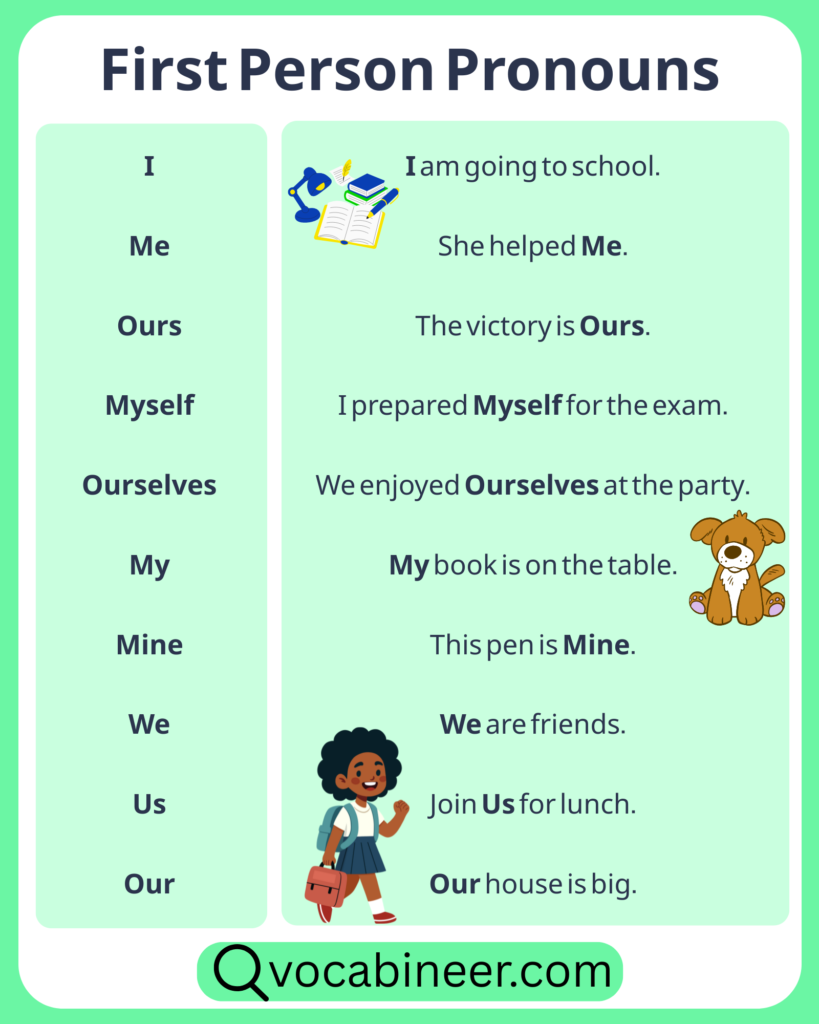
First Person Pronouns Chart
| Use | Singular | Plural |
|---|---|---|
| Subject pronoun | I | We |
| Object pronoun | Me | Us |
| Possessive adjective | My | Our |
| Possessive pronoun | Mine | Ours |
| Reflexive pronoun | Myself | Ourselves |
This chart shows how first person pronouns change according to their role in a sentence. For example, I and we are used as subjects, while me and us are used as objects.
Singular First Person Pronouns
Singular first person pronouns refer to one speaker or writer.
| Pronoun | Use | Example |
|---|---|---|
| I | Subject | I like reading. |
| Me | Object | She called me. |
| My | Before a noun | This is my book. |
| Mine | Shows ownership alone | This book is mine. |
| Myself | Refers back to I/me | I made it myself. |
More examples:
- I am happy today.
- Please wait for me.
- My room is clean.
- The blue pencil is mine.
- I introduced myself to the class.
Plural First Person Pronouns
Plural first person pronouns refer to a group that includes the speaker.
| Pronoun | Use | Example |
|---|---|---|
| We | Subject | We are friends. |
| Us | Object | They invited us. |
| Our | Before a noun | This is our house. |
| Ours | Shows ownership alone | This house is ours. |
| Ourselves | Refers back to we/us | We cleaned it ourselves. |
More examples:
- We are studying together.
- The coach trained us well.
- Our teacher is kind.
- This project is ours.
- We prepared the food ourselves.
First Person Pronouns and Their Uses
First person pronouns do different jobs in sentences. Some show who is doing the action, some receive the action, and some show ownership.
Use I and we when the pronoun is doing the action.
Examples:
- I write in my notebook.
- I enjoy learning new words.
- We play after school.
- We finished the project.
Use me and us when the pronoun receives the action or comes after a preposition.
Examples:
- She helped me.
- He gave me a gift.
- The teacher praised us.
- This seat is for us.
Use my and our before nouns to show ownership.
Examples:
- This is my bag.
- My sister likes music.
- Our school is large.
- Our team won the game.
Use mine and ours when the noun is already understood.
Examples:
- This bag is mine.
- The red pencil is mine.
- That classroom is ours.
- The final decision is ours.
Finally, use myself and ourselves when the subject and object refer to the same person or group.
Examples:
- I hurt myself.
- I made this card myself.
- We introduced ourselves.
- We cleaned the room ourselves.
Quick Rules to Remember
Here are the easiest rules for using first person pronouns:
| Rule | Correct Pronouns | Example |
|---|---|---|
| Use for the doer | I, We | I opened the door. |
| Use for the receiver | Me, Us | She called me. |
| Use before a noun | My, Our | This is my notebook. |
| Use without a noun | Mine, Ours | This notebook is mine. |
| Use for the same person/group | Myself, Ourselves | I fixed it myself. |
These quick rules help you avoid most common mistakes with first person pronouns.
First Person Pronouns in Sentences
These examples show how first person pronouns are used in everyday English.
- I wake up early every morning.
- I like to read short stories.
- Please call me after class.
- The teacher gave me a new book.
- This is my pencil case.
- My parents are very supportive.
- The black bag is mine.
- This idea is mine.
- I completed the task myself.
- I taught myself a new song.
- We are learning grammar today.
- We cleaned the classroom.
- The manager thanked us.
- The guide showed us the way.
- Our garden has many flowers.
- Our lesson starts at nine.
- The bigger room is ours.
- This responsibility is ours.
- We introduced ourselves politely.
- We solved the problem ourselves.
In daily use, first person pronouns help us avoid repeating names and make sentences sound natural.
I vs Me
Use I when the pronoun is the subject. Use me when the pronoun is the object.
| Pronoun | Use | Example |
|---|---|---|
| I | Doer of the action | I called Anna. |
| Me | Receiver of the action | Anna called me. |
More examples:
- I am ready.
- I saw a rainbow.
- Please wait for me.
- She sat beside me.
- I wrote the answer.
- The teacher helped me.
Quick trick:
Remove the other person from the sentence. If the sentence still sounds correct with I, use I. If it sounds correct with me, use me.
Examples:
- Correct: Anna and I went to school.
Test: I went to school. - Correct: The teacher helped Anna and me.
Test: The teacher helped me.
Common mistake:
- Incorrect: Me and Anna went to school.
- Correct: Anna and I went to school.
My vs Mine
Use my before a noun. Use mine when the noun is not written after it.
| Pronoun | Use | Example |
|---|---|---|
| My | Comes before a noun | This is my book. |
| Mine | Stands alone | This book is mine. |
More examples:
- My room is clean.
- This room is mine.
- My answer is correct.
- The correct answer is mine.
- My shoes are new.
- The new shoes are mine.
Quick trick:
If a noun comes right after the word, use my. If no noun comes after it, use mine.
Examples:
- My pencil is sharp.
- This pencil is mine.
Common mistake:
- Incorrect: This is mine bag.
- Correct: This is my bag.
We vs Us
Use we when the pronoun is the subject. Use us when the pronoun is the object.
| Pronoun | Use | Example |
|---|---|---|
| We | Doer of the action | We helped them. |
| Us | Receiver of the action | They helped us. |
More examples:
- We are classmates.
- We made a poster.
- The coach trained us.
- The teacher called us.
- We are ready.
- This gift is for us.
Quick trick:
Use we before the action. Use us after a verb or preposition.
Examples:
- We joined the game.
- They joined us.
- The message is for us.
Common mistake:
- Incorrect: Us are going home.
- Correct: We are going home.
Our vs Ours
Use our before a noun. Use ours when the noun is already understood.
| Pronoun | Use | Example |
|---|---|---|
| Our | Comes before a noun | This is our garden. |
| Ours | Stands alone | This garden is ours. |
More examples:
- Our house is near the park.
- This house is ours.
- Our team played well.
- The final point was ours.
- Our classroom is bright.
- This classroom is ours.
Quick trick:
Use our before a noun. Use ours when the noun is not repeated.
Examples:
- This is our table.
- This table is ours.
Common mistake:
- Incorrect: This is ours school.
- Correct: This is our school.
First Person vs Second Person vs Third Person Pronouns
Pronouns can show who is speaking, who is listening, and who is being discussed.
| Person | Meaning | Examples |
|---|---|---|
| First person | The speaker or writer | I, me, we, us |
| Second person | The listener or reader | You, your, yours |
| Third person | Someone or something else | He, she, it, they |
Examples:
- I am speaking.
- You are listening.
- They are playing.
First person pronouns refer to the speaker. Second person pronouns refer to the listener. Third person pronouns refer to other people, animals, places, or things.
Common Mistakes with First Person Pronouns
Learners often confuse first person pronouns because some forms look similar but work differently. The table below shows common mistakes and the correct forms.
| Incorrect | Correct |
|---|---|
| Me am happy. | I am happy. |
| Us are ready. | We are ready. |
| She helped I. | She helped me. |
| This is mine book. | This is my book. |
| This bag is my. | This bag is mine. |
| We did it ourself. | We did it ourselves. |
| Me and Anna are friends. | Anna and I are friends. |
| They invited we. | They invited us. |
| This is ours classroom. | This is our classroom. |
| I saw me in the mirror. | I saw myself in the mirror. |
To avoid these mistakes, remember the role of each pronoun. Use I and we for subjects, me and us for objects, my and our before nouns, and mine and ours when the noun is not repeated.
First Person Pronouns in Writing
First person pronouns are useful in many types of writing. They help the writer sound personal, direct, and clear.
You can use first person pronouns in:
- Personal stories.
- Diary entries.
- Opinion paragraphs.
- Reflections.
- Emails.
- Friendly letters.
- Speeches.
- Personal essays.
Examples:
- I believe kindness is important.
- My favorite subject is English.
- We should protect our environment.
- Our group worked together.
- I learned the answer myself.
In informal writing, first person pronouns are used freely, while in formal writing, they are used more carefully. Personal essays and reflections often use first person pronouns naturally, but research reports and formal academic papers may use them less.
FAQs
First person pronouns are pronouns that refer to the speaker or writer. Examples include I, me, my, mine, myself, we, us, our, ours, and ourselves.
Examples of first person pronouns are I, me, my, mine, myself, we, us, our, ours, and ourselves. These words are used when someone talks about themselves or a group that includes them.
Yes, we is a first person plural pronoun. It refers to a group that includes the speaker.
Use I as the subject of a sentence, as in “I am ready.” Use me as the object, as in “She helped me.”
Yes, but it depends on the type of writing. First person pronouns are common in personal essays, reflections, and opinion writing. Some formal academic styles may prefer fewer first person pronouns.
Summary
First person pronouns are words we use to talk about ourselves or a group that includes us. The main first person pronouns are I, me, my, mine, myself, we, us, our, ours, and ourselves.
These pronouns help us describe actions, ownership, feelings, opinions, and personal experiences. Use I and we as subjects, me and us as objects, my and our before nouns, mine and ours without nouns, and myself and ourselves for reflexive meaning. Learning these forms will help you write clearer sentences, avoid common grammar mistakes, and speak English more naturally.
Read More
- List of Pronouns in English
- Gender Pronouns in English
- Pronouns Chart Table in English
- Distributive Pronouns in English