

Pronouns are words we use instead of nouns. They help us avoid repeating the same names, people, places, or things. Common pronouns include I, you, he, she, it, we, they, me, him, her, this, that, who, and someone.
For example, instead of saying “Emma has a book. Emma is reading the book,” we can say “Emma has a book. She is reading it.” In this sentence, she replaces Emma, and it replaces the book, making the sentence shorter, clearer, and more natural.
This guide gives you a complete list of pronouns in English, organized by type. You will also find useful charts, simple examples, quick rules, and common pronoun mistakes. It is helpful for students, beginners, and anyone who wants to improve English grammar, writing, and speaking.
In This Page
What Is a Pronoun?
A pronoun is a word that replaces a noun in a sentence.
Example:
- Emma is reading. Emma likes the book.
- Emma is reading. She likes the book.
In the second sentence, she replaces Emma. So, she is a pronoun.
More examples:
- The book is old. It is on the table.
- The students are ready. They are waiting.
- Jack has a pen. He writes with it.
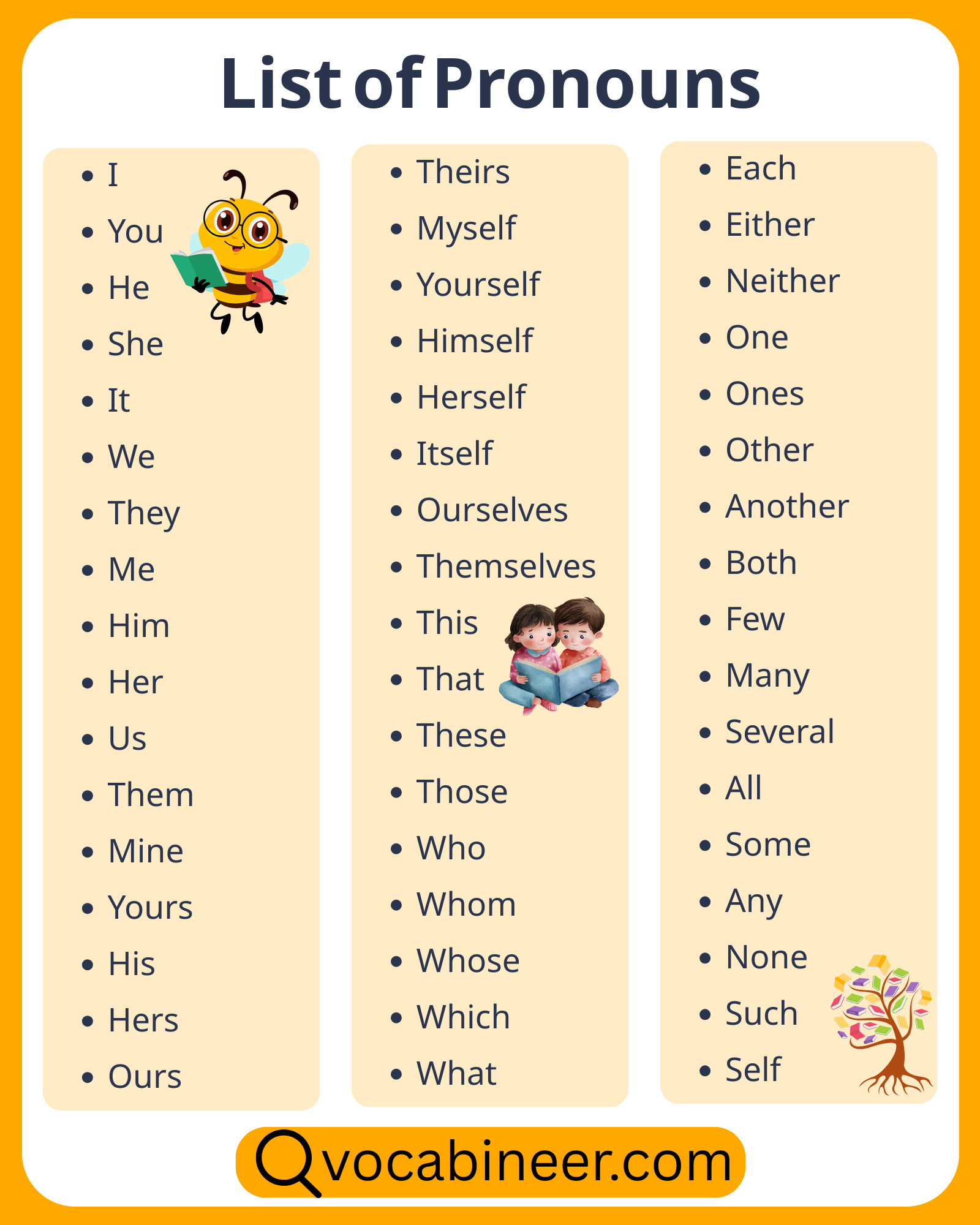
Pronouns vs Nouns: Quick Difference
Pronouns and nouns are connected, but they are not the same.
| Noun | Pronoun |
|---|---|
| Emma | she |
| David | he |
| Book | it |
| Students | they |
| Teacher and I | we |
A noun names something directly. A pronoun replaces that noun.
Most Common Pronouns in English
Here is a quick list of common pronouns used every day:
- I
- You
- He
- She
- It
- We
- They
- Me
- Him
- Her
- Us
- Them
- My
- Your
- His
- Her
- Our
- Their
- Mine
- Yours
- Ours
- Theirs
- This
- That
- These
- Those
- Who
- What
- Which
- Someone
- Everyone
- Anything
These are the pronouns learners see most often in speaking, writing, stories, questions, and daily conversation.
Complete List of Pronouns in English
Here is a grouped master list of pronouns in English:
- Personal pronouns: I, you, he, she, it, we, they, me, him, her, us, them
- Possessive pronouns: mine, yours, his, hers, ours, theirs
- Possessive adjectives: my, your, his, her, its, our, their
- Reflexive pronouns: myself, yourself, himself, herself, itself, ourselves, yourselves, themselves
- Demonstrative pronouns: this, that, these, those
- Interrogative pronouns: who, whom, whose, which, what
- Relative pronouns: who, whom, whose, which, that
- Indefinite pronouns: someone, anyone, everyone, no one, nobody, something, anything, everything, nothing, all, some, many, few, several, both, each, either, neither
- Reciprocal pronouns: each other, one another
- Intensive pronouns: myself, yourself, himself, herself, itself, ourselves, yourselves, themselves
Pronouns List by Type
| Pronoun Type | Pronouns | Example |
|---|---|---|
| Personal pronouns | I, you, he, she, it, we, they | She is reading. |
| Possessive pronouns | mine, yours, his, hers, ours, theirs | This book is mine. |
| Reflexive pronouns | myself, yourself, himself, herself | I made it myself. |
| Demonstrative pronouns | this, that, these, those | This is my bag. |
| Interrogative pronouns | who, whom, whose, which, what | Who is calling? |
| Relative pronouns | who, whom, whose, which, that | The boy who won is happy. |
| Indefinite pronouns | someone, anyone, everyone, nothing | Everyone is ready. |
| Reciprocal pronouns | each other, one another | They helped each other. |
| Intensive pronouns | myself, yourself, himself, herself | I myself opened the door. |
Pronouns List A to Z
Here is a quick alphabetical pronouns list for easy reference:
| Letter | Pronouns |
|---|---|
| A | all, another, anyone, anybody, anything |
| B | both |
| E | each, either, everyone, everybody, everything |
| F | few |
| H | he, her, hers, herself, him, himself, his |
| I | I, it, its, itself |
| M | many, me, mine, myself |
| N | neither, no one, nobody, none, nothing |
| O | one, one another, ours, ourselves |
| S | several, she, someone, somebody, something |
| T | that, their, theirs, them, themselves, these, they, this, those |
| U | us |
| W | we, what, whatever, which, who, whom, whose |
| Y | you, your, yours, yourself, yourselves |
Personal Pronouns List
Personal pronouns refer to people, animals, things, or groups.
Subject Personal Pronouns
- I
- You
- He
- She
- It
- We
- They
Examples:
- I am ready.
- She is reading.
- They are outside.
Object Personal Pronouns
- Me
- You
- Him
- Her
- It
- Us
- Them
Examples:
- Please help me.
- The teacher called him.
- We invited them.
Possessive Pronouns List
Possessive pronouns show ownership. They stand alone and do not come before a noun.
- Mine
- Yours
- His
- Hers
- Ours
- Theirs
Examples:
- This book is mine.
- That seat is yours.
- The final decision is theirs.
Do not write mine book or yours bag. Use my book and your bag instead.
Possessive Adjectives Used with Pronouns
Possessive adjectives also show ownership, but they come before nouns. They are often taught with pronouns because they work closely with pronoun forms.
- My
- Your
- His
- Her
- Its
- Our
- Their
Examples:
- This is my notebook.
- Her answer is correct.
- Their house is near the park.
Quick difference:
| Possessive Adjective | Possessive Pronoun |
|---|---|
| This is my book. | This book is mine. |
| That is your seat. | That seat is yours. |
| This is our house. | This house is ours. |
Reflexive Pronouns List
Reflexive pronouns refer back to the subject of the sentence.
- Myself
- Yourself
- Himself
- Herself
- Itself
- Ourselves
- Yourselves
- Themselves
Examples:
- I made it myself.
- She introduced herself.
- They cleaned the room themselves.
Use reflexive pronouns when the subject and object are the same person or thing.
Demonstrative Pronouns List
Demonstrative pronouns point to people, places, or things.
- This
- That
- These
- Those
| Pronoun | Use |
|---|---|
| This | One thing near |
| That | One thing far |
| These | More than one thing near |
| Those | More than one thing far |
Examples:
- This is my bag.
- That is your chair.
- These are fresh apples.
- Those are old books.
Interrogative Pronouns List
Interrogative pronouns are used to ask questions.
- Who
- Whom
- Whose
- Which
- What
Examples:
- Who is at the door?
- Whose bag is this?
- Which do you prefer?
- What is your name?
In daily English, who is more common than whom, but whom is still useful in formal writing.
Relative Pronouns List
Relative pronouns connect a noun to more information about it.
- Who
- Whom
- Whose
- Which
- That
Examples:
- The girl who won the race is happy.
- The student whose bag was lost is here.
- This is the book that I bought.
- The car which stopped is old.
Relative pronouns help join ideas and make sentences smoother.
Indefinite Pronouns List
Indefinite pronouns refer to people, things, or amounts in a general way.
Indefinite Pronouns for People
- Someone
- Anyone
- Everyone
- No one
- Nobody
- Somebody
- Anybody
- Everybody
Examples:
- Someone is calling you.
- Everyone is ready.
- Nobody answered the phone.
Indefinite Pronouns for Things
- Something
- Anything
- Everything
- Nothing
Examples:
- Something is missing.
- Everything is ready.
- Nothing is impossible.
Indefinite Pronouns for Amounts
- All
- Some
- Many
- Few
- Several
- Both
- Each
- Either
- Neither
Examples:
- Many were invited.
- Few came on time.
- Both are correct.
- Neither is available.
Other Pronouns List
Some pronouns have special jobs, such as showing a two-way action or adding emphasis.
Reciprocal Pronouns
- Each other
- One another
Examples:
- The two friends helped each other.
- The students talked to one another.
Intensive Pronouns
- Myself
- Yourself
- Himself
- Herself
- Itself
- Ourselves
- Yourselves
- Themselves
Examples:
- I myself opened the door.
- The teacher herself checked the papers.
- They themselves cleaned the hall.
If you remove the intensive pronoun, the sentence still makes sense.
Subject and Object Pronouns List
Subject pronouns do the action. Object pronouns receive the action.
| Subject Pronouns | Object Pronouns |
|---|---|
| I | Me |
| You | You |
| He | Him |
| She | Her |
| It | It |
| We | Us |
| They | Them |
Examples:
- I called him.
- She helped me.
- We invited them.
- They saw us.
Quick rule:
Use subject pronouns before the verb when they do the action. Use object pronouns after verbs or prepositions.
Pronoun Examples in Sentences
Here are useful pronouns in sentences:
- I am ready.
- You are welcome.
- She is my friend.
- He works hard.
- It is cold today.
- We are going home.
- They are playing outside.
- Please help me.
- The teacher praised him.
- I gave the book to her.
- This seat is mine.
- That bag is yours.
- These are my shoes.
- Who is calling?
- Someone left a message.
- Everyone enjoyed the trip.
- The boy who won smiled.
- They helped each other.
- I completed the work myself.
- The students themselves made the posters.
Pronoun Usage Rules
Here are some simple rules for using pronouns correctly:
| Rule | Example |
|---|---|
| Use pronouns to avoid repeating nouns. | Emma is kind. She helps others. |
| Use subject pronouns before actions. | He is running. |
| Use object pronouns after verbs or prepositions. | I called him. |
| Use possessive pronouns without nouns. | This book is mine. |
| Use possessive adjectives before nouns. | This is my book. |
| Use reflexive pronouns when the action returns to the subject. | She hurt herself. |
| Use demonstrative pronouns to point. | This is new. |
| Use interrogative pronouns to ask questions. | Who is there? |
Common Pronoun Confusions
Some pronouns are easy to confuse because they look or sound similar.
I vs Me
Use I as the subject. Use me as the object.
Examples:
- I called David.
- David called me.
- Anna and I went to school.
- The teacher helped Anna and me.
Who vs Whom
Use who for the subject. Use whom for the object.
Examples:
- Who called you?
- Whom did you call?
In daily English, many people use who instead of whom, but whom is still useful in formal writing.
This vs That
Use this for one thing near you. Use that for one thing farther away.
Examples:
- This is my notebook.
- That is your bag.
For plural nouns, use these and those.
Examples:
- These are my pencils.
- Those are your books.
Common Pronoun Mistakes
Pronouns are easy to use once you know their forms, but learners often confuse subject, object, and possessive pronouns.
| Incorrect | Correct |
|---|---|
| Me am happy. | I am happy. |
| Him is my friend. | He is my friend. |
| Her is singing. | She is singing. |
| They invited we. | They invited us. |
| She helped I. | She helped me. |
| This is mine book. | This is my book. |
| This book is my. | This book is mine. |
| The dog wagged it’s tail. | The dog wagged its tail. |
| Me and John went home. | John and I went home. |
| I saw me in the mirror. | I saw myself in the mirror. |
FAQs
A pronoun is a word that replaces a noun. For example, in “Emma is kind. She helps others,” the word she replaces Emma.
Examples of pronouns include I, you, he, she, it, we, they, me, him, her, us, them, this, that, who, someone, and everyone.
The main types of pronouns are personal, possessive, reflexive, demonstrative, interrogative, relative, indefinite, reciprocal, and intensive pronouns.
A personal pronoun refers to a specific person, thing, animal, or group. Examples include I, you, he, she, it, we, they, me, him, her, us, and them.
Pronouns are important because they help avoid repetition and make sentences shorter, clearer, and more natural.
Summary
Pronouns are words that replace nouns in sentences. They help us avoid repeating the same names, people, places, or things. Common pronouns include I, you, he, she, it, we, they, me, him, her, this, that, who, and someone.
The main types of pronouns include personal, possessive, reflexive, demonstrative, interrogative, relative, indefinite, reciprocal, and intensive pronouns. A strong pronouns list should be grouped by type, easy to scan, and supported with simple examples. Learning these pronoun lists will help you write clearer sentences and speak English more naturally.
Read More
- Pronouns Chart Table in English
- First Person Pronouns in English
- Distributive Pronouns in English
- Possessive Pronouns Chart in English