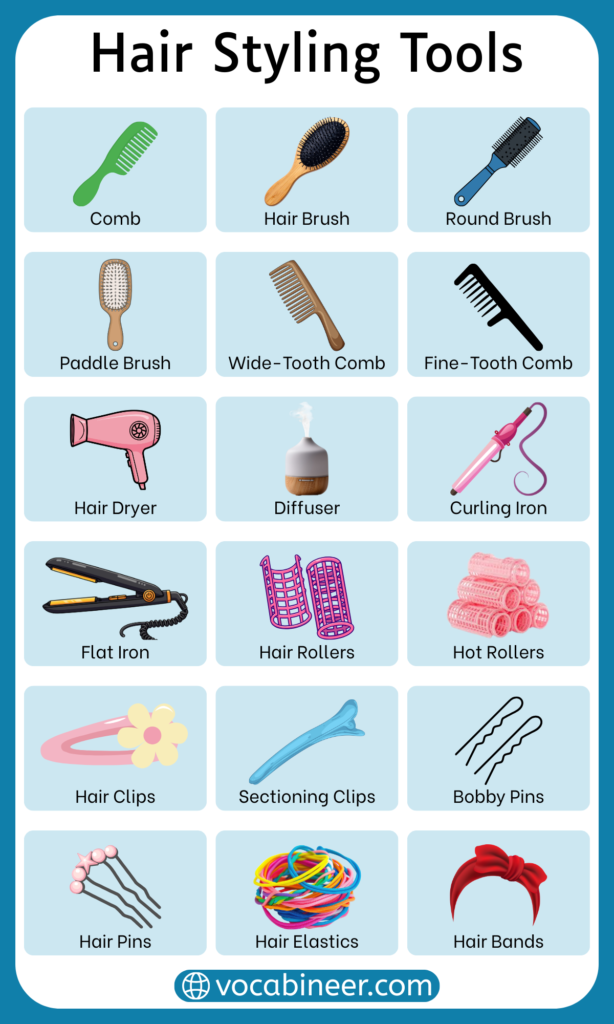
Hair styling tools names are used daily when people talk about drying, smoothing, curling, or finishing hair. These names appear in salons, stores, product labels, and simple instructions, yet many are used loosely or mixed up. Knowing correct hair styling tools names helps connect each tool with its shape and function, rather than relying on appearance alone.
This section focuses on learning hair styling tools names so readers can recognize tools, follow styling steps, and communicate accurately during shopping, training, or routine hair care conversations.
In This Page
Basic Hair Styling Tools to Know
Most hair styling routines start with tools that control hair, manage moisture, and guide direction. These tools are used across hair types and lengths, and many advanced styling tools depend on their basic functions. Getting familiar with these makes later styling steps easier to understand and follow.
- Hairbrush: Smooths hair, guides strands, and supports everyday shaping during styling.
- Comb: Creates clean parts and helps control small or detailed sections.
- Wide Tooth Comb: Detangles wet, curly, or thick hair gently with less pulling.
- Fine Tooth Comb: Refines parts and smooths short or precise sections.
- Hair Dryer: Removes moisture while shaping hair through airflow and brush movement.
- Paddle Brush: Flat and wide, it smooths long hair and reduces surface frizz.
- Round Brush: Lifts hair at the roots and helps shape lengths during blow drying.
- Vent Brush: Allows air to pass through the brush for faster drying.
- Sectioning Clips: Hold hair apart so one area can be styled at a time.
- Duckbill Clips: Secure thicker sections during drying or styling.
- Elastic Hair Bands: Temporarily hold sections during preparation or styling steps.
Common Hair Styling Tool Names Used Daily
In everyday conversation, many hair styling tools are mentioned by short or casual names rather than technical ones. These are the words people commonly use at salons, stores, or while giving quick instructions, even when they are not styling experts. Understanding these names helps connect spoken terms with the correct tools.
- Blow Dryer: A casual name commonly used instead of hair dryer.
- Flat Iron: A widely used everyday term for a hair straightener.
- Hair Straightener: A general name for tools that flatten hair using heat.
- Curling Iron: A heated barrel tool with a clamp used to create curls.
- Curling Wand: A clamp free curling tool known for loose waves.
- Hair Rollers: Cylindrical tools used to curl hair or add volume.
- Hot Rollers: Rollers that heat up before being placed in hair.
- Velcro Rollers: Rollers with a gripping surface mainly used for volume.
- Diffuser: A dryer attachment often mentioned in curly hair routines.
- Round Brush: Commonly named when talking about blow drying for lift.
- Blow Dry Brush: A brush shaped tool that dries and styles hair together.
- Straightening Brush: A heated brush used to smooth hair with less tension.
Hair Styling Tools Names with Their Uses
Tool names alone do not always explain what they do during styling. Understanding how each tool affects hair makes it easier to choose the right one and avoid confusion.
- Hair Straightener: Presses hair between heated plates to remove waves and bends.
- Ceramic Flat Iron: Distributes heat evenly for smoother and more controlled straightening.
- Titanium Flat Iron: Heats quickly and works well on thick or coarse hair textures.
- Curling Iron: Creates firm, defined curls using a heated barrel and clamp.
- Curling Wand: Forms soft, natural looking curls without clamping hair.
- Hair Dryer: Dries hair while shaping it through airflow and brush movement.
- Diffuser: Spreads airflow gently to protect curls and coils from frizz.
- Round Brush: Lifts hair at the roots while smoothing the lengths during drying.
- Paddle Brush: Smooths large sections of hair and reduces surface frizz.
- Hot Rollers: Set curls by heating rollers before placing them in hair.
- Velcro Rollers: Add lift and body as hair cools around the roller.
- Straightening Brush: Smooths hair using heat while brushing through sections.
Hair Styling Tools Names with Pictures
Some hair styling tools are easier to understand when their names match their shape and design. These tools are commonly shown in stores, salons, and learning materials, so recognizing them by appearance helps connect names with function.
- Hair Dryer with Concentrator Nozzle: A dryer fitted with a narrow tip that directs airflow for smoother and more controlled styling.
- Ceramic Flat Iron: A straightener with ceramic plates that spread heat evenly across hair sections.
- Titanium Flat Iron: A lightweight straightener that heats quickly and handles thick or coarse hair well.
- Curling Iron with Clamp: A curling tool that grips hair while wrapping it around a heated barrel.
- Curling Wand: A smooth barrel tool without a clamp, often used for loose waves.
- Diffuser Attachment: A round dryer attachment with prongs that spread airflow gently over curls.
- Round Brush: A circular brush commonly shown during blow drying for volume and shape.
- Vent Brush: A brush with open slots that allow air to pass through during drying.
- Hot Rollers: Heated rollers placed in hair to form curls as they cool.
- Velcro Rollers: Rollers with a textured surface that grip hair and add lift.
Hair Styling Tools Used Before Styling Hair
Before any shaping or heat styling begins, hair usually needs preparation. These tools help manage tangles, moisture, and sectioning so the styling process feels more controlled and even.
- Wide Tooth Comb: Gently detangles wet or curly hair without pulling or snapping strands.
- Detangling Brush: Slides through knots more easily, especially on damp hair.
- Microfiber Hair Towel: Absorbs excess water while reducing friction on hair.
- Spray Bottle: Lightly dampens hair to improve control during sectioning.
- Sectioning Clips: Hold parts of hair apart while working on specific areas.
- Duckbill Clips: Secure thicker sections during preparation or blow drying.
- Pre Styling Brush: Smooths hair lightly before heat tools are applied.
- Scalp Massaging Brush: Loosens hair at the roots and refreshes the scalp before styling.
- Hair Ties: Temporarily hold sections while preparing hair for styling.
Hair Styling Tools by What They Do
Grouping hair styling tools by function helps explain their purpose more clearly. Instead of focusing only on names, this approach shows what each group of tools is designed to do during styling.
| Tool Function | Hair Styling Tools |
|---|---|
| Drying Hair | Hair Dryer, Hood Dryer, Bonnet Dryer, Diffuser |
| Straightening Hair | Flat Iron, Straightening Brush, Blow Dry Brush |
| Curling Hair | Curling Iron, Curling Wand, Hot Rollers, Flexi Rods |
| Adding Volume | Round Brush, Velcro Rollers, Teasing Comb |
| Detangling and Smoothing | Wide Tooth Comb, Detangling Brush, Paddle Brush |
Tools Used for Drying Hair
Drying tools remove moisture from hair and help control direction early in the styling process. Some focus on speed, while others aim for even airflow or gentle drying, depending on hair type and styling needs.
- Hair Dryer: Blows warm or cool air to dry hair while shaping it with airflow.
- Professional Hair Dryer: A more powerful dryer designed for faster drying and longer use.
- Hood Dryer: Covers the head and dries hair evenly, often used with rollers.
- Bonnet Dryer: A soft hood attached to a dryer that allows hands free drying.
- Diffuser: Spreads airflow gently to protect curls and reduce frizz.
- Concentrator Nozzle: Directs airflow to smooth hair and control direction.
- Ionic Hair Dryer: Reduces static and helps hair feel smoother while drying.
Tools Used for Straightening Hair
Straightening tools reduce waves, bends, or texture using heat or tension. Some tools focus on precision, while others combine drying and straightening in one step.
- Flat Iron: Presses hair between heated plates to create straight styles.
- Ceramic Flat Iron: Distributes heat evenly for smoother straightening.
- Titanium Flat Iron: Heats quickly and works well on thick or coarse hair.
- Straightening Brush: A heated brush that smooths hair while brushing through sections.
- Blow Dry Brush: Dries and straightens hair at the same time.
- Paddle Brush: Helps stretch hair straight during blow drying.
- Fine Tooth Comb: Assists with precise straightening near roots or edges.
Tools Used for Curling Hair
Curling tools shape hair into curls, waves, or coils. The size and type of tool affect how tight or loose the curl appears.
- Curling Iron: Uses a heated barrel and clamp to create defined curls.
- Curling Wand: Forms loose curls without clamping hair in place.
- Hot Rollers: Heated rollers that set curls as hair cools.
- Velcro Rollers: Add body and soft curls without heat.
- Foam Rollers: Create gentle curls and are comfortable for longer use.
- Flexi Rods: Bendable rods used to form curls without heat.
- Spiral Curling Rods: Guide hair into spiral shapes for uniform curls.
Tools Used for Adding Volume
Volume focused tools lift hair away from the scalp and add fullness through airflow, tension, or shape. Some tools work best at the roots, while others create overall body through curl or bend.
- Round Brush: Lifts hair at the roots while shaping the lengths during blow drying.
- Large Round Brush: Creates softer volume and movement in longer hair.
- Velcro Rollers: Grip hair and add lift as hair cools around the roller.
- Hot Rollers: Add volume while also creating structured curls.
- Teasing Comb: Uses short strokes near the scalp to add height.
- Root Lifting Brush: Targets the crown area to raise hair at the roots.
- Blow Dryer with Concentrator: Helps direct airflow upward for added lift.
Tools Used for Detangling and Smoothing
Detangling and smoothing tools manage knots, reduce friction, and improve hair surface texture. These tools are often used both before and after styling to keep hair controlled and neat.
- Wide Tooth Comb: Gently removes tangles from wet or textured hair.
- Detangling Brush: Slides through knots with less pulling and resistance.
- Paddle Brush: Smooths large sections of hair evenly.
- Boar Bristle Brush: Polishes hair and spreads natural oils along strands.
- Fine Tooth Comb: Refines small sections and smooths edges.
- Edge Brush: Controls short hairs around the hairline.
- Smoothing Brush: Finishes styles by flattening flyaways.
Hair Styling Tools by Styling Result
Some hair styling tools are chosen based on the final look rather than the action they perform. Thinking in terms of results helps match tools with the style you want, whether the goal is straight, curly, full, or smooth hair.
Tools for Straight Hair Looks
Straight hair styles focus on reducing waves, bends, and uneven texture. These tools use heat, tension, or controlled airflow to keep hair aligned and smooth.
- Flat Iron: Presses hair between heated plates to create sleek, straight styles.
- Ceramic Flat Iron: Straightens hair evenly with balanced heat distribution.
- Titanium Flat Iron: Works quickly on thick or coarse hair that resists straightening.
- Straightening Brush: Smooths hair while brushing through sections with less tension.
- Blow Dry Brush: Dries and straightens hair at the same time.
- Paddle Brush: Helps stretch hair straight during blow drying.
- Fine Tooth Comb: Refines straight styles near roots and parts.
Tools for Curly Hair Styles
Curly hair styles depend on tools that shape bends, waves, or coils while maintaining definition. The size and type of tool affect how tight or loose the curls appear.
- Curling Iron: Creates defined curls using a heated barrel and clamp.
- Curling Wand: Forms loose, natural looking curls without clamping hair.
- Hot Rollers: Set curls as heated rollers cool inside the hair.
- Flexi Rods: Bendable rods used to create curls without heat.
- Foam Rollers: Produce soft curls and waves gently.
- Spiral Curling Rods: Guide hair into uniform spiral shaped curls.
- Diffuser: Supports natural curls while drying without disrupting shape.
Tools for Volume and Lift
Volume and lift styles focus on raising hair at the roots and adding fullness through shape, airflow, or curl. These tools work by creating space between hair strands or encouraging movement away from the scalp.
- Round Brush: Lifts hair at the roots while shaping the lengths during blow drying.
- Large Round Brush: Creates softer lift and movement in longer hair.
- Velcro Rollers: Grip hair and add volume as hair cools around the roller.
- Hot Rollers: Add lift while also forming structured curls.
- Teasing Comb: Uses short strokes near the scalp to build height.
- Root Lifting Brush: Targets the crown area for focused root lift.
- Blow Dryer with Concentrator: Directs airflow upward to increase volume.
- Bonnet Dryer: Helps set volume evenly when used with rollers.
Tools for Smooth and Polished Hair
Smooth and polished styles aim for even texture, reduced frizz, and clean lines. These tools focus on surface control and gentle finishing rather than major reshaping.
- Boar Bristle Brush: Polishes hair and spreads natural oils along strands.
- Paddle Brush: Smooths large sections and flattens surface frizz.
- Flat Iron: Creates sleek finishes with defined edges.
- Ceramic Flat Iron: Maintains smoothness with balanced heat.
- Smoothing Brush: Flattens flyaways after styling is complete.
- Fine Tooth Comb: Refines parts and smooths small sections.
- Edge Brush: Controls short hairs along the hairline.
- Cooling Shot Dryer: Sets smooth styles using cool airflow.
Heat Based Hair Styling Tools
Heat based hair styling tools change hair shape using controlled temperature. These tools are commonly used to straighten, curl, dry, or add volume, and they usually work faster than non heat options.
- Hair Dryer: Uses warm or cool air to dry hair and guide shape during styling.
- Professional Hair Dryer: A stronger dryer designed for frequent or long styling sessions.
- Flat Iron: Presses hair between heated plates to create straight styles.
- Ceramic Flat Iron: Spreads heat evenly for smoother results.
- Titanium Flat Iron: Heats quickly and works well on thick or coarse hair.
- Curling Iron: Forms curls using a heated barrel and clamp.
- Curling Wand: Creates loose curls without clamping hair.
- Hot Rollers: Heat rollers that set curls as hair cools.
- Blow Dry Brush: Combines drying and straightening in one tool.
- Straightening Brush: Uses heat to smooth hair while brushing through sections.
Non Heat Hair Styling Tools
Non heat hair styling tools rely on tension, wrapping, or airflow direction instead of temperature. These tools are often used for gentle styling, preparation, or finishing.
- Flexi Rods: Bendable rods used to form curls without heat.
- Foam Rollers: Soft rollers that create gentle curls or waves.
- Velcro Rollers: Add volume and body as hair cools around the roller.
- Hair Rollers: General term for rollers used to shape hair without heat.
- Wide Tooth Comb: Detangles hair gently, especially when wet.
- Paddle Brush: Smooths hair using tension rather than heat.
- Round Brush: Shapes and lifts hair when used with airflow.
- Sectioning Clips: Hold hair in place during non heat styling methods.
- Elastic Hair Bands: Secure hair temporarily for styling or shaping.
Hair Styling Tools Used After Styling
After the main styling step, finishing tools help refine the look, control flyaways, and adjust small details. These tools focus on neatness and final shape rather than major changes.
- Smoothing Brush: Flattens flyaways and evens out the hair surface.
- Boar Bristle Brush: Polishes hair and distributes natural oils.
- Fine Tooth Comb: Refines parts and smooths small sections.
- Edge Brush: Shapes short hairs along the hairline.
- Cooling Shot Dryer: Uses cool air to set the style after heat styling.
- Detail Comb: Adjusts small areas without disturbing the full style.
- Finishing Brush: Gently blends sections for a clean look.
Hair Styling Tools for Quick Everyday Styling
Quick everyday styling tools are chosen for ease, speed, and minimal setup. These tools handle simple smoothing, drying, or light shaping without taking much time or effort.
- Hair Dryer: Dries hair quickly and allows light shaping with simple brush use.
- Blow Dry Brush: Dries and styles hair in one step, useful for rushed routines.
- Straightening Brush: Smooths hair faster than a flat iron with less sectioning.
- Paddle Brush: Detangles and smooths hair in a few strokes.
- Round Brush: Adds quick lift at the front or crown while blow drying.
- Wide Tooth Comb: Refreshes hair gently without disturbing natural texture.
- Hair Clips: Hold sections briefly during fast touch ups.
Hair Styling Tools for Different Hair Textures
Hair texture affects how styling tools work. Some tools perform better on straight or fine hair, while others are designed to protect curl shape or manage thicker textures.
- Hair Dryer: Works across textures, with attachments changing results.
- Diffuser: Supports curly and coily hair by spreading airflow gently.
- Wide Tooth Comb: Prevents breakage in curly, coily, or thick hair.
- Paddle Brush: Smooths straight or wavy hair more easily.
- Round Brush: Adds shape to straight and wavy hair during drying.
- Flat Iron: Straightens hair, with plate choice affecting texture handling.
- Flexi Rods: Shape curls without heat, especially useful for textured hair.
Tools for Straight and Wavy Hair
Straight and wavy hair usually responds well to tools that smooth, stretch, or lightly shape strands. These tools help control frizz and create neat or softly styled looks.
- Flat Iron: Creates sleek, straight styles with defined lines.
- Ceramic Flat Iron: Smooths hair evenly with balanced heat.
- Straightening Brush: Controls waves while keeping some natural movement.
- Blow Dry Brush: Shapes and smooths hair during drying.
- Paddle Brush: Keeps straight hair smooth and aligned.
- Round Brush: Adds volume and bend to wavy hair while blow drying.
- Fine Tooth Comb: Refines parts and smooths small sections.
Tools for Curly and Coily Hair
Curly and coily hair needs tools that protect natural shape and reduce tension. These tools focus on gentle detangling, controlled airflow, and curl definition rather than pulling or flattening.
- Diffuser: Spreads airflow evenly to keep curls defined and reduce frizz.
- Wide Tooth Comb: Detangles curls gently without breaking curl patterns.
- Detangling Brush: Designed to slide through coils with less resistance.
- Flexi Rods: Bendable rods used to shape curls without heat.
- Foam Rollers: Create soft curls and waves without pulling hair tight.
- Spray Bottle: Lightly dampens curls for reshaping or refreshing.
- Bonnet Dryer: Allows curls to dry evenly while keeping hands free.
- Hair Clips: Hold sections apart during curl styling or drying.
Hair Styling Tools Commonly Used at Home
Home styling tools are usually simple, versatile, and easy to store. They handle everyday drying, smoothing, and light shaping without the power or size of salon equipment.
- Hair Dryer: Used for regular drying and basic styling.
- Paddle Brush: Smooths hair quickly during home routines.
- Round Brush: Adds lift and shape while blow drying.
- Wide Tooth Comb: Detangles hair gently after washing.
- Flat Iron: Straightens hair for simple styles at home.
- Curling Iron: Creates curls or waves for casual styling.
- Hair Rollers: Add volume or soft curls without much effort.
- Sectioning Clips: Keep hair organized during home styling.
Hair Styling Tools Commonly Used in Salons
Salon styling tools are designed for precision, durability, and frequent use. They often offer stronger airflow, faster heating, and better control for professional results.
- Professional Hair Dryer: Delivers powerful airflow for faster drying.
- Ceramic Flat Iron: Provides even heat for smooth straightening.
- Titanium Flat Iron: Handles thick or coarse hair efficiently.
- Curling Wand: Creates consistent curls in different sizes.
- Curling Iron: Forms defined curls using a clamp.
- Hood Dryer: Dries hair evenly, often used with rollers or treatments.
- Bonnet Dryer: Allows controlled drying during longer salon processes.
- Round Brushes: Used in multiple sizes for shaping and volume.
- Sectioning Clips: Support precise, organized styling work.
Hair Styling Tools That Look Similar but Work Differently
Some hair styling tools look almost the same at first glance, which often leads to confusion. Small design details like clamps, bristles, heat placement, or airflow direction change how each tool works on hair. Understanding these differences helps choose the right tool for the desired styling result.
| Tool Pair | How They Look Similar | How They Work Differently |
|---|---|---|
| Flat Iron vs Straightening Brush | Both are long, heated tools used on dry hair | A flat iron presses hair between plates for firm straightening, while a straightening brush smooths hair using heated bristles with lighter tension |
| Curling Iron vs Curling Wand | Both use a heated barrel to curl hair | A curling iron has a clamp that holds hair in place, while a curling wand has no clamp and creates looser curls |
| Round Brush vs Paddle Brush | Both are brushes used during blow drying | A round brush adds lift and shape, while a paddle brush smooths hair flat and reduces frizz |
| Hot Rollers vs Velcro Rollers | Both are cylindrical rollers placed in hair | Hot rollers use heat to set curls faster, while velcro rollers rely on cooling and tension for volume |
| Diffuser vs Concentrator Nozzle | Both attach to a hair dryer | A diffuser spreads airflow gently for curls, while a concentrator focuses air for smooth styles |
| Blow Dry Brush vs Round Brush | Both are round and used for volume | A blow dry brush produces heat and airflow on its own, while a round brush needs a separate dryer |
| Fine Tooth Comb vs Wide Tooth Comb | Both are combs for sectioning and smoothing | A fine tooth comb controls small sections precisely, while a wide tooth comb detangles gently |
Hair Styling Tool Names People Often Mix Up
Many hair styling tools are called by the wrong name in daily conversation. This usually happens because tools look alike or perform related tasks. Knowing the correct name helps avoid confusion when buying tools, following instructions, or talking to stylists.
- Hair Dryer and Blow Dryer: These are actually the same tool, just two different names used interchangeably.
- Flat Iron and Hair Straightener: Both names refer to the same straightening tool with heated plates.
- Curling Iron and Curling Wand: A curling iron has a clamp, while a curling wand does not, even though both create curls.
- Curling Rod and Curling Wand: Curling rod is often used casually, but curling wand is the more accurate name.
- Hair Rollers and Hot Rollers: Hot rollers use heat, while regular hair rollers rely on air cooling and tension.
- Straightening Brush and Paddle Brush: A straightening brush uses heat, while a paddle brush is non heat and relies on brushing only.
- Diffuser and Dryer Nozzle: A diffuser spreads airflow gently, while a nozzle concentrates air in one direction.
- Round Brush and Blow Dry Brush: A round brush needs a dryer, while a blow dry brush produces heat and airflow itself.
- Fine Tooth Comb and Wide Tooth Comb: Both are combs, but one controls small sections while the other detangles gently.
- Bonnet Dryer and Hood Dryer: Both cover the head, but a bonnet dryer is softer and more flexible than a hood dryer.
FAQs About Hair Styling Tools
The most common tools include hair dryers, flat irons, curling irons, brushes, combs, and hair rollers. These handle basic drying, smoothing, curling, and shaping tasks.
A curling iron has a clamp that holds hair in place, while a curling wand does not. Wands usually create looser curls, while irons give more defined curls.
Heat based tools work faster and change hair shape quickly, while non heat tools are gentler and rely on wrapping or tension instead of temperature.
Common home tools include a hair dryer, paddle brush, round brush, flat iron, and curling iron. These cover most everyday styling needs.
Small design differences, such as clamps, bristles, or airflow direction, change how a tool affects hair, even if the tools look almost the same.
Conclusion
Hair styling tools serve different purposes, from drying and smoothing to curling and finishing hair. Knowing the correct names and uses helps avoid confusion, improves communication in salons or stores, and makes styling steps easier to follow. When tools are understood by function and result, choosing the right one for any hair routine becomes more straightforward and practical.
Read More