

A grocery label may say beef, brisket, ground meat, or pastrami, even though those words do not describe the same kind of thing. One names the source meat, another identifies a cut, and the others describe a physical form or processed product.
Meat vocabulary becomes easier when each term sits in the right group. This guide explains common source meats, poultry names, butcher cuts, ground and sliced forms, processed products, organ meats, and the differences readers often notice on menus, food labels, and recipes.

In This Page
What Do Meat Names Describe?
A meat name may identify the animal source, a particular cut, a physical form, or a prepared product. Therefore, beef, steak, ground beef, and corned beef are related terms, but they do not mean the same thing.
Common meat vocabulary groups include:
- Source meats: beef, pork, lamb, veal, and venison
- Poultry meats: chicken, turkey, duck, goose, and quail
- Cuts and portions: steak, chop, ribs, brisket, and shank
- Physical forms: ground, cubed, sliced, and shredded meat
- Processed products: bacon, ham, sausage, salami, and jerky
- Organ meats: liver, kidney, heart, tongue, and tripe
Some meats have a special food name that differs from the animal name. For example, meat from cattle is beef, while meat from pigs is pork. However, words such as chicken, turkey, and duck can name both the bird and its meat.
In American food vocabulary, people commonly discuss meat, poultry, and seafood as separate categories. Fish and shellfish may count as animal flesh in a broad sense, but their names belong more naturally in dedicated fish and seafood guides.
Common Source Meat Names
Source-meat names tell readers which animal produced the meat. These terms often appear before a cut or physical form, as in beef brisket, pork chop, ground lamb, or venison steak.
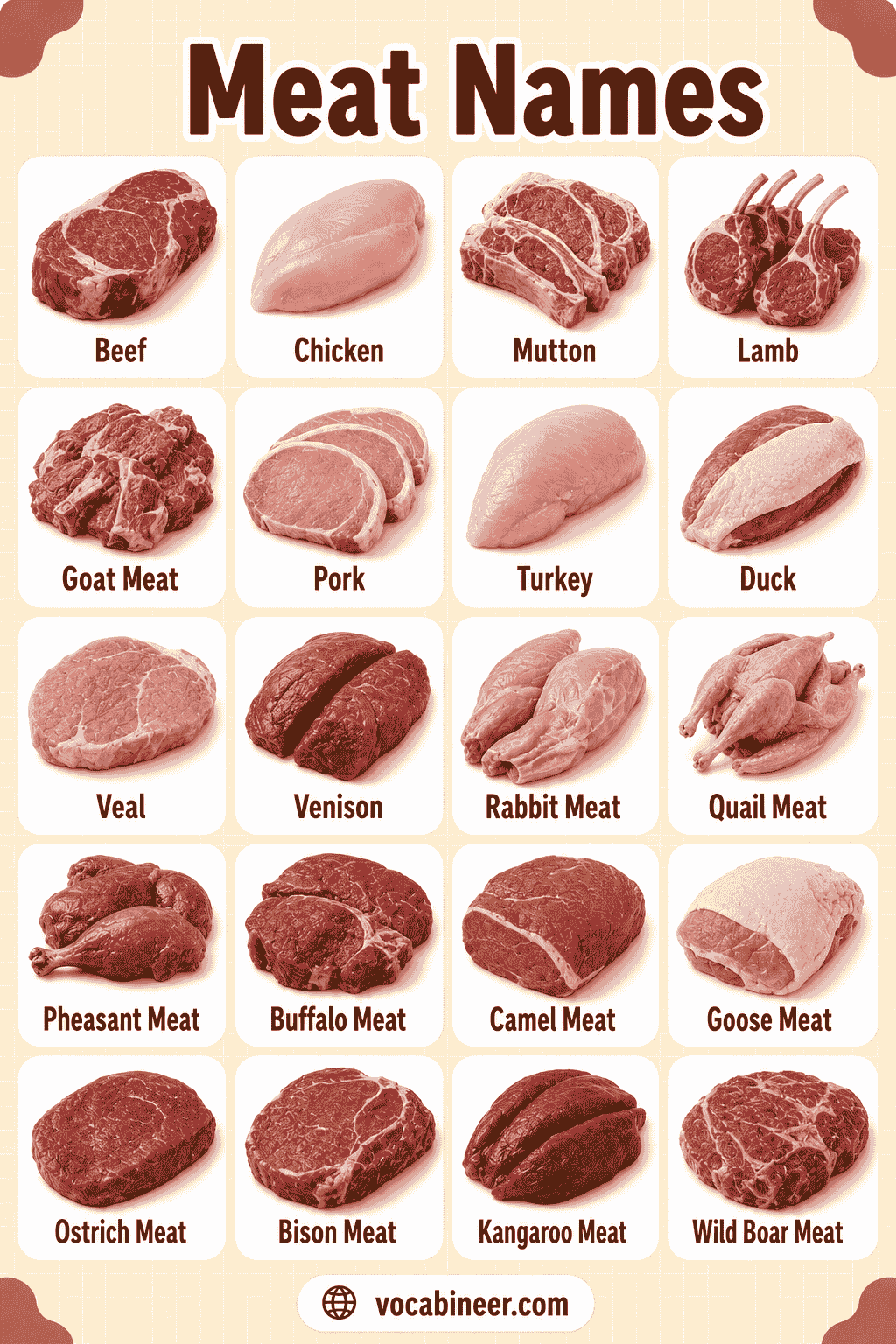
Beef is meat from cattle and one of the most familiar meat names in American English. Common beef products include steaks, roasts, brisket, ribs, stew meat, and ground beef.
Veal /viːl/ 🔊 is meat from calves rather than mature cattle. It may appear as cutlets, chops, roasts, shanks, or ground veal.
Pork is the general name for meat from pigs. Pork chops, tenderloin, shoulder, ribs, bacon, and ham all come from the same animal source, although bacon and ham describe particular products.
Lamb refers to meat from young sheep. Cooks commonly prepare lamb chops, leg of lamb, shoulder, ribs, ground lamb, and lamb shanks.
Mutton /ˈmʌtən/ 🔊 comes from mature sheep. Compared with lamb, it usually has a fuller flavor and often appears in slow-cooked dishes, stews, and curries.
Goat meat is the clearest everyday term for meat from goats. Although some specialist sources use chevon, most readers understand goat meat more easily.
Venison /ˈvɛnɪsən/ 🔊 usually means meat from deer. Menus and recipes may feature venison steaks, roasts, sausages, burgers, or stew meat.
Bison meat comes from bison and often appears in burgers, steaks, roasts, and ground-meat products. In casual American speech, people sometimes say buffalo, but bison and true buffalo are different animals.
Rabbit meat uses the same word as the animal itself. Cooks may prepare it as a roast, braise, stew, or pie filling.
Poultry Meat Names
Poultry /ˈpoʊltri/ 🔊 is a group term for domesticated birds raised for meat or eggs. It does not mean chicken alone, although chicken is the poultry meat that many readers encounter most often.
Chicken can name the bird or the meat. Stores sell it whole or as breasts, thighs, wings, drumsticks, tenders, and ground chicken.
Turkey also names both the bird and its meat. People often buy whole turkey, turkey breast, ground turkey, turkey sausage, or sliced deli turkey.
Duck has a richer flavor than chicken or turkey and includes both light and dark portions. Duck breast, duck leg, and whole roasted duck are familiar menu terms.
Goose is another poultry name used for both the bird and its meat. Whole goose and goose breast commonly appear in traditional or seasonal dishes.
Quail refers to a small bird and its meat. Restaurants may serve quail whole, grilled, roasted, or stuffed.
Guinea fowl has the same name as the bird that provides it. Cooks often roast or braise it in ways similar to chicken.
Poultry and white meat: People often call chicken and turkey “white meat,” but individual birds contain both lighter and darker portions. Breast meat is usually lighter, while thighs and drumsticks are darker.
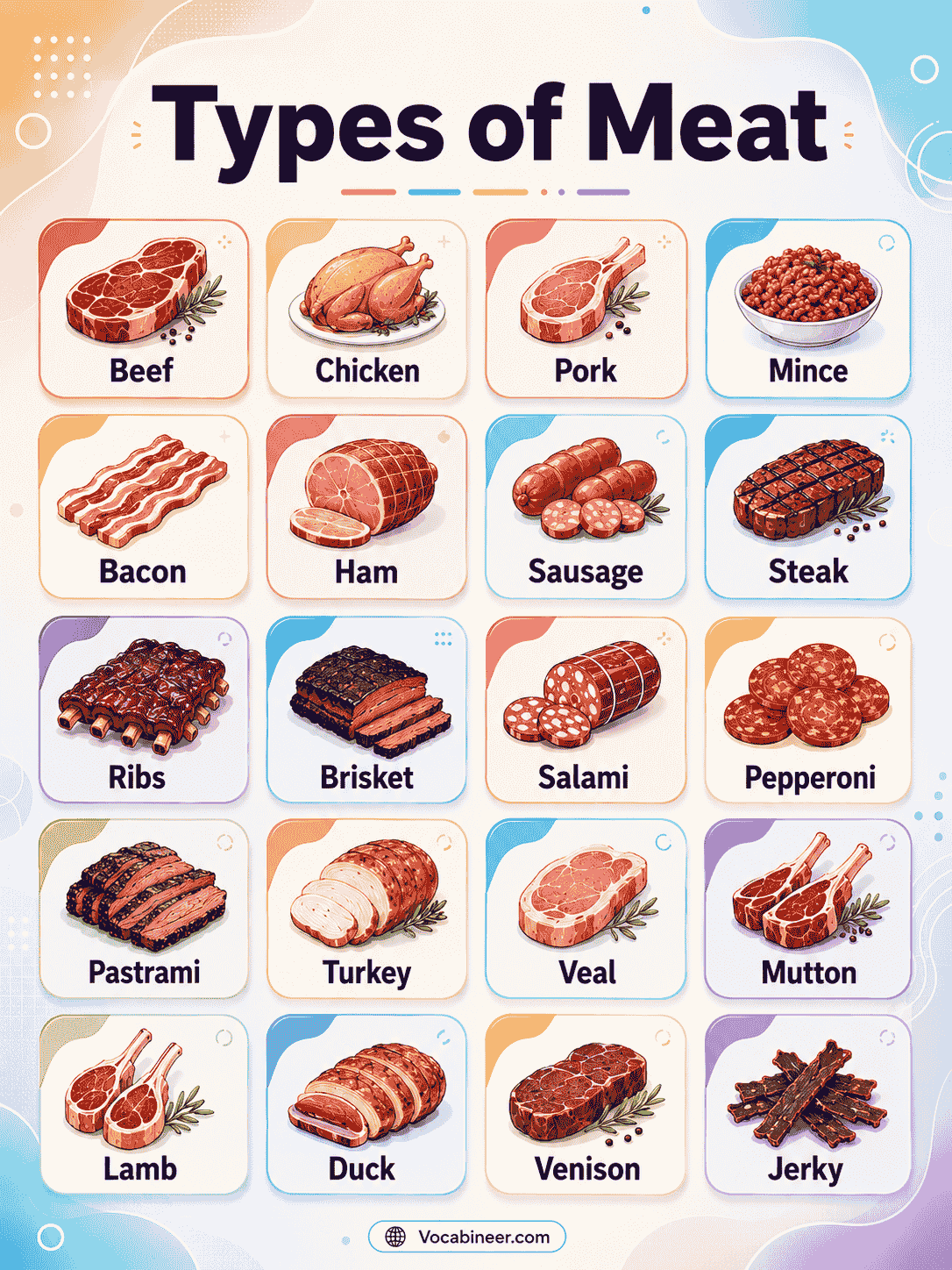
Common Meat Cuts and Portions
A meat cut identifies a body section, shape, or serving portion rather than the animal source. For that reason, readers usually need the complete phrase—such as beef steak, pork chop, or lamb shank—when the source is not obvious.
Steak is a thick slice or portion cut across muscle. The word most often refers to beef, although menus may also offer pork steak, lamb steak, venison steak, or fish steak.
Chop describes a portion cut from the loin or rib area, often with a bone attached. Pork chops and lamb chops are the most familiar examples.
Roast can name a larger cut intended for oven cooking or the dish prepared from that cut. Beef roast, pork roast, and leg of lamb all fit this broad term.
Ribs are cuts taken from the rib area with meat surrounding the bones. Beef ribs, pork ribs, and lamb ribs differ in size, shape, and common preparation.
Brisket /ˈbrɪskɪt/ 🔊 comes from the breast or lower chest area of cattle. Slow cooking helps soften this firm cut, so it commonly appears smoked, braised, roasted, or cured.
Tenderloin /ˈtɛndərlɔɪn/ 🔊 is a long, narrow muscle known for its tender texture. Both beef and pork have tenderloin cuts, though their sizes and uses differ.
Loin refers to the area along the back between the ribs and hind leg. Pork loin, lamb loin, and beef loin produce several familiar chops, steaks, and roasts.
Shoulder comes from the upper front section of an animal. Cooks often roast, braise, or grind shoulder cuts because they respond well to longer cooking.
Shank is the lower part of the leg. Beef, veal, and lamb shanks usually benefit from slow, moist cooking.
Cutlet is a thin, flat piece of meat that cooks quickly. Veal cutlets, pork cutlets, and chicken cutlets may receive breading before pan-frying or baking.
Ground, Cubed, Sliced, and Shredded Meat
These terms describe a physical form rather than a source or cut. Consequently, the name should include the meat source whenever readers need greater precision.
Ground meat consists of meat that a grinder has broken into small pieces. Common examples include ground beef, ground pork, ground turkey, ground chicken, and ground lamb.
Minced meat usually means finely chopped or ground meat. British and other English varieties use minced meat more often, while American English generally favors ground meat.
Cubed meat consists of larger, roughly square pieces that suit stews, skewers, and slow-cooked dishes. Stores may label packages as beef cubes, pork cubes, or lamb cubes.
Diced meat uses smaller pieces than cubed meat. However, recipe writers do not always apply the two size labels consistently.
Sliced meat has been cut into thin or thick pieces. Roast beef slices, turkey slices, ham slices, and sliced chicken commonly appear in sandwiches and deli counters.
Shredded meat separates into narrow strips after cooking or mechanical preparation. Pulled pork, shredded chicken, and shredded beef are familiar examples.
Grinding does not automatically create processed meat. Plain ground beef or ground turkey remains a fresh meat form unless producers add curing, smoking, fermentation, or other processing.
Poultry Cut Names
Poultry labels often identify a specific part of the bird. Although these words appear most often with chicken, they may also apply to turkey, duck, goose, or other poultry.
Breast is the large chest portion of a bird. Chicken breast and turkey breast commonly appear whole, sliced, ground, or cut into smaller pieces.
Thigh comes from the upper section of the leg. It contains darker meat and generally has a richer flavor than breast meat.
Wing includes the smaller limb sections attached near the breast. Chicken wings often appear baked, fried, grilled, or coated with sauce.
Drumstick is the lower portion of a bird’s leg. Its rounded top and narrow bone make it easy to recognize.
Tender or tenderloin describes a narrow strip of meat located beneath the breast. Chicken tenders may use this natural strip or similarly shaped pieces cut from breast meat.
Leg quarter combines the thigh and drumstick in one larger portion. Stores often sell chicken leg quarters as an economical cut.
Processed Meat Names
Processed meat products undergo methods such as curing, smoking, fermenting, drying, cooking, or extensive seasoning. Grinding may form part of the process, but grinding alone does not turn fresh meat into a processed product.
Bacon and Ham
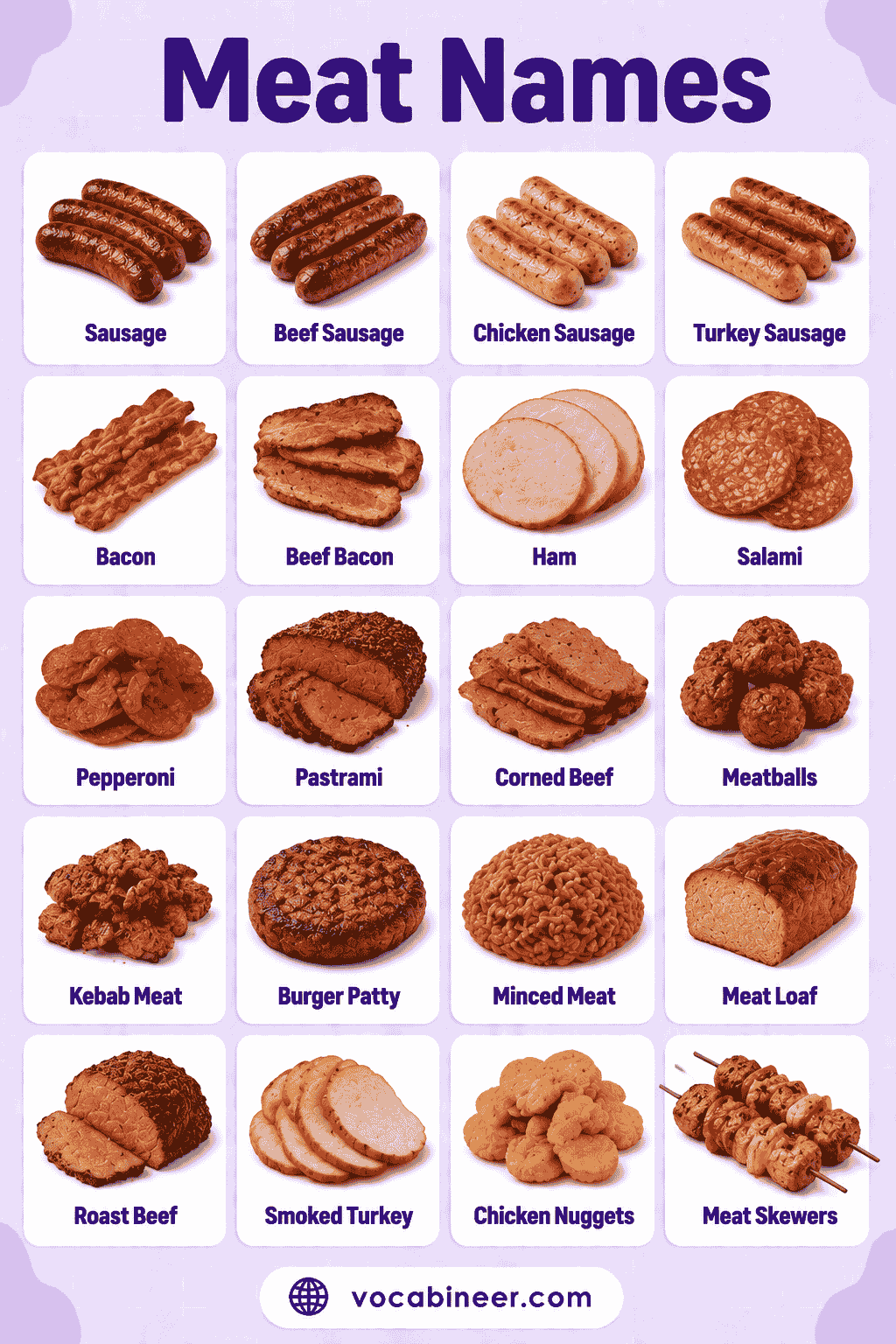
Bacon is a cured pork product, commonly made from pork belly in the United States. Producers may also smoke it, slice it, or sell it as thicker slabs.
Ham usually refers to meat from a pig’s hind leg. It may appear fresh, cured, smoked, cooked, or sliced, although packaged ham commonly undergoes several processing steps.
Pork is the source meat, while bacon and ham are products made from particular pork sections. Therefore, the three words should not appear as unrelated basic meat categories.
Sausage and Hot Dogs
Sausage combines chopped or ground meat with seasonings and sometimes fat, grains, herbs, or other ingredients. Depending on the product, it may be fresh, cooked, smoked, dried, or fermented.
The source meat can vary. Pork sausage, beef sausage, chicken sausage, turkey sausage, lamb sausage, and mixed-meat sausage are all possible.
Hot dog is a seasoned, cooked sausage commonly served in a long bun. Product labels may identify beef, pork, chicken, turkey, or a mixture as the source.
Salami, Pepperoni, and Pastrami
Salami /səˈlɑːmi/ 🔊 is a seasoned sausage that producers commonly ferment, cure, or dry. Pork and beef are frequent ingredients, although recipes vary.
Pepperoni is a spicy, cured sausage commonly made from pork, beef, or a combination. Thin pepperoni slices often appear as pizza toppings.
Pastrami /pəˈstrɑːmi/ 🔊 is a seasoned, cured, and usually smoked meat product. Beef is the most familiar source in American delis, particularly for pastrami sandwiches.
Corned Beef, Jerky, and Deli Meat
Corned beef is beef cured in a seasoned brine. It commonly appears sliced in sandwiches or chopped into corned-beef hash.
Jerky is thin or shaped meat that producers season and dry. Beef jerky is widespread, though turkey, venison, bison, and other meats can also become jerky.
Deli meat is a broad term for cooked, cured, or prepared meat sold in slices. Turkey, chicken, roast beef, ham, salami, and bologna are common deli-counter products.
Bologna /bəˈloʊni/ 🔊 is a cooked sausage product with a smooth texture. Labels may identify beef, pork, poultry, or mixed meats.
Organ Meat Names
Organ meats come from edible internal organs and related parts. The broader term offal /ˈɔːfəl/ 🔊 may include organs as well as other edible parts that do not fit ordinary muscle-meat cuts.
Liver is an organ meat that may come from chicken, beef, veal, lamb, pork, or other animals. Cooks fry, grill, sauté, or blend it into pâté and spreads.
Kidney commonly comes from beef, veal, lamb, or pork. Its name appears in traditional pies, stews, and grilled dishes.
Heart is a muscular organ with a firm texture. Beef, chicken, and lamb hearts may be grilled, braised, roasted, or added to stews.
Tongue is a muscular variety meat, most commonly associated with beef. Slow cooking softens it before cooks slice or season it.
Tripe /traɪp/ 🔊 is the edible lining from an animal’s stomach, commonly cattle, sheep, or goats. It appears in soups, stews, and regional dishes.
Sweetbreads are not bread or sweet pastries. The term usually refers to the thymus or pancreas of calves or lambs.
Meat Terms That Commonly Cause Confusion
Several terms sound interchangeable even though they identify different sources, ages, cuts, or products. The following comparisons clarify the most common mix-ups.
| Terms | Key difference |
|---|---|
| Beef and veal | Both come from cattle, but veal comes from calves, while beef generally refers to meat from older cattle. |
| Lamb and mutton | Both come from sheep; lamb comes from younger animals, whereas mutton comes from mature sheep. |
| Pork, bacon, and ham | Pork is the general source meat. Bacon and ham are pork products from particular sections that may undergo curing, smoking, or cooking. |
| Chicken and poultry | Chicken is one poultry species. Poultry is the wider group that also includes turkey, duck, goose, quail, and similar birds. |
| Beef and steak | Beef identifies the source meat, while steak identifies a cut or portion. Many steaks are beef, but the word can apply to other meats. |
| Ground meat and sausage | Ground meat describes a physical form. Sausage combines chopped or ground meat with seasonings and may undergo further processing. |
| Meat and seafood | Everyday language may use meat broadly, but American food vocabulary commonly treats mammal meat, poultry, and seafood as separate groups. |
Meat Names in Example Sentences
These sentences show how source meats, cuts, forms, and processed products appear in ordinary English.
- The butcher sliced the beef brisket into thick portions.
- We used ground turkey instead of ground beef in the recipe.
- The restaurant serves lamb chops with roasted vegetables.
- She added shredded chicken to the soup.
- This sandwich contains sliced pastrami and mustard.
- The package says the sausage contains pork and beef.
- He ordered a pork tenderloin rather than a pork chop.
- The stew contains cubes of venison and root vegetables.
- Turkey breast is lighter than turkey thigh meat.
- The deli sells ham, salami, roast beef, and other sliced meats.
- Mutton usually needs more cooking time than tender lamb cuts.
- The menu lists grilled beef tongue as a specialty dish.
FAQs
The main types of meat include red meat, white meat, poultry, seafood, processed meat, organ meat, and game meat. For example, beef and lamb are red meats, chicken and turkey are poultry meats, salmon and shrimp are seafood, and bacon and sausage are processed meats.
Red meat usually comes from mammals and has a darker color. Examples include beef, pork, lamb, and venison. White meat usually refers to lighter poultry meat, such as chicken and turkey. However, some meats can vary in color, fat, and cooking style.
Many food categories count fish as meat because it comes from an animal. However, some diets, cultures, and religious traditions group fish separately from other meats. In food vocabulary, fish and seafood still belong in a meat names guide because they describe animal-based protein foods.
Processed meat is meat that people cure, smoke, dry, season, or grind for flavor and storage. Common examples include bacon, ham, sausage, salami, hot dogs, and jerky. These foods often come from pork, beef, chicken, or mixed meats.
Organ meat means edible internal animal parts, such as liver, kidney, heart, tongue, and tripe. Many traditional recipes use organ meats because they have strong flavors and rich nutrients. People also call organ meat offal.
Summary
Meat vocabulary becomes easier when you group the names by category. Red meats include beef, pork, lamb, mutton, and venison. Poultry includes chicken, turkey, duck, and goose. Seafood includes salmon, tuna, shrimp, crab meat, and lobster meat.
In addition, processed meats include bacon, ham, sausage, and salami, while organ meats include liver, kidney, heart, and tripe. Once you learn these 50 types of meat, you can understand menus, recipes, labels, and everyday food conversations with more confidence.
Read More
