

A square of dark chocolate, a creamy piece of milk chocolate, a pale chunk of white chocolate, and a spoonful of cocoa powder all belong to the chocolate family. Some chocolate is made for eating, some is made for baking, and some is made for melting, coating, or decorating.
This guide explains the main types of chocolate with simple meanings, common names, practical uses, and easy differences. It stays focused on chocolate categories, baking chocolate, coating chocolate, chocolate forms, and picture-friendly examples without adding brand lists, recipes, health claims, or unnecessary history.
In This Page
What Is Chocolate?
Chocolate is a food made from cacao beans. The beans are processed into ingredients such as cocoa solids, cocoa butter, and cocoa powder. Different types of chocolate use different amounts of cocoa, sugar, milk, fat, and flavoring.
Chocolate can be sweet, bitter, creamy, rich, smooth, or powdery, depending on how it is made. For example, dark chocolate has a stronger cocoa taste, milk chocolate is sweeter and creamier, white chocolate is made with cocoa butter, and cocoa powder is often used for baking and drinks.
Main Types of Chocolate
These are the most common types of chocolate people use for eating, baking, melting, coating, and decorating.
- dark chocolate — chocolate with a stronger cocoa taste and little or no milk
- milk chocolate — sweet, creamy chocolate made with milk
- white chocolate — cocoa butter-based chocolate without cocoa solids
- ruby chocolate — pink chocolate with a fruity, slightly tangy taste
- unsweetened chocolate — bitter chocolate with no added sugar, mostly used in baking
- semisweet chocolate — moderately sweet chocolate often used in cookies and brownies
- bittersweet chocolate — darker chocolate with less sweetness and a deeper cocoa flavor
- sweet baking chocolate — sweeter chocolate used in cakes, brownies, and desserts
- couverture chocolate — high-cocoa-butter chocolate used for smooth melting, dipping, and coating
- compound chocolate — chocolate-like coating made with cocoa flavor and vegetable fats
- baking chocolate — chocolate made for baking, melting, and mixing into recipes
- cocoa powder — dry chocolate ingredient used in cakes, brownies, drinks, and frosting
- chocolate chips — small chocolate pieces used for cookies, muffins, and toppings
- chocolate chunks — larger chocolate pieces used in baking and desserts
- chocolate bars — flat chocolate pieces made for eating, baking, or melting
- chocolate truffles — rich chocolate sweets with a soft center
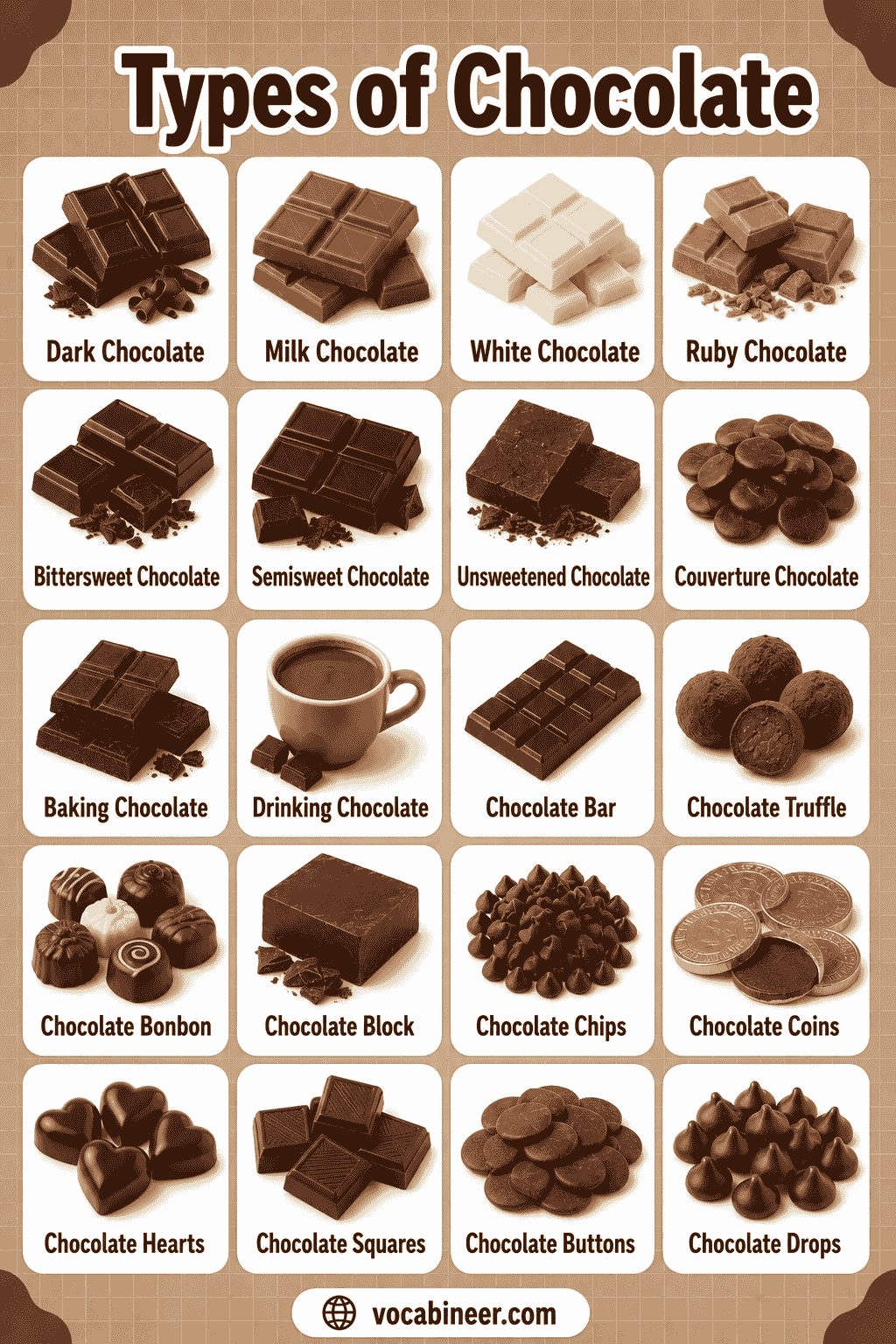
Chocolate Colors at a Glance
Chocolate is often recognized by color. Color does not explain every ingredient, but it helps readers quickly identify the most familiar chocolate groups.
| Chocolate Color | Common Type | Simple Description |
|---|---|---|
| Dark brown | dark chocolate | stronger cocoa taste and less milk |
| Light brown | milk chocolate | sweet, creamy chocolate made with milk |
| Ivory or pale yellow | white chocolate | cocoa butter-based chocolate without cocoa solids |
| Pink | ruby chocolate | pink chocolate with a fruity, slightly tangy taste |
| Golden beige | blond chocolate | caramelized white chocolate with a toasted taste |
Dark Chocolate
Dark chocolate has a stronger cocoa flavor than milk chocolate. It usually contains cocoa solids, cocoa butter, and sugar, but little or no milk.
Common dark chocolate examples include:
- dark chocolate bar
- dark chocolate chips
- dark chocolate chunks
- dark chocolate squares
- dark chocolate truffles
- dark chocolate-covered nuts
- dark chocolate curls
- dark chocolate ganache
Milk Chocolate
Milk chocolate is sweet, creamy chocolate made with cocoa, sugar, milk, and cocoa butter or other permitted fats depending on the product.
Common milk chocolate examples include:
- milk chocolate bar
- milk chocolate chips
- milk chocolate chunks
- milk chocolate squares
- milk chocolate coins
- milk chocolate truffles
- milk chocolate-covered raisins
- milk chocolate spread
White Chocolate
White chocolate is made with cocoa butter, sugar, milk, and flavoring. It does not contain cocoa solids, so it does not have the brown color or deep cocoa taste of dark or milk chocolate.
Common white chocolate examples include:
- white chocolate bar
- white chocolate chips
- white chocolate chunks
- white chocolate squares
- white chocolate curls
- white chocolate truffles
- white chocolate coating
- white chocolate ganache
White chocolate often causes confusion because it comes from cocoa butter but does not contain cocoa solids.
Ruby Chocolate
Ruby chocolate is a pink-colored chocolate with a fruity, slightly tangy taste. It is different from white chocolate with pink coloring because ruby chocolate has its own natural pink tone and flavor style.
Common ruby chocolate examples include:
- ruby chocolate bar
- ruby chocolate chips
- ruby chocolate chunks
- ruby chocolate squares
- ruby chocolate truffles
- ruby chocolate coating
- ruby chocolate curls
- ruby chocolate decorations
Baking Chocolate Types
Baking chocolate is chocolate used for cakes, brownies, cookies, sauces, fillings, frosting, and other desserts. Some baking chocolate is very bitter, while some is lightly sweet or moderately sweet. The right type depends on how much cocoa flavor, sweetness, and melting texture a recipe needs.
- Unsweetened chocolate — very bitter chocolate with no added sugar, mostly used in brownies, cakes, and rich chocolate desserts
- Semisweet chocolate — moderately sweet chocolate often used for chocolate chip cookies, muffins, brownies, and toppings
- Bittersweet chocolate — darker, less sweet chocolate used for deep chocolate flavor in baking, ganache, and sauces
- Sweet baking chocolate — sweeter baking chocolate used in cakes, frostings, bars, and easy dessert recipes
- Baking chocolate squares — measured blocks or squares of chocolate used for melting and mixing into recipes
- Chocolate chips — small chocolate pieces that hold their shape well in cookies, muffins, and baked treats
- Chocolate chunks — larger pieces of chocolate used for cookies, brownies, and bakery-style desserts
- Cocoa powder — dry chocolate ingredient used to add chocolate flavor to cakes, brownies, drinks, frosting, and dusting
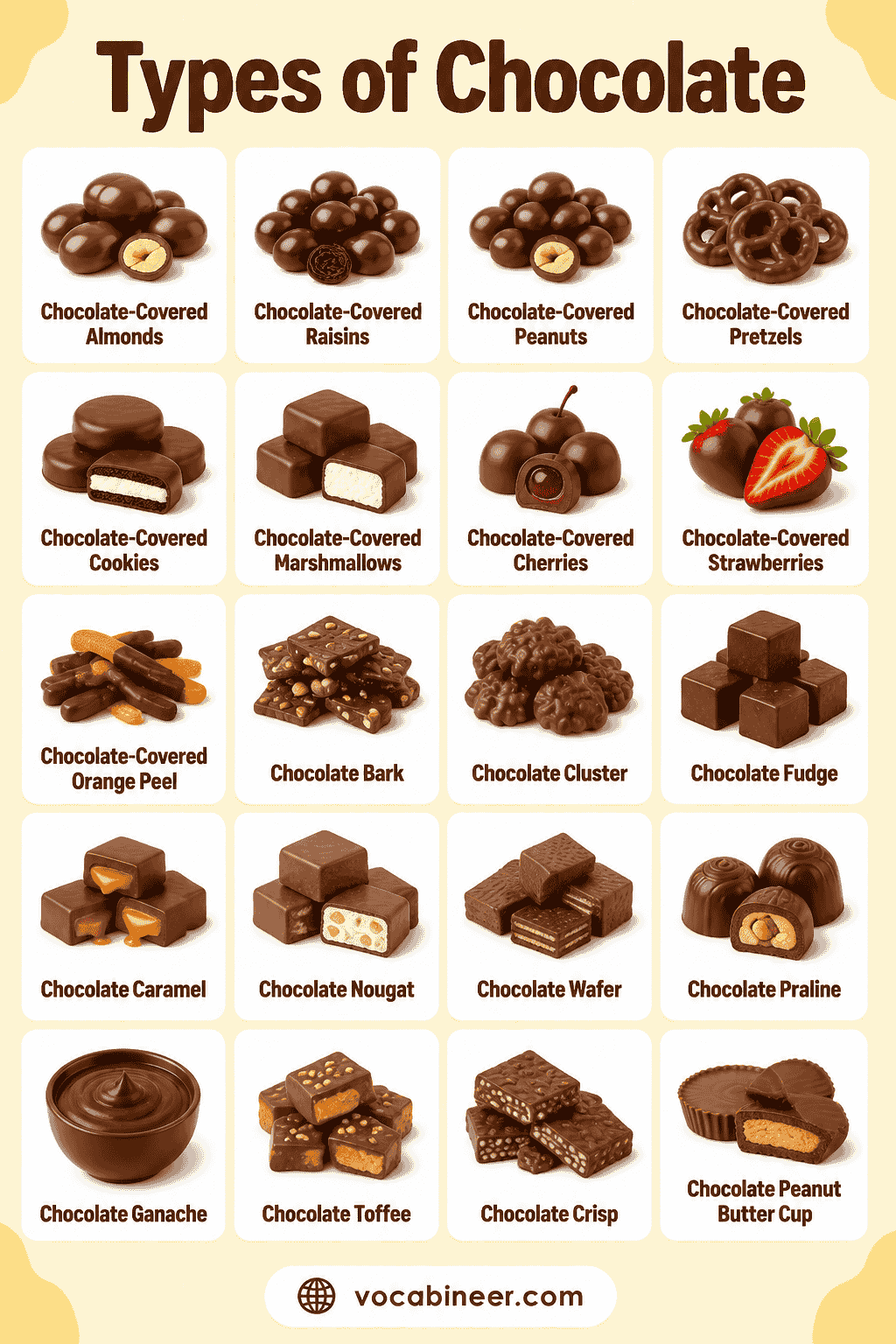
Chocolate for Eating vs Baking
Some chocolate is made mainly for eating, while other chocolate is better for baking. Eating chocolate is usually smoother and sweeter, while baking chocolate may be stronger, less sweet, or easier to measure for recipes.
| Use | Chocolate Types | Simple Purpose |
|---|---|---|
| Eating | milk chocolate, dark chocolate, white chocolate, ruby chocolate | eaten as bars, squares, pieces, or treats |
| Baking | unsweetened, semisweet, bittersweet, cocoa powder | used in cakes, cookies, brownies, and sauces |
| Filling | ganache, truffle filling, cream-filled chocolate | used inside sweets and desserts |
| Decorating | chocolate curls, shavings, chips, chunks | used on cakes, cupcakes, and desserts |
| Coating | couverture chocolate, compound chocolate | used for dipping, molding, and covering |
Chocolate for Melting and Coating
Some chocolate types melt more smoothly than others. For coating, dipping, or molding, the best choice depends on the finish, texture, and use.
| Chocolate Type | Best Use |
|---|---|
| couverture chocolate | professional coating, dipping, molding, and shiny finishes |
| compound chocolate | easy coating, dipping, and candy molds |
| chocolate chips | cookies, muffins, quick melting, and toppings |
| chocolate chunks | baking, brownies, cookies, and dessert pieces |
| baking chocolate | melting into cakes, sauces, and brownies |
| chocolate wafers | melting, coating, and decorative use |
Couverture chocolate gives a more professional result, while compound chocolate is often easier for simple coating work.
Chocolate Forms and Pieces
Chocolate types and chocolate forms are different. A type explains what kind of chocolate it is, while a form explains its shape or product style.
Common chocolate forms include:
- chocolate bar
- chocolate square
- chocolate block
- chocolate chip
- chocolate chunk
- chocolate curl
- chocolate shaving
- chocolate coin
- chocolate disc
- chocolate wafer
- chocolate callet
- chocolate truffle
Common Chocolate Names
These common chocolate names are useful for vocabulary lists, food charts, shopping, baking, and simple chocolate comparisons.
| Chocolate Name | Short Description |
|---|---|
| dark chocolate | chocolate with a stronger cocoa taste |
| milk chocolate | sweet chocolate made with milk |
| white chocolate | cocoa butter-based chocolate without cocoa solids |
| ruby chocolate | pink chocolate with a fruity taste |
| unsweetened chocolate | bitter chocolate with no added sugar |
| semisweet chocolate | moderately sweet baking chocolate |
| bittersweet chocolate | darker, less sweet chocolate |
| couverture chocolate | high-cocoa-butter chocolate for professional use |
| compound chocolate | chocolate-like coating made with vegetable fats |
| cocoa powder | dry chocolate ingredient used for baking and drinks |
| chocolate chips | small pieces used for baking |
| chocolate chunks | larger chocolate pieces used in baking |
| chocolate bar | flat chocolate piece for eating or baking |
| chocolate truffle | rich chocolate sweet with a soft center |
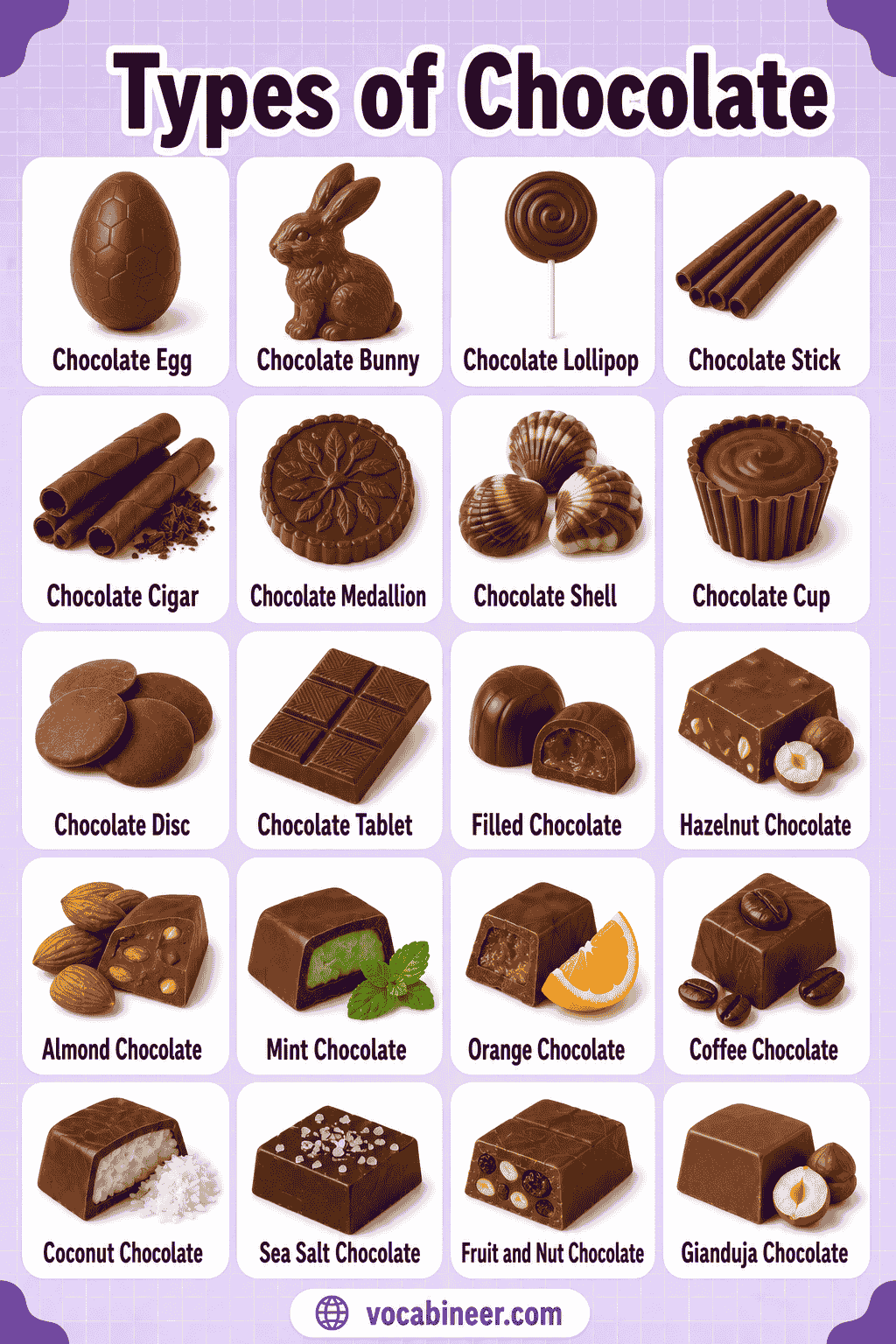
Chocolate Types That Are Easy to Confuse
Some chocolate names sound similar, but they do not always mean the same thing. These differences help readers choose the right type.
| Confusing Types | Simple Difference |
|---|---|
| dark chocolate and bittersweet chocolate | Dark chocolate is a broad type; bittersweet is usually a darker baking category. |
| semisweet chocolate and bittersweet chocolate | Semisweet is usually a little sweeter; bittersweet has a stronger cocoa taste. |
| milk chocolate and white chocolate | Milk chocolate has cocoa solids; white chocolate uses cocoa butter but no cocoa solids. |
| white chocolate and compound chocolate | White chocolate uses cocoa butter; compound chocolate usually uses vegetable fats. |
| cocoa powder and chocolate | Cocoa powder is dry and powdery; chocolate is usually solid or melted. |
| couverture chocolate and compound chocolate | Couverture uses cocoa butter and gives a professional finish; compound is easier to melt and set. |
| chocolate chips and baking chocolate | Chips are small formed pieces; baking chocolate is a broader category. |
| chocolate truffles and chocolate candy | Truffles are a specific finished chocolate sweet; chocolate candy is a broader group. |
Simple Meanings of Chocolate Types
This table gives quick meanings for the most important chocolate types. It is useful for readers who want a clean chocolate vocabulary list.
| Chocolate Type | Simple Meaning |
|---|---|
| dark chocolate | chocolate with more cocoa and little or no milk |
| milk chocolate | sweet, creamy chocolate made with milk |
| white chocolate | cocoa butter-based chocolate without cocoa solids |
| ruby chocolate | pink chocolate with a fruity, slightly tangy taste |
| blond chocolate | caramelized white chocolate with a toasted flavor |
| unsweetened chocolate | chocolate with no added sugar |
| semisweet chocolate | moderately sweet chocolate often used in baking |
| bittersweet chocolate | darker chocolate with less sweetness |
| baking chocolate | chocolate used in baked foods and desserts |
| couverture chocolate | high-cocoa-butter chocolate used for coating and dipping |
| compound chocolate | chocolate-like coating made with vegetable fats |
| cocoa powder | dry chocolate ingredient used for baking and drinks |
| chocolate chips | small chocolate pieces used for baking |
| chocolate chunks | larger chocolate pieces used in baking |
| chocolate bar | flat chocolate form for eating or baking |
| chocolate truffle | rich chocolate sweet with a soft center |
Chocolate Type vs Chocolate Form
A chocolate type tells what kind of chocolate it is. A chocolate form tells the shape, piece, or product style. One chocolate type can appear in many forms.
| Chocolate Item | Type | Form |
|---|---|---|
| dark chocolate bar | dark chocolate | bar |
| milk chocolate chips | milk chocolate | chips |
| white chocolate curls | white chocolate | curls |
| ruby chocolate pieces | ruby chocolate | pieces |
| semisweet chocolate chunks | semisweet chocolate | chunks |
| couverture callets | couverture chocolate | callets |
| cocoa powder | cocoa ingredient | powder |
| chocolate truffle | chocolate sweet | round filled piece |
FAQs
The main types of chocolate include dark chocolate, milk chocolate, white chocolate, ruby chocolate, unsweetened chocolate, semisweet chocolate, bittersweet chocolate, couverture chocolate, compound chocolate, and cocoa powder.
Dark chocolate has a stronger cocoa taste and usually contains little or no milk. Milk chocolate is sweeter and creamier because it is made with milk.
White chocolate is made with cocoa butter, sugar, and milk, but it does not contain cocoa solids. Because of this, it tastes and looks different from dark and milk chocolate.
Common baking chocolates include unsweetened chocolate, semisweet chocolate, bittersweet chocolate, baking chocolate, chocolate chips, chocolate chunks, and cocoa powder.
Couverture chocolate is high-quality chocolate with more cocoa butter and is used for professional coating and dipping. Compound chocolate is a chocolate-like coating made with vegetable fats and is often easier to melt and set.
Read More
- Types of Food in English
- Street Food Items Names
- Sweets and their Names
- Breakfast Food Names
- Packaged Food Names
- Different Types of Candy