

A tray of cookies can hold soft chocolate chip rounds, crisp wafers, crumbly shortbread, jam-filled centers, and delicate almond shells. Although they all belong to the same broad food family, their textures, shapes, ingredients, fillings, and preparation styles make them easy to tell apart.
This guide explains the main types of cookies through familiar names, simple meanings, visual clues, and clear comparisons. It focuses on edible cookies rather than browser cookies, recipes, brands, calorie rankings, or long baking instructions.
In This Page
What Makes One Cookie Different from Another?
A cookie is a small sweet food usually made from flour, sugar, fat, and flavoring. However, some varieties rely more heavily on oats, coconut, nuts, chocolate, fruit, or whipped egg whites.
Cookie names may describe different features:
- ingredient — chocolate chip, peanut butter, oatmeal, or coconut
- texture — soft, chewy, crisp, crunchy, or crumbly
- construction — sandwich, filled, stuffed, or layered
- shape — shell, spiral, crescent, ring, finger, or folded form
- preparation — dropped, rolled, pressed, molded, sliced, or pan-baked
- tradition — linked to a regional or international baking style
Therefore, chocolate chip cookie, shortbread, sandwich cookie, and drop cookie do not describe the same kind of category. One name refers to an ingredient, another to texture, another to construction, and another to preparation.
Common Types of Cookies
These cookie varieties appear frequently in bakeries, cafés, homes, shops, and food vocabulary lessons.
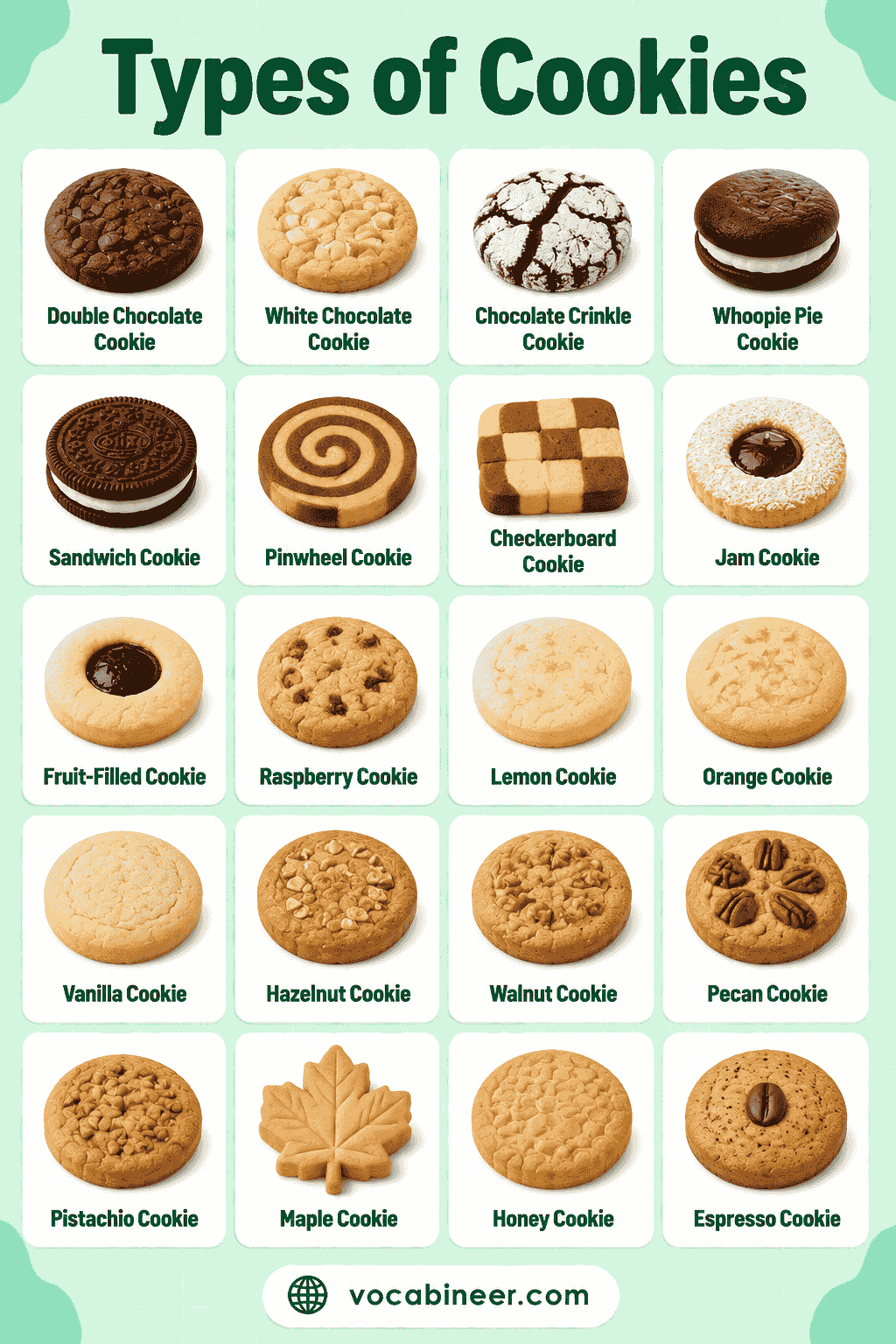
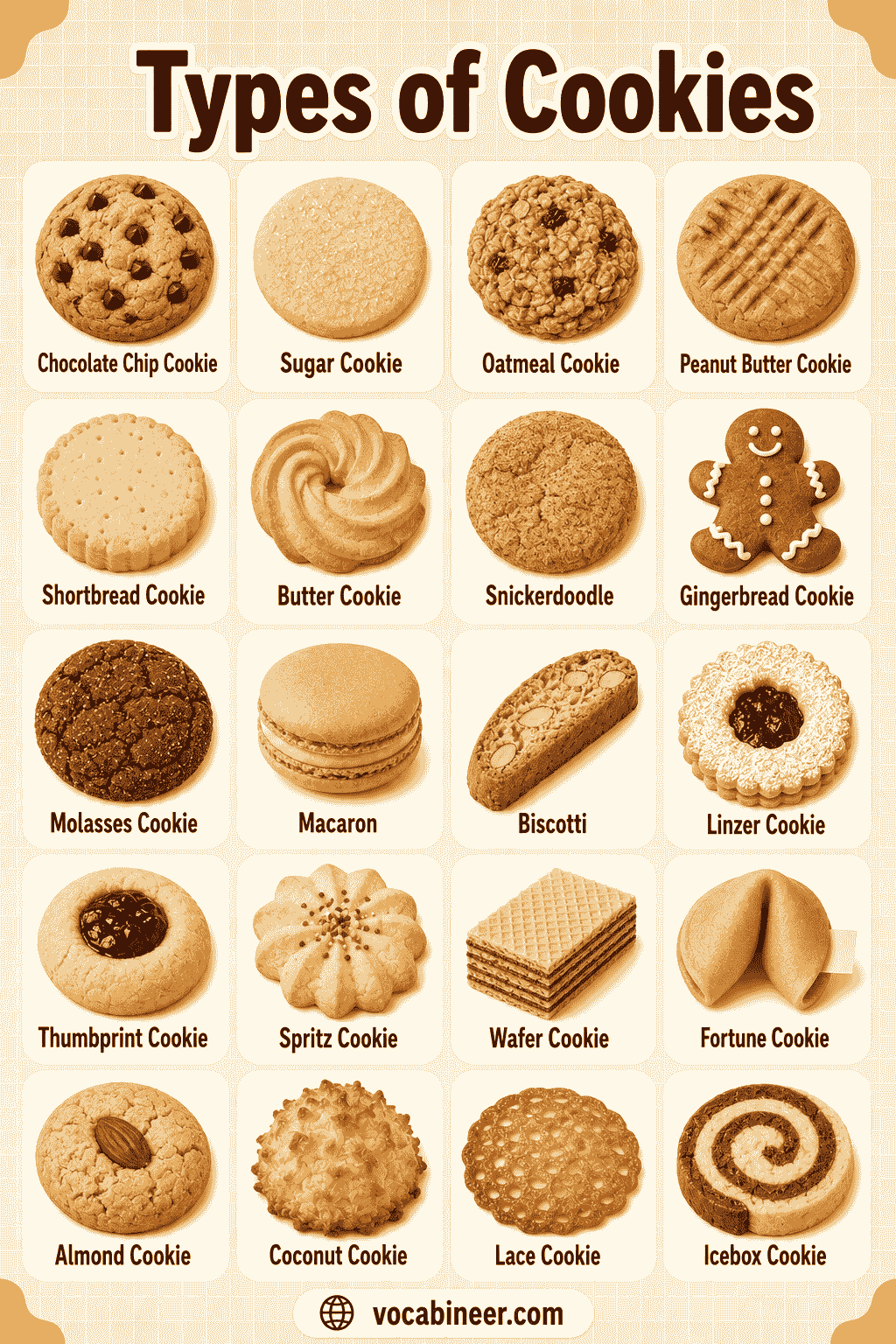
- Chocolate chip cookies — round cookies containing visible chocolate pieces
- Sugar cookies — sweet cookies commonly rolled, shaped, or decorated
- Peanut butter cookies — rich nutty cookies often marked with a fork
- Oatmeal cookies — textured cookies made with rolled oats
- Oatmeal raisin cookies — oat cookies containing raisins
- Shortbread — buttery cookies with a dense, crumbly texture
- Butter cookies — crisp cookies often piped into rings, swirls, or flowers
- Snickerdoodles — soft cookies coated with cinnamon sugar
- Gingerbread cookies — spiced cookies often cut into decorative shapes
- Ginger snaps — thin, crisp cookies with a strong ginger flavor
- Molasses cookies — dark, warmly spiced cookies with a soft or chewy center
- Crinkle cookies — cookies with a cracked surface, often coated in powdered sugar
- Sandwich cookies — two cookies joined with cream, jam, or another filling
- Thumbprint cookies — small cookies with a filled indentation
- Wafer cookies — thin, crisp cookies that may contain layered filling
- Biscotti — long, firm cookies baked twice for a dry crunch
- Macarons — almond-meringue sandwich cookies with smooth shells
- Coconut macaroons — mound-shaped cookies made mainly with coconut
- Spritz cookies — decorative cookies formed with a cookie press
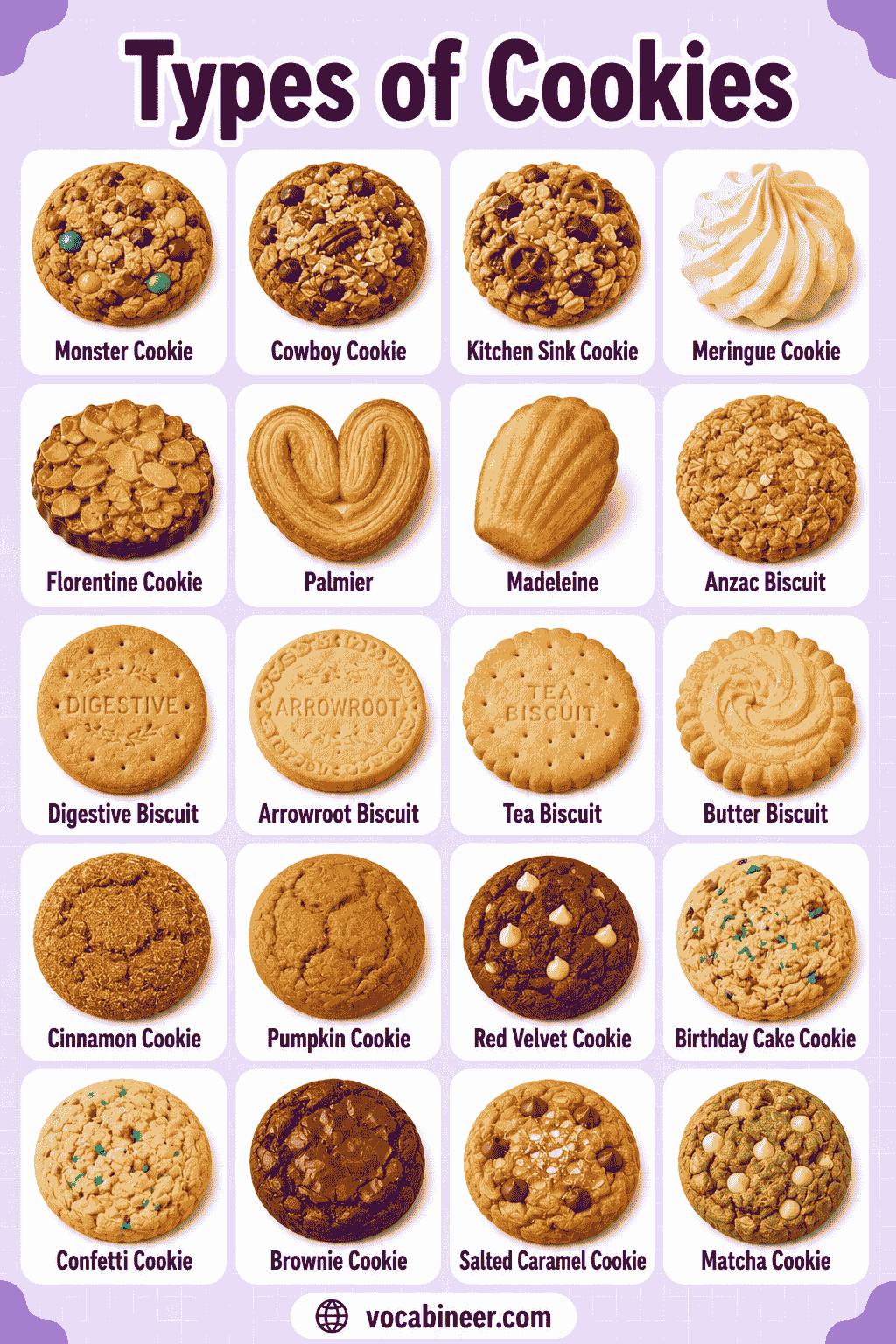
- Madeleines — small shell-shaped sponge cookies
- Fortune cookies — folded crisp cookies containing paper messages
- Linzer cookies — jam sandwich cookies with a cut-out top
- Meringue cookies — light cookies made from whipped egg whites and sugar
- Pinwheel cookies — spiral cookies made from rolled layers of dough
Soft and Chewy Cookie Varieties
Soft cookies bend or break easily, while chewy cookies offer more resistance when bitten. Nevertheless, one cookie type may have several textures depending on its thickness, ingredients, and baking time.
Chocolate Chip Cookies
Chocolate chip cookies usually contain chocolate chips, chunks, or chopped chocolate. Many versions have lightly crisp edges and a soft or chewy center.
Visible chocolate pieces make these cookies easy to recognize. Larger chunks create melted pockets, whereas smaller chips spread more evenly through the dough.
Oatmeal Cookies
Rolled oats give oatmeal cookies a rougher and more textured surface than smooth sugar cookies. Some versions remain soft and thick, while thinner ones develop crisp edges.
Common additions include raisins, nuts, chocolate pieces, spices, or dried fruit.
Peanut Butter Cookies
Peanut butter cookies have a rich nutty flavor and often develop a soft, slightly crumbly texture. A crisscross fork pattern commonly marks the top.
Some bakers add chocolate, jam, or another filling. However, peanut butter remains the defining ingredient.
Snickerdoodles
Snickerdoodles are usually soft cookies coated with cinnamon sugar before baking. Their tops may crack slightly, while the centers remain tender.
Unlike plain sugar cookies, snickerdoodles gain their strongest identity from the cinnamon coating and soft texture.
Molasses Cookies
Dark molasses gives molasses cookies a deep color and a rich flavor. In addition, ginger, cinnamon, cloves, or nutmeg may add warmth.
Many molasses cookies remain soft and chewy, although thinner versions can become crisp around the edges.
Crisp Cookies with a Firm Snap
Crisp cookies contain less moisture than soft varieties. As a result, they break cleanly when bitten.
Biscotti
Biscotti are long, firm cookies traditionally baked twice. Bakers first cook the dough as a log, then slice it and bake the pieces again.
The second bake creates a dry, hard texture that works well with coffee, tea, or hot chocolate.
Ginger Snaps
Ginger snaps are usually thin, round, and strongly spiced. Their name refers to the clean snap associated with their crisp texture.
Compared with gingerbread cookies, ginger snaps are generally thinner and less decorative.
Wafer Cookies
Wafer cookies are thin, light, and delicate. Their surfaces often show a fine grid or patterned texture.
Some wafers appear as single crisp sheets. Meanwhile, layered versions may contain chocolate, vanilla, fruit, or cream filling.
Pizzelle
Pizzelle are thin Italian wafer cookies made with a patterned iron. Their surfaces often display flowers, lace-like details, or geometric designs.
Although fresh pizzelle may feel slightly flexible, they become crisp as they cool.
Fortune Cookies
A fortune cookie is a thin crisp cookie folded around a small paper message. Its curved form makes it instantly recognizable.
The modern version developed through Japanese American and Chinese American restaurant traditions.
Why Some Cookies Crumble
Crumbly cookies break into fine pieces instead of bending or snapping sharply. Usually, a high proportion of fat and a delicate structure create this texture.
Shortbread
Shortbread is rich, dense, and crumbly. Traditional versions rely on a simple mixture of flour, butter, and sugar.
Common shapes include fingers, rounds, wedges, and molded pieces. Chocolate, nuts, citrus zest, or spices may add flavor, but the buttery crumb remains the defining feature.
Butter Cookies
Butter cookies are usually crisp, rich, and decorative. Bakers often pipe or press the dough into rings, swirls, flowers, and ridged strips.
Although butter cookies resemble shortbread, they are often sweeter and slightly lighter in texture.
Polvorón
Polvorón is a very crumbly shortbread-style cookie associated with Spain and several regions influenced by Spanish baking traditions.
Its soft, powdery texture often comes from flour, sugar, fat, and sometimes ground nuts.
Amaretti
Amaretti are Italian almond cookies. Some versions are crisp and brittle, while others remain soft and chewy.
Almond flavor gives them their strongest identity, even though their textures can vary.
How Filling Is Added to Cookies
Cookie fillings may sit between two pieces, remain visible in the center, or stay hidden inside the dough.
Sandwich Cookies
A sandwich cookie places filling between two separate cookies.
Common fillings include:
- vanilla cream
- chocolate cream
- jam
- caramel
- nut butter
- ganache
- marshmallow filling
The outer cookies may be crisp wafers, soft cakes, shortbread rounds, chocolate cookies, or almond-meringue shells.
Center-Filled Cookies
Center-filled cookies hold filling in an open indentation or visible window.
Thumbprint cookies contain a small hollow filled with jam, chocolate, caramel, or nut spread.
Linzer cookies, by contrast, use two layers. A cut-out in the upper cookie reveals the jam underneath.
Stuffed Cookies
A stuffed cookie encloses filling inside the dough. Therefore, the center often remains hidden until the cookie is broken open.
Common fillings include:
- chocolate
- caramel
- nut butter
- cream cheese
- fruit paste
- marshmallow
- cookie spread
Stuffed cookies are often thicker because the dough must surround the filling.
Cookie Shapes with Distinctive Names
Some cookies are easier to recognize by shape than by flavor.
- Madeleines — shell-shaped cookies with ridged lines
- Fortune cookies — folded cookies with curved ends
- Pinwheel cookies — spiral cookies made from contrasting dough layers
- Spritz cookies — ridged flowers, stars, rings, or ribbons
- Gingerbread people — human-shaped cookies decorated with icing
- Ladyfingers — long, narrow sponge cookies
- Crescent cookies — curved cookies shaped like half-moons
- Pizzelle — flat round cookies with pressed patterns
- Macarons — small round sandwich cookies with smooth shells
- Crinkle cookies — cookies with a visibly cracked surface
How Cookies Are Shaped and Prepared
Bakers also classify cookies by the way they handle the dough. These preparation terms describe technique rather than flavor.
Drop Cookies
Drop cookies begin with soft dough placed onto a tray in spoonfuls or scoops. The portions spread as they bake.
Chocolate chip and oatmeal cookies often use this method.
Rolled and Cut-Out Cookies
Bakers flatten rolled-cookie dough before cutting it into shapes.
Sugar cookies and gingerbread cookies commonly use this method because firm dough holds detailed outlines.
Pressed Cookies
A cookie press or piping tool pushes soft dough into decorative forms.
Spritz cookies provide the best-known example, with shapes such as flowers, stars, rings, and ribbons.
Molded Cookies
Bakers shape molded cookies by hand or press the dough into decorative molds.
Patterned shortbread, ma’amoul, and several traditional nut cookies use this style.
Chilled-and-Sliced Cookies
Bakers chill a log or block of dough until firm and then cut it into even slices.
These varieties are also called refrigerator cookies or icebox cookies. Pinwheel cookies often use this method after contrasting dough layers are rolled together.
Pan-Baked Cookies
Pan-baked cookies cook as one large layer inside a baking pan. Afterward, the baker cuts the slab into squares, rectangles, or bars.
Examples include:
- chocolate chip cookie bars
- oat bars
- layered jam bars
- blondies
- shortbread bars
No-Bake Cookies
No-bake cookies set without oven baking. Instead, cooling, chilling, or drying helps them become firm.
Common ingredients include oats, cocoa, coconut, dates, nut butter, and melted chocolate.
Traditional Cookies with International Origins
Many traditional cookies have become recognizable far beyond the places where they developed.
- Biscotti — firm Italian cookies baked twice
- Macarons — almond-meringue sandwich cookies strongly associated with French pastry
- Madeleines — French shell-shaped sponge cookies
- Amaretti — Italian almond cookies that may be crisp or soft
- Pizzelle — thin Italian wafer cookies with pressed patterns
- Ma’amoul — molded Middle Eastern cookies filled with dates, nuts, or fruit paste
- Speculoos — thin spiced cookies associated with Belgium and the Netherlands
- Polvorón — crumbly shortbread-style cookie linked to Spain and other regions
- Alfajores — sandwich cookies commonly filled with dulce de leche
- Linzer cookies — Austrian-inspired jam cookies with a cut-out top
- Coconut macaroons — coconut-based cookies found in several baking traditions
- Fortune cookies — folded message cookies associated with Chinese American restaurants
Cookie Names That Are Commonly Confused
Several cookie names sound similar or share ingredients. However, their shapes, textures, and construction differ.
| Cookie Names | Main Difference |
|---|---|
| Macaron and macaroon | A macaron uses almond-meringue shells and filling, whereas a macaroon is usually a coconut mound. |
| Shortbread and butter cookie | Shortbread is dense and crumbly, while butter cookies are often crisper and more decorative. |
| Sugar cookie and shortbread | Sugar cookies are generally sweeter and easier to roll or decorate; shortbread is richer and more crumbly. |
| Sandwich cookie and filled cookie | A sandwich cookie places filling between two cookies; a filled cookie may hold it in the center or inside the dough. |
| Ginger snap and gingerbread cookie | Ginger snaps are usually thin and crisp, whereas gingerbread cookies are often thicker, shaped, and decorated. |
| Wafer cookie and sandwich cookie | A wafer is defined by its thin crisp layers, while a sandwich cookie is defined by filling between two outer pieces. |
Cookies and Biscuits in American and British English
The words cookie and biscuit do not always mean the same thing in American and British English.
In American English, cookie refers to many small sweet baked foods, including chocolate chip, oatmeal, and sugar cookies. An American biscuit, however, is a soft bread-like baked item.
British English commonly uses biscuit for crisp sweet snacks such as shortbread, digestives, and cream-filled biscuits. However, the word cookie often describes larger, softer, American-style varieties.
| American English | British English |
|---|---|
| cookie | biscuit or cookie |
| sandwich cookie | sandwich biscuit |
| cracker | cracker or savoury biscuit |
| biscuit | no exact everyday equivalent |
FAQs
Common varieties include chocolate chip cookies, sugar cookies, peanut butter cookies, oatmeal cookies, shortbread, butter cookies, sandwich cookies, thumbprint cookies, biscotti, macarons, and gingerbread cookies.
Moisture, ingredients, thickness, preparation, and baking time affect texture. Soft cookies retain more moisture, chewy cookies offer more resistance, and crisp cookies break more cleanly.
A macaron contains two almond-meringue shells joined with filling. A macaroon is usually a mound-shaped coconut cookie.
No. Shortbread is usually dense and crumbly, whereas butter cookies tend to be crisper, sweeter, and more decorative.
American English commonly uses cookie for sweet baked snacks. British English often uses biscuit, while an American biscuit is a soft bread-like food.
Read More
- Types of Food in English
- Different Types of Candy
- Sweets and their Names
- Different Types of Chips
- Types of Chocolate