A bowl of thin potato chips, a plate of triangular tortilla chips, and a handful of crisp plantain chips may all seem similar at first. However, each one gets its name from a different ingredient, texture, shape, or cooking method. Some chips come from sliced potatoes, while others begin as corn dough, pita bread, lentil flour, fruit, or root vegetables.
This guide explains the main types of chips with simple meanings, familiar examples, and clear differences. It also shows how chip names change according to cut, texture, cooking style, flavor, and regional English usage.
In This Page
What Are Chips?
Chips are thin, crisp, or crunchy snack foods made from ingredients such as potatoes, corn, bread, grains, legumes, roots, vegetables, and fruit. Manufacturers may slice the main ingredient directly, or they may shape a dough made from flour, starch, or meal.
Although frying remains common, chips can also be baked, puffed, roasted, dried, or dehydrated. As a result, the word chip describes a broad group of snacks rather than one single food.
The name also changes by region. In American English, chips usually refers to thin crunchy snacks. In British English, people commonly call potato chips crisps, while the word chips usually means thick fried potato strips.
Familiar Chip Names
These are some of the most recognizable chip names found in shops, restaurants, lunch boxes, and snack bowls:
- Potato chips — thin, crispy slices made from potatoes
- Kettle-cooked chips — thick potato chips with a firm crunch
- Ridged chips — potato chips with raised lines across the surface
- Wavy chips — chips with broad curved ridges
- Stacked potato crisps — uniformly shaped crisps made from processed potato
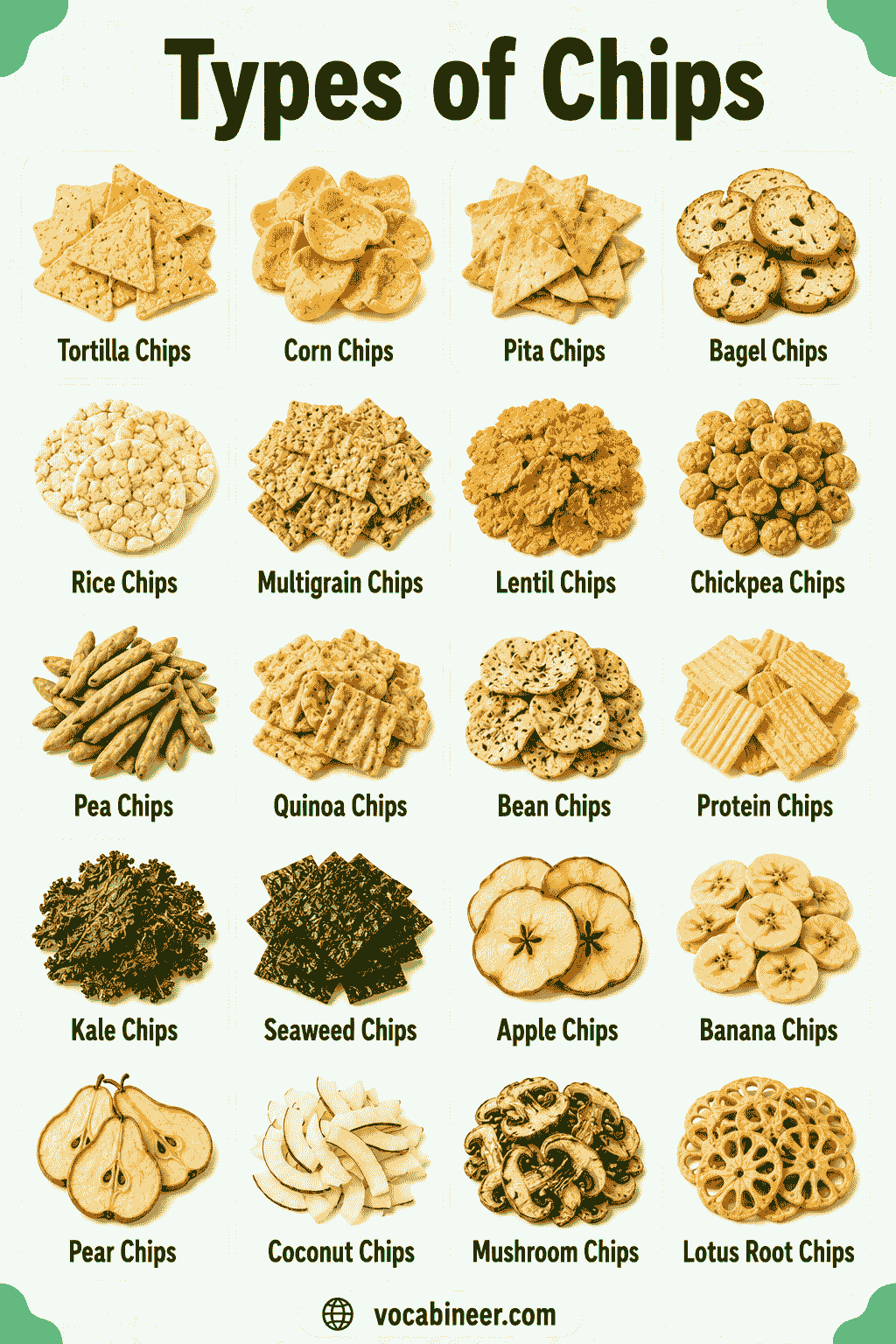
- Tortilla chips — crisp pieces made from corn tortillas
- Corn chips — crunchy snacks formed from cornmeal or corn dough
- Pita chips — baked or fried pieces of pita bread
- Sweet potato chips — crisp slices made from sweet potatoes
- Cassava chips — crunchy chips made from cassava root
- Taro chips — thin chips made from sliced taro
- Vegetable chips — chips made from vegetables such as beet, carrot, or kale
- Lentil chips — shaped snacks made with lentil flour or dough
- Chickpea chips — crunchy chips made from chickpeas or chickpea flour
- Rice chips — light, crisp snacks made mainly from rice
- Multigrain chips — chips made from a mixture of grains
- Banana chips — dried, baked, or fried banana slices
- Plantain chips — firm chips made from sliced plantains
- Apple chips — thin apple slices baked or dried until crisp
- Puffed chips — light, airy chips expanded with heat or pressure
Potato Chips by Cut and Texture
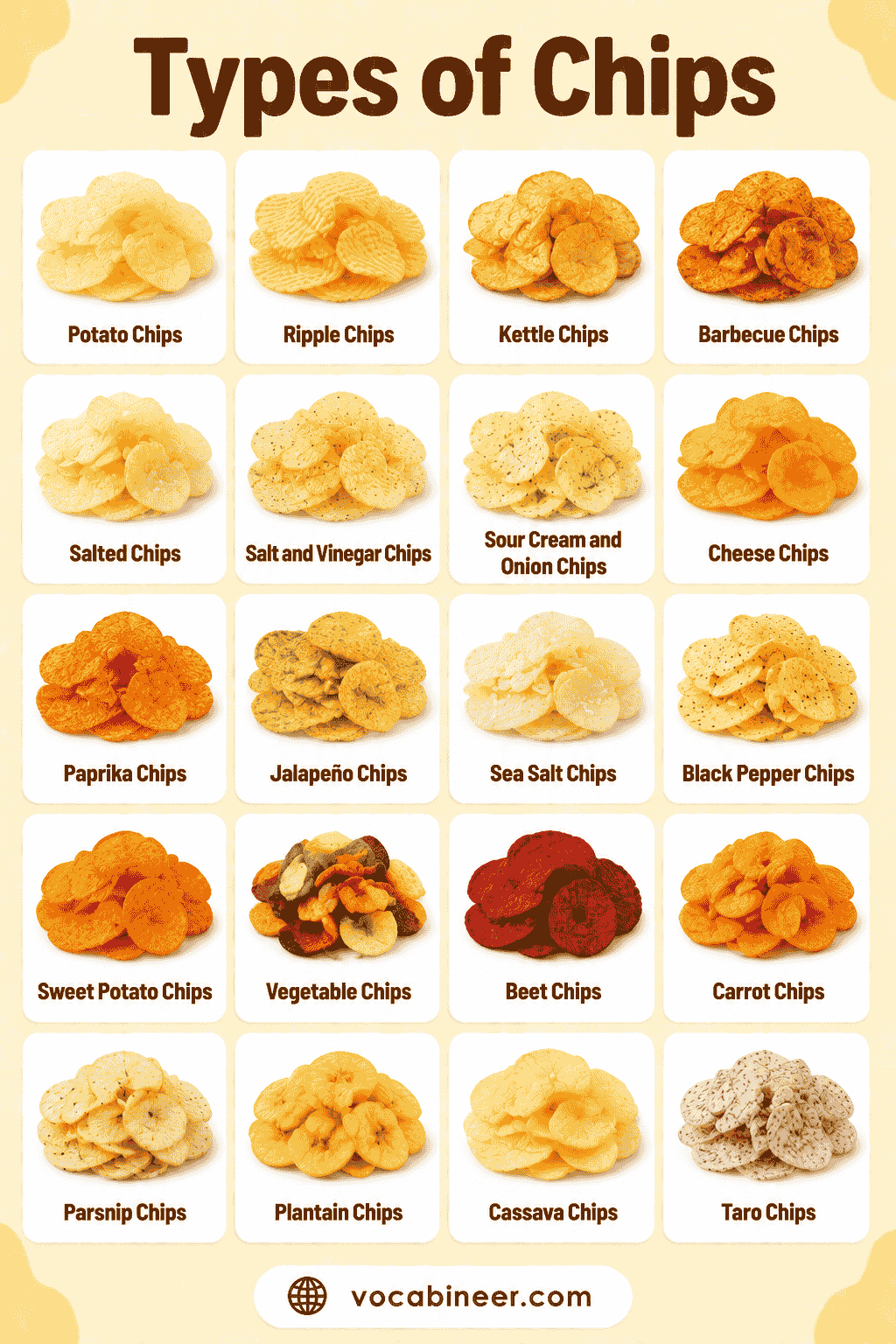
Potato chips are among the most familiar snack chips. Producers usually make them by slicing potatoes, cooking the slices until crisp, and adding seasoning. However, the cut and texture can create several distinct styles.
Classic Potato Chips
Classic potato chips are thin, light, and crisp. Because they have a delicate texture, they break more easily than thick-cut or ridged varieties.
Common forms include:
- plain salted potato chips
- lightly salted potato chips
- unsalted potato chips
- thin-cut potato chips
- skin-on potato chips
Kettle-Cooked Chips
Kettle-cooked chips are generally thicker and harder than classic potato chips. Their surface often looks less uniform, while their crunch feels firmer.
The name refers to the cooking style rather than the flavor. Therefore, a kettle-cooked chip may still come in salted, barbecue, cheese, chili, or vinegar varieties.
Ridged and Wavy Chips
Ridged chips have raised lines that run across the surface. Wavy chips have broader curves, although people sometimes use the two names loosely.
Because these chips are usually thicker than smooth potato chips, they often hold heavy dips more effectively. Their textured surfaces can also carry more seasoning.
Stacked Potato Crisps
Stacked potato crisps differ from sliced potato chips. Instead of cutting whole potatoes into individual slices, manufacturers usually form them from processed potato ingredients and press them into a uniform curved shape.
As a result, each crisp looks almost identical in size, thickness, and curve.
Tortilla Chips
Tortilla chips are usually made from corn tortillas cut into pieces and cooked until crisp. Although triangular chips are the most familiar, tortilla chips may also appear as rounds, strips, rolls, or scoop-shaped cups.
Common tortilla chip styles include:
- yellow corn tortilla chips
- white corn tortilla chips
- blue corn tortilla chips
- restaurant-style tortilla chips
- scoop tortilla chips
- rolled tortilla chips
- baked tortilla chips
Tortilla chips commonly accompany salsa, guacamole, bean dip, cheese dip, and nacho toppings. Because of their broad flat surface, they also work well as a base for layered snacks.
Corn Chips
Corn chips are made from cornmeal, masa, or another corn-based mixture that producers shape before cooking. Unlike tortilla chips, they do not usually begin as prepared tortillas.
Corn chips often have a denser texture and a stronger corn taste. Their forms include:
- flat corn chips
- scoop-shaped corn chips
- rolled corn chips
- puffed corn chips
- curved corn chips
- corn strips
Some versions suit dipping, while others work better as small handheld snacks.
Pita and Bread-Based Chips
Pita chips begin as pita bread. Bakers cut the bread into wedges or strips and then bake or fry the pieces until crisp.
Compared with tortilla chips, pita chips usually feel thicker and more bread-like. They commonly appear with hummus, yogurt dips, soft cheese, or olive-based spreads.
Other bread-based chips include:
- bagel chips — thin toasted bagel slices
- bread crisps — small baked or toasted bread pieces
- flatbread chips — crisp pieces made from thin flatbread
- crostini-style crisps — small toasted bread slices
These snacks rely on bread rather than potatoes, corn dough, or vegetables.
Root and Vegetable Chips
Root and vegetable chips expand the category beyond potatoes. Some versions use real sliced vegetables, while others combine vegetable powder with flour, starch, or another base.
Root and Tuber Chips
Roots and tubers usually produce firm slices that become crisp when fried, baked, or dehydrated.
Common examples include:
- sweet potato chips — slightly sweet chips made from sweet potato
- cassava chips — crisp slices made from cassava root
- taro chips — firm chips made from sliced taro
- beet chips — colorful chips with an earthy taste
- carrot chips — thin carrot slices cooked until crisp
- parsnip chips — lightly sweet chips made from parsnips
Leafy and Other Vegetable Chips
Leafy vegetables and other produce create lighter or more delicate chips.
Examples include:
- kale chips
- spinach chips
- okra chips
- zucchini chips
- green bean chips
- tomato chips
- pumpkin chips
- seaweed chips
Kale chips and seaweed chips usually look very different from sliced root chips. Nevertheless, both fit within the broader vegetable-chip category because their main ingredient comes from plant material rather than potato, corn, or bread.
Lentil, Bean, and Pea Chips
Legume-based chips use lentils, beans, peas, or chickpeas. Since these ingredients do not usually form thin natural slices, producers often grind them into flour or dough before shaping the chips.
Common types include:
- lentil chips
- chickpea chips
- black bean chips
- pea chips
- broad bean chips
- mixed bean chips
Their shapes may be flat, triangular, scooped, rolled, or puffed. In addition, many legume chips have a dense crunch because of the flour-based mixture.
Rice and Other Grain Chips
Grain-based chips use rice, wheat, oats, quinoa, corn, or several grains together. Depending on the recipe, they may be baked, fried, puffed, or pressed.
Common grain chip names include:
- rice chips
- multigrain chips
- quinoa chips
- oat chips
- wheat crisps
- whole-grain chips
A multigrain chip does not describe one single grain. Instead, it combines two or more grains, such as corn, rice, oats, wheat, or quinoa.
Banana, Plantain, and Other Fruit Chips
Fruit chips are usually made by drying, baking, freeze-drying, or frying fruit slices. Some become light and brittle, whereas others remain slightly chewy.
Banana Chips
Banana chips come from sliced bananas. They may be dried, baked, or fried, and sweetened versions may include sugar, honey, or cinnamon.
Familiar styles include:
- dried banana chips
- fried banana chips
- sweetened banana chips
- unsweetened banana chips
- cinnamon banana chips
Plantain Chips
Plantain chips come from sliced plantains. Green plantains usually create firm, savory chips, while ripe plantains can produce sweeter versions.
Common plantain chip flavors include:
- salted plantain chips
- chili plantain chips
- lime plantain chips
- sweet plantain chips
- ripe plantain chips
Other Fruit Chips
Many fruits can become chips when producers remove enough moisture.
Examples include:
- apple chips
- coconut chips
- pineapple chips
- jackfruit chips
- mango chips
- pear chips
- peach chips
- strawberry chips
Coconut chips often appear as curved flakes, while apple and pear chips usually keep a round sliced shape.
How Chips Are Cooked
The cooking method can change a chip’s texture, color, and crunch. However, it does not always define the main chip category. For example, a potato chip may be baked or fried, and a lentil chip may be puffed or baked.
Fried Chips
Frying cooks the chip in hot oil. This method commonly produces:
- potato chips
- tortilla chips
- corn chips
- plantain chips
- banana chips
- cassava chips
Fried chips often have a crisp surface and a rich texture.
Baked Chips
Baked chips cook in an oven rather than in a deep fryer.
Examples include:
- baked potato chips
- baked tortilla chips
- baked pita chips
- baked sweet potato chips
- baked vegetable chips
- baked lentil chips
Because baked describes the cooking method, it can appear alongside another label. Therefore, a chip may be both baked and ridged, baked and multigrain, or baked and tortilla-based.
Puffed Chips
Puffed chips expand when heat or pressure causes their ingredients to form a light, airy structure.
Common varieties include:
- puffed corn chips
- puffed rice chips
- puffed potato chips
- puffed pea chips
- puffed lentil chips
- puffed multigrain chips
Dried and Dehydrated Chips
Drying removes moisture without necessarily frying the food. Fruit and vegetable chips commonly use this method.
Examples include:
- dried apple chips
- dehydrated banana chips
- dried coconut chips
- dehydrated beet chips
- dried kale chips
Shapes Designed for Dips and Toppings
Some chips are shaped specifically to carry dips, salsa, cheese, or toppings. In general, deep curves and thick surfaces make dipping easier.
Useful dipping styles include:
- scoop chips — curved chips that hold dip
- bowl-shaped chips — small cup-like chips for thick toppings
- ridged chips — textured chips that grip creamy dips
- rolled chips — tube-shaped chips with a firm crunch
- thick-cut chips — sturdy chips that resist breaking
- pita chips — broad bread-based pieces suited to hummus
- restaurant-style tortilla chips — wide chips often used for salsa or nachos
Thin classic potato chips can still work with light dips, but they may break under heavier toppings.
Popular Chip Flavors
A chip flavor describes the seasoning rather than the ingredient, texture, or shape. For instance, barbecue chips can be potato-based, corn-based, ridged, baked, or kettle-cooked.
Common chip flavors include:
- salted chips — seasoned mainly with salt
- barbecue chips — smoky, sweet, and savory
- cheese chips — coated with cheese-flavored seasoning
- sour cream and onion chips — creamy and onion-flavored
- salt and vinegar chips — sharp and tangy
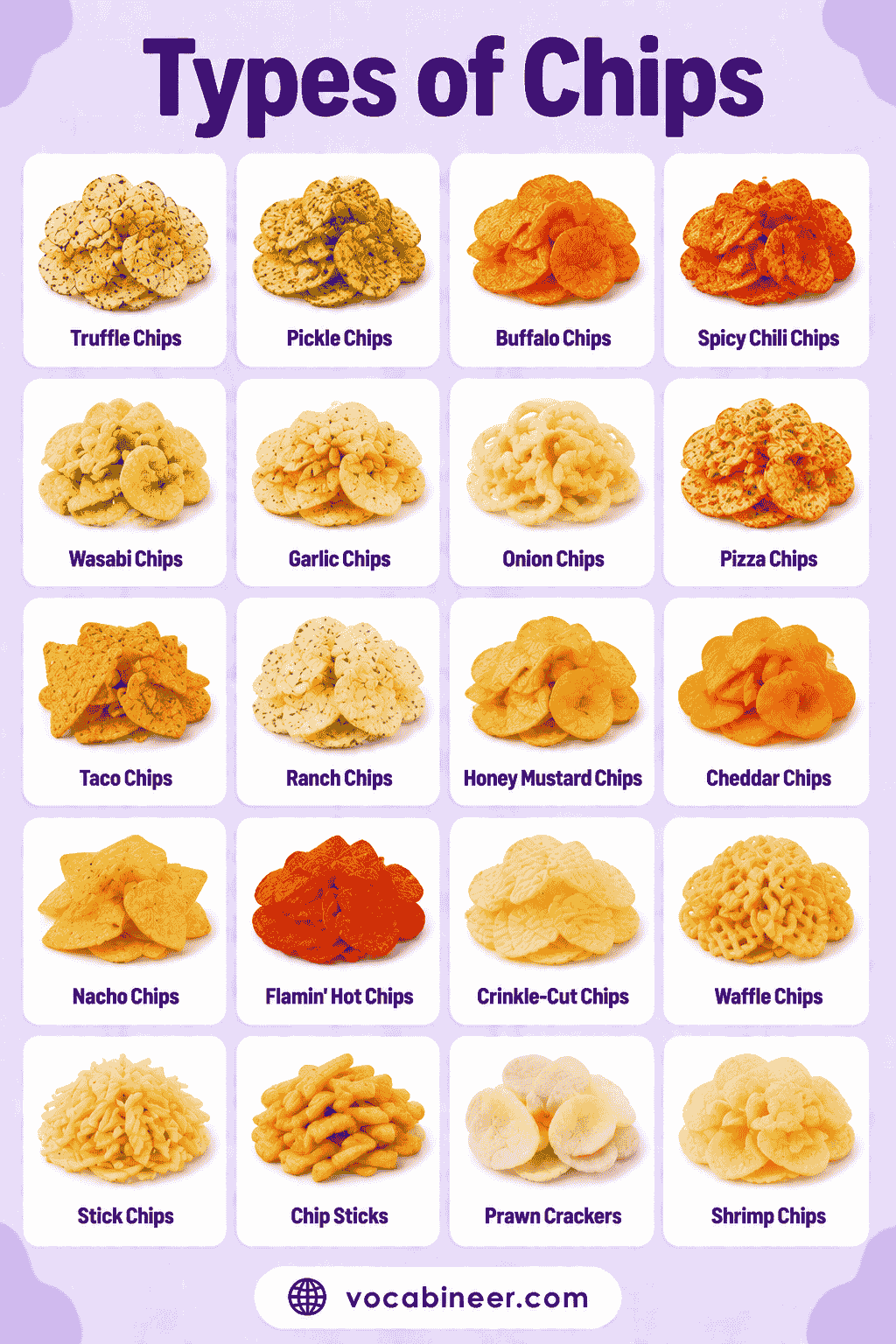
- chili chips — seasoned with chili
- jalapeño chips — flavored with hot pepper seasoning
- ranch chips — seasoned with herbs and creamy flavors
- lime chips — bright citrus-flavored chips
- spicy chips — made with hot seasoning blends
Tortilla Chips and Corn Chips Compared
Tortilla chips and corn chips both use corn, but their preparation and texture differ.
| Feature | Tortilla Chips | Corn Chips |
|---|---|---|
| Starting base | Corn tortillas | Cornmeal, masa, or corn dough |
| Common shape | Triangle or round | Strip, curve, scoop, roll, or puff |
| Texture | Usually flatter and lighter | Usually denser and crunchier |
| Typical use | Salsa, guacamole, and nachos | Snacking and dipping |
| Corn flavor | Often mild | Often stronger |
Banana Chips and Plantain Chips Explained
Banana chips and plantain chips may look alike, but their flavors and textures are different. Usually sweeter and slightly lighter, banana chips may be dried, baked, or fried. Depending on the variety, they may also contain sugar, honey, or cinnamon.
By contrast, plantain chips often have a firmer crunch. Green plantains create savory chips, whereas ripe plantains produce sweeter versions. The main difference comes from the fruit itself rather than the shape of the finished chips.
Chips and Crisps in Different English Varieties
The meaning of chips changes between American and British English.
| American English | British English |
|---|---|
| potato chips | crisps |
| French fries | chips |
| thick-cut fries | chips |
| tortilla chips | tortilla chips |
| corn chips | corn chips or corn snacks |
Therefore, an American asking for chips may expect thin potato snacks, while a British speaker may expect fried potato strips.
FAQs
The main types include potato chips, tortilla chips, corn chips, pita chips, vegetable chips, root chips, lentil chips, grain chips, banana chips, plantain chips, and other fruit chips.
Tortilla chips usually begin as corn tortillas that are cut and cooked. Corn chips are shaped directly from cornmeal, masa, or corn dough.
Kettle-cooked chips are thick potato chips with a firm crunch and a less uniform surface than classic thin potato chips.
No. Banana chips usually taste sweeter and may have a lighter texture, while plantain chips are often firmer and more savory.
British English uses crisps for thin crunchy potato snacks. The word chips usually refers to fried potato strips.
Read More
- Types of Food in English
- Street Food Items Names
- Sweets and their Names
- Breakfast Food Names
- Packaged Food Names
- Different Types of Candy