A hard popcorn kernel can burst into a delicate flake with thin wings or a compact, rounded piece strong enough to hold caramel. Before popping, kernels also differ in colour, size, and shape.
Because popcorn names describe different stages of the same food, they can seem confusing at first. Some terms identify the raw kernel, while others refer to the popped flake, cooking method, or finished flavour.
Types of Popcorn with Names & Pictures: Easy Guide
- advertisements -
In This Page
Why Popcorn Names Describe Different Things
Popcorn is a type of maize with a hard outer hull and a small amount of moisture inside. As the kernel heats, that moisture becomes steam, pressure builds, and the softened starch expands when the hull breaks.
A popcorn name may describe:
Popped flake: butterfly or mushroom
Kernel shape: pearl or rice-shaped
Hull colour: white, yellow, red, blue, purple, black, or mixed
Commercial size: baby, medium, large, or extra-large
Cooking method: air-popped, stovetop, microwave, or machine-popped
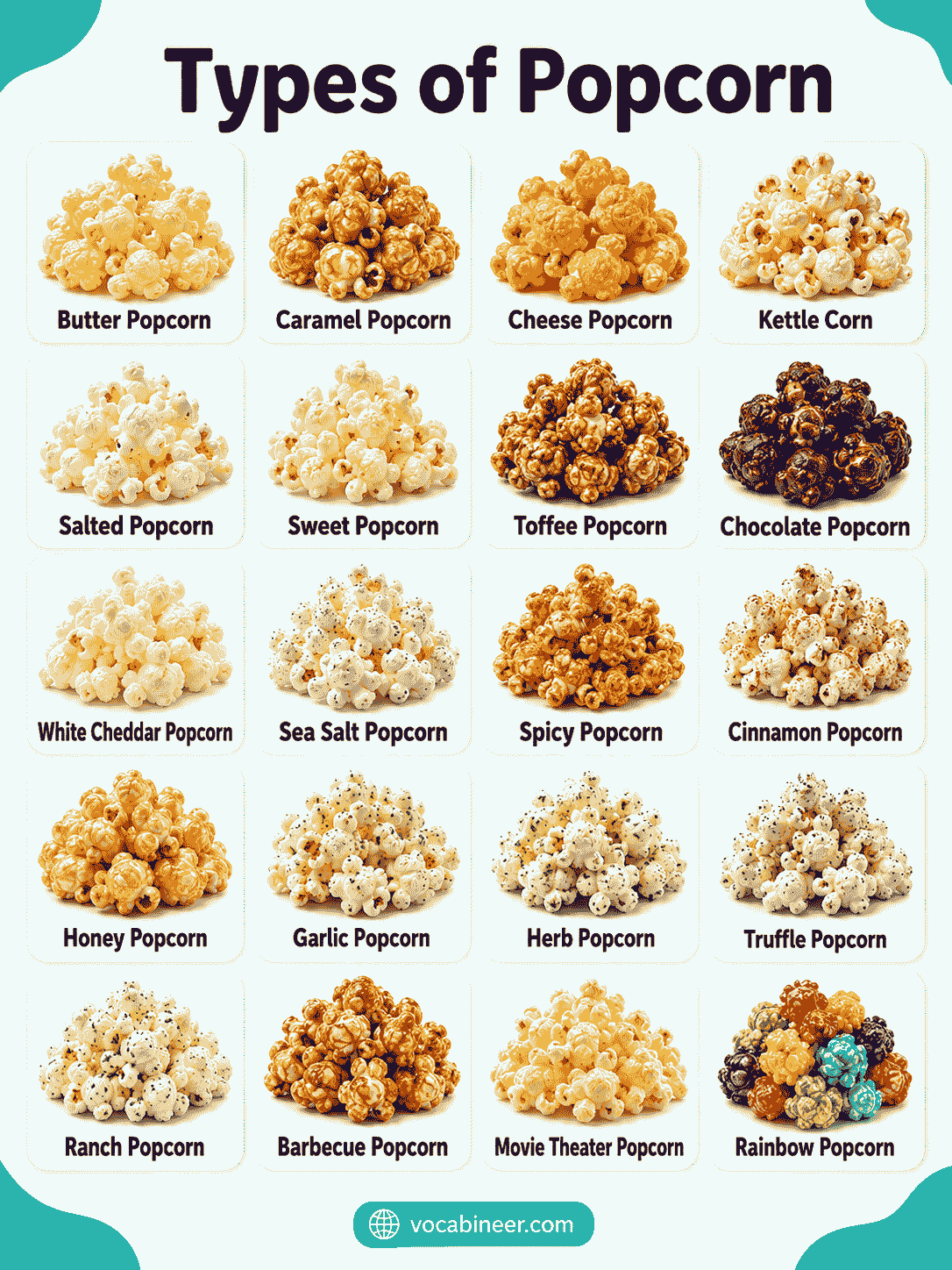
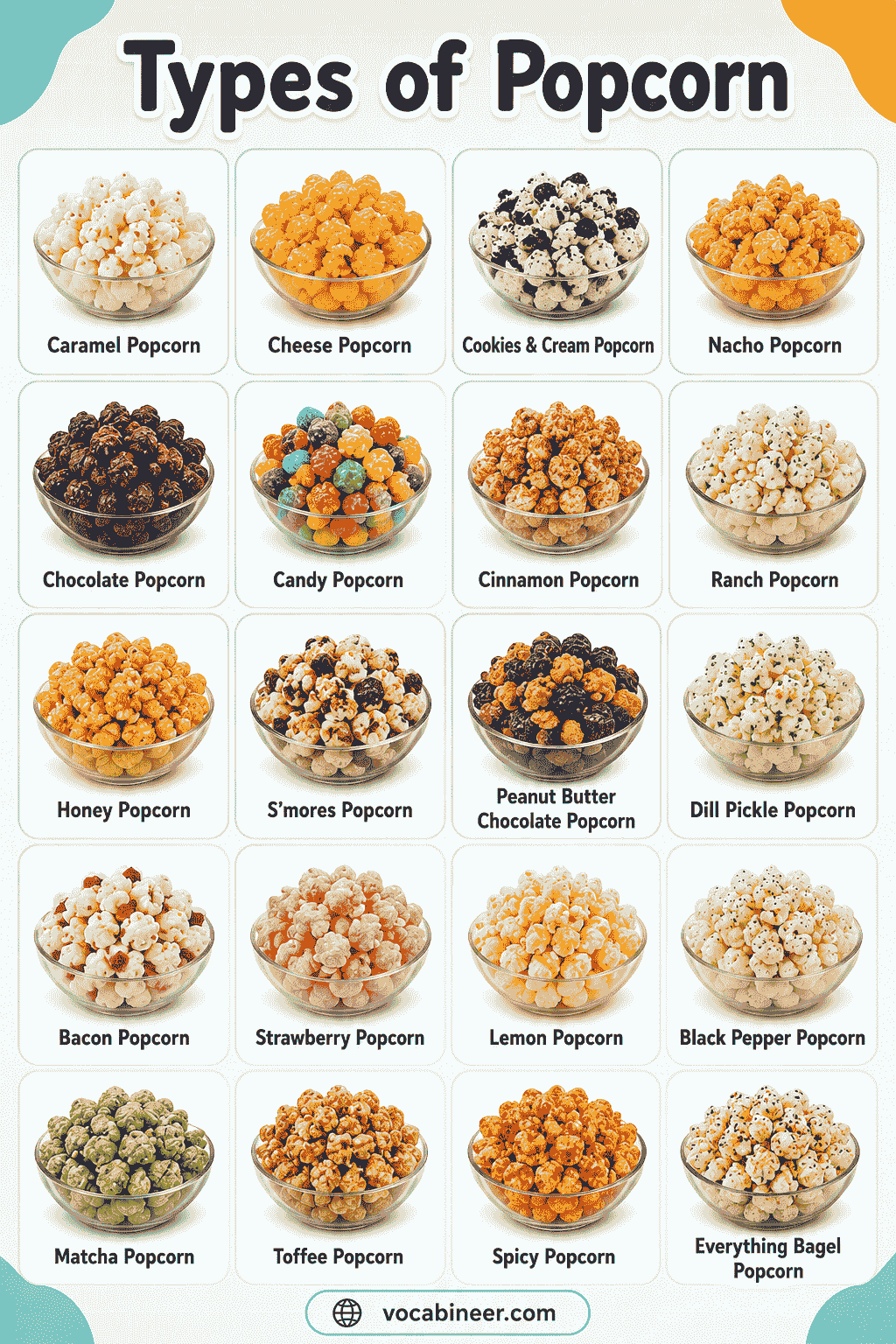
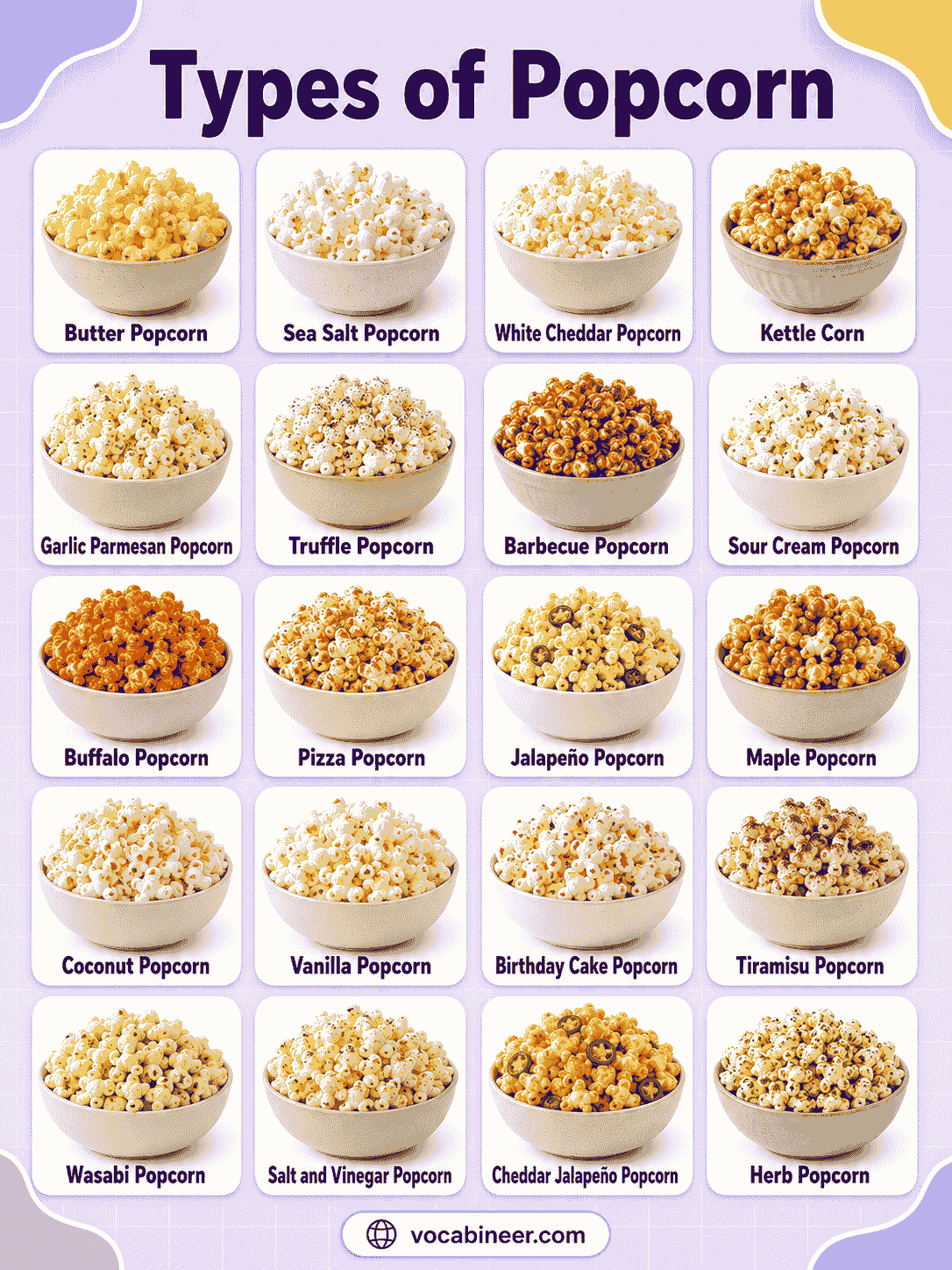
Finished snack: buttered, kettle, caramel, cheese, chocolate, or spicy popcorn
These features often overlap in one bowl. For example, a yellow pearl-shaped kernel may produce a butterfly flake, cook on the stovetop, and then receive cheese seasoning.
However, gourmet popcorn is not one fixed variety. Sellers use the term for speciality kernels, premium coatings, unusual flavours, small-batch products, or gift packaging.
Butterfly Popcorn vs. Mushroom Popcorn
Butterfly and mushroom are the two main commercial shapes used to describe popcorn after the kernel bursts. In other words, these names identify the expanded flake rather than the colour, size, or form of the original kernel.
Butterfly popcorn, also called snowflake popcorn, opens into an irregular flake with several thin wings. Because its surface has many crevices, it catches butter, fine salt, herbs, and powdered seasoning easily.
Mushroom popcorn produces a rounder, denser flake with fewer fragile projections. By contrast, its compact shape withstands stirring and heavy coatings better than butterfly popcorn.
Feature
Butterfly popcorn
Mushroom popcorn
Popped shape
Irregular with several wings
Rounded and compact
Texture
Light and delicate
Dense and sturdy
Breakage
More fragile during mixing
More resistant to breakage
Best use
Butter, salt, herbs, light powders
Caramel, chocolate, toffee, thick coatings
Other name
Snowflake popcorn
Usually called mushroom popcorn
The weight of the topping usually determines the better shape:
Choose butterfly popcorn for melted butter, salt, herbs, and light cheese powder.
Use mushroom popcorn for caramel, chocolate, toffee, and thick savoury coatings.
Pick larger flakes when visual volume matters.
Select smaller flakes for lightly seasoned everyday snacking.
Pearl and Rice-Shaped Popcorn Kernels
Pearl and rice-shaped popcorn describe what the kernel looks like before heating. Although either form may later produce a butterfly or mushroom flake, the two kernel shapes are easy to tell apart before popping.
Pearl popcorn has a smooth, rounded kernel with a curved crown. It is often associated with commercial yellow popcorn, although colour and kernel shape are not permanently linked.
Rice-shaped popcorn kernel is narrower and more elongated, with one or two pointed ends. Despite the name, it is still maize; rice-shaped refers only to its appearance.
The difference is visible before popping:
Pearl kernels are rounded and compact.
Rice-shaped kernels are longer and pointed.
Neither form guarantees a particular popped-flake shape.
Modern white and yellow varieties may use either kernel form.
Popcorn Kernel Colours
Popcorn colour mainly belongs to the hard outer hull. Once the pale starch expands, most flakes become white, cream, or light yellow, although coloured hull pieces often remain near the centre.
White popcorn has white or cream-coloured kernels and belongs to one of the main commercial groups. Since white varieties come in several sizes, colour alone does not determine tenderness or flake size.
Yellow popcorn has yellow or golden kernels and appears widely in cinemas, packaged products, and concession stands. Meanwhile, commercial forms range from small kernels to varieties bred for larger flakes.
Red popcorn carries a red, burgundy, or maroon hull. After popping, the flake turns pale while reddish hull fragments remain visible around the centre.
Blue popcorn has blue-grey, navy, or indigo kernels. Once heated, its expanded starch appears mostly pale, with darker pieces of the original hull still attached.
Purple popcorn has a purple outer covering before heating. However, its final size, flavour, and texture depend more on the specific variety and preparation than on colour alone.
Black popcorn uses very dark brown or black kernels. As a result, it generally pops into a pale flake marked by dark hull fragments.
Multicoloured popcorn, often sold as rainbow or calico popcorn, may come from a mixed-colour cultivar or a blend of several varieties. Each individual kernel normally has one dominant hull colour.
White Popcorn and Yellow Popcorn
White and yellow identify colour groups rather than guaranteed differences in flavour, tenderness, or popped shape.
White popcorn commonly appears in small-kernel varieties, while yellow popcorn is widely sold in small, medium, and large commercial forms. Even so, two cultivars of the same colour may differ more than one white and one yellow variety.
Traditional commercial descriptions often connect white popcorn with rice-shaped kernels and yellow popcorn with pearl-shaped kernels. Nevertheless, modern varieties do not always follow that pattern.
Colour after popping: Red, blue, purple, and black kernels normally produce pale flakes with coloured hull pieces near the centre.
Different Types of Popcorn and Their Key Differences
Small-Kernel Popcorn and Market Size Names
Words such as baby, medium, large, and extra-large are commercial descriptions rather than universal scientific categories. Therefore, exact kernel and flake sizes can differ between producers.
Baby white popcorn refers to small white kernels that produce petite flakes. Sellers often promote it for its delicate size and relatively fine hull fragments.
Baby yellow popcorn uses smaller yellow kernels than many standard yellow products. Because the flakes stay compact, they suit plain snacking and light seasonings.
Ladyfinger popcorn is a small type with narrow, elongated kernels. It produces petite flakes and commonly appeals to people who prefer less noticeable hull pieces.
Medium, large, and extra-large popcorn are broad market-size labels. Although larger kernels often produce greater visual volume, one supplier’s large popcorn may resemble another company’s extra-large variety.
Larger flakes commonly suit:
cinema and event servings
gift tins and display bowls
caramel and chocolate coatings
products where visible flake size matters
What Hulless Popcorn Really Means
Every popcorn kernel needs a strong outer hull to contain the steam pressure required for popping. Therefore, popcorn cannot be completely hull-free before it bursts.
Hulless popcorn usually describes a small or thin-hulled variety whose shell breaks into finer, less noticeable fragments. The label does not mean that every hull piece disappears.
Air-Popped, Stovetop, Microwave, and Machine Popcorn
Preparation names describe how heat reaches the kernel rather than identifying a different botanical variety. The same popcorn can often cook through several methods.
Air-popped popcorn uses circulating hot air without requiring cooking oil. As a result, it begins with a dry surface, although butter, oil, salt, or seasoning may be added afterward.
Stovetop popcorn cooks in a covered pot or pan over direct heat. Most versions use a small amount of oil because it spreads heat evenly and helps seasonings stick.
Microwave popcorn cooks in a microwave-safe bag, bowl, or popper. Depending on the product, the package may already contain oil, salt, sugar, or butter-style flavouring.
Commercial-machine popcorn comes from dedicated popping equipment, usually in larger batches. Cinemas, stadiums, fairs, and concession stands commonly use this method.
Oil-popped popcorn: Oil can be used in stovetop, microwave, or commercial-machine preparation, so the term describes a cooking detail rather than a separate kernel type.
Popcorn Styles Created After Popping
Many familiar popcorn “types” are actually finished snack styles. Salt, butter, sugar, cheese, chocolate, and spices change the flavour and surface without changing the original kernel variety.
Plain and Lightly Seasoned Popcorn
Light finishes preserve the natural shape and crispness of the flake. Butterfly popcorn works especially well because its uneven wings catch fine seasoning.
Plain popcorn has no major coating beyond any fat used during cooking. Its taste depends mainly on the kernel and preparation method.
Salted popcorn uses salt as its main seasoning. A small amount of butter or oil helps fine grains cling more evenly.
Buttered popcorn receives melted butter, clarified butter, butter-flavoured oil, or another butter-style topping. Consequently, the coating may range from a light drizzle to a rich finish.
Cinema-style popcorn commonly combines machine-popped butterfly flakes with oil, fine salt, and a butter-style topping. In addition, its large flakes create a light bite and generous bowl volume.
Kettle Corn, Caramel Popcorn, and Chocolate Popcorn
These styles all add sweetness, but their coatings differ in thickness and preparation. Kettle corn remains lightly glazed, whereas caramel and chocolate create heavier coverings.
Kettle corn combines sugar and salt during or close to the popping process. Therefore, it develops a thin, crisp glaze with a clear sweet-and-salty balance.
Caramel popcorn receives a cooked sugar-based mixture that hardens around the flakes as it cools. Mushroom popcorn often performs well because it resists breakage during coating.
Types of Popcorn Explained from Kernel to Finished Snack
Feature
Kettle corn
Caramel popcorn
Sweetness
Light to moderate
Richer and heavier
Salt
Central to the flavour balance
Optional or secondary
Coating
Thin sugar glaze
Thick caramel shell
Texture
Light and crisp
Harder and more coated
Suitable flake
Butterfly or mushroom
Mushroom usually handles coating better
Chocolate popcorn carries a chocolate drizzle, cocoa coating, or firmer chocolate shell. Similarly, dense mushroom flakes generally support heavy chocolate more effectively than delicate butterfly flakes.
Savoury Seasoned Popcorn
Cooks may dust powdered seasonings directly over the flakes or mix them with a little butter or oil to improve adhesion. Light coatings suit butterfly flakes, while heavier mixtures may perform better on mushroom popcorn.
Cheese popcorn carries cheese powder, grated cheese, or cheese-flavoured seasoning. Cheddar is especially common, although Parmesan and other cheese styles also appear.
Spicy popcorn may contain chilli, cayenne, paprika, jalapeño, black pepper, or mixed spices. Depending on the blend, its heat can range from gentle warmth to a strong finish.
Herb-and-garlic popcorn combines dried herbs, garlic powder, garlic-infused butter, or roasted garlic seasoning. For example, rosemary, thyme, basil, oregano, and dill all work well in savoury blends.
Popcorn and Puffcorn Are Different Foods
Although popcorn and puffcorn may look similar, they start as different products. Intact whole kernels create popcorn, whereas processed cornmeal or corn grits usually form puffcorn.
Whole-kernel popcorn expands when steam pressure breaks the kernel’s natural hull. The result is an irregular flake that may be butterfly-shaped, mushroom-shaped, tender, or dense.
Puffcorn usually expands through extrusion or another manufacturing process. By contrast, its pieces are often more uniform, airy, and free from the hull fragments found in whole-kernel popcorn.
The clearest differences are:
Starting material: whole kernels for popcorn; processed cornmeal or grits for puffcorn
Expansion: internal steam pressure for popcorn; extrusion or industrial puffing for puffcorn
Shape: naturally irregular flakes for popcorn; more uniform pieces for puffcorn
Hull: small hull fragments remain on popcorn; puffcorn has no original popcorn hull
FAQs
What are the two main shapes of popped popcorn?
Butterfly and mushroom are the two main commercial flake shapes. Butterfly popcorn has several irregular wings, while mushroom popcorn forms a rounder, sturdier piece.
Is snowflake popcorn different from butterfly popcorn?
No. Snowflake popcorn is another common name for butterfly popcorn rather than a separate third shape.
Does red, blue, or purple popcorn stay coloured after popping?
Not completely. The pale inner starch expands outward, while pieces of the original coloured hull remain visible near the centre.
Is hulless popcorn really free of hulls?
No. Every kernel needs an outer hull to trap the steam pressure required for popping. Hulless varieties simply leave smaller or less noticeable fragments.
Which popcorn type is best for caramel?
Mushroom popcorn is generally the strongest choice because its compact flakes resist breakage during stirring and hold thick caramel coating more evenly.
Clara Wren is the founder and lead editor of Vocabineer, where she has taught English to adult learners for more than a decade. A Cambridge CELTA holder with an MA in Applied Linguistics and TESOL, she has taught in classrooms across Spain and Vietnam and now teaches online, and she writes every Vocabineer lesson around the questions real learners bring to class.