

A bakery counter can display curved croissants, glossy éclairs, spiral rolls, crisp tarts, tube-shaped cannoli, and savory filled pastries side by side. Although they all belong to the broad pastry family, their doughs, shapes, fillings, textures, and preparation styles make each one different.
This guide explains common pastry names through simple meanings, visible features, pronunciation support, and clear comparisons. It focuses on finished pastries rather than recipes, ingredient measurements, baking temperatures, commercial brands, or lengthy technical instructions.
In This Page
What Is a Pastry?
A pastry is a baked or fried food made from dough that usually contains flour and fat. Depending on its ingredients and preparation, the finished food may become flaky, airy, crisp, tender, layered, firm, or crumbly.
Some pastries contain fruit, custard, cream, chocolate, nuts, cheese, meat, vegetables, or herbs. Others gain their identity from a distinctive shape, such as a crescent, spiral, shell, horn, triangle, tube, or folded pocket.
The word pastry can describe two related things:
- Pastry dough — the uncooked base used to make a pastry
- Finished pastry — the baked or fried food made from that dough
For example, choux pastry names a dough, whereas an éclair is a finished pastry made from it. Similarly, puff pastry creates foods such as turnovers, palmiers, cream horns, vol-au-vents, and mille-feuille.
Common Pastry Names
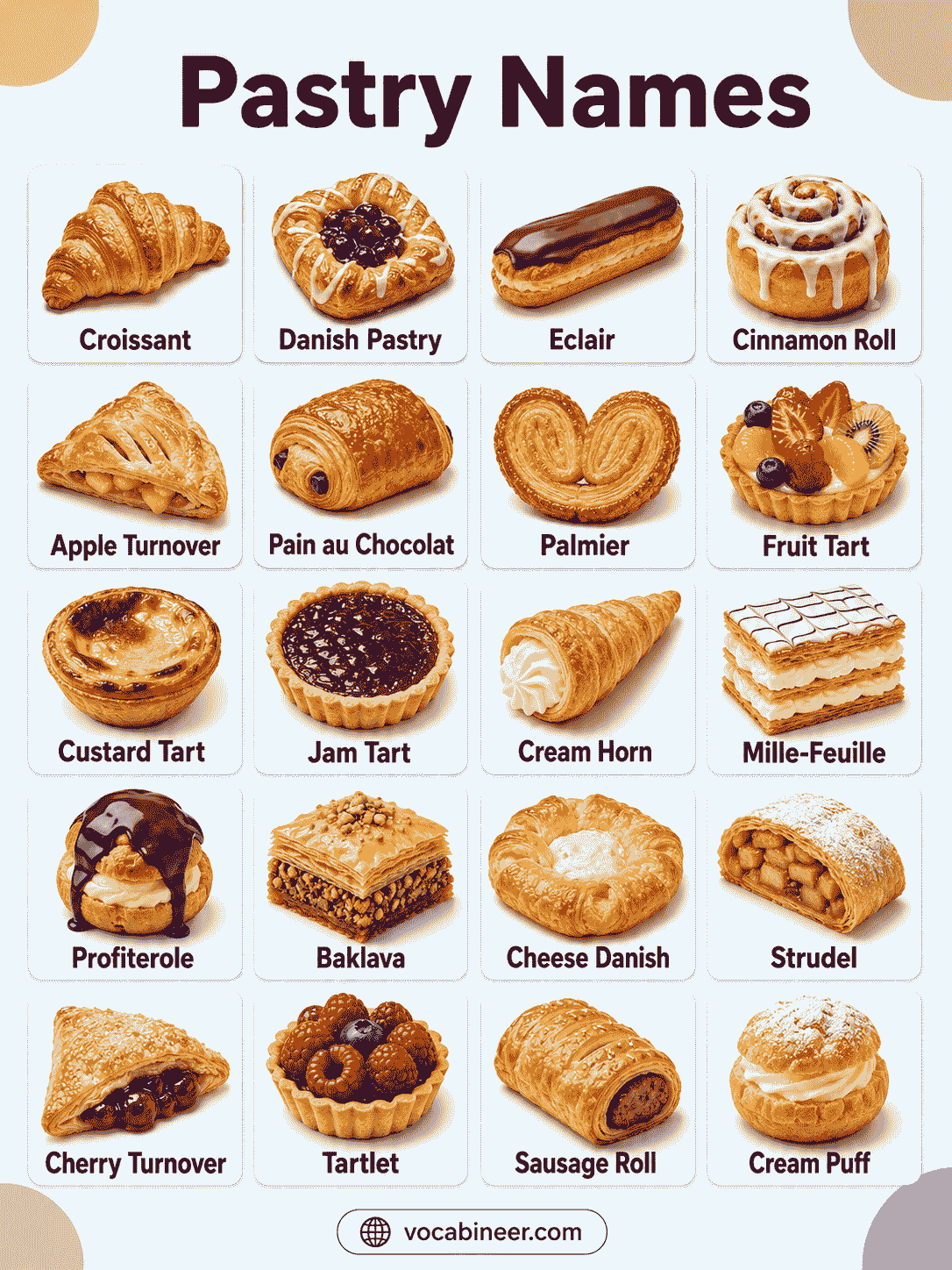
The most familiar pastry names come from bakeries, cafés, dessert counters, street-food stalls, and regional food traditions. The short descriptions below highlight the shape, filling, texture, or construction that makes each pastry recognizable.
- Croissant 🔊 /krəˈsɑːnt/ — a curved pastry with buttery, flaky layers
- Pain au chocolat 🔊 /pæ̃ oʊ ʃɒkəˈlɑː/ — a rectangular laminated pastry containing chocolate
- Danish pastry — a soft, flaky pastry often filled with fruit, custard, or cheese
- Éclair 🔊 /ɪˈkleər/ — a long choux pastry filled with cream and topped with icing
- Cream puff — a round, hollow choux pastry with a sweet filling
- Profiterole 🔊 /prəˈfɪtəroʊl/ — a small filled choux pastry often served with sauce
- Turnover — a folded pastry enclosing a sweet or savory filling
- Fruit tart — an open pastry shell topped with cream, custard, and fruit
- Custard tart — a pastry shell filled with smooth custard
- Palmier 🔊 /ˈpɑːmiˌeɪ/ — a crisp heart-shaped pastry made from rolled layers
- Mille-feuille 🔊 /ˌmiːl ˈfɜːj/ — crisp pastry sheets separated by cream or custard
- Cream horn — a cone-shaped pastry shell filled with cream
- Cinnamon roll — a spiral pastry filled with cinnamon and sugar
- Strudel 🔊 /ˈstruːdəl/ — thin dough rolled around fruit, cheese, or another filling
- Baklava 🔊 /ˌbɑːkləˈvɑː/ — layered filo pastry with nuts and syrup
- Cannoli 🔊 /kəˈnoʊli/ — crisp pastry tubes filled with sweetened cream
- Pastel de nata 🔊 /pɐʃˈtɛl dɨ ˈnatɐ/ — a small Portuguese custard tart
- Kouign-amann 🔊 /ˌkwiːn əˈmæn/ — a layered pastry with caramelized sugar
- Sfogliatella 🔊 /sfoʊljəˈtɛlə/ — an Italian shell-shaped pastry with thin layers
- Sausage roll — sausage wrapped inside flaky pastry
- Samosa — a triangular pastry filled with vegetables, meat, or lentils
- Empanada 🔊 /ˌɛmpəˈnɑːdə/ — a folded pastry with a sweet or savory filling
- Börek 🔊 /ˈbɜːrɛk/ — a layered or rolled savory pastry containing cheese, meat, or vegetables
- Vol-au-vent 🔊 /ˌvɒl oʊ ˈvɒn/ — a hollow puff pastry case filled after baking
Savory Pastry Names
Savory pastries replace fruit, cream, and syrup with ingredients such as cheese, meat, vegetables, herbs, eggs, potatoes, or lentils. They commonly appear at breakfast, lunch, parties, bakeries, and street-food stalls because their compact shapes make them easy to carry and serve.
Sausage roll wraps seasoned sausage meat inside flaky pastry. Bakeries may sell it whole, cut it into smaller pieces, or finish the surface with seeds and herbs.
Samosa is usually a triangular pastry with a crisp outer shell. Common fillings include spiced potatoes, peas, lentils, minced meat, onions, or cheese.
Empanada uses a round piece of dough folded over a filling and sealed along the curved edge. Beef, chicken, cheese, vegetables, fruit, or sweet cream may appear inside.
Börek refers to layered or rolled pastries made with thin dough. Depending on the regional style, it may contain cheese, spinach, potatoes, meat, or herbs.
Curry puff is a small folded pastry with a spiced filling. Potatoes, chicken, egg, onions, and vegetables commonly sit inside its crimped shell.
Cheese pastry contains soft, creamy, salty, or firm cheese inside puff, filo, shortcrust, or laminated dough. Familiar forms include turnovers, twists, spirals, and filled Danish-style pastries.
Meat pie contains cooked meat and gravy inside a pastry shell. Some versions use pastry on the base and top, whereas others have only a pastry lid.
Vol-au-vent is a tall, hollow puff pastry case filled after baking. Mushrooms, chicken, seafood, vegetables, or cheese sauce commonly fill the open center.
Flaky and Layered Pastries
Flaky pastries contain thin layers that separate and rise during baking. Consequently, the outside becomes crisp and delicate, while the interior may remain soft, buttery, airy, or tender.
Croissant has a curved form and visible buttery layers. Its outer surface feels crisp and flaky, while the center remains soft, light, and tender.
Pain au chocolat uses laminated dough similar to croissant dough, but its shape is rectangular. Chocolate batons rest inside the rolled layers and soften during baking.
Danish pastry is a soft, flaky pastry made from laminated yeasted dough. Fruit, custard, cream cheese, icing, or glaze often adds sweetness and color.
Kouign-amann is a layered pastry associated with Brittany. Butter and sugar between the folds create a crisp, deeply caramelized surface.
Mille-feuille contains several crisp pastry sheets separated by cream or custard. Powdered sugar, icing, or a patterned glaze often covers the top.
Baklava combines thin filo sheets with chopped nuts and syrup or honey. Bakers commonly cut it into squares, diamonds, rolls, or layered nests.
Sfogliatella has a shell-like form made from many thin overlapping layers. Its crisp ridges usually surround ricotta, semolina, citrus, or spiced filling.
Pastries Filled with Cream or Custard
Cream-filled and custard-filled pastries may use hollow shells, layered sheets, crisp tubes, or open tart cases. Although their forms differ, the smooth filling usually provides the strongest contrast to the crisp or airy pastry around it.
Éclair is a long, hollow choux pastry filled with pastry cream, whipped cream, chocolate cream, or coffee cream. Icing or glaze usually covers the top.
Cream puff is a round choux pastry with a light, hollow center. Bakers commonly fill it with whipped cream, pastry cream, ice cream, or flavored filling.
Profiterole is a small round choux pastry with a soft filling. It often appears in plated desserts with chocolate sauce, caramel, or several filled pieces arranged together.
Custard tart has a pastry shell filled with smooth custard. Its surface may remain pale and glossy or develop lightly browned areas during baking.
Pastel de nata is a small Portuguese custard tart with a crisp layered shell. Its creamy filling usually has a caramelized or dark-spotted surface.
Cream horn uses pastry strips wrapped around a cone-shaped mold. After baking, whipped cream, pastry cream, or another soft filling goes into the hollow shell.
Cannoli are crisp fried pastry tubes filled with sweetened ricotta-based cream. Pistachios, chocolate pieces, candied fruit, or citrus may decorate the open ends.
Rolled and Folded Pastries
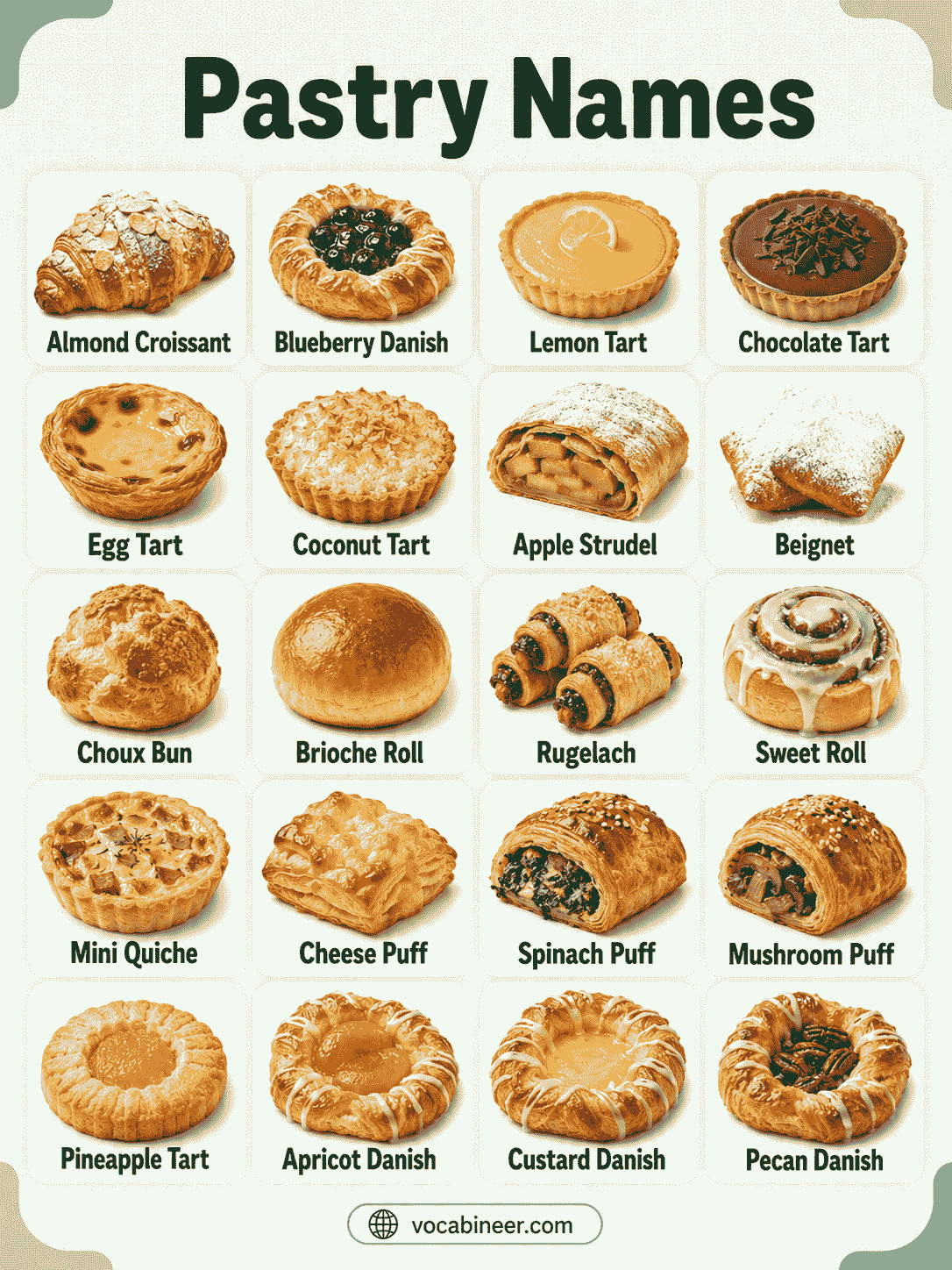
Rolling and folding shape pastry into spirals, pockets, coils, braids, crescents, and cylinders. These methods also help hold fillings inside the dough or display them attractively across the surface.
Turnover starts with flat dough folded over filling. Its triangular, semicircular, or rectangular shell may contain fruit, cheese, meat, or vegetables.
Strudel uses thin dough rolled around filling. Apple remains the best-known variety, although cherry, cheese, poppy seed, meat, and vegetable versions also exist.
Cinnamon roll begins with dough spread with butter, cinnamon, and sugar. Rolling and slicing the dough creates its visible spiral shape.
Palmier forms when pastry dough rolls inward from both sides. The two coils create a heart-like shape, while caramelized sugar gives it a crisp bite.
Pinwheel pastry has corners or strips folded toward the center. Jam, fruit, custard, cheese, pesto, or vegetables may fill the middle.
Braided pastry uses overlapping dough strips around a partly visible filling. Fruit, cream cheese, chocolate, nuts, spinach, or cheese commonly appears inside.
Tarts and Open Pastry Shells
Tarts use shallow pastry cases that leave most or all of the filling visible. Unlike enclosed pies, turnovers, and filled pockets, they usually have no full pastry lid.
Fruit tart combines a crisp pastry shell with custard, cream, or another soft base. Fresh fruit usually sits on top in neat rows or decorative patterns.
Custard tart contains smooth custard inside an open pastry case. Nutmeg, cinnamon, caramelized sugar, or fruit may add extra flavor.
Tartlet is a small individual tart with a sweet or savory filling. Familiar examples include lemon, chocolate, fruit, cheese, and mushroom tartlets.
Lemon tart has a smooth citrus filling inside a crisp pastry shell. Some versions add meringue, while others use lemon curd or baked lemon custard.
Jam tart is a small open pastry shell filled with fruit jam. Its bright center and simple round shape make it easy to identify.
Bakewell tart usually contains a pastry base, jam, and almond-flavored filling. Flaked almonds or icing may cover the top.
Pastries with Distinctive Shapes
Shape is one of the quickest ways to identify an unfamiliar pastry. Crescent, spiral, shell, horn, triangle, tube, and half-moon forms often reveal the correct pastry name before the filling becomes visible.
- Croissant — curved or crescent-shaped with layered ends
- Éclair — long and narrow with icing across the top
- Cream puff — round and hollow
- Palmier — heart-shaped or double-coiled
- Cream horn — cone-shaped
- Turnover — triangular or half-moon shaped
- Cinnamon roll — round with a visible spiral
- Cannoli — tube-shaped
- Sfogliatella — ridged and shell-shaped
- Pastel de nata — small and round with an open custard center
- Strudel — long and rolled
- Baklava — layered squares, diamonds, or rolls
- Samosa — triangular and enclosed
- Empanada — folded into a half-moon
- Vol-au-vent — tall, hollow pastry case
Doughs Used for Different Pastries
Finished pastry names and dough names are not interchangeable. However, learning the main pastry bases makes it easier to understand why some finished foods have visible layers, some become hollow, and others form firm or crumbly shells.
Puff pastry contains alternating layers of dough and fat that separate during baking. Turnovers, palmiers, mille-feuille, cream horns, vol-au-vents, and some sausage rolls use this flaky base.
Choux pastry is an egg-rich dough that forms a hollow center as it bakes. Éclairs, cream puffs, profiteroles, Paris-Brest, and religieuses use this light shell.
Filo pastry consists of many paper-thin dough sheets layered with butter or oil. Baklava, börek, spinach pies, and nut-filled rolls commonly use it.
Shortcrust pastry has a firm, tender, and sometimes crumbly texture. Bakers often use it for fruit tarts, custard tarts, tartlets, pies, and quiches.
Laminated yeasted dough combines yeast fermentation with folded butter layers. Croissants, pain au chocolat, Danish pastries, and some breakfast pastries use this soft yet flaky dough.
Traditional Pastries from Different Regions
Many pastries began as local specialties before becoming familiar in bakeries around the world. The examples below represent distinctive shapes, fillings, and pastry traditions without turning the article into an oversized country-by-country catalog.
- Croissant — laminated pastry strongly associated with French bakeries
- Pastel de nata — Portuguese custard tart with a browned surface
- Kouign-amann — caramelized layered pastry from Brittany
- Cannoli — Sicilian pastry tubes filled with sweetened ricotta
- Sfogliatella — layered Italian shell-shaped pastry
- Strudel — rolled pastry linked to Central European traditions
- Baklava — layered nut pastry found across several regional cuisines
- Ma’amoul — molded pastry filled with dates, pistachios, or walnuts
- Börek — savory layered or rolled pastry found across many regions
- Empanada — folded filled pastry common in Spain, Latin America, and beyond
- Samosa — triangular filled pastry strongly associated with South Asian cuisine
- Cornish pasty — enclosed savory pastry associated with Cornwall
- Spanakopita — Greek filo pastry filled with spinach and cheese
- Galette — a French term used for several flat or free-form pastries
Pastry Names That Are Easy to Confuse
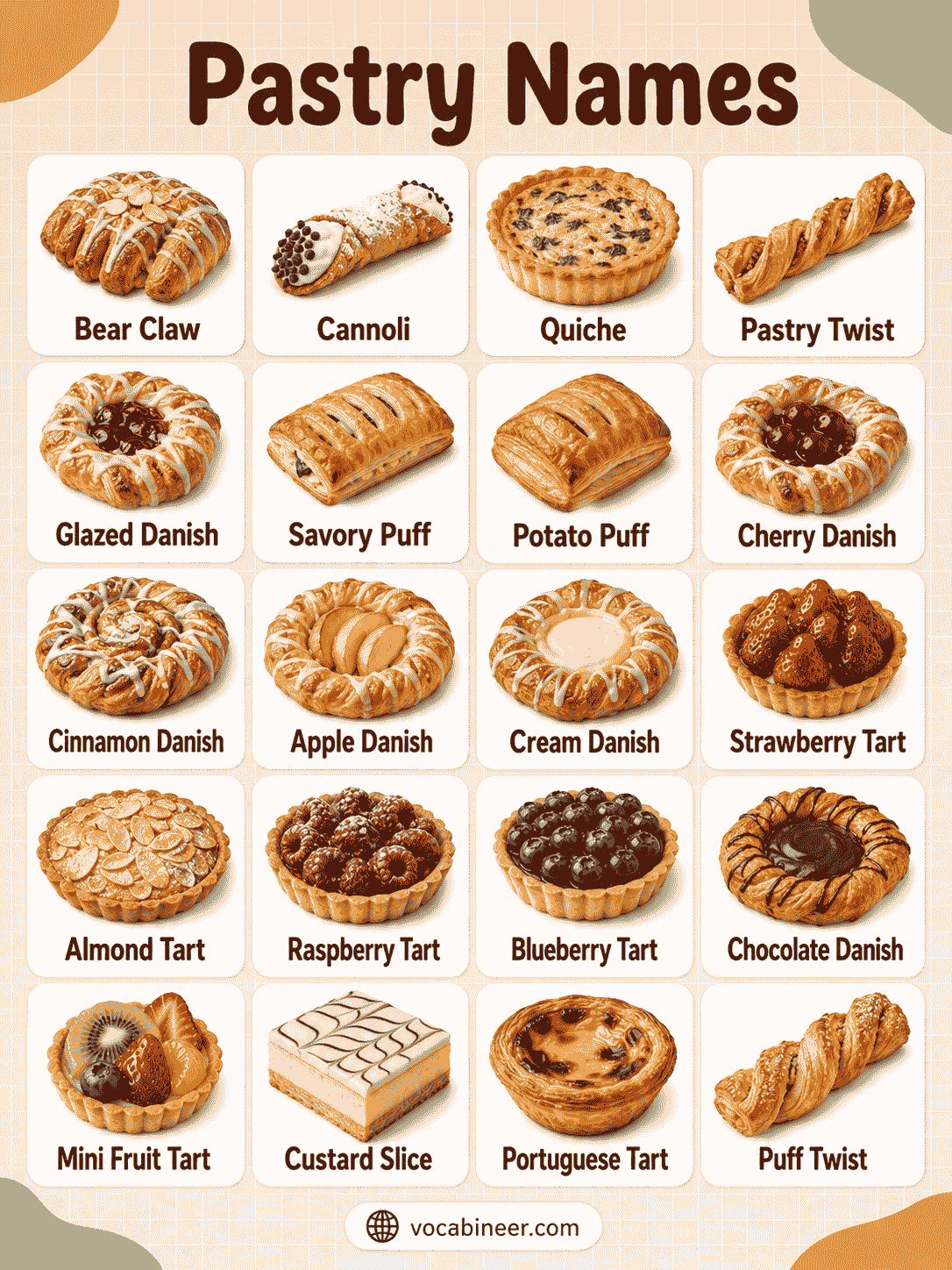
Some pastries share the same dough, filling, or general form, so their names can seem interchangeable. The clearest differences usually come from shape, construction, serving style, or the specific pastry base.
| Pastry Names | Main Difference |
|---|---|
| Éclair and cream puff | Both use choux pastry, but an éclair is long while a cream puff is round. |
| Cream puff and profiterole | The terms overlap, although profiteroles are often smaller and served with sauce. |
| Croissant and Danish pastry | Both use laminated yeasted dough, but Danish pastries are usually sweeter and more often filled or glazed. |
| Puff pastry and filo pastry | Puff pastry has laminated dough-and-fat layers, while filo uses separate paper-thin sheets. |
| Turnover and hand pie | Both enclose filling in folded dough, although turnover often emphasizes the folded form. |
| Tart and pie | A tart usually has a shallow open shell, while a pie is often deeper and may have a top crust. |
| Mille-feuille and Napoleon | The names often describe closely related layered pastries, although fillings and regional usage vary. |
| Croissant and pain au chocolat | A croissant is usually curved, while pain au chocolat is rectangular and contains chocolate. |
| Cream horn and cannoli | A cream horn uses baked layered pastry, while cannoli use fried pastry tubes. |
FAQs
Common pastry names include croissant, Danish pastry, éclair, cream puff, turnover, fruit tart, custard tart, palmier, mille-feuille, strudel, baklava, cannoli, sausage roll, samosa, and empanada.
Pastry dough is the uncooked base, such as puff, choux, filo, or shortcrust pastry. A finished pastry is the food made from that dough, such as an éclair, turnover, tart, or baklava.
Croissants use laminated yeasted dough rather than standard puff pastry. Both have layers, but croissant dough contains yeast and develops a softer interior.
Both use choux pastry. However, an éclair has a long shape, while a cream puff is generally round.
Yes. Savory pastries include sausage rolls, samosas, empanadas, börek, meat pies, cheese pastries, curry puffs, and vol-au-vents.
Read More
- Types of Food in English
- Different Types of Candy
- Sweets and their Names
- Different Types of Chips
- Types of Chocolate
- Types of Cookies