

A handful of dry grains can look like tiny pearls, long needles, flat flakes, or dark triangular seeds. Wheat, rice, corn, oats, and barley are familiar names, while teff, fonio, and triticale may be harder to recognize at first.
Grain names can identify cereal crops, named wheat types, pseudocereals, or products made from a parent grain. Learning these differences helps readers recognize each grain accurately and avoid confusing grains with pulses, culinary seeds, flour, pasta, and cooked dishes.
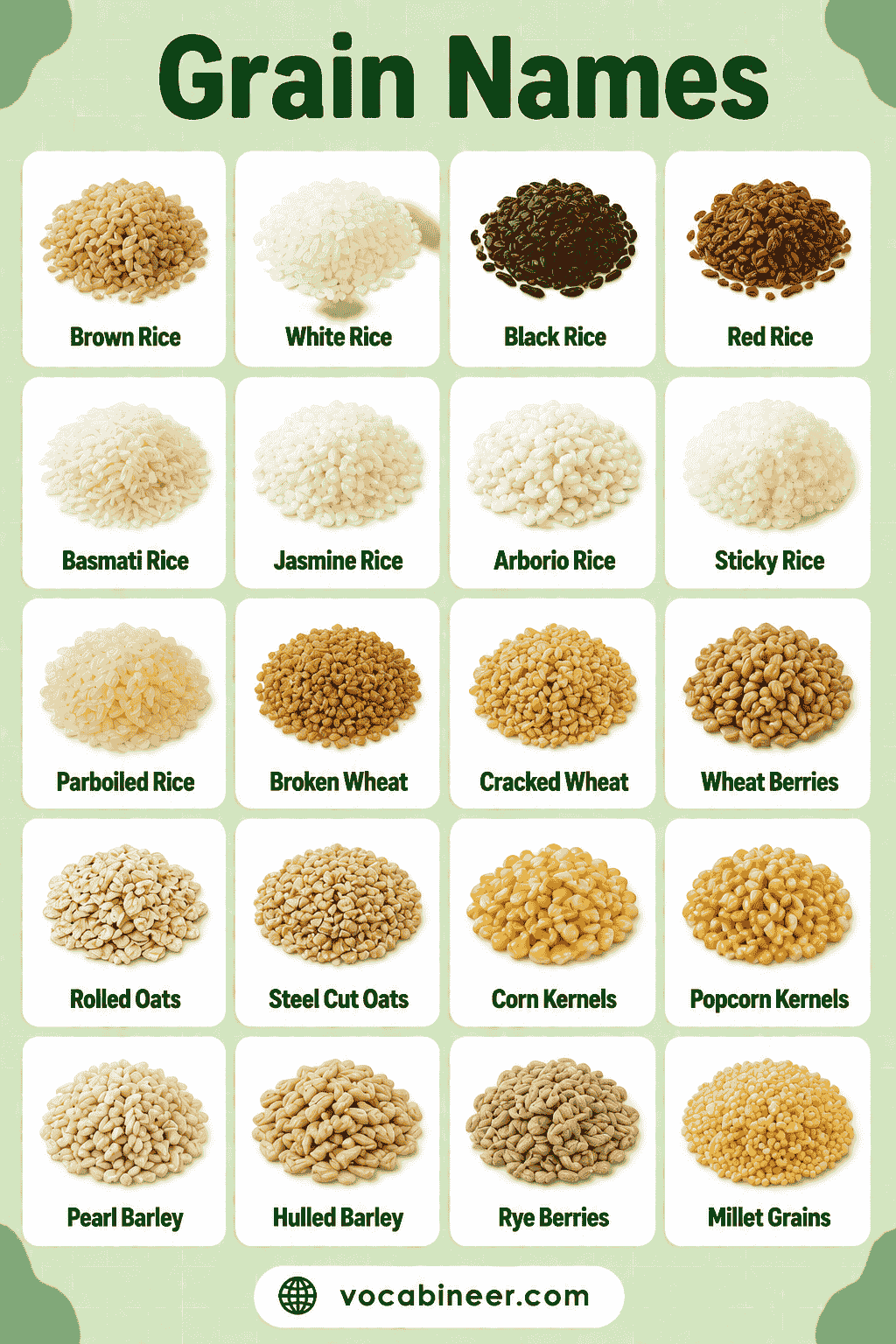
In This Page
What Is a Grain?
A cereal grain is the edible seed of a plant in the grass family. Familiar cereal grains include wheat, rice, corn, barley, oats, rye, millet, and sorghum. In everyday food language, people also group quinoa, amaranth, and buckwheat with grains because they cook and serve them in similar ways, although these three foods are pseudocereals from non-grass plants.
The word grain may describe the harvested kernel itself. By contrast, flour, bread, couscous, polenta, and oatmeal come from grains but are not separate grain crops.
| Group | Meaning | Examples |
|---|---|---|
| Cereal grains | Edible seeds from grasses | Wheat, rice, corn, oats |
| Pseudocereals | Non-grass seeds used like grains | Quinoa, amaranth, buckwheat |
| Grain products | Foods or ingredients made from grains | Bulgur, semolina, cornmeal, couscous |
| Pulses | Dry edible seeds from legumes | Lentils, chickpeas, dry beans |
Common Cereal Grain Names
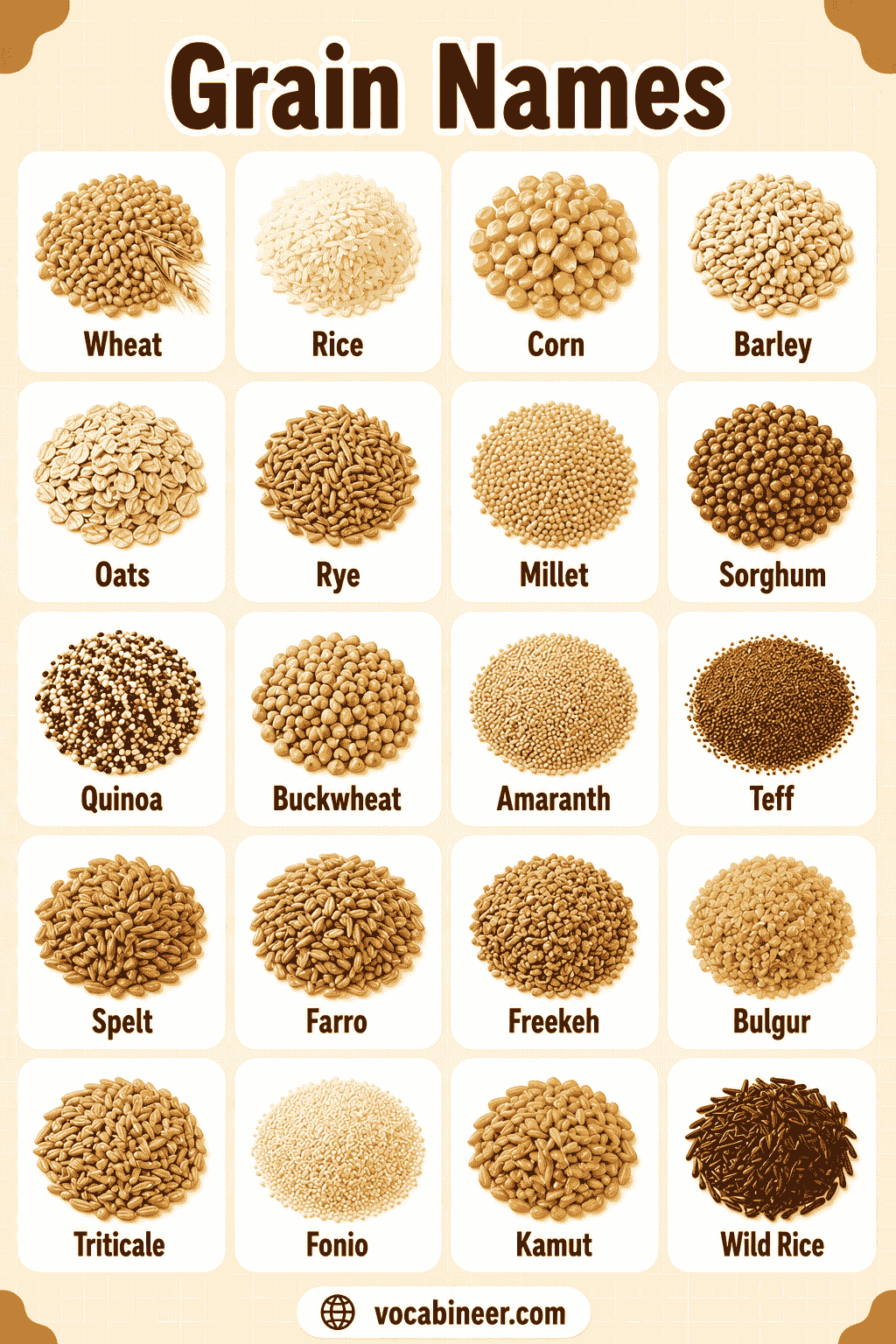
The best-known cereal grains appear in breads, porridges, noodles, tortillas, soups, breakfast foods, and cooked side dishes. Their dry kernels vary in length, color, shape, and surface texture.
Wheat has plump, oval kernels with a noticeable crease along one side. Millers turn it into flour for bread, pasta, cakes, crackers, and many other baked foods.
Rice forms smooth kernels that may be short, medium, or long. People usually cook the kernels whole, though manufacturers also use rice for flour, noodles, cakes, and breakfast foods.
Corn, also called maize, grows as large kernels on a cob and appears in yellow, white, blue, red, and mixed colors. Different varieties become tortillas, cornmeal, grits, popcorn, and other familiar foods.
Barley has pale, rounded kernels that look slightly broader than many wheat grains. Its firm, chewy texture works well in soups, stews, and grain bowls, while malted barley supports several food and beverage processes.
Oats begin as long, narrow groats inside tough outer hulls. However, shoppers more often see rolled flakes, steel-cut pieces, or quick oats than intact groats.
Rye produces slender tan or gray-green kernels with pointed ends. Its flour gives rye breads, crispbreads, and crackers their familiar earthy flavor.
Millet is a broad name for several small-seeded cereal grasses rather than one single crop. Pearl, finger, foxtail, proso, barnyard, little, and kodo millet belong to this wider grain group.
Sorghum /ˈsɔːrɡəm/ 🔊 has small, round kernels that may appear white, tan, red, brown, or nearly black. Cooks use it whole, grind it into flour, prepare it as porridge, or pop certain varieties.
Other Cereal Grains
Several cereal grains play important roles in particular regions and cuisines even though beginner vocabulary lists often omit them. These names broaden the guide without turning it into an unfiltered grain database.
Teff /tɛf/ 🔊 is an extremely small cereal grain associated especially with Ethiopia and Eritrea. Brown, red, and ivory forms exist, and cooks use teff in injera, porridge, flour blends, and baked foods.
Fonio /ˈfoʊnioʊ/ 🔊 is a tiny West African cereal with pale grains and a light cooked texture. People prepare it as porridge, a side dish, or flour.
Triticale /ˌtrɪtɪˈkeɪli/ 🔊 is a cereal created by crossing wheat and rye. Its kernels resemble slightly wrinkled wheat grains and carry characteristics from both parent crops.
Wild rice has long, narrow, dark brown or black grains. It comes from aquatic grasses in the genus Zizania, not from the same genus as ordinary rice.
Job’s tears are smooth, rounded cereal grains from a grass-family plant. After hulling, edible forms usually look pale gray or cream and may appear in soups, porridges, and mixed-grain dishes.
Wheat Grain Names
Durum, spelt, einkorn, emmer, and khorasan all belong to the wheat family. Each type has its own kernel shape, history, and common uses, but none forms a completely separate cereal category.
Durum wheat /ˈdʊrəm/ 🔊 has hard, amber-colored kernels. Millers produce semolina from durum, and pasta makers value the grain for firm dough.
Spelt /spɛlt/ 🔊 is a hulled wheat with elongated, reddish-brown kernels. Bakers use spelt flour in bread, crackers, pastries, and other specialty products.
Einkorn /ˈaɪnkɔːrn/ 🔊 has small, narrow kernels that remain tightly enclosed in their hulls after harvest. It is an early cultivated wheat that now appears mainly in specialty flour, bread, and whole-grain products.
Emmer /ˈɛmər/ 🔊 produces firm, elongated kernels and is another hulled wheat. The word farro often refers to cooked emmer, although regional usage may apply the name to einkorn or spelt as well.
Khorasan wheat /ˌkɔːrəˈsɑːn/ 🔊 has kernels that are noticeably longer and larger than common wheat berries. Some qualifying products use the protected KAMUT® brand name, while other khorasan wheat sells under its generic name.
Pseudocereals Used Like Grains
Pseudocereals come from non-grass plants, yet their edible seeds work much like cereal grains in porridge, flour, salads, and cooked side dishes. Quinoa, amaranth, and buckwheat are the three best-known examples.
Quinoa /ˈkiːnwɑː/ 🔊 has tiny, round seeds with a visible curved germ ring. White, red, and black varieties commonly appear in salads, bowls, soups, and breakfast dishes.
Amaranth /ˈæmərænθ/ 🔊 produces extremely small, round seeds in pale gold, tan, reddish, or dark colors. People simmer the seeds into porridge, pop them, or mill them into flour.
Buckwheat /ˈbʌkwiːt/ 🔊 has dark, triangular seeds rather than long cereal kernels. Despite its name, it is not a wheat type; cooks use its groats and flour in porridge, pancakes, noodles, and baked foods.
How to Recognize Grains by Shape, Size, and Color
Close-up appearance provides useful clues when labels are missing. Still, processing can change a grain dramatically, so dry whole kernels offer the clearest basis for comparison.
- Long and narrow: rice, wild rice, rye, oats, and some wheat types
- Plump and oval: common wheat, barley, and several hulled wheats
- Small and round: sorghum, millet, quinoa, and amaranth
- Exceptionally tiny: teff and fonio
- Triangular: buckwheat
- Large and rounded: corn or maize
- Dark-colored: wild rice, black quinoa, red sorghum, and some corn varieties
- Marked by a side crease: wheat and barley
Color alone cannot identify a grain reliably. Rice, corn, sorghum, quinoa, wheat, and millet can each appear in several colors, while polishing or milling may remove darker outer layers.
Grain Products Often Mistaken for Separate Grains
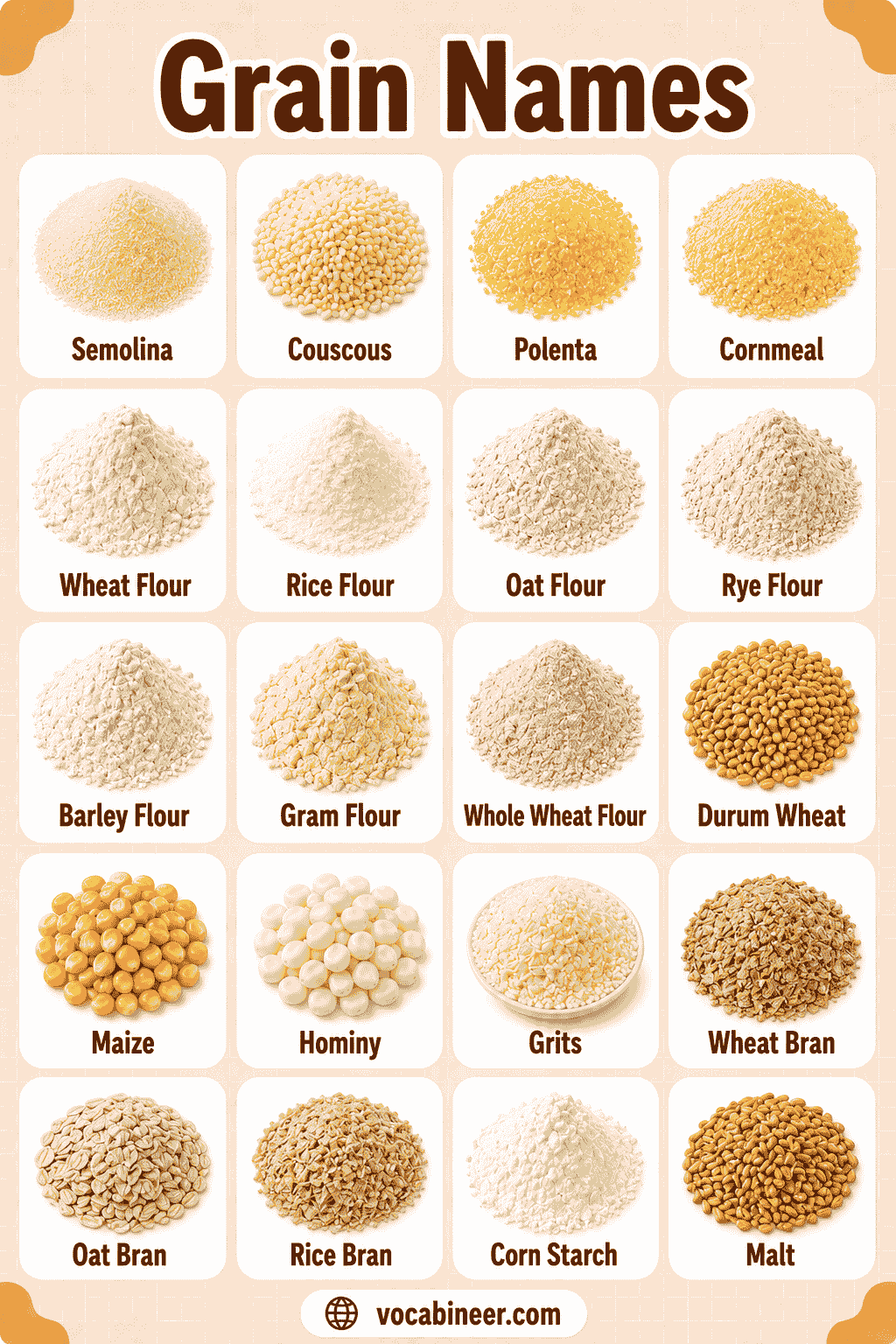
Many familiar names describe wheat, oats, or corn after producers crack, roll, roast, or mill them. These terms belong in a grain guide because readers often mistake them for independent crops. USDA classifications group bulgur, couscous, freekeh, flour, and semolina among wheat products, while cornmeal, grits, and polenta come from corn.
Bulgur /ˈbʊlɡər/ 🔊 is wheat that producers parboil, dry, and crack into fine, medium, or coarse pieces. It cooks quickly and commonly appears in pilafs, salads, and tabbouleh.
Freekeh /ˈfriːkə/ 🔊 comes from young wheat harvested while the kernels are still green, then roasted and usually cracked. The roasting process gives it a smoky flavor, but freekeh remains a wheat product.
Semolina /ˌsɛməˈliːnə/ 🔊 is a coarse milling product made mainly from hard durum wheat. Its yellow granules commonly go into pasta, couscous, puddings, and some breads.
Couscous /ˈkuːskuːs/ 🔊 consists of small granules traditionally formed from moistened semolina. Although it resembles a cooked grain, it is a wheat product rather than a separate cereal crop.
Rolled oats begin as oat groats that processors steam and flatten into flakes. Old-fashioned and quick oats differ mainly in thickness and further processing, but both come from the oat grain.
Cornmeal comes from dried corn ground to a fine, medium, or coarse texture. Depending on the corn variety, it may appear white, yellow, or blue.
Grits are a coarsely ground corn product that softens into a thick, creamy dish during cooking. Stone-ground, regular, quick, and instant forms differ in particle size and processing.
Polenta /pəˈlɛntə/ 🔊 may refer to coarse cornmeal or to the cooked dish made from it. Context therefore determines whether the word names the dry ingredient or the prepared food.
How Processing Changes Grain Names and Forms
Processing can change a grain’s color, shape, texture, cooking time, and name without creating a new crop. Some methods remove parts of the kernel, while others polish, cut, crack, steam, or flatten it.
| Comparison | First form | Second form |
|---|---|---|
| Brown rice vs. white rice | Brown rice keeps its bran and germ after the inedible hull is removed. It looks tan or brown and usually has a firmer, chewier texture. | White rice undergoes further milling and polishing, which remove the bran and germ. It cooks faster and has a softer texture. |
| Whole wheat vs. refined wheat | Whole wheat contains the bran, germ, and endosperm of the wheat kernel. Its color and texture depend on the wheat type and milling method. | Refined wheat contains mainly the endosperm after millers remove most of the bran and germ. All-purpose, bread, cake, and pastry flour are wheat products rather than separate grains. |
| Hulled barley vs. pearled barley | Hulled barley loses only its tough outer hull and keeps most of its bran. It remains darker, chewier, and slower to cook. | Pearled barley receives additional polishing that removes some or most of the bran. It looks paler and cooks more quickly. |
| Oat groats vs. rolled oats | Oat groats are whole oat kernels with the inedible hull removed. They retain their long shape and require more cooking time. | Rolled oats are groats that have been steamed and flattened. They cook faster but can still remain whole grain because the bran, germ, and endosperm stay present. |
Grain Names That Commonly Cause Confusion
Some grain terms sound like separate foods even when they name the same crop, a related species, or a broad grain group. Clear pairings prevent duplicate entries and inaccurate classifications.
Corn and Maize
Corn and maize are two English names for the same crop. American English uses corn more often in everyday speech, whereas agricultural and international sources frequently use maize.
Sweet corn, popcorn, flour corn, dent corn, and flint corn are forms of maize. Cornmeal, grits, and polenta, however, are products made from the grain.
Rice and Wild Rice
Ordinary rice belongs mainly to the genus Oryza, while wild rice belongs to Zizania. Both plants are grasses that produce edible grains, but wild rice is not simply a dark variety of common rice.
Their appearances also differ. Most rice kernels range from short to long and may look white, tan, red, or black, whereas processed wild rice usually appears especially long, narrow, and dark.
Wheat and Buckwheat
Buckwheat is not a wheat variety despite the shared word in its name. Wheat comes from the grass family, while buckwheat is a broadleaf pseudocereal with triangular seeds.
Their raw forms look different as well. Wheat kernels are generally oval with a side crease, whereas hulled buckwheat groats have an angular shape.
Millet as a Grain Group
Millet is an umbrella term for several small-seeded cereal crops. Pearl, finger, foxtail, proso, barnyard, little, and kodo millet are distinct crops rather than color variations of one plant.
A beginner grain list can use millet as the main name, then introduce individual kinds in a dedicated guide. This approach keeps the central list readable while acknowledging the group’s diversity.
Grains, Seeds, and Pulses
Every cereal grain is botanically a seed, but food vocabulary often uses seeds for crops such as sesame, sunflower, flax, chia, and pumpkin. Those foods belong outside a cereal-grain list unless the article explains their different plant groups.
Pulses are dry edible seeds from legume plants, including lentils, chickpeas, dry peas, and dry beans. Therefore, pulses need their own vocabulary category rather than placement under grain names.
FAQs
The most familiar cereal grains are wheat, rice, corn or maize, barley, oats, rye, millet, and sorghum. Other cereal names include teff, fonio, triticale, wild rice, and Job’s tears.
The terms often overlap, but cereal specifically refers to grain-producing grasses. Everyday grain lists may also include pseudocereals such as quinoa, amaranth, and buckwheat because people use them in similar ways.
Quinoa is a pseudocereal rather than a true cereal grass. Nevertheless, people cook, mill, and serve its seeds much like cereal grains.
No. Corn and maize are two names for the same crop, and the preferred term depends mainly on region and context.
No. Beans are pulses from legume plants, while foods such as sesame, flax, sunflower, and pumpkin seeds come from other plant groups. They should not appear in a cereal-grain list without clarification.
Read More
- Types of Food in English
- Different Types of Candy
- Sweets and their Names
- Different Types of Chips
- Types of Crackers
- Types of Chocolate
- Types of Cookies