

The last syllable of a word is the final beat of sound you hear when pronouncing it. Each syllable has one vowel sound, and the last one is called the ultimate syllable. Knowing this helps with stress, spelling, and reading patterns. Some words place stress on the last syllable, while others do not. In this article, you will learn what it is, how it works, and see plenty of examples.
In This Page
What Is the Last Syllable of a Word?
The last syllable is simply the final sound unit of a word. For example:
- ap-ple → ple is the last syllable
- ba-na-na → na is the last syllable
- in-for-ma-tion → tion is the last syllable
When stress falls on this syllable, it gives the word a different rhythm and emphasis.
Rules for Stress on the Last Syllable
- Many two-syllable verbs are stressed on the last syllable: reLAX, beGIN, preTEND.
- Words borrowed from French or Spanish often stress the last syllable: café, ballet, routine.
- Longer academic or formal words can also stress the final syllable: Japanese, cigarette, guarantee.
Common Words with Stress on the Last Syllable
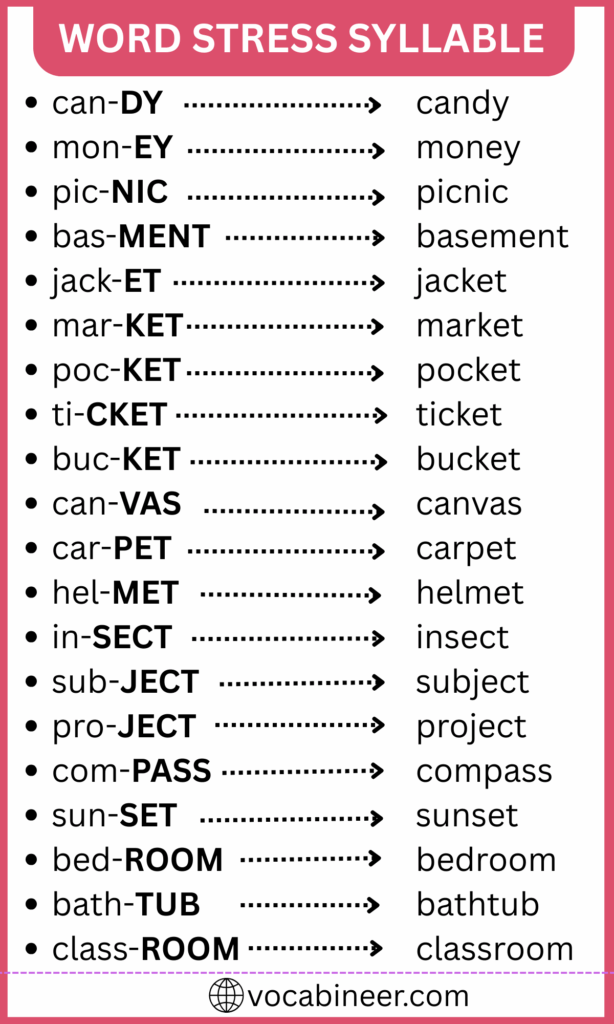
Stress sometimes falls naturally on the final part of the word. Below are groups of words where the last syllable carries the main stress.
Verbs with Stress on the Last Syllable
- relax
- begin
- prefer
- decide
- arrive
- complete
- attend
- explain
- ignore
- occur
- enjoy
- invite
- apply
- reveal
- suggest
- escape
- repair
- connect
- provide
- repeat
Adjectives with Stress on the Last Syllable
- divine
- alive
- polite
- supreme
- severe
- afraid
- upset
- correct
- unknown
- profound
- intense
- unique
- secure
- extreme
- concise
- mature
- alert
- robust
- precise
- elite
Nouns with Stress on the Last Syllable
- café
- ballet
- routine
- guarantee
- design
- cigarette
- resort
- employee
- mandarin
- creole
- depot
- cliché
- bouquet
- shampoo
- encore
- bamboo
- fiancé
- brigade
- buffet
- garage
Words Lists with Last-Syllable Stress
To help practice, here are word groups where the last syllable is stressed.
Short Everyday Words with Last-Syllable Stress
- relax
- begin
- alive
- polite
- upset
- arrive
- attend
- ignore
- enjoy
- invite
- apply
- escape
- repeat
- repair
- connect
- decide
- prefer
- provide
- explain
- complete
Academic or Formal Words with Last-Syllable Stress
- guarantee
- routine
- supreme
- correct
- design
- unique
- intense
- precise
- concise
- secure
- mature
- robust
- elite
- severe
- profound
- divine
- mandate
- decree
- import
- support
Loanwords from French or Spanish with Last-Syllable Stress
- café
- ballet
- machete
- façade
- porté
- cliché
- bouquet
- depot
- fiancé
- buffet
- encore
- bamboo
- brigade
- champagne
- croquet
- sauté
- pâté
- jalapeño
- rendezvous
- prestige
Last Syllable in Sentences
Using words in sentences helps learners notice how the last syllable stress changes the flow of speech.
- He will relax after work.
- She began to prefer the new style.
- The design comes with a lifetime guarantee.
- They danced in the ballet last night.
- The building has a modern façade.
Penultimate Syllable and Beyond
The last syllable is not the only one important for stress. Many English words shift stress to the penultimate syllable (the second-to-last) or the antepenultimate syllable (the third-to-last). These patterns are common in longer words and useful for improving rhythm.
Words with Penultimate Syllable Stress
- banana → ba-na-na
- computer → com-pu-ter
- disaster → di-sas-ter
- tomato → to-ma-to
- tomorrow → to-mor-row
- potato → po-ta-to
- umbrella → um-bre-lla
- gorilla → go-ril-la
- vacation → va-ca-tion
- relation → re-la-tion
- protection → pro-tec-tion
- instruction → in-struc-tion
- creation → cre-a-tion
- position → po-si-tion
- decision → de-ci-sion
Words with Antepenultimate Syllable Stress
- photography → pho-tog-ra-phy
- cinema → cin-e-ma
- political → po-lit-i-cal
- family → fam-i-ly
- animal → an-i-mal
- chocolate → choc-o-late
- dangerous → dan-ger-ous
- generous → gen-er-ous
- difficult → dif-fi-cult
- calculate → cal-cu-late
- memory → mem-o-ry
- tragedy → trag-e-dy
- ordinary → or-di-na-ry
- beautiful → beau-ti-ful
- Saturday → Sat-ur-day
Why the Last Syllable Matters
The last syllable of a word often carries strong stress in English, especially in many verbs, adjectives, and borrowed words. Stressing the final syllable changes the rhythm and can even affect meaning. Knowing when the last syllable is stressed helps you pronounce words naturally and understand them clearly in speech.
Conclusion
The last syllable of a word plays an important role in stress, rhythm, and meaning. While some words stress the first or middle syllable, others place stress on the final one. By practicing bullet word lists and using them in sentences, you can strengthen your reading, spelling, and speaking skills.
FAQs About the Last Syllable of a Word
The last syllable is called the ultimate syllable. It’s the final beat of sound in a word.
That is the penultimate syllable. It comes right before the ultimate syllable.
It’s known as the antepenultimate syllable. This is the third syllable counting backward.
No, not every word does. Stress can fall on earlier syllables depending on the word.
Because French and Spanish words usually carry end stress. English often keeps that pattern.
Read More
