Polite vs Rude Words describe how tone changes meaning in everyday communication. The same idea can sound respectful or disrespectful depending on the words chosen. These differences appear in requests, greetings, apologies, disagreements, and daily conversations.
In this post, you will learn Polite vs Rude Words through structured lists and examples. Understanding these word choices helps you recognize respectful language and avoid expressions that sound harsh in school, workplace, and social settings.
In This Page
What Are Polite vs Rude Words?
Polite vs Rude Words refer to expressions that change the tone of a sentence. A polite word shows respect and consideration. A rude word sounds direct, harsh, or dismissive. The message may stay the same, but the feeling changes depending on word choice.
For example, “Close the door” sounds direct. “Please close the door” sounds respectful. Tone shifts with small word changes.
Polite language often includes words like please, thank you, excuse me, and sorry. Rude language may remove these softeners or use blunt commands.
Polite vs Rude Words in English
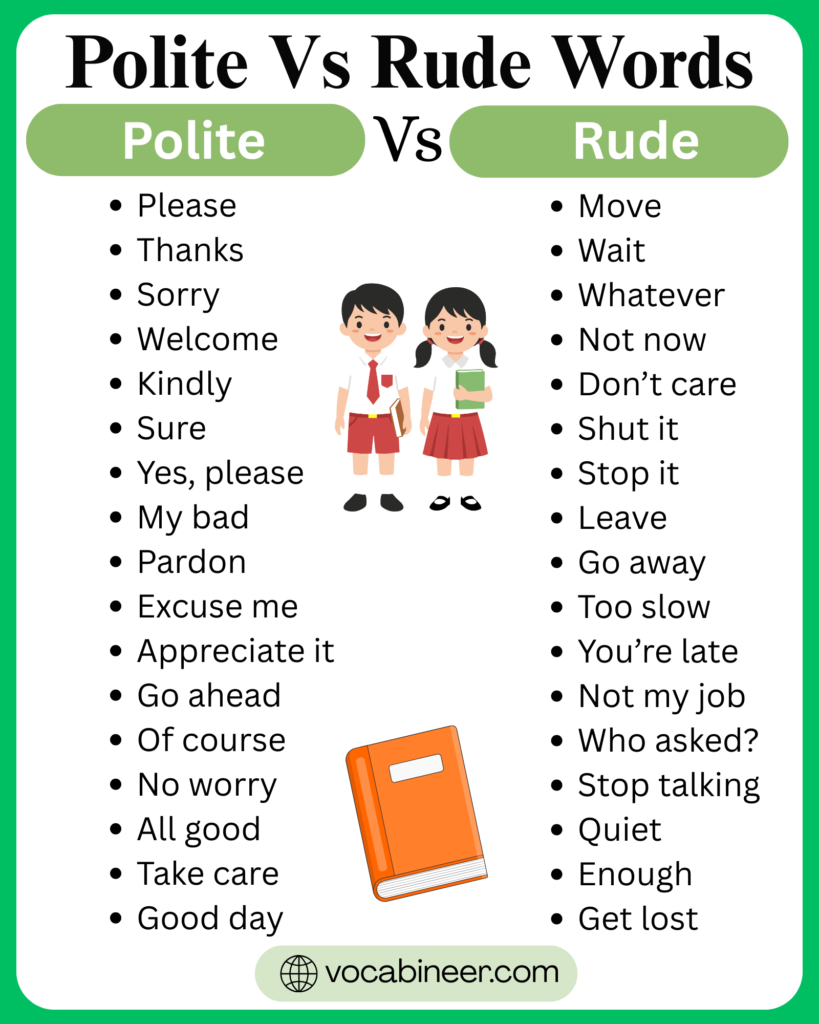
Words change the tone of a sentence very quickly. A small addition like please can soften a command. Without courtesy words, the same sentence may sound sharp. Below are organized comparisons of Polite vs Rude Words in English.
Basic Courtesy Words
Courtesy words show respect in simple daily speech. When they are missing, the sentence may feel direct or unfriendly.
Below is a comparison table.
| Polite Words | Rude Words |
|---|---|
| Please | Do it |
| Thank you | Fine |
| Excuse me | Move |
| Sorry | Whatever |
| May I | I will |
| Could you | You must |
| Would you mind | Just do it |
| Pardon me | What |
Now read them in sentences.
- Please close the window, instead of saying close the window.
- Thank you for your help, instead of just saying fine.
- Excuse me, could I pass, instead of saying move.
- I am sorry for the delay, instead of saying whatever.
Even one polite word softens the tone.
Greeting and Farewell Words
Greetings shape first impressions. Polite greetings sound respectful. Rude replies may feel cold or dismissive.
Below is a comparison list.
- Good morning → Yeah
- Hello → What
- Hi there → Hey
- Goodbye → Whatever
- Have a nice day → Bye
Example sentences:
- Good morning, it is nice to see you.
- Hello, how are you today?
- Goodbye, see you tomorrow.
Short replies like what or yeah can sound careless.
Thank You and Appreciation Words
Appreciation shows respect. Without it, responses may sound ungrateful.
Below is a comparison table.
| Polite Words | Rude Words |
|---|---|
| Thank you very much | Thanks |
| I appreciate it | Fine |
| That was helpful | Okay |
| I am grateful | Sure |
Example sentences:
- I appreciate it sounds warmer than fine.
- Thank you very much feels more respectful than thanks.
- That was helpful shows recognition.
Tone becomes more positive when appreciation words are used.
Apology Words
Apology words reduce tension. Rude responses may increase conflict.
Below is a comparison list.
- I am sorry → Not my fault
- My mistake → So what
- I apologize → Relax
- Excuse me → Move
Example sentences:
- I am sorry for the mistake.
- My mistake, I will correct it.
- I apologize for the confusion.
Polite apologies help keep communication respectful.
Direct Commands vs Polite Requests
Commands tell someone to do something. Polite requests ask instead of ordering. The action stays the same, but the tone changes. Direct commands can sound strong or even rude. Polite requests sound respectful and considerate.
Below are common comparisons of direct and polite forms.
Short Commands
Short commands are clear and direct. Without softening words, they may sound harsh.
Below is a comparison table.
| Direct Command | Polite Request |
|---|---|
| Sit down | Please sit down |
| Be quiet | Could you be quiet |
| Close the door | Please close the door |
| Give me the book | May I have the book |
| Stop talking | Would you mind stopping |
| Move | Excuse me, could you move |
| Hurry up | Please hurry up |
| Listen | Please listen |
Now read these in sentences.
- Sit down, sounds direct.
- Please sit down, sounds respectful.
- Be quiet, may feel strict.
- Could you be quiet, feels softer.
- Close the door, sounds like an order.
- Please close the door, sounds polite.
A small word like please changes the tone immediately.
Softened Requests
Softened requests reduce pressure. They often include modal verbs or gentle phrases.
Below is a list of polite request starters.
- Could you please
- Would you mind
- May I
- Can I please
- Would it be possible to
- I was wondering if
- If you don’t mind
Compare these examples.
- Could you please help me with this task?
- Would you mind opening the window?
- May I ask a question?
- I was wondering if you could explain that again.
These forms sound more respectful than direct commands.
Suggestion Phrases
Suggestions offer ideas without forcing someone.
Below is a comparison list.
- Let’s try this → Do this
- Why don’t we → Just do it
- Maybe we could → You should
- How about → You must
Example sentences:
- Let’s try this approach instead.
- Why don’t we take a short break?
- Maybe we could start earlier tomorrow.
Suggestions feel cooperative instead of controlling.
Permission Phrases
Permission phrases show respect before acting.
Below is a comparison table.
| Polite Permission | Rude Form |
|---|---|
| May I come in | I am coming in |
| Could I borrow this | I will take this |
| Is it okay if I | I am doing this |
| Would it be alright | I am going to |
Example sentences:
- May I come in, instead of I am coming in.
- Could I borrow this, instead of I will take this.
- Is it okay if I leave early?
Polite permission phrases make communication smoother.
Polite Words That Soften Tone
Some words make a sentence sound gentler without changing the meaning. These softening words reduce pressure and avoid sounding harsh. Polite vs Rude Words often differ only because of these small additions.
Below are common softening words and phrases grouped by use.
Softening Words in Requests
Softening words make requests sound respectful instead of demanding.
Below is a comparison table.
| Softer Request | Direct or Rude Form |
|---|---|
| Please sit down | Sit down |
| Could you help | Help me |
| Would you mind waiting | Wait |
| If you don’t mind | Do it |
| Just a moment please | Wait |
| I would appreciate it | Do it now |
| When you have time | Now |
Example sentences:
- Could you pass the notebook?
- Would you mind explaining again?
- If you don’t mind, close the window.
- I would appreciate it if you replied soon.
Notice how the request sounds calmer with these additions.
Softening Words in Disagreement
Disagreement can sound rude if spoken directly. Softening phrases reduce tension.
Below is a comparison list.
- I think → That’s wrong
- Maybe → No
- I understand, but → You’re wrong
- I see your point, however → That makes no sense
- Perhaps → Definitely not
- I’m not sure → That’s incorrect
Example sentences:
- I think we should try another idea.
- Maybe we could review this again.
- I understand, but I have a different opinion.
- I see your point, however we may need more time.
These phrases help express disagreement without sounding harsh.
Softening Words in Advice
Advice may sound controlling without polite wording.
Below is a comparison table.
| Polite Advice | Rude Advice |
|---|---|
| You might want to | You should |
| It may help to | Do this |
| You could try | Just try |
| It would be better to | Change it |
| I suggest | Fix it |
Example sentences:
- You might want to check your work again.
- It may help to arrive earlier.
- You could try speaking more slowly.
Softened advice feels supportive rather than commanding.
Softening Words in Complaints
Complaints become rude when spoken too directly. Softening phrases reduce conflict.
Below is a comparison list.
- I’m afraid → This is wrong
- I’m sorry, but → You messed up
- I was expecting → This is bad
- It seems that → This is incorrect
- There may be a mistake → This is wrong
Example sentences:
- I’m sorry, but there seems to be an issue.
- It seems that my order is missing.
- There may be a mistake in the total amount.
These softening phrases keep the tone respectful even during problems.
Polite vs Rude Everyday Expressions
Everyday expressions shape how conversations feel. A small phrase can show respect or sound dismissive. Polite vs Rude Words often differ in tone, not meaning. Below are common daily expressions that change the mood of a conversation.
Attention Getting Phrases
When you need someone’s attention, tone matters.
Below is a comparison table.
| Polite Expression | Rude Expression |
|---|---|
| Excuse me | Hey |
| Pardon me | Move |
| Could I ask | Listen |
| May I speak with you | Come here |
| Sorry to interrupt | Stop |
Example sentences:
- Excuse me, may I ask a question?
- Pardon me, could you repeat that?
- Sorry to interrupt, I have something to add.
Direct words like hey or move may sound abrupt.
Interrupting Politely
Interruptions can feel rude without polite wording.
Below is a comparison list.
- Sorry to interrupt → Wait
- May I add something → Let me talk
- If I may → Stop
- Just a moment → Hold on
- Can I quickly say → Listen
Example sentences:
- Sorry to interrupt, but I have a question.
- May I add something to that point?
- If I may, I would like to explain.
Polite interruption phrases reduce tension.
Agreeing and Disagreeing
Agreement sounds warm when phrased politely. Disagreement can stay respectful with careful wording.
Below is a comparison table.
| Polite Form | Rude Form |
|---|---|
| I agree | Whatever |
| That makes sense | Fine |
| I see your point | No |
| I understand | Wrong |
| I respectfully disagree | You are wrong |
Example sentences:
- I agree, that is a good idea.
- I see your point, but I have another thought.
- I respectfully disagree, because I see it differently.
Rude responses may shut down conversation.
Ending a Conversation
Ending politely keeps relationships positive.
Below is a comparison list.
- It was nice speaking with you → Bye
- I have to leave now → I am going
- Thank you for your time → That’s it
- See you later → Whatever
Example sentences:
- It was nice speaking with you, have a good day.
- I have to leave now, see you tomorrow.
- Thank you for your time, I appreciate it.
Polite endings feel respectful and complete.
Rude Words to Avoid in Conversation
Some words create tension very quickly. Even if the meaning seems simple, the tone can feel sharp or dismissive. Polite vs Rude Words often differ in respect level, not content. Avoiding harsh expressions keeps communication calmer and more respectful.
Harsh Commands
Harsh commands sound forceful and controlling.
Below is a comparison table.
| Rude Command | Polite Alternative |
|---|---|
| Shut up | Please be quiet |
| Move | Excuse me |
| Hurry up | Please hurry |
| Give it to me | Could you give it to me |
| Stop it | Please stop |
| Sit down | Please sit down |
| Come here | Could you come here |
| Do it now | Please do it now |
Example sentences:
- Instead of saying shut up, say please be quiet.
- Instead of saying move, say excuse me.
- Instead of saying hurry up, say please hurry.
Small changes remove harshness.
Dismissive Responses
Dismissive replies show lack of interest or respect.
Below is a comparison list.
- Whatever → I understand
- So what → I see
- Fine → Thank you
- Who cares → It matters
- Not my problem → I will check
- That’s stupid → I disagree
Example sentences:
- Instead of saying whatever, say I understand.
- Instead of saying so what, say I see.
- Instead of saying not my problem, say I will check.
Dismissive words may end conversations negatively.
Blunt Refusals
Refusals can sound rude if too direct.
Below is a comparison table.
| Rude Refusal | Polite Refusal |
|---|---|
| No | I’m afraid not |
| I can’t | I’m sorry, I can’t |
| Not happening | That may not be possible |
| I won’t | I’m unable to |
| Forget it | Perhaps another time |
Example sentences:
- Instead of saying no, say I’m afraid not.
- Instead of saying I can’t, say I’m sorry, I can’t.
- Instead of saying forget it, say perhaps another time.
Polite refusals soften disappointment.
Sarcastic Replies
Sarcasm may sound humorous, but it often feels rude.
Below is a comparison list.
- Yeah, right → I disagree
- Sure, whatever → I understand
- Obviously → I think
- Good for you → That’s interesting
- Nice job → That needs improvement
Example sentences:
- Instead of saying yeah, right, say I disagree.
- Instead of saying sure, whatever, say I understand.
- Instead of saying obviously, say I think.
Sarcastic replies may damage trust.
Polite vs Rude Words in Formal Situations
Formal situations require careful word choice. The same sentence may sound acceptable among friends but disrespectful in school or work settings. Polite vs Rude Words matter more in professional and academic environments.
Below are common comparisons for formal communication.
Speaking at School
Students and teachers use respectful language in classrooms.
Below is a comparison table.
| Rude Expression | Polite Expression |
|---|---|
| I don’t get it | Could you explain that again |
| That’s wrong | I have a different answer |
| What | Pardon me |
| I need help | Could I get some help |
| This is boring | I am finding this difficult |
Example sentences:
- Instead of saying what, say pardon me.
- Instead of saying I don’t get it, say could you explain that again.
- Instead of saying that’s wrong, say I have a different answer.
Polite language shows respect for teachers and classmates.
Workplace Communication
Professional settings require controlled tone.
Below is a comparison list.
- Do it → Could you please handle this
- That’s not my job → I will check on that
- Fix this → Could you review this
- You’re wrong → I see it differently
- Send it now → When you have time, please send it
Example sentences:
- Instead of saying do it, say could you please handle this.
- Instead of saying fix this, say could you review this.
- Instead of saying you’re wrong, say I see it differently.
Workplace tone affects teamwork and cooperation.
Customer Interaction
Politeness is especially important when dealing with customers.
Below is a comparison table.
| Rude Response | Polite Response |
|---|---|
| That’s not possible | I’m afraid that may not be possible |
| You’re mistaken | There may be a misunderstanding |
| Calm down | Let me help you |
| Wait | Just a moment please |
| That’s your problem | I will look into that |
Example sentences:
- Instead of saying calm down, say let me help you.
- Instead of saying wait, say just a moment please.
- Instead of saying that’s your problem, say I will look into that.
Formal situations demand careful language.
Common Polite vs Rude Word Pairs With Examples
Some word pairs clearly show how tone changes meaning. The idea may stay the same, yet the feeling becomes respectful or harsh. Polite vs Rude Words often differ by only one or two small additions.
Below is a comparison table of common word pairs.
| Polite Form | Rude Form |
|---|---|
| Please sit | Sit |
| Could you help | Help me |
| I’m sorry | My bad |
| Thank you | Thanks |
| Excuse me | Move |
| May I ask | I’m asking |
| I understand | Whatever |
| I disagree | You’re wrong |
| I would appreciate | Do it |
| When you have time | Now |
| I’m afraid not | No |
| Let me explain | Listen |
| That may be true | That’s wrong |
| I see your point | No |
| I apologize | Relax |
Now read these word pairs in short examples.
- Please sit, instead of just saying sit.
- Could you help, instead of help me.
- I’m sorry, instead of saying my bad.
- I disagree, instead of saying you’re wrong.
- I’m afraid not, instead of just saying no.
- When you have time, instead of now.
These comparisons show how small word changes create respectful communication.
Most Common Polite vs Rude Words
Some words appear again and again in daily speech. These common pairs quickly show the difference between respectful and harsh tone. Learning these frequent Polite vs Rude Words helps you recognize tone shifts instantly.
Below is a comparison table of high frequency pairs.
| Polite Words | Rude Words |
|---|---|
| Please | Do it |
| Thank you | Thanks |
| Sorry | Whatever |
| Excuse me | Move |
| May I | I will |
| Could you | You must |
| Would you mind | Just do it |
| I understand | Fine |
| I see | So what |
| I appreciate it | Okay |
| I’m afraid not | No |
| I respectfully disagree | You’re wrong |
| Just a moment please | Wait |
| If you don’t mind | Do it |
| I would prefer | I want |
| Perhaps | No |
| I think | That’s wrong |
| Let me help | Calm down |
| That may be possible | Not happening |
| I apologize | Relax |
Now read these common Polite vs Rude Words in sentences.
- Please pass the notebook, instead of saying do it.
- Excuse me, may I speak, instead of saying move.
- I understand, instead of saying fine.
- I respectfully disagree, instead of saying you’re wrong.
- I’m afraid not, instead of saying no.
- Just a moment please, instead of saying wait.
These words appear frequently in conversation. Choosing polite forms improves tone and respect.
A–Z Polite vs Rude Words List
An alphabetical list helps you review Polite vs Rude Words quickly. Some letters include several common tone shifts. Others may have fewer examples, yet the contrast still matters.
Below is an A–Z comparison table.
| Letter | Polite Word | Rude Word |
|---|---|---|
| A | Apologize | Whatever |
| B | Please be seated | Sit |
| C | Could you | Do it |
| D | Dear | Hey |
| E | Excuse me | Move |
| F | Forgive me | Not my problem |
| G | Good morning | Yeah |
| H | Hello | What |
| I | I understand | Fine |
| J | Just a moment please | Wait |
| K | Kindly | Now |
| L | Let me explain | Listen |
| M | May I | I will |
| N | No, thank you | No |
| O | I apologize | Relax |
| P | Perhaps | No |
| Q | Quite right | Whatever |
| R | Respectfully | Wrong |
| S | Sorry | So what |
| T | Thank you | Thanks |
| U | I understand | You’re wrong |
| V | Very well | Fine |
| W | Would you mind | Just do it |
| X | Excuse me again | Move |
| Y | Yes, please | Yeah |
| Z | Please zip it gently | Zip it |
Now read a few examples in sentences.
- Excuse me sounds respectful, while move sounds abrupt.
- Thank you feels warmer than thanks.
- May I sounds polite, while I will sounds forceful.
- Sorry reduces tension, while so what increases it.
This alphabetical view helps you recognize tone differences quickly.
FAQs About Polite vs Rude Words
A word becomes polite when it shows respect, consideration, or softness. Words like please, sorry, and excuse me reduce directness. Rude words often remove these softeners or sound dismissive.
Not always. Thanks is casual and acceptable among friends. However, thank you sounds more respectful in formal or professional situations.
“You’re wrong” sounds direct and confrontational. A softer form like I see it differently expresses disagreement without sounding harsh.
Often they are. Polite forms usually add words such as could you, would you mind, or I’m afraid. Rude forms tend to be shorter and more direct.
Yes. Even polite words may sound rude if spoken sharply. Tone, facial expression, and context influence how Polite vs Rude Words are understood.
Conclusion:
Polite vs Rude Words change the tone of a sentence without changing its meaning. A small addition like please or sorry can soften a request. Removing those words may make the same sentence sound sharp or dismissive.
By learning common polite and rude word pairs, you can recognize tone differences quickly. Careful word choice helps maintain respect in school, workplace, and daily conversations.
Read More
- American vs British English Words
- Normal vs Advanced English Words
- Basic vs Advanced English Words
- 1000 Daily Use English Words