
Curtains are fabric panels used to cover windows, doors, and open spaces inside buildings. They help manage sunlight, maintain privacy, reduce heat or cold, and shape the overall look of a room. Different curtain types are created based on fabric, hanging method, length, light control, and room purpose. Knowing curtain names helps people choose the right option for homes, offices, and daily living spaces.
In This Page
Curtains Commonly Used In Homes
Curtains used in daily homes are selected based on how often a room is used, how much light enters, and the level of privacy needed. Each space inside a home usually requires a different curtain style to remain practical and comfortable.
- Living Room Curtains: Designed to control daylight while enhancing interior appearance and creating a welcoming environment.
- Bedroom Curtains: Usually thicker to block light and ensure privacy during rest hours.
- Kitchen Curtains: Lightweight curtains that allow sunlight while staying easy to wash.
- Bathroom Curtains: Water-resistant curtains used mainly for privacy in wet spaces.
- Dining Room Curtains: Curtains that add warmth and softness to shared meal spaces.
- Guest Room Curtains: Neutral curtains that suit different preferences and occasional use.
- Hallway Curtains: Used mainly for decoration and light filtering in passage areas.
Curtains Based On Hanging Style
The hanging style affects how curtains slide, fold, and visually frame the window. Different heading styles suit different interior layouts and curtain weights.
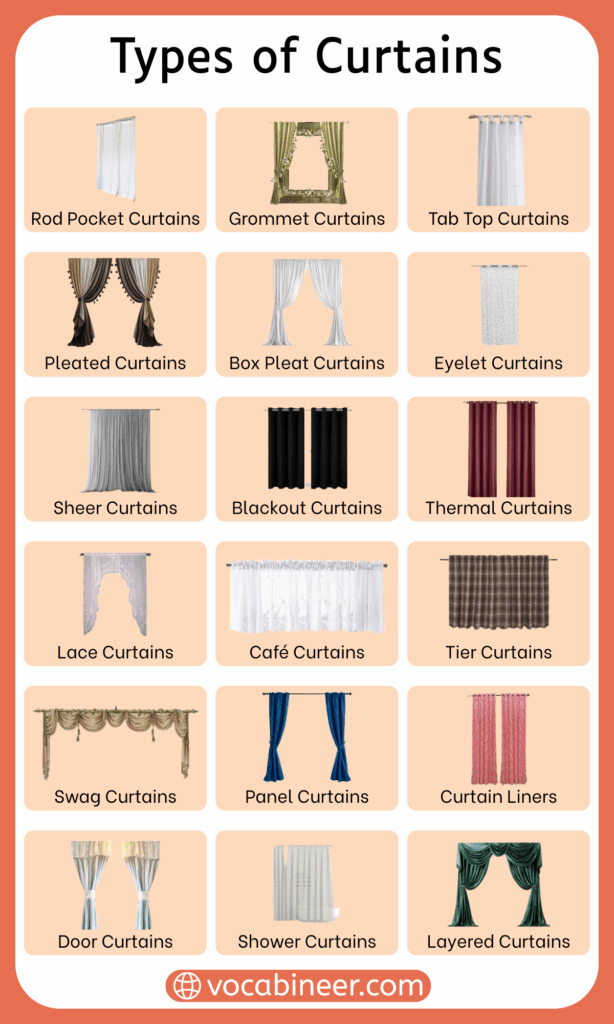
- Rod Pocket Curtains: Slide directly onto rods and create gathered folds.
- Eyelet Curtains: Feature metal rings that allow smooth movement and neat pleats.
- Pinch Pleat Curtains: Sewn pleats provide a formal and structured appearance.
- Tab Top Curtains: Fabric loops give a relaxed and casual look.
- Pencil Pleat Curtains: Adjustable pleats that fit various rod widths.
- Box Pleat Curtains: Wide pleats that offer a clean and tailored finish.
- Goblet Pleat Curtains: Decorative pleats shaped like goblets for luxury spaces.
Curtains Based On Fabric Type
Fabric choice plays a major role in curtain weight, durability, texture, and light control. Some fabrics are chosen for everyday use, while others suit decorative or formal rooms.
- Cotton Curtains: Breathable and suitable for regular household use.
- Linen Curtains: Textured fabric that allows soft natural light.
- Silk Curtains: Smooth and glossy fabric used mainly in formal settings.
- Velvet Curtains: Heavy curtains that block light and insulate rooms.
- Polyester Curtains: Wrinkle-resistant and easy to maintain.
- Voile Curtains: Very lightweight fabric used for sheer coverage.
- Jacquard Curtains: Woven designs that add visual depth.
- Net Curtains: Thin fabric used mainly for privacy during daytime.
Curtains Based On Light Control
Light control is one of the most important factors when choosing curtains. Different types allow varying levels of brightness inside a room.
- Sheer Curtains: Let in maximum daylight while softening visibility.
- Semi-Sheer Curtains: Balance light entry and partial privacy.
- Blackout Curtains: Block almost all outside light for dark rooms.
- Light Filtering Curtains: Reduce glare without darkening spaces completely.
- Room Darkening Curtains: Dim the room while remaining lighter than blackout options.
- Sun-Blocking Curtains: Reduce harsh sunlight and protect interiors.
Curtains Based On Length And Size
Curtain length affects how windows look and how much coverage is provided. Length choices often depend on window size and room style.
- Short Curtains: Cover part of the window and suit kitchens.
- Floor Length Curtains: Reach the floor for a finished appearance.
- Extra Long Curtains: Used for tall windows or decorative draping.
- Café Curtains: Cover only the lower half of windows.
- Puddle Curtains: Extend slightly onto the floor for a decorative effect.
Curtains Based On Opening Style
Opening style determines how curtains are drawn and arranged on the rod.
- Single Panel Curtains: Use one fabric panel for coverage.
- Double Panel Curtains: Open from the center with two panels.
- Center Opening Curtains: Meet evenly in the middle.
- Side Opening Curtains: Pull open from one direction.
- Tie-Back Curtains: Held aside using fabric or rope ties.
Curtains For Privacy And Insulation
Some curtains focus more on comfort and environmental control than decoration.
- Thermal Curtains: Reduce heat loss and control room temperature.
- Soundproof Curtains: Help reduce outside noise.
- Privacy Curtains: Block visibility from outside.
- Insulated Curtains: Add an extra protective fabric layer.
- UV-Blocking Curtains: Protect interiors from sunlight damage.
Decorative Curtain Styles
Decorative curtains are chosen mainly to enhance interior design and room character.
- Printed Curtains: Feature floral, abstract, or themed patterns.
- Plain Curtains: Solid-color curtains for minimal interiors.
- Patterned Curtains: Include stripes or geometric designs.
- Embroidered Curtains: Decorated with stitched details.
- Layered Curtains: Combine sheer and thick panels.
- Beaded Curtains: Decorative hanging strands used in doorways.
Curtains Based On Room Function
Different rooms demand different curtain qualities depending on usage.
- Office Curtains: Reduce glare and maintain a professional setting.
- Study Room Curtains: Manage brightness for reading or screens.
- Kids Room Curtains: Often colorful or themed.
- Prayer Room Curtains: Simple and calming in design.
- Hospital Curtains: Used for privacy and space division.
Curtains Based On Installation Area
Curtains can be installed beyond standard windows.
- Window Curtains: Designed for regular windows.
- Door Curtains: Used on glass or entry doors.
- Balcony Curtains: Provide shade and privacy.
- Partition Curtains: Divide indoor spaces.
- Stage Curtains: Used in halls and theaters.
Seasonal Curtain Types
Some curtains are chosen specifically for seasonal comfort.
- Summer Curtains: Lightweight and breathable fabrics.
- Winter Curtains: Thick materials that retain warmth.
- All-Season Curtains: Suitable throughout the year.
- Monsoon Curtains: Moisture-resistant fabrics.
Curtains Based On Maintenance Needs
Maintenance level affects long-term convenience.
- Washable Curtains: Easy to clean at home.
- Low-Maintenance Curtains: Resist wrinkles and stains.
- Dust-Resistant Curtains: Suitable for allergy-sensitive homes.
- Fade-Resistant Curtains: Retain color over time.
Curtains By Color Style
Color selection changes room mood and brightness.
- Light Color Curtains: Brighten rooms and reflect light.
- Dark Color Curtains: Add depth and reduce glare.
- Neutral Color Curtains: Blend easily with interiors.
- Two-Tone Curtains: Combine contrast colors.
- Printed Color Curtains: Add visual interest.
Curtains For Special Uses
Certain curtains serve unique purposes.
- Shower Curtains: Prevent water splashes.
- Outdoor Curtains: Provide shade in patios.
- Fire-Resistant Curtains: Used in commercial buildings.
- Medical Curtains: Used in clinics and hospitals.
Curtains For Different Age Groups
Curtain preferences vary by age group.
- Curtains For Kids: Bright colors and playful designs.
- Curtains For Adults: Balance comfort and style.
- Curtains For Elderly Rooms: Simple designs with easy handling.
FAQs About Types Of Curtains
The most common types of curtains used in homes include sheer curtains, blackout curtains, cotton curtains, linen curtains, and polyester curtains. These are chosen based on light control, privacy needs, and ease of maintenance in daily living spaces.
Blackout curtains are the best option for blocking sunlight. They are made with thick, tightly woven fabric that prevents outside light from entering the room, making them suitable for bedrooms and media rooms.
Polyester curtains are considered the easiest to maintain. They resist wrinkles, dry quickly after washing, and hold their shape well, which makes them suitable for regular household use.
Sheer curtains provide limited privacy during the daytime by reducing visibility from outside. However, they do not offer complete privacy at night, so they are often paired with thicker curtain layers.
Choosing the right curtain depends on the room’s purpose, the amount of light needed, and privacy requirements. Bedrooms usually need thicker curtains, while living rooms and kitchens often use lighter fabrics for balanced light and airflow.
Conclusion
Types of curtains differ based on fabric, hanging style, light control, length, room function, and seasonal use. From sheer and blackout curtains to decorative and thermal styles, each type serves a specific purpose. Learning curtain names helps people choose suitable curtains for comfort, privacy, and everyday living.
Read More