Flasks are containers used in laboratories, homes, and many other settings to hold, mix, carry, or store liquids. They come in different shapes and sizes, and each type is designed for a specific purpose.
In this post, you’ll learn about the different types of flasks, how they look, and what they are used for. You’ll also see how pictures and names make each flask easier to recognize.
In This Page
What Are Laboratory Flasks?
Laboratory flasks are vessels used for handling liquids during experiments and practical work. Most have a wider body and a narrower neck, which helps with safer pouring, swirling, and controlled heating.
Different flasks are made for different lab jobs. Some are used for exact measurement, while others are better for boiling, filtration, distillation, or chemical reactions.
Main Types of Laboratory Flasks
The easiest way to learn flask types is to connect each one with its shape and main use. Once you notice the body, neck, and base, each name becomes easier to remember.
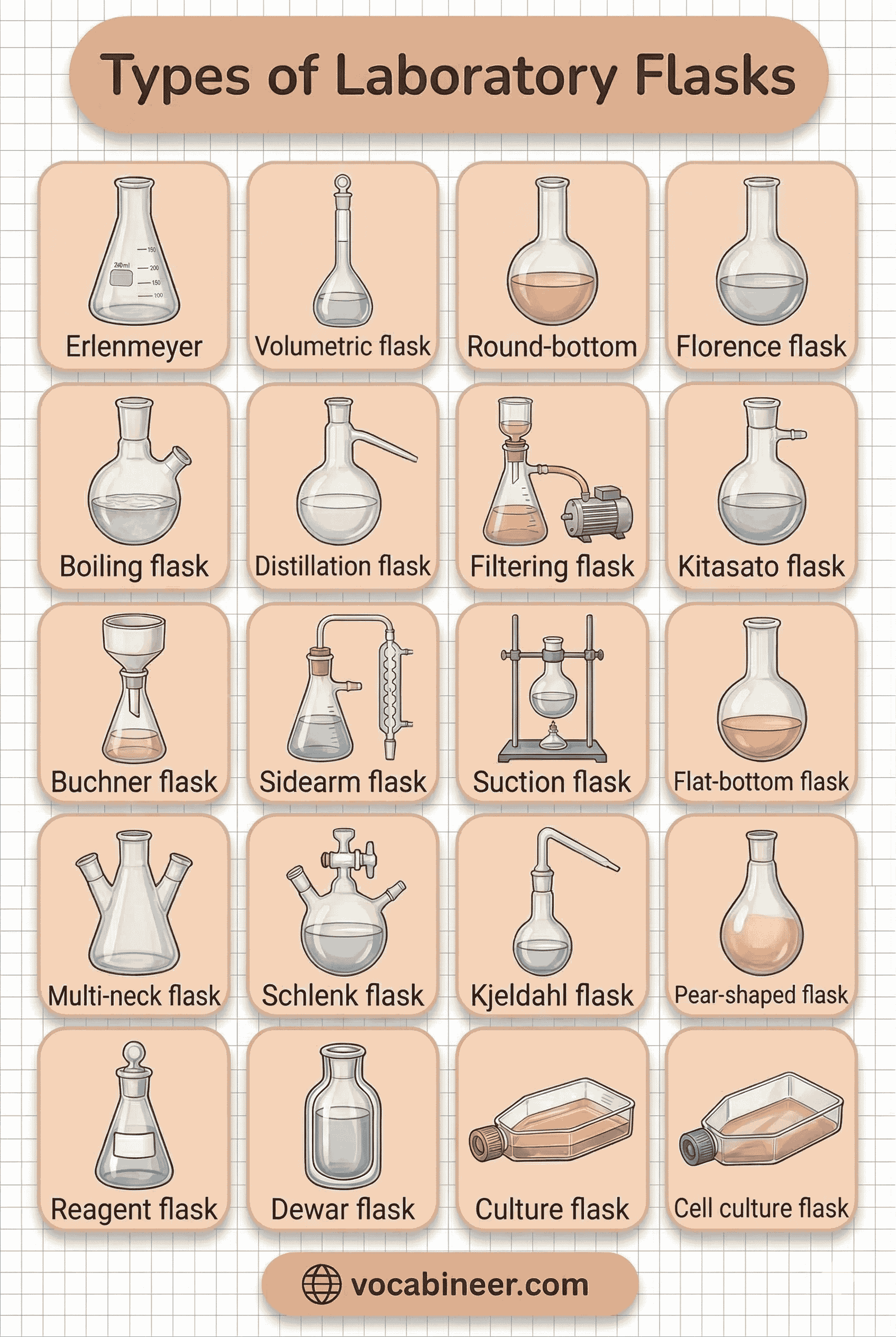
- Erlenmeyer flask: A cone-shaped flask with a flat base and narrow neck. It is used for mixing, swirling, and heating liquids.
- Volumetric flask: A bulb-shaped flask with a long narrow neck and one marking line. It is used to prepare liquids to one exact volume.
- Round-bottom flask: A spherical flask with no flat base. It is used for heating, reflux, and chemical reactions.
- Florence flask: A round-bodied flask with a long neck. It is commonly used for boiling and heating liquids.
- Boiling flask: A heat-resistant flask with a rounded body and narrow neck. It is designed for boiling liquids safely.
- Distillation flask: A flask with a side arm near the neck. It is used in distillation setups.
- Filtering flask: A thick-walled flask with a side tube. It is used for vacuum filtration.
- Kitasato flask: A strong flask with a side arm. It is mainly used for suction filtration.
- Schlenk flask: A reaction flask with a side outlet and stopcock. It is used in air-sensitive chemistry.
- Multi-neck flask: A round flask with two or more neck openings. It is used when several attachments are needed.
- Flat-bottom flask: A flask with a rounded body and flat base. It is used for holding, heating, or mixing liquids.
Laboratory Flasks by Shape
Laboratory flasks can also be grouped by shape. This makes it easier to recognize each type quickly and understand why different flasks are used for different lab tasks.
Cone-shaped flasks
- Erlenmeyer flask: A cone-shaped flask with a flat base and narrow neck. It is used for mixing, swirling, and heating liquids.
Bulb-shaped flasks
- Volumetric flask: A bulb-shaped flask with a long narrow neck and one marking line. It is used to prepare liquids to one exact volume.
Round-bodied flasks
- Round-bottom flask: A spherical flask with no flat base. It is used for heating, reflux, and chemical reactions.
- Florence flask: A round-bodied flask with a long neck. It is used for boiling and heating liquids.
- Boiling flask: A heat-resistant flask with a rounded body and narrow neck. It is used for boiling liquids safely.
- Flat-bottom flask: A rounded flask with a flat base. It is used for heating, mixing, and holding liquids.
Side-arm flasks
- Distillation flask: A flask with a side arm near the neck. It is used in distillation setups.
- Filtering flask: A thick-walled flask with a side tube. It is used for vacuum filtration.
- Kitasato flask: A strong flask with a side arm. It is used for suction filtration.
Multi-neck flasks
- Multi-neck flask: A round flask with two or more neck openings. It is used when several lab attachments are needed in one setup.
Special reaction flasks
- Schlenk flask: A reaction flask with a side outlet and stopcock. It is used for air-sensitive chemical work.
Flasks Grouped by Use
Grouping flasks by use makes the topic easier to understand. Instead of memorizing names only, you can connect each flask to the job it does in the lab.
Grouping flasks by use makes the topic easier to understand. Instead of learning names by themselves, it helps to link each flask with the task it handles in the lab.
Measuring flasks
- Volumetric flask: Best for preparing liquids to one exact volume.
Mixing flasks
- Erlenmeyer flask: The narrow neck allows easy swirling and helps reduce spills.
- Flat-bottom flask: A stable base makes it useful for holding and mixing liquids on a bench.
Heating flasks
- Round-bottom flask: Even heat distribution makes it ideal for reactions and heating work.
- Florence flask: A long neck and rounded body support boiling and steady heating.
- Boiling flask: Built to handle boiling safely during lab procedures.
Distillation flasks
- Distillation flask: A side arm carries vapor into a condenser during separation.
Filtration flasks
- Filtering flask: Thick walls support vacuum filtration.
- Kitasato flask: During suction filtration, it connects to a vacuum source through its side arm.
Reaction flasks
- Schlenk flask: Air-sensitive reactions are often carried out in this flask.
- Multi-neck flask: Extra neck openings allow several attachments in one setup.
Difference Between Common Laboratory Flasks
Some laboratory flasks look similar, so it helps to compare them directly. Small shape differences often show why each flask is used for a different task.
| Flask | Main shape feature | Main use |
|---|---|---|
| Erlenmeyer flask | Cone-shaped body, flat base | Mixing and swirling |
| Volumetric flask | Bulb body, long marked neck | Exact volume preparation |
| Round-bottom flask | Spherical body, no flat base | Heating and reactions |
| Florence flask | Round body, long neck | Boiling and heating |
| Distillation flask | Side arm near neck | Distillation |
| Filtering flask | Thick wall, side tube | Vacuum filtration |
| Kitasato flask | Strong flask with side arm | Suction filtration |
| Multi-neck flask | Two or more necks | Complex reaction setup |
Round-bottom and Florence flasks both support heating, but the round-bottom type is more common in reaction setups. Filtering and Kitasato flasks are also close, although the Kitasato type is specifically known for vacuum filtration.
Laboratory Flasks Students Should Know First
Students do not need to memorize every specialized flask at once. A smaller group appears most often in school, college, and beginner chemistry labs.
- Erlenmeyer flask
- Volumetric flask
- Round-bottom flask
- Florence flask
- Boiling flask
- Distillation flask
- Filtering flask
These are the flask names students usually see first in diagrams, lab benches, and practical classes. Learning these core types makes the rest of the topic much easier.
Summary
Types of laboratory flasks are easiest to learn through shape and use together. Once you know which flask has a flat base, round body, long neck, or side arm, identification becomes much simpler.
Some flasks are made for measuring, while others are better for heating, filtering, distilling, or running reactions. That is why each flask type has its own form and purpose in the laboratory.
FAQs
Laboratory flasks are used for holding, mixing, heating, measuring, filtering, and transferring liquids during science experiments and practical lab work.
The Erlenmeyer flask is one of the most common laboratory flasks because it is easy to swirl, heat, and use in many basic experiments.
The volumetric flask is used for exact measurement. It is designed to prepare a liquid to one fixed volume with high accuracy.
A round-bottom flask has no flat base and is mainly used for heating and reactions. A flat-bottom flask can stand upright on a bench.
The filtering flask, and sometimes the Kitasato flask, is used for filtration. It has a side arm that connects to a vacuum source.
Read More