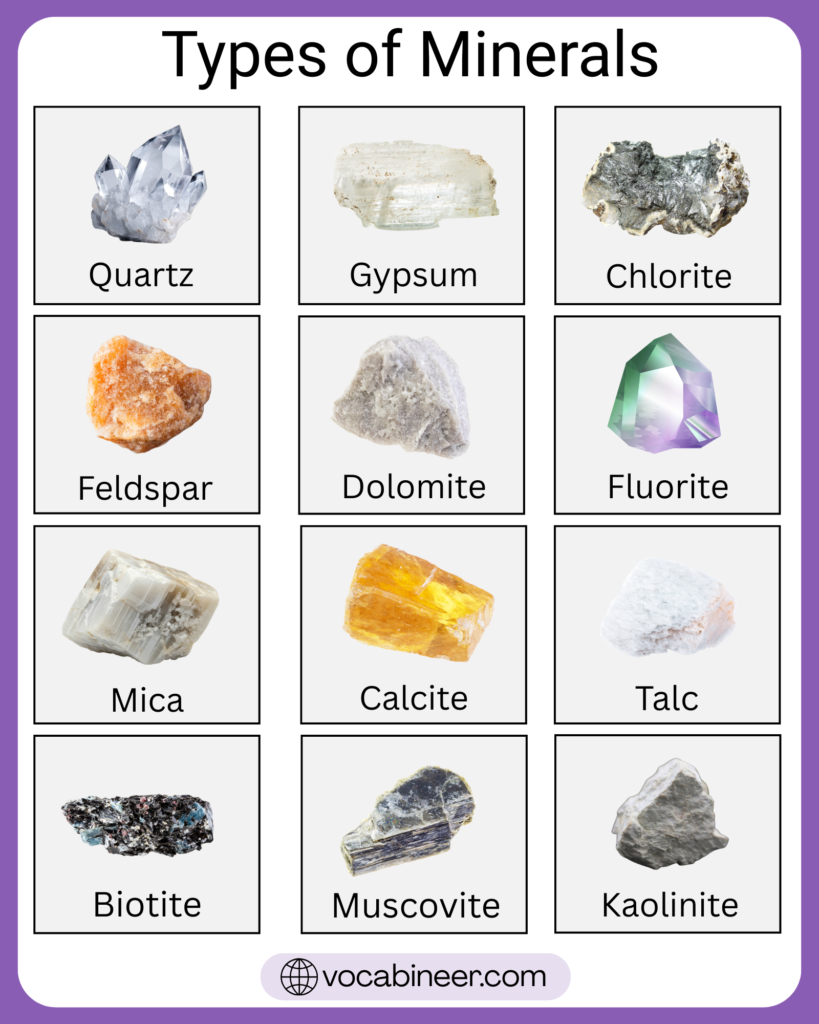
Types of minerals are grouped by chemical composition and crystal structure, and the main classes commonly explained in science sources include silicates, carbonates, oxides, sulfates, halides, phosphates, sulfides, and native elements. Silicates are especially important because they make up the largest mineral group and account for most of Earth’s crust.
This article covers types of minerals with names and pictures in a simple and organized way. You will learn the main mineral groups, understand their basic characteristics, and see common examples from each class for easier learning and identification.
In This Page
What are Minerals?
Minerals are natural solid substances found in the earth. They form naturally, have a fixed chemical makeup, and usually have a crystal structure. Examples of minerals include quartz, mica, calcite, gold, and halite.
In simple words, minerals are the natural materials that make up many rocks and are also used in jewelry, industry, and everyday products.
Common Types of Minerals
Common types of minerals include the main mineral classes used in geology and earth science. Some mineral groups are made mostly of silicon and oxygen, while others are made of carbonates, sulfides, oxides, halides, phosphates, or native elements.
Silicate Minerals
Silicate minerals are the largest mineral group. They contain silicon and oxygen, and common examples include quartz, feldspar, and mica. These minerals make up most of Earth’s crust.
Carbonate Minerals
Carbonate minerals contain the carbonate ion in their composition. Familiar examples include calcite and dolomite.
Oxide Minerals
Oxide minerals are made with oxygen joined to one or more metal elements. Hematite and magnetite are common examples.
Sulfate Minerals
Sulfate minerals contain the sulfate group. Gypsum is one of the best-known examples.
Halide Minerals
Halide minerals form with halogen elements such as chlorine or fluorine. Halite and fluorite are common examples.
Phosphate Minerals
Phosphate minerals contain the phosphate group. Apatite is one of the most familiar examples.
Sulfide Minerals
Sulfide minerals contain sulfur combined with metals or semimetals. Pyrite and galena are common examples.
Native Element Minerals
Native element minerals are made of a single element. Gold, silver, copper, sulfur, and graphite are common examples.
Silicate Minerals
Silicate minerals are the most important mineral group in earth science because they make up the largest share of Earth’s crust. They are built from silicon and oxygen, and many of the most familiar rock-forming minerals belong to this class.
Quartz
Quartz is one of the most common silicate minerals. It is widely found in rocks and is easy to recognize in mineral collections.
Feldspar
Feldspar is another very common silicate mineral. Along with quartz, it is one of the most widespread minerals in Earth’s crust.
Mica
Mica is a silicate mineral known for splitting into thin sheets. It is a common example used in basic mineral study.
Olivine
Olivine is a silicate mineral often recognized by its green color. It is commonly discussed in geology as a rock-forming mineral.
Pyroxene
Pyroxene is another silicate mineral group found in many rocks. It is important in mineral classification and earth science learning.
Carbonate Minerals
Carbonate minerals form an important non-silicate mineral group. They are commonly studied because they appear often in sedimentary rocks and mineral classification systems.
Calcite
Calcite is one of the best-known carbonate minerals. It is very common and often used as a basic example in mineral study.
Dolomite
Dolomite is another important carbonate mineral. It is frequently grouped with calcite in mineral classification.
Aragonite
Aragonite is a carbonate mineral with the same chemical formula as calcite but a different crystal form. It is commonly mentioned in mineral classification and geology.
Malachite
Malachite is a green carbonate mineral. It is often recognized for its striking color and use as a mineral specimen.
Azurite
Azurite is a blue carbonate mineral. It is commonly paired with malachite because both are copper carbonate minerals.
Oxide Minerals
Oxide minerals are made of oxygen combined with one or more metal elements. They are an important non-silicate mineral group and are commonly studied in earth science because many of them are widespread and easy to recognize.
Hematite
Hematite is one of the best-known oxide minerals. It is commonly linked with iron and is often recognized by its reddish or dark metallic appearance.
Magnetite
Magnetite is another important oxide mineral. It is widely known because of its magnetic property and its role as an iron-bearing mineral.
Corundum
Corundum is a hard oxide mineral that is well known in mineral classification. It is important both scientifically and as a gemstone mineral family.
Rutile
Rutile is an oxide mineral commonly associated with titanium. It appears often in mineral collections and classification discussions.
Spinel
Spinel is another oxide mineral group recognized in geology and mineral study. It is often included in formal mineral classification because of its distinct composition and crystal form.
Sulfate Minerals
Sulfate minerals contain the sulfate group in their structure. They form an important non-silicate class and are often discussed in geology because several well-known examples belong to this group.
Gypsum
Gypsum is one of the most familiar sulfate minerals. It is a soft mineral and is commonly used as a standard example of the sulfate group.
Barite
Barite is another important sulfate mineral. It is frequently listed in mineral classification and is easy to find in educational examples of sulfates.
Anhydrite
Anhydrite is closely related to gypsum and is another recognized sulfate mineral. It is commonly discussed in mineralogy as part of the same broader group.
Celestine
Celestine is a sulfate mineral known for its pale blue color in many specimens. It is often included in geology and mineral collections.
Alunite
Alunite is also part of the sulfate mineral class. It appears in formal mineral classification and helps broaden sulfate examples beyond the most common names.
Halide Minerals
Halide minerals form when halogen elements such as chlorine or fluorine combine with other elements. They are part of the non-silicate mineral groups and are often easy to recognize in basic mineral classification.
Halite
Halite is one of the best-known halide minerals. It is commonly recognized as rock salt and is a standard example of this mineral class.
Fluorite
Fluorite is another common halide mineral. It is often included in mineral study because of its clear crystal form and range of colors.
Sylvite
Sylvite is a halide mineral that is often grouped with halite in mineral classification. It is an important example of potassium-bearing halide minerals.
Cryolite
Cryolite is a less common halide mineral, but it appears in formal mineral classification and helps show the wider range of this group.
Carnallite
Carnallite is another halide mineral often mentioned in broader mineral classification systems. It adds more depth to the halide group beyond the most familiar examples.
Phosphate Minerals
Phosphate minerals contain the phosphate group in their composition. They are an important non-silicate class and are often studied because some members are common in rocks, mineral collections, and gem materials.
Apatite
Apatite is one of the most familiar phosphate minerals. It is widely used as a standard example when phosphate minerals are introduced.
Turquoise
Turquoise is a phosphate mineral known for its blue to blue-green color. It is one of the best-known decorative and gemstone-related examples in this group.
Monazite
Monazite is another phosphate mineral commonly included in formal mineral classification. It is important in geology because of its composition and occurrence.
Pyromorphite
Pyromorphite is a phosphate mineral often recognized in mineral collections. It is one of the named examples that broadens understanding of this class.
Vivianite
Vivianite is also part of the phosphate mineral group. It appears in mineral classification and gives another example beyond the most commonly known names.
Sulfide Minerals
Sulfide minerals contain sulfur combined with metals or semimetals. They are an important non-silicate mineral group and are often studied because many of them are linked with metal ores and common geological processes.
Pyrite
Pyrite is one of the best-known sulfide minerals. It is often recognized by its metallic look and brassy color, which is why many learners remember it easily.
Galena
Galena is another important sulfide mineral. It is commonly included in mineral classification and is known as a lead-bearing mineral.
Sphalerite
Sphalerite is a sulfide mineral often grouped with other common ore minerals in geology. It is a standard example in the sulfide class.
Chalcopyrite
Chalcopyrite is a sulfide mineral associated with copper. It is widely mentioned in mineral study and helps represent the variety found in this group.
Cinnabar
Cinnabar is another sulfide mineral and is often recognized for its strong red color. It adds a visually distinctive example to the sulfide class.
Native Element Minerals
Native element minerals are made of a single element rather than a combination of different chemical groups. This makes them different from many other mineral classes such as silicates, oxides, or sulfides.
Gold
Gold is one of the most familiar native element minerals. It is widely known for its natural metallic form and high value.
Silver
Silver is another native element mineral that occurs in natural metallic form. It is commonly included in basic mineral classification examples.
Copper
Copper is a native element mineral that can occur in pure form. It is important in geology and easy to recognize as a metallic mineral example.
Sulfur
Sulfur is a native element mineral that often appears with a bright yellow color. It is one of the clearest examples of a nonmetal native element.
Graphite
Graphite is a native element mineral made of carbon. It is commonly included in mineral classification because it shows that native elements are not limited to shiny metals.
Other Mineral Groups
Besides the major mineral classes, some other mineral groups are also included in formal classification systems. These groups are less central in broad beginner articles, but they help make mineral classification more complete.
Borate Minerals
Borate minerals contain boron and oxygen in their structure. They are a recognized mineral class, although they are discussed less often than silicates or carbonates.
Nitrate Minerals
Nitrate minerals contain the nitrate group. They are part of formal mineral classification, even though they are not as commonly taught as the larger classes.
Hydroxide Minerals
Hydroxide minerals include hydroxide in their composition. They are usually mentioned as a smaller mineral class in scientific classification.
Tungstate Minerals
Tungstate minerals are classified by the presence of tungsten and oxygen in their structure. They appear in broader mineral systems for completeness.
Molybdate Minerals
Molybdate minerals contain molybdenum and oxygen in their composition. They are another smaller mineral class included in formal classification systems.
Types of Minerals and Their Characteristics
Different types of minerals can be compared by chemical group, common examples, appearance, and general role in geology. This makes it easier to understand how one mineral class differs from another without turning the article into a very technical science lesson.
Silicate Minerals
Silicate minerals contain silicon and oxygen and make up the largest mineral group. Quartz, feldspar, and mica are common examples, and many of these minerals are important rock-forming minerals.
Carbonate Minerals
Carbonate minerals contain the carbonate group. Common examples include calcite and dolomite, and they are often linked with sedimentary rocks.
Oxide Minerals
Oxide minerals combine oxygen with metals or other elements. Hematite and magnetite are familiar examples, and many oxide minerals are important in ore geology.
Sulfate Minerals
Sulfate minerals contain the sulfate group. Gypsum is one of the best-known examples, and sulfate minerals often appear in mineral collections and geology texts.
Halide Minerals
Halide minerals form with halogen elements such as chlorine or fluorine. Halite and fluorite are common examples, and many halides are easy to recognize in basic mineral study.
Phosphate Minerals
Phosphate minerals contain the phosphate group. Apatite is the best-known example, while turquoise is another familiar name in this class.
Sulfide Minerals
Sulfide minerals contain sulfur joined with metals or semimetals. Pyrite, galena, and chalcopyrite are common examples, and many sulfides are important ore minerals.
Native Element Minerals
Native element minerals are made of a single element. Gold, silver, copper, sulfur, and graphite are common examples, and this class is easy to understand because it does not depend on complex chemical groups.
How to Identify Different Types of Minerals
Different types of minerals can be identified in a simple way by looking at their group, color, crystal habit, luster, and common examples. Silicates are often recognized as rock-forming minerals, while native elements are single-element minerals such as gold or sulfur. Carbonates, oxides, sulfides, and other classes are usually identified more clearly when their common examples are learned first.
FAQs
The main types of minerals are silicates, carbonates, oxides, sulfates, halides, phosphates, sulfides, and native element minerals.
Silicate minerals are the largest mineral group and make up most of Earth’s crust.
Examples of native element minerals include gold, silver, copper, sulfur, and graphite.
Silicate minerals contain silicon and oxygen, while non-silicate minerals belong to other chemical groups such as carbonates, oxides, sulfides, or halides.
Mineral types are important because they help scientists, students, and readers understand how minerals are grouped and how they differ in composition and examples.
Conclusion
Types of minerals are grouped into major classes based on chemical composition and structure. The most important groups include silicate minerals, carbonate minerals, oxide minerals, sulfate minerals, halide minerals, phosphate minerals, sulfide minerals, and native element minerals.
Learning the names and characteristics of different mineral types makes it easier to understand geology and earth science. With pictures, these mineral groups and examples become even easier to identify and compare.
Read More