A roof is the top covering of a building. It protects rooms under it from sun, rain, wind, and snow. Roofs come in many shapes and materials, so they match different weather and building styles. Learning the types of roofs helps you name what you see on houses, schools, shops, and other buildings in clear everyday English.
In This Page
Types of Roofs by Shape
Roof shape is the easiest way to recognize roof types. Each shape has a clear look and a common purpose.
Gable roof types
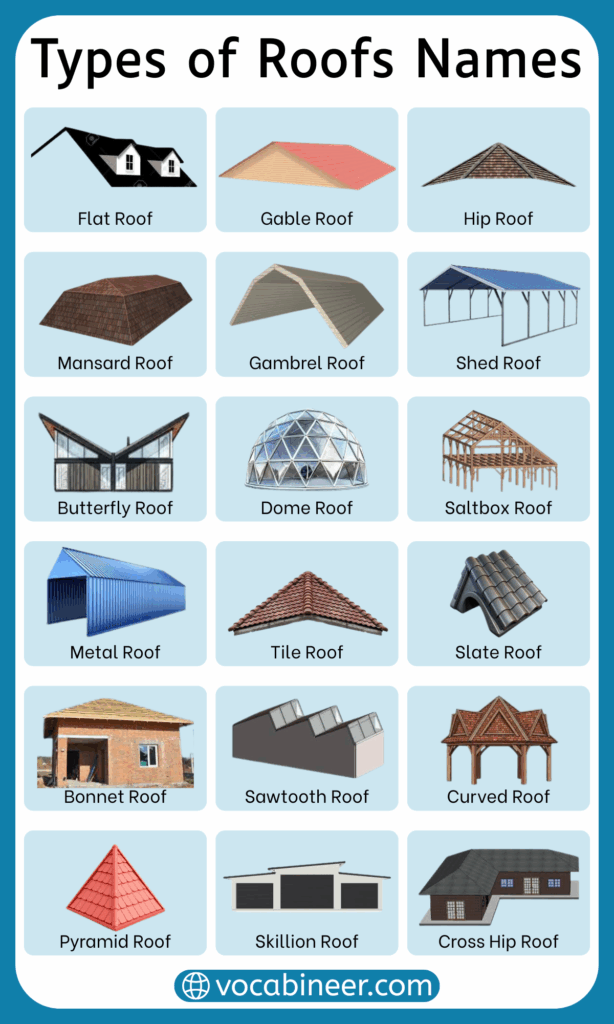
Gable roofs have two sloping sides that meet at a top line. They are very common on houses. Below is a list of gable roof types with meanings
- Gable roof: A roof with two slopes meeting in the middle, forming triangles on the ends.
- Front gable roof: The gable triangle faces the front of the building.
- Side gable roof: The gable triangles face the two side walls.
- Cross gable roof: Two gable roofs join at right angles on a larger house.
- Dutch gable roof: A hip roof with a small gable sitting on top.
- Box gable roof: A gable roof where the triangle end is boxed in with solid walls.
- Open gable roof: A gable end that stays open under the roof edge.
- Jerkinhead gable roof: A gable roof with short clipped sides near the top.
- Saltbox roof: A gable roof with one side longer and lower than the other.
- Dormer gable roof: A gable roof with small gable windows sticking out.
Hip roof types
Hip roofs slope down on all sides, so there are no flat ends. They are strong in windy areas. Below is a list of hip roof types with meanings
- Hip roof: A roof with four sloping sides meeting at the top.
- Simple hip roof: A basic hip roof on a square or rectangle building.
- Cross hip roof: Two hip roofs joined on a complex building shape.
- Half hip roof: A hip roof that leaves a small gable section visible.
- Pyramid hip roof: A hip roof on a square building meeting at one top point.
- Hip and valley roof: A hip roof with inner valleys where two sections meet.
- Tent roof: A steep pyramid hip roof that looks like a tent.
- Pavilion hip roof: A hip roof spread over a wide base, common on halls.
- Hipped dormer roof: A hip roof with a small hipped window extension.
Flat roof types
Flat roofs look almost level, though they still tilt a little for water flow. Below is a list of flat roof types with meanings
- Flat roof: A nearly level roof used on modern buildings.
- Built up flat roof: A flat roof made from many layered sheets.
- Single ply flat roof: A flat roof covered by one strong waterproof sheet.
- Terrace roof: A flat roof used as an open sitting space.
- Concrete slab roof: A flat roof made from a solid concrete slab.
- Bitumen flat roof: A flat roof sealed with thick, tar-like waterproof layers.
- EPDM rubber roof: A flat roof covered with rubber membrane sheets.
- TPO flat roof: A flat roof covered with a heat-reflective plastic membrane.
- PVC flat roof: A flat roof sealed with strong plastic sheets.
Shed roof types
Shed roofs have one sloping surface, like a single tilted plane. Below is a list of shed roof types with meanings
- Shed roof: A roof that slopes in one direction only.
- Mono pitch roof: Another name for a shed roof.
- Skillion roof: A shed roof with a sharper, modern look.
- Lean to roof: A shed roof attached to a taller wall on one side.
- Single slope roof: A simple one-plane roof, often on small homes.
Gambrel roof types
Gambrel roofs have two slopes on each side. The lower slope is steeper. Below is a list of gambrel roof types with meanings
- Gambrel roof: A roof with two slopes per side, often seen on barns.
- Symmetrical gambrel roof: Both sides match in angle and length.
- Asymmetrical gambrel roof: One side has different slope angles.
- Dutch colonial gambrel roof: A house gambrel roof with a wider lower slope.
- Gambrel with dormers: A gambrel roof with window extensions for attic space.
Mansard roof types
Mansard roofs also have two slopes on each side, but the lower slope is very steep. Below is a list of mansard roof types with meanings
- Mansard roof: A roof with steep lower slopes and gentle upper slopes on all sides.
- Straight mansard roof: The lower slope is straight, not curved.
- Convex mansard roof: The lower slope curves outward.
- Concave mansard roof: The lower slope curves inward.
- Mansard with dormers: A mansard roof with window extensions on the steep sides.
- Modern mansard roof: A cleaner mansard style with simpler lines.
A frame roof types
A frame roofs form a sharp triangle, like the letter A. Snow slides off easily. Below is a list of A frame roof types with meanings
- A frame roof: A steep triangle roof where both sides meet at a high point.
- Steep A frame roof: A sharper A frame for heavy snow areas.
- Modified A frame roof: An A frame with changes like extra windows or a short top ridge.
- Chalet A frame roof: A wide A frame often used on cabins.
Butterfly roof types
Butterfly roofs slope down toward the center, forming a V shape. Below is a list of butterfly roof types with meanings
- Butterfly roof: Two inward slopes meeting in a center valley.
- Asymmetrical butterfly roof: One side slopes more steeply than the other.
- Double butterfly roof: Two butterfly sections placed side by side.
Dome roof types
Dome roofs are round, like a half ball. They are used on large halls and religious buildings. Below is a list of dome roof types with meanings
- Dome roof: A rounded roof shaped like a half sphere.
- Geodesic dome roof: A dome built from many triangle sections.
- Onion dome roof: A dome that bulges outward then narrows at the top.
- Ribbed dome roof: A dome with raised ribs for strength and style.
Sawtooth roof types
Sawtooth roofs look like repeated zigzag teeth, often on factories. Below is a list of sawtooth roof types with meanings
- Sawtooth roof: A roof made of repeating angled sections like a zigzag.
- North light roof: A sawtooth roof that brings in soft daylight through vertical windows.
- Monitor sawtooth roof: A sawtooth roof with raised central sections for extra air and light.
Types of Roofs by Slope
Roof slope means how steep the roof is. Slope affects how water and snow move off.
Steep roof types
Steep roofs have sharp angles, so rain and snow slide off fast. Below is a list of steep roof types with meanings
- Steep gable roof: A gable roof with a sharper rise.
- Steep hip roof: A hip roof with strong steep slopes.
- A frame roof: A very steep triangle roof.
- High pitch roof: Any roof with a strong upward angle.
Low slope roof types
Low slope roofs have gentle angles and are common in dry areas. Below is a list of low slope roof types with meanings
- Low slope roof: A roof with a small tilt, not fully flat.
- Shallow gable roof: A gable roof with softer slopes.
- Shallow hip roof: A hip roof with low, gentle slopes.
- Minimal pitch roof: A roof with the smallest safe slope for water flow.
Curved roof types
Curved roofs use rounded lines instead of straight planes. Below is a list of curved roof types with meanings
- Barrel roof: A curved roof shaped like a half cylinder.
- Arch roof: A roof that forms a smooth arch across a space.
- Dome roof: A fully rounded roof.
- Bow roof: A gentle curved roof that bows upward in the middle.
Types of Roofs by Material
Roof materials change how a roof looks and how long it lasts.
Metal roof types
Metal roofs are strong and common in many climates. Below is a list of metal roof types with meanings
- Corrugated metal roof: Metal sheets with wavy ridges for strength.
- Standing seam metal roof: Metal panels joined with raised seams.
- Metal tile roof: Metal shaped to look like tiles.
- Aluminum roof: A light metal roof that resists rust.
- Steel roof: A strong metal roof used in homes and factories.
- Copper roof: A metal roof that changes color over time and lasts long.
- Zinc roof: A long lasting metal roof with smooth panels.
Tile roof types
Tile roofs use baked clay or concrete tiles and handle heat well. Below is a list of tile roof types with meanings
- Clay tile roof: Roof covered with baked clay tiles.
- Concrete tile roof: Roof covered with strong concrete tiles.
- Spanish tile roof: Roof with curved tiles creating a wave pattern.
- Flat tile roof: Roof with flat tiles laid in overlapping rows.
- Interlocking tile roof: Tiles that lock together to stop leaks.
Shingle roof types
Shingle roofs use small overlapping pieces. Below is a list of shingle roof types with meanings
- Asphalt shingle roof: Roof made from asphalt coated shingles.
- Wooden shingle roof: Roof made from thin wooden pieces.
- Architectural shingle roof: Thicker shingles that give a layered look.
- Fiberglass shingle roof: Asphalt shingles strengthened with fiberglass mat.
- Three tab shingle roof: Flat shingles cut into three equal tabs.
Concrete roof types
Concrete roofs are heavy and very strong. Below is a list of concrete roof types with meanings
- Concrete slab roof: A flat roof made from a solid concrete slab.
- Reinforced concrete roof: Concrete roof strengthened with steel inside.
- Precast concrete roof: Concrete panels made before installation and placed on site.
Slate roof types
Slate roofs use flat stone pieces and last a long time. Below is a list of slate roof types with meanings
- Natural slate roof: Roof made from real slate stone pieces.
- Synthetic slate roof: Roof made from manmade slate-like material.
- Slate tile roof: Roof using cut slate tiles in neat rows.
Wood roof types
Wood roofs look warm and natural. Below is a list of wood roof types with meanings
- Wood shake roof: Roof made from thick rough wooden pieces.
- Wood shingle roof: Roof made from thinner, smoother wooden pieces.
- Cedar shake roof: A wood shake roof made from cedar for better weather resistance.
Glass roof types
Glass roofs let sunlight pass through. Below is a list of glass roof types with meanings
- Glass roof: Roof made mostly from glass panels.
- Skylight roof: Roof that includes many skylight windows.
- Conservatory roof: A mostly glass roof used for sunrooms.
- Polycarbonate roof: A clear plastic roof that looks like glass but is lighter.
Green roof types
Green roofs have soil and plants on top. Below is a list of green roof types with meanings
- Extensive green roof: Thin soil with small plants, low weight.
- Intensive green roof: Thick soil that can grow larger plants.
- Semi intensive green roof: Medium soil depth with grass and small shrubs.
Roof Styles for Houses
House roofs are chosen for space, looks, and weather needs.
Modern roof styles
Modern homes often use simple lines. Below is a list of modern house roof types with meanings
- Flat roof: Clean level roof used in modern designs.
- Shed roof: One slope roof that looks simple and sharp.
- Butterfly roof: Two inward slopes giving a modern V shape.
- Low slope roof: Gentle tilt roof often used in warm areas.
- Curved roof: Rounded roof used for a soft modern look.
Traditional roof styles
Traditional homes use classic shapes. Below is a list of traditional house roof types with meanings
- Gable roof: Two slope triangle roof common on homes.
- Hip roof: Four slope roof strong against wind.
- Gambrel roof: Two slope barn style roof with extra attic space.
- Mansard roof: Four side roof with steep lower slopes for more upper space.
- Saltbox roof: Traditional roof with one long back slope.
Roof Parts Names
Roof parts have their own names. Knowing them helps you describe roof structure clearly. Below is a list of roof parts with meanings
- Ridge: The top line where two roof sides meet.
- Eave: The roof edge that sticks out past the wall.
- Valley: The inner line where two roof slopes meet.
- Rafter: Slanted beams that hold up the roof.
- Truss: A strong frame that supports the roof shape.
- Fascia: The board along the roof edge under the eaves.
- Gutter: A channel that carries rainwater away.
- Skylight: A roof window that lets light in.
- Soffit: The underside panel under the eaves.
- Flashing: Thin metal strips that stop water at joints and edges.
- Roof deck: The flat base layer that all roofing sits on.
- Underlayment: A protective sheet under the main roof material.
- Drip edge: A metal strip that guides water into the gutter.
- Vent: An opening that lets hot air escape from the roof space.
FAQs about Types of Roofs
A gable roof has two sloping sides and a triangle shape at each end. A hip roof slopes on all sides and has no flat triangle ends. Hip roofs look more rounded and handle wind better.
A flat roof looks level, but it still has a small slope. That tiny tilt lets rainwater flow toward drains or gutters instead of staying on the roof.
A shed roof has one sloping surface, so it is simple to build. It works well for small homes, side rooms, and modern designs where clean lines are wanted.
Shingles are thin overlapping pieces, often asphalt or wood. Tiles are thicker pieces, usually clay or concrete, and they often have a curved or flat block shape.
A green roof is a roof covered with soil and plants. It is built in layers so water stays controlled, and plants can grow on top without damaging the building.
Conclusion
Types of roofs can be grouped by shape, slope, and material. Gable, hip, flat, shed, gambrel, mansard, A frame, butterfly, dome, and sawtooth are major shape names, and each has useful subtypes. Materials like metal, tile, shingles, slate, wood, glass, concrete, and green roofing add more roof types. With these names and meanings, you can describe roofs clearly in school, home, or building topics.
Read More