

Antonyms for hope help readers understand how English expresses disappointment, uncertainty, and loss of belief with greater accuracy. When hope weakens or disappears, language shifts to reflect emotional strain, hesitation, or acceptance of negative outcomes. These opposite words appear regularly in stories, school texts, conversations, and descriptive writing, shaping how situations and feelings are communicated. Learning them allows readers to follow emotional changes clearly and understand why a situation feels uncertain, difficult, or discouraging rather than positive.
In This Page
Meaning of Hope in English
Hope means believing that something good may happen in the future. It reflects trust, confidence, or a positive expectation, even when outcomes are uncertain. People often use hope when talking about improvement, recovery, success, or change, and the word usually carries a forward-looking tone.
When hope is missing, English relies on other words to express doubt, fear, disappointment, or acceptance of failure. Knowing what hope represents makes its opposites easier to understand and use correctly.
Common Antonyms for Hope With Meanings
Some words directly express the opposite of hope by showing a lack of positive expectation about the future. These antonyms for hope are among the most frequently used, and they appear often in reading passages, exams, and reflective writing where outcomes feel uncertain or negative.
- Hopelessness: A state in which improvement or success no longer seems possible.
- Despair: A deep loss of hope that feels overwhelming and emotionally painful.
- Doubt: Uncertainty that weakens belief in a positive outcome.
- Pessimism: A tendency to expect negative results rather than positive ones.
- Resignation: Calm acceptance that a situation will not change for the better.
- Discouragement: Loss of confidence caused by repeated difficulty or failure.
- Desperation: A strong feeling that no solution or escape exists.
- Defeatism: The belief that effort will not lead to success.
- Uncertainty: Lack of confidence or clarity about what will happen next.
- Fear: Anxiety or worry that replaces belief in a positive future.
- Cynicism: A mindset that doubts good intentions or positive outcomes.
- Skepticism: Doubt about whether improvement or success is possible.
- Helplessness: The feeling of being unable to change a situation.
- Disbelief: Refusal or inability to accept a hopeful outcome.
- Misery: Ongoing emotional suffering linked to loss of hope.
- Anguish: Severe mental or emotional pain connected to hopeless situations.
- Distress: Emotional strain caused by worry, pressure, or fear of failure.
- Fatalism: The belief that outcomes are fixed and cannot be changed.
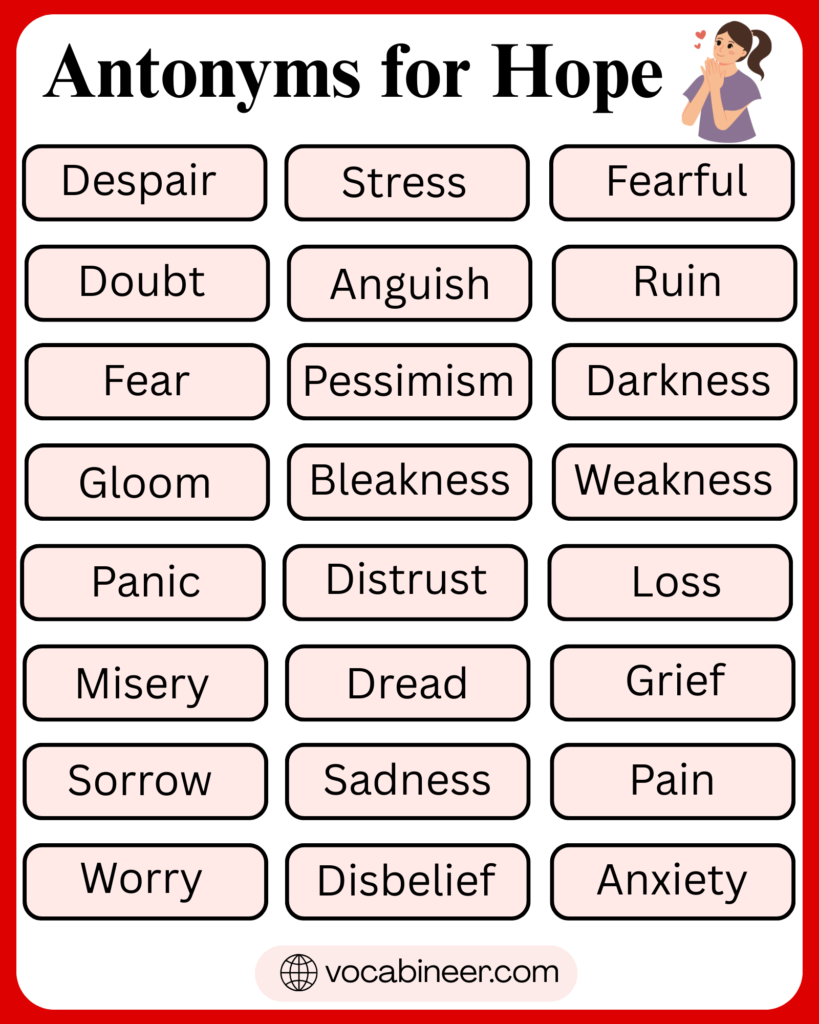
Emotional Antonyms of Hope
Some antonyms of hope focus on feelings rather than beliefs or expectations. The emotional states below reflect the absence of hope and are often used to describe personal reactions, inner struggles, and moments of loss in stories and conversations.
- Despair: Intense emotional pain caused by believing nothing will improve.
- Misery: Long-lasting emotional suffering linked to disappointment or hardship.
- Sadness: A heavy feeling that follows unmet hopes.
- Fear: Emotional tension that grows when the future feels uncertain.
- Grief: Deep sorrow often connected to permanent loss of hope.
- Anguish: Strong emotional distress that feels overwhelming and personal.
- Distress: Emotional discomfort caused by worry or helplessness.
Mental Antonyms of Hope
Other antonyms of hope describe ways of thinking rather than emotional pain. The mental attitudes listed below contrast clearly with hope and focus on belief systems, expectations, and thought patterns about the future.
- Doubt: A thinking pattern where success feels uncertain.
- Cynicism: A belief that good intentions usually fail.
- Pessimism: A steady expectation that negative results will occur.
- Resignation: A mental decision to stop expecting change.
- Defeatism: A belief that effort does not matter.
- Skepticism: Doubt about whether improvement is possible.
- Fatalism: The belief that outcomes cannot be changed.
Words Related to Hopelessness
Some words do not replace hope directly but often appear alongside its antonyms to describe situations where confidence weakens or disappears. The following words are closely related to hopelessness and help expand meaning in context.
- Failure: An outcome that removes confidence in future success.
- Helplessness: Feeling unable to change or control a situation.
- Loss: A condition where something important is gone.
- Defeat: An ending that weakens belief in improvement.
- Collapse: A sudden breakdown of plans or expectations.
- Decline: A gradual movement toward worse conditions.
- Setback: An event that delays progress and reduces confidence.
Hope vs Similar Words
Hope expresses belief or expectation that something positive may happen in the future. It looks ahead and allows room for improvement, even when the situation is uncertain. Hope does not guarantee success, but it keeps the possibility open.
Hope vs Despair
Despair reflects a complete loss of hope. While hope believes change is still possible, despair accepts that improvement will not happen. Despair carries emotional weight and finality, whereas hope keeps the future open.
Hope vs Doubt
Doubt questions whether a positive outcome will occur. Hope leans toward belief, while doubt leans toward uncertainty. A person may still hope while doubting, but doubt weakens confidence in success.
Hope vs Pessimism
Pessimism expects negative results. Hope expects positive ones or at least believes they are possible. Pessimism focuses on what may go wrong, while hope focuses on what may still go right.
Hope vs Resignation
Resignation means accepting that a situation will not change. Hope encourages effort and waiting for improvement, but resignation stops expecting any better outcome. Resignation sounds calm, but it lacks belief in progress.
Antonyms for Hope in Sentences
Seeing antonyms used in sentences helps learners understand how these words work naturally in English. Each sentence below shows how replacing hope changes the meaning and emotional direction.
- After many failures, she felt hopelessness.
- His voice was filled with despair during the announcement.
- There was doubt about whether the plan would succeed.
- Repeated losses caused deep discouragement.
- He accepted the result with resignation.
- Her outlook reflected constant pessimism.
- The situation pushed them into desperation.
- Years of setbacks led to defeatism.
- The future remained full of uncertainty.
How to Choose the Right Antonym for Hope
Choosing the right antonym for hope depends on what you want to express in a situation. If the focus is on feelings, words like despair, sadness, or misery work better because they describe emotional pain. When the focus is on thinking or belief, words such as doubt, pessimism, or resignation are more accurate.
Think about whether the situation shows emotion, mindset, or acceptance of an outcome. Matching the antonym to the situation helps your message sound clear, natural, and precise instead of vague or confusing.
Conclusion
Understanding antonyms for hope helps readers recognize how English expresses loss of confidence, emotional struggle, and negative expectations. These words shape meaning across reading, writing, and conversation. Learning them through grouped explanations and sentence use builds stronger control over emotional and descriptive language.
Read More
