Phrasal verbs are very common in everyday English. They are made with a verb and a small word like up, out, off, in, on, or away. For example, get up, turn off, look for, and give up are phrasal verbs.
These phrasal verbs are commonly used in daily English conversation and writing. In this guide, you will learn 100 common phrasal verbs in English with meanings and examples, grouped by real-life use so you can understand and remember them more easily.
In This Page
What Are Phrasal Verbs?
A phrasal verb is a verb combined with an adverb or preposition. Together, they create a new meaning.
For example:
- Look means to use your eyes.
- Look after means to take care of someone or something.
- Give means to hand something to someone.
- Give up means to stop trying.
Many phrasal verbs have meanings that are different from the original verb, so they should be learned as complete phrases.
List of 100 Common Phrasal Verbs
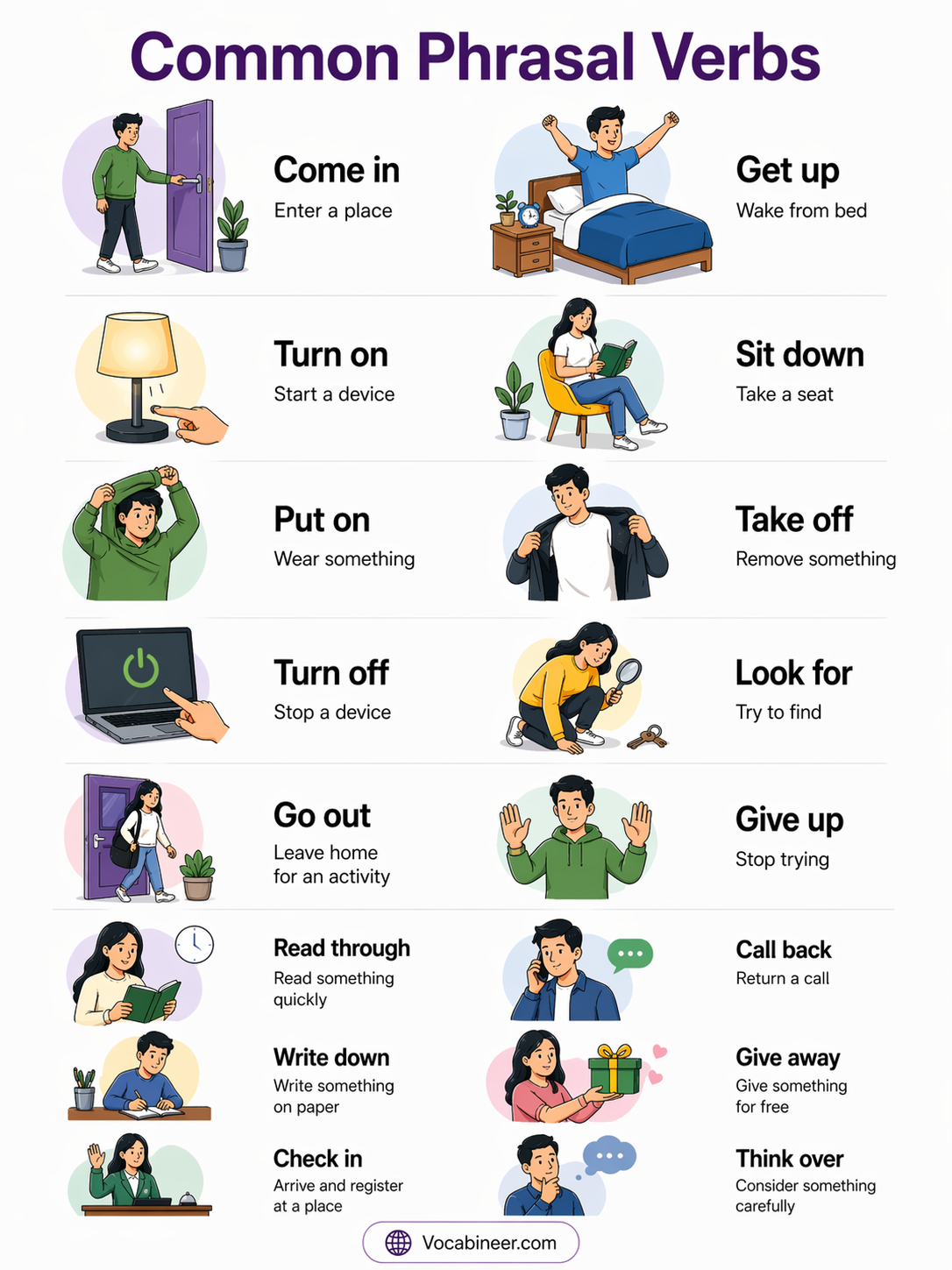
Here is a quick list of useful phrasal verbs in English:
- Get up
- Wake up
- Sit down
- Stand up
- Go out
- Come in
- Go back
- Come back
- Turn on
- Turn off
- Put on
- Take off
- Pick up
- Put down
- Clean up
- Eat out
- Hang out
- Run out
- Fill up
- Throw away
- Speak up
- Calm down
- Point out
- Talk over
- Ask for
- Call back
- Bring up
- Find out
- Look up
- Write down
- Read over
- Go over
- Hand in
- Work on
- Carry out
- Set up
- Come up with
- Figure out
- Look into
- Put off
- Get on
- Get off
- Get in
- Get out
- Move on
- Go away
- Come over
- Drop off
- Pick out
- Check in
- Check out
- Slow down
- Speed up
- Pull over
- Break down
- Cheer up
- Give up
- Get over
- Fall apart
- Open up
- Hold on
- Let down
- Look forward to
- Deal with
- Put up with
- Break up
- Make up
- Get along
- Fall out
- Look after
- Take care of
- Grow up
- Back up
- Come across
- Run into
- Show up
- Take over
- End up
- Carry on
- Keep up
- Give back
- Take back
- Pay back
- Look for
- Look at
- Look around
- Look out
- Get away
- Go on
- Take up
- Cut down on
- Cut off
- Turn down
- Put away
- Bring back
- Call off
- Try on
- Pass away
- Come true
- Sort out
Phrasal Verbs for Daily Actions
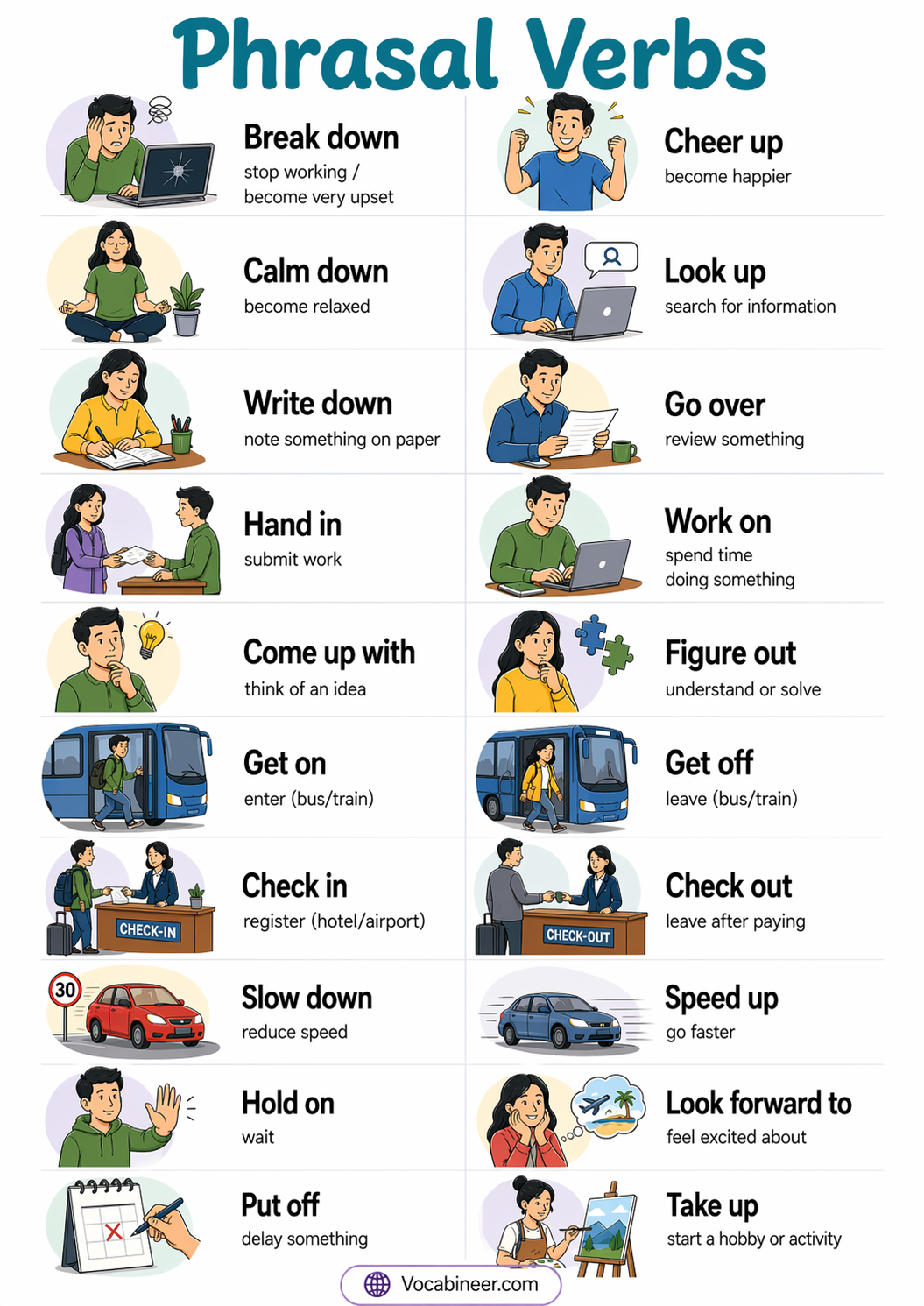
These phrasal verbs are used in normal daily routines, home activities, and simple actions.
Get up – to leave your bed after sleeping.
I get up at 6 a.m.
Wake up – to stop sleeping.
She wakes up early every morning.
Sit down – to take a seat.
Please sit down.
Stand up – to rise to your feet.
The students stood up when the teacher entered.
Go out – to leave home for an activity.
We go out on weekends.
Come in – to enter a place.
Please come in and sit down.
Go back – to return to a place.
He went back to his room.
Come back – to return.
She came back after lunch.
Turn on – to start a machine, light, or device.
Turn on the fan, please.
Turn off – to stop a machine, light, or device.
Turn off the lights before you leave.
Put on – to wear something.
He put on his coat.
Take off – to remove clothes, shoes, or accessories.
Please take off your shoes.
Pick up – to lift something or collect someone.
She picked up the book from the floor.
Put down – to place something on a surface.
Put down the cup carefully.
Clean up – to make a place clean.
We cleaned up the kitchen.
Eat out – to eat at a restaurant.
They eat out every Friday.
Hang out – to spend relaxed time with someone.
We hang out after school.
Run out – to have no more of something.
We ran out of sugar.
Fill up – to make something full.
Fill up the bottle with water.
Throw away – to put something in the trash.
Throw away the old newspaper.
Phrasal Verbs for Communication
These phrasal verbs help you talk about speaking, asking, explaining, and sharing information.
Speak up – to speak louder.
Please speak up; I cannot hear you.
Calm down – to become relaxed or make someone relaxed.
Calm down and explain the problem.
Point out – to show or mention something important.
She pointed out a mistake in the report.
Talk over – to discuss something carefully.
We need to talk over the plan.
Ask for – to request something.
He asked for help.
Call back – to return a phone call.
I will call you back later.
Bring up – to mention a topic.
She brought up an interesting idea.
Find out – to discover information.
I found out the truth.
Look up – to search for information.
Look up the meaning in a dictionary.
Write down – to write something on paper or in notes.
Write down your password.
Phrasal Verbs for Work and Study
These phrasal verbs are useful for school, office work, projects, and tasks.
Read over – to read something carefully to check it.
Read over your essay before submitting it.
Go over – to review or examine something.
Let’s go over the lesson again.
Hand in – to submit work.
I handed in my assignment on time.
Work on – to spend time doing or improving something.
She is working on a new project.
Carry out – to complete or perform a task.
The team carried out the plan.
Set up – to arrange or prepare something.
We set up a meeting for Monday.
Come up with – to think of an idea or solution.
He came up with a smart answer.
Figure out – to understand or solve something.
I finally figured out the problem.
Look into – to examine or investigate something.
The manager will look into the issue.
Put off – to delay something.
They put off the exam.
Phrasal Verbs for Travel and Movement
These phrasal verbs are common when talking about transport, movement, and going places.
Get on – to enter a bus, train, plane, or bike.
We got on the bus.
Get off – to leave a bus, train, plane, or bike.
She got off at the next stop.
Get in – to enter a car, taxi, or small vehicle.
Get in the car quickly.
Get out – to leave a car or place.
He got out of the taxi.
Move on – to continue after stopping or leaving something behind.
Let’s move on to the next topic.
Go away – to leave a place.
The dog went away.
Come over – to visit someone’s home.
Come over for dinner tonight.
Drop off – to leave someone or something at a place.
I dropped her off at school.
Pick out – to choose something.
She picked out a red dress.
Check in – to register at a hotel or airport.
We checked in at the hotel.
Check out – to leave a hotel after paying.
They checked out at noon.
Slow down – to reduce speed.
Slow down near the school.
Speed up – to move faster.
The car sped up on the highway.
Pull over – to stop a vehicle at the side of the road.
The police asked the driver to pull over.
Phrasal Verbs for Feelings and Situations
These phrasal verbs are useful for emotions, problems, and personal situations.
Break down – to stop working or lose control emotionally.
She broke down in tears.
Cheer up – to become happier or make someone happier.
This song will cheer you up.
Give up – to stop trying or stop doing something.
Do not give up on your goals.
Get over – to recover from illness, sadness, or a problem.
He got over the flu.
Fall apart – to break into pieces or become emotionally weak.
She fell apart after hearing the news.
Open up – to talk honestly about feelings.
He opened up about his worries.
Hold on – to wait for a short time.
Hold on for a minute.
Let down – to disappoint someone.
He let me down.
Look forward to – to feel excited about something in the future.
I look forward to meeting you.
Deal with – to handle a problem or situation.
She knows how to deal with stress.
Put up with – to tolerate something unpleasant.
I cannot put up with this noise.
Phrasal Verbs for Relationships and People
These phrasal verbs are common when talking about family, friends, and relationships.
Break up – to end a romantic relationship.
They broke up last year.
Make up – to become friendly again after an argument.
They made up after the fight.
Get along – to have a good relationship.
The two sisters get along well.
Fall out – to stop being friendly after an argument.
They fell out over money.
Look after – to take care of someone or something.
She looks after her younger brother.
Take care of – to care for someone or something.
He takes care of his dog.
Grow up – to become older or mature.
I grew up in a small city.
Back up – to support or help someone.
My friends backed me up during the discussion.
Phrasal Verbs for Common Situations
These phrasal verbs appear often in daily English, stories, conversations, and casual writing.
Come across – to find something by chance.
I came across an old photo.
Run into – to meet someone by chance.
I ran into an old friend.
Show up – to arrive or appear.
He showed up late.
Take over – to take control of something.
She took over the project.
End up – to finally be in a situation.
We ended up staying home.
Carry on – to continue.
Please carry on with your work.
Keep up – to continue at the same speed or level.
Keep up the good work.
Give back – to return something.
Give back my pen.
Take back – to return something or withdraw words.
He took back his statement.
Pay back – to return money.
I will pay back the money tomorrow.
Phrasal Verbs with Look
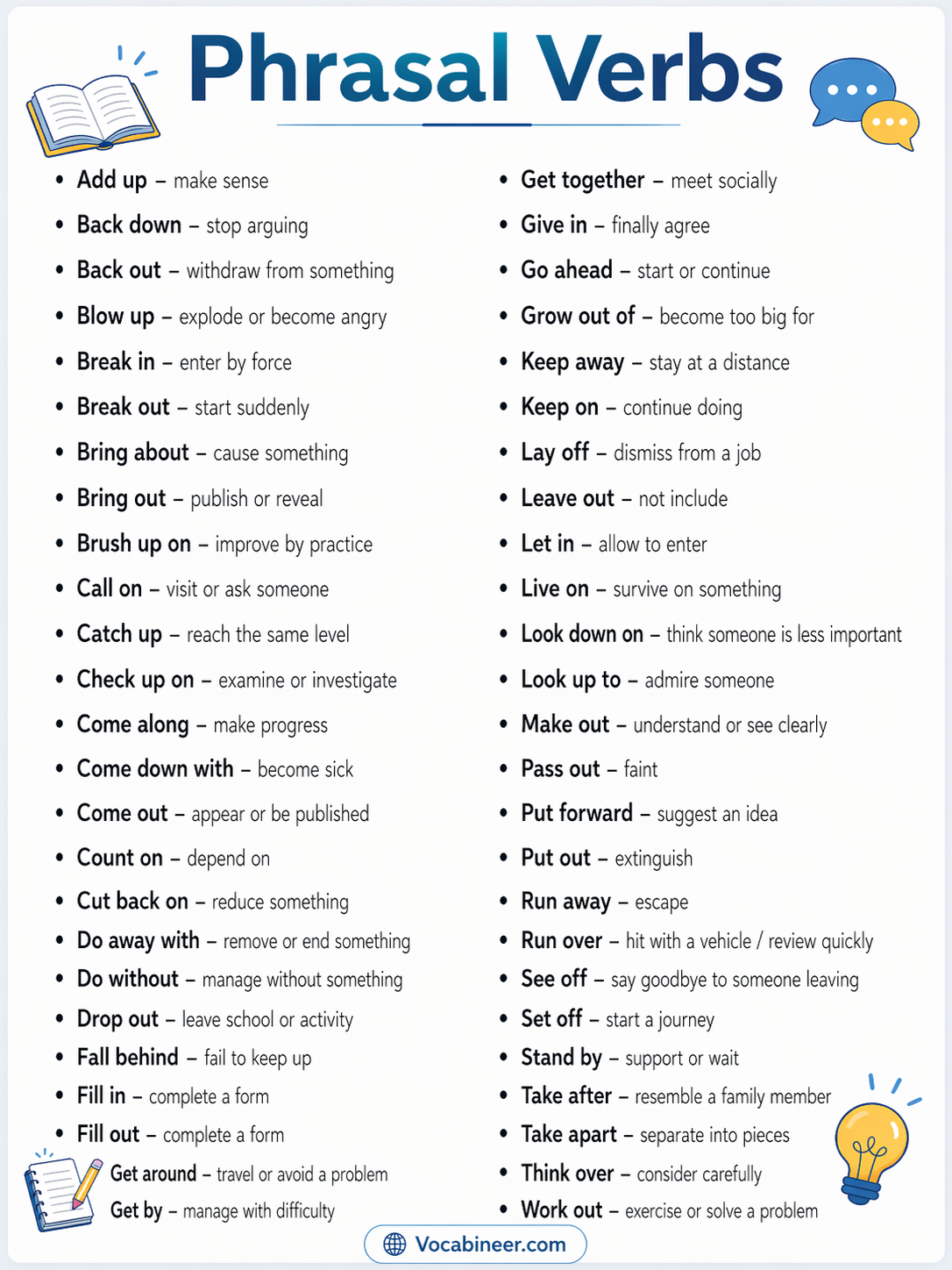
The verb look forms many useful phrasal verbs. These are especially common in daily English.
Look for – to search for something.
I am looking for my keys.
Look at – to direct your eyes toward something.
Look at the board.
Look around – to explore a place.
We looked around the market.
Look out – to be careful.
Look out! A bike is coming.
Look up – to search for information.
Look up this word online.
Look after – to take care of someone or something.
She looks after the baby.
Phrasal Verbs with Get, Take, Turn, and Put
These common verbs create many useful phrasal verbs.
Get away – to escape or go on a short holiday.
They got away for the weekend.
Go on – to continue or happen.
What is going on?
Take up – to start a hobby or activity.
She took up painting.
Cut down on – to reduce something.
He cut down on sugar.
Cut off – to stop supply or separate something.
The storm cut off the electricity.
Turn down – to refuse or reduce volume.
She turned down the offer.
Put away – to place something in its proper place.
Put away your clothes.
Bring back – to return something or make something return to memory.
This song brings back memories.
Call off – to cancel something.
They called off the match.
Try on – to wear something to see if it fits.
Try on this jacket.
Pass away – to die.
His grandfather passed away last year.
Come true – to become real.
Her dream came true.
Sort out – to organize or solve something.
We need to sort out this problem.
Commonly Confused Phrasal Verbs
Some phrasal verbs look similar but have different meanings. Here are a few easy comparisons:
| Phrasal Verb | Meaning | Example |
|---|---|---|
| Look for | try to find something | I am looking for my bag. |
| Look after | take care of someone or something | She looks after her brother. |
| Take off | remove clothing / plane leaves ground | Take off your shoes. |
| Take out | remove something or take someone somewhere | Take out the trash. |
| Turn on | start a device | Turn on the light. |
| Turn up | increase volume or appear | Turn up the music. |
| Give up | stop trying | Do not give up. |
| Give back | return something | Give back my book. |
| Put off | delay something | They put off the meeting. |
| Put away | place something in its proper place | Put away your clothes. |
Common Phrasal Verbs in Simple Sentences
Here are easy sentences to help you remember common phrasal verbs:
- I wake up early every morning.
- Please turn off the lights.
- She is looking for her phone.
- He gave up smoking.
- We set up a new account.
- They called off the meeting.
- I ran into an old friend.
- She handed in her homework.
- The plane took off on time.
- He looked after his little sister.
- We need to figure out the answer.
- Did you look up the word?
- I did not give up easily.
- She came across an old letter yesterday.
- Please write down the rule.
- He tried to cheer up his friend.
- They checked in at the hotel.
- Can you call back later?
- We should go over the lesson again.
- She came up with a great idea.
Easy Ways to Learn Phrasal Verbs
Phrasal verbs become easier when you learn them with context, not as random words.
Helpful ways to learn them:
- Learn phrasal verbs in topic groups.
- Start with daily-use phrasal verbs first.
- Read one example sentence for each verb.
- Make your own simple sentence.
- Practice 5 to 10 phrasal verbs at a time.
- Notice phrasal verbs in movies, books, and conversations.
- Review old phrasal verbs before learning new ones.
For example, instead of learning random verbs, learn a small group like:
- Get up
- Wake up
- Put on
- Take off
- Go out
These all connect to daily routine, so they are easier to remember.
Common Mistakes with Phrasal Verbs
English learners often make small mistakes with phrasal verbs. Here are some simple points to remember:
- Do not translate every phrasal verb word by word.
- Learn the full meaning, not only the main verb.
- Use phrasal verbs in sentences.
- Pay attention to word order.
- Remember that some phrasal verbs have more than one meaning.
Example:
Take off can mean:
- remove clothes: Take off your shoes.
- leave the ground: The plane took off.
So always check the meaning from the sentence.
FAQs
Phrasal verbs are combinations of a verb and a small word, such as up, off, in, out, or away, that create a new meaning.
Phrasal verbs are important because they are very common in spoken English, casual writing, stories, and daily conversation.
You can learn phrasal verbs easily by grouping them by topic, reading simple examples, and using them in your own sentences.
Phrasal verbs can feel difficult at first because one verb can have many meanings. They become easier when you learn them with examples.
Give up is a phrasal verb. It means to stop trying or stop doing something.
A verb is one action word, such as look. A phrasal verb combines a verb with another word, such as look after, which means to take care of someone.
Yes. Some phrasal verbs have more than one meaning. For example, take off can mean to remove something or for a plane to leave the ground.
Summary
Phrasal verbs are an important part of everyday English. In this article, you learned 100 common phrasal verbs in English with meanings and examples.
The phrasal verbs were grouped by daily actions, communication, work, travel, feelings, relationships, common situations, and common verb patterns. Learning them in groups makes them easier to understand, remember, and use in real conversations.
Read More