

Quantifier pronouns show amount or quantity without repeating the noun. Words like all, some, many, few, none, both, each, and neither can work as quantifier pronouns when they stand alone and replace a noun already understood.
For example, instead of saying “Many students came, but few students stayed,” we can say “Many came, but few stayed.” Here, many and few replace the noun students and show quantity in a shorter sentence.
Quantifier pronouns are useful when the noun is already clear from context. They make sentences smoother and less repetitive, especially when talking about people, things, groups, amounts, choices, or parts of a larger number.
In This Page
What Are Quantifier Pronouns?
Quantifier pronouns are quantifiers that stand alone without a noun after them. They replace a noun that is already clear from the sentence or context.
Examples:
- Some were ready.
- Many agreed.
- Few understood.
- All arrived on time.
- None answered.
- Both are correct.
- Each has a number.
- Neither worked.
In these sentences, the quantifier pronouns show quantity and replace a noun.
For example:
- Some students were ready.
- Some were ready.
In the second sentence, some replaces some students.
Quantifier Pronouns List
Here is a useful list of common quantifier pronouns in English:
- All
- Both
- Some
- Any
- Many
- Much
- Few
- A few
- Little
- A little
- Several
- Most
- More
- Enough
- None
- Neither
- Either
- Each
These words can show total quantity, partial quantity, large amount, small amount, no amount, or choice.
Examples:
- All were invited.
- Some stayed.
- Many agreed.
- Few understood.
- None replied.
- Each has a role.
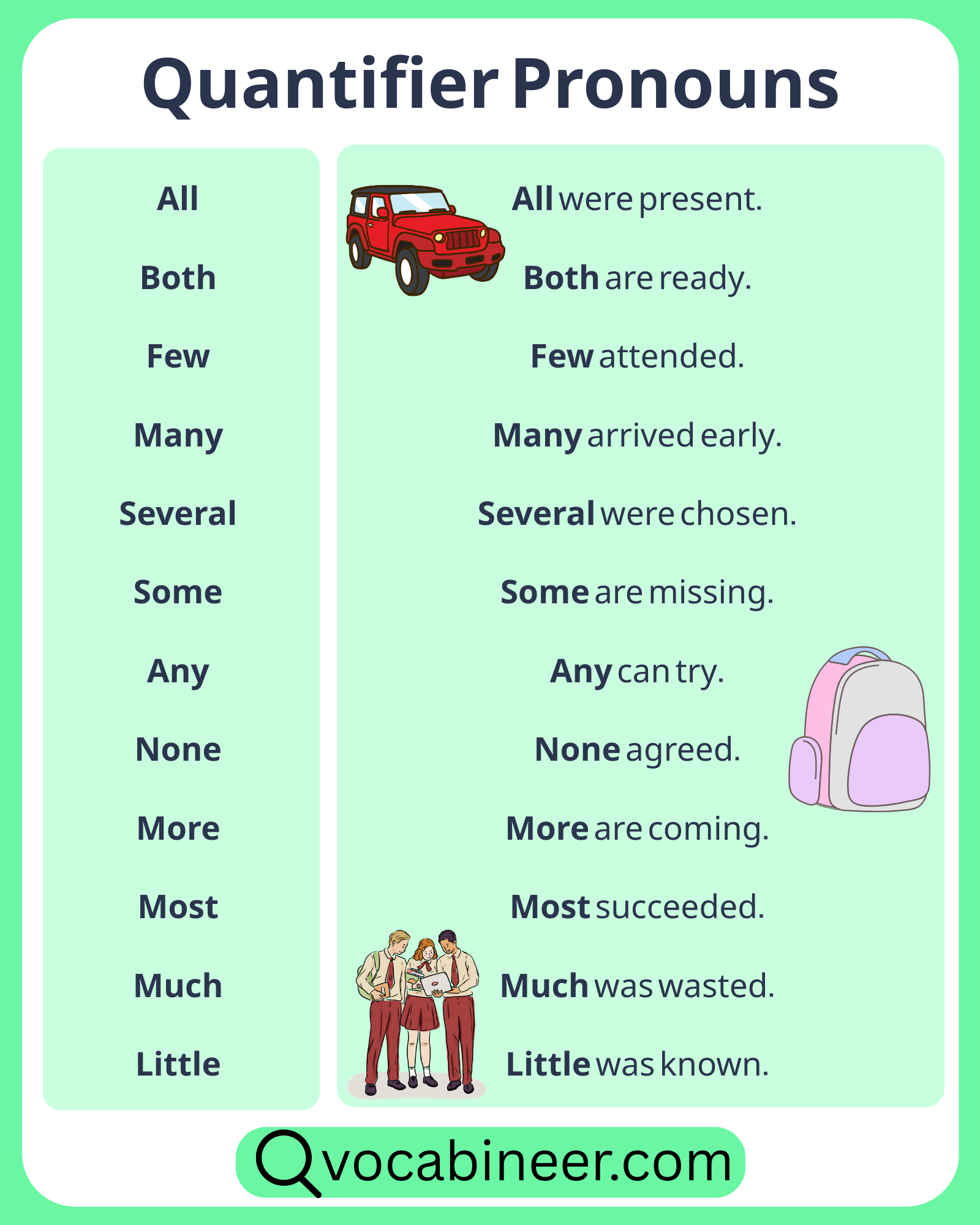
Quantifier Pronouns Chart
| Meaning | Quantifier Pronouns | Example |
|---|---|---|
| Total quantity | all, both | All were ready. |
| Partial quantity | some, any, several | I ate some. |
| Large quantity | many, much, most, more | Many agreed. |
| Small quantity | few, a few, little, a little | Few understood. |
| No quantity | none, neither | None answered. |
| One-by-one choice | each, either | Each has a number. |
This chart shows quantifier pronouns by meaning. The noun is not written after the pronoun because it is already understood.
Quantifier Pronouns vs Quantifiers
A quantifier usually comes before a noun. A quantifier pronoun stands alone and replaces the noun.
| Use | Example | Function |
|---|---|---|
| Quantifier before noun | I bought some apples. | Some describes the noun apples. |
| Quantifier pronoun | I bought some. | Some replaces the noun because it is understood. |
More examples:
| Quantifier Before Noun | Quantifier Pronoun |
|---|---|
| Many students came. | Many came. |
| Few people agreed. | Few agreed. |
| All books were sold. | All were sold. |
| Some food was left. | Some was left. |
| Neither answer is correct. | Neither is correct. |
The simple rule is: if the word comes before a noun, it is acting as a quantifier. If it stands alone and replaces the noun, it is acting as a quantifier pronoun.
Countable and Uncountable Quantifier Pronouns
Some quantifier pronouns are used with countable ideas. Others are used with uncountable ideas. Some can work with both.
| Use | Quantifier Pronouns | Examples |
|---|---|---|
| Countable | many, few, a few, several, both | Many were invited. |
| Uncountable | much, little, a little | Little was left. |
| Countable or uncountable | some, any, all, most, none, enough | I ate some. / Some was left. |
Countable Quantifier Pronouns
Use countable quantifier pronouns when the meaning refers to things you can count.
Examples:
- Many were invited.
- Few came on time.
- Several agreed.
- Both are correct.
- A few stayed after class.
Uncountable Quantifier Pronouns
Use uncountable quantifier pronouns when the meaning refers to something not counted one by one, such as water, time, money, food, or information.
Examples:
- Much was wasted.
- Little remained.
- A little was enough.
- Enough was prepared.
Quantifier Pronouns Used with Both
Some quantifier pronouns can refer to countable or uncountable nouns, depending on context.
Examples:
- I needed pencils, and I found some.
- I needed water, and I drank some.
- Many students came, but none stayed.
- There was milk in the glass, but none was left.
Quantifier Pronouns with “Of”
Quantifier pronouns are often used with of before object pronouns or specific noun groups.
Examples:
- Some of them agreed.
- Many of us were tired.
- All of it was useful.
- None of them answered.
- Both of us came.
- Each of them has a role.
- Neither of them was ready.
- Most of it was helpful.
Use of before object pronouns like us, them, it, and you.
Correct:
- Many of them came.
- All of us helped.
- Some of it was useful.
Incorrect:
- Many them came.
- All us helped.
- Some it was useful.
You can also use quantifier pronouns with of the when talking about a specific group.
Examples:
- Many of the students passed.
- Some of the books were old.
- None of the answers were correct.
- Most of the food was fresh.
Examples of Quantifier Pronouns in Sentences
Here are useful examples of quantifier pronouns in sentences.
All
- All were ready.
- All arrived on time.
- I checked the papers, and all were correct.
Both
- Both are correct.
- Both came early.
- I liked the two options, and both were useful.
Some
- I ate some.
- Some were missing.
- We needed chairs, and some were available.
Any
- Did any arrive?
- I did not see any.
- Take any you like.
Many
- Many agreed.
- Many were invited.
- Many students came, but many left early.
Much
- Much was wasted.
- I learned much from the lesson.
- Much was said, but little was done.
Few
- Few understood the answer.
- Few were chosen.
- Many applied, but few were accepted.
A few
- A few stayed after class.
- A few were still available.
- I invited many people, and a few came.
Little
- Little was left.
- Little changed after the meeting.
- We had food, but little remained.
A little
- A little was enough.
- I saved a little for later.
- A little was added to the mixture.
Several
- Several agreed.
- Several were absent.
- I asked questions, and several were answered.
Most
- Most were happy.
- Most agreed with the plan.
- We checked the answers, and most were correct.
More
- I need more.
- More arrived later.
- Some were ready, but more were needed.
Enough
- Enough was prepared.
- I have enough.
- Enough were available for the class.
None
- None answered.
- None were ready.
- I called ten people, but none replied.
Neither
- Neither was correct.
- Neither worked.
- I tried both keys, but neither opened the door.
Either
- Either is fine.
- You can choose either.
- Two seats are open; take either.
Each
- Each has a number.
- Each was different.
- I checked the boxes, and each was labeled.
Quantifier Pronouns in Questions and Negative Sentences
Quantifier pronouns are common in questions and negative sentences.
Questions
- Did any arrive?
- Were many invited?
- Is much left?
- Did both agree?
- Are all ready?
- Did some leave early?
- Were several missing?
- Is either correct?
- Did none reply?
- Has each been checked?
Negative Sentences
- None were ready.
- I did not see any.
- Neither was correct.
- Few understood the answer.
- Not all agreed.
- Not many came.
- There was food, but little remained.
- I asked for help, but none came.
In questions and negatives, any is common.
Examples:
- Did you see any?
- I did not see any.
Common Quantifier Pronoun Pairs
Some quantifier pronouns are easy to confuse. These pairs help show the difference.
| Pair | Difference | Example |
|---|---|---|
| Many vs Much | Many is used for countable ideas; much is used for uncountable ideas. | Many came. / Much was wasted. |
| Few vs Little | Few is used for countable ideas; little is used for uncountable ideas. | Few agreed. / Little remained. |
| A few vs Few | A few means some; few means not many. | A few helped. / Few helped. |
| A little vs Little | A little means some; little means not much. | A little was left. / Little was left. |
| Some vs Any | Some is common in positive sentences; any is common in questions and negatives. | I ate some. / Did you eat any? |
| None vs Neither | None means not any from a group; neither means not one of two. | None came. / Neither worked. |
| Both vs Either | Both means two together; either means one of two. | Both are correct. / Either is fine. |
Verb Agreement with Quantifier Pronouns
Quantifier pronouns can use singular or plural verbs depending on meaning.
Usually plural
Use plural verbs when the quantifier pronoun refers to countable plural people or things.
Examples:
- Many are ready.
- Few were chosen.
- Several have replied.
- Both are correct.
- A few were missing.
Usually singular
Use singular verbs when the quantifier pronoun refers to an uncountable amount or one-by-one meaning.
Examples:
- Much is needed.
- Little was left.
- A little is enough.
- Each is different.
- Neither is correct.
- Either is fine.
Depends on meaning
Some quantifier pronouns can use singular or plural verbs depending on the noun idea.
Examples:
- All is ready. (all = everything)
- All are ready. (all = all people)
- Some was left. (some = some food/water/time)
- Some were left. (some = some people/things)
- None was left. (none = no amount)
- None were ready. (none = no people/things)
Quantifier Pronouns vs Indefinite Pronouns
Some quantifier pronouns overlap with indefinite pronouns. This is because both can refer to an unspecified amount, person, thing, or group.
Examples:
- Some were ready.
- Many agreed.
- Few stayed.
- None answered.
- Each has a role.
- Neither worked.
These words can be called quantifier pronouns when they show amount and stand alone. They are also often grouped with indefinite pronouns in grammar lessons.
Simple difference:
| Term | Focus | Example |
|---|---|---|
| Quantifier pronoun | Shows amount or quantity | Many agreed. |
| Indefinite pronoun | Refers to an unspecified person, thing, or amount | Someone called. |
The categories can overlap, so the most important thing is to understand how the word works in the sentence.
Common Mistakes with Quantifier Pronouns
Learners often make mistakes with of, countable and uncountable meanings, and verb agreement.
| Incorrect | Correct |
|---|---|
| Many of students came. | Many students came. / Many of the students came. |
| All them arrived. | All of them arrived. |
| Few of people agreed. | Few people agreed. / Few of the people agreed. |
| Every of them came. | Every one of them came. |
| Much were ready. | Many were ready. |
| Few was chosen. | Few were chosen. |
| Little were left. | Little was left. |
| Neither were correct. | Neither was correct. |
| Both is correct. | Both are correct. |
| Many was absent. | Many were absent. |
A simple way to avoid mistakes is to check whether the meaning is countable or uncountable, singular or plural, and whether the word needs of before a pronoun.
Quick Rules to Remember
| Rule | Example |
|---|---|
| A quantifier pronoun stands alone without a noun after it. | I ate some. |
| Use many, few, several, both for countable ideas. | Many came. |
| Use much, little, a little for uncountable ideas. | Little was left. |
| Use of before object pronouns. | All of them arrived. |
| Use neither for not one of two. | Neither worked. |
| Use none for no amount or no member of a group. | None answered. |
| Use plural verbs for countable plural meanings. | Many are ready. |
| Use singular verbs for uncountable meanings. | Much is needed. |
Simple reminders:
- Say many students or many of the students, not many of students.
- Say all of them, not all them.
- Use many for countable nouns and much for uncountable nouns.
- Use few for countable nouns and little for uncountable nouns.
FAQs
Quantifier pronouns are quantifiers that stand alone and replace a noun that is already understood. Examples include some, many, few, all, both, none, each, either, and neither.
Examples of quantifier pronouns include Many agreed, Some stayed, Few understood, All arrived, None answered, Both are correct, and Each has a role.
A quantifier comes before a noun, as in many students. A quantifier pronoun stands alone, as in Many agreed.
Yes. Quantifier pronouns are often used with of, especially before pronouns or specific groups. Examples include some of them, many of us, all of it, and none of the answers.
Some quantifier pronouns overlap with indefinite pronouns. Words like some, many, few, none, each, either, and neither can be called quantifier pronouns when they show amount and stand alone.
Summary
Quantifier pronouns are quantifiers that stand alone and show quantity without repeating the noun. Common examples include all, both, some, any, many, much, few, little, several, most, none, either, neither, and each.
Use quantifier pronouns when the noun is already understood, as in Many agreed, Some stayed, or None answered. Learning these words helps you talk about amounts clearly and avoid common mistakes with countable nouns, uncountable nouns, and of phrases.
Read More
- List of Pronouns in English
- Subject Pronouns in English
- First Person Pronouns in English
- Possessive Pronouns in English
- Second Person Pronouns in English