

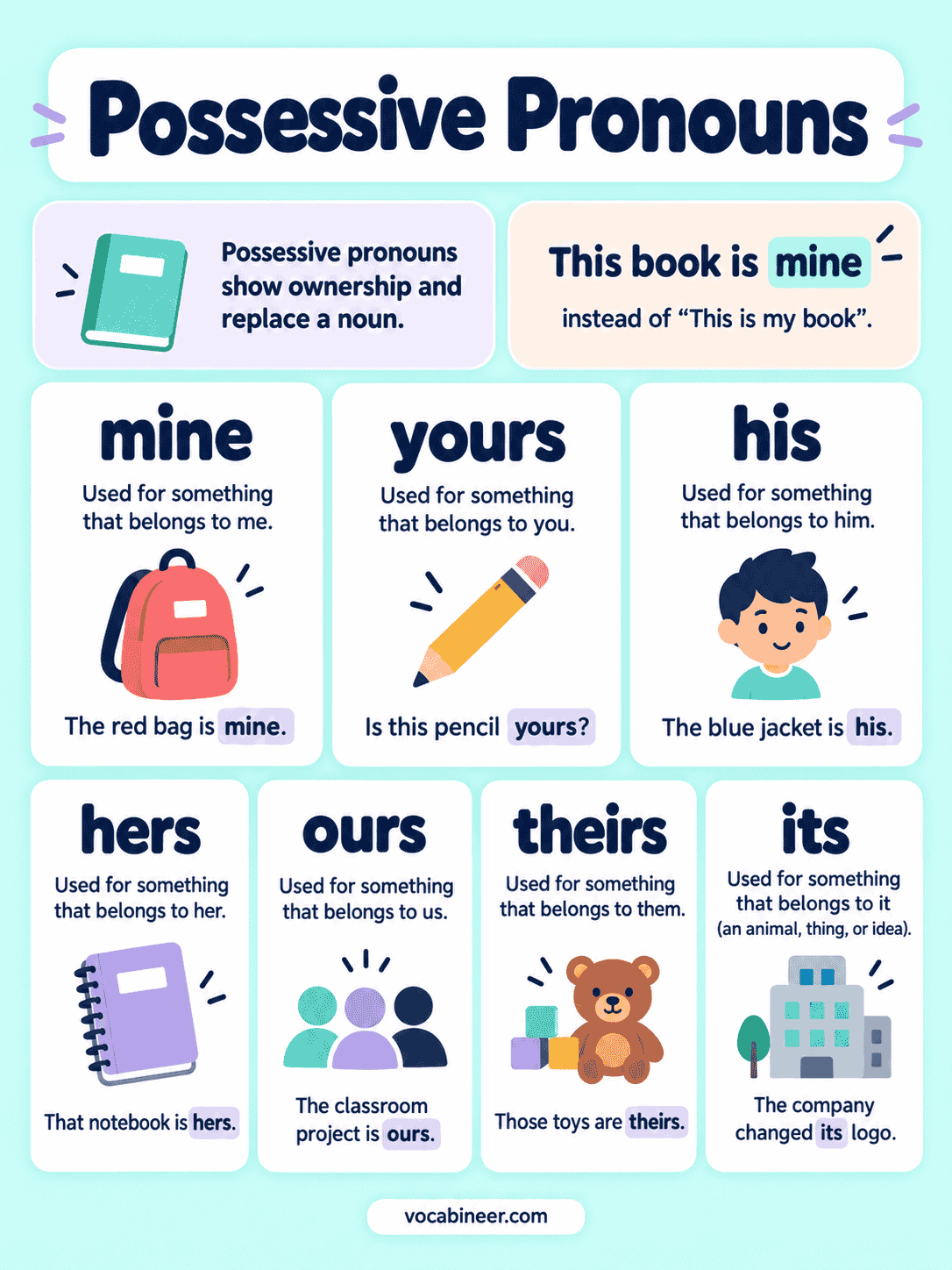
Possessive pronouns are words that show ownership without repeating the noun. Common possessive pronouns include mine, yours, his, hers, ours, and theirs.
For example, instead of saying “This is my book. That is your book,” we can say “This book is mine. That book is yours.” Here, mine means my book, and yours means your book. Possessive pronouns make sentences shorter, clearer, and more natural.
These words are useful in everyday English because they help us talk about things that belong to people. This guide will show you simple possessive pronoun examples, sentence patterns, questions, and common mistakes so you can use them correctly.
In This Page
What Are Possessive Pronouns?
Possessive pronouns are pronouns that show something belongs to someone. They stand alone in a sentence and do not need a noun after them.
Examples:
- This pencil is mine.
- That seat is yours.
- The blue bag is his.
- The red notebook is hers.
- This classroom is ours.
- The final decision is theirs.
In these examples, the possessive pronouns show ownership. Mine means “my pencil,” yours means “your seat,” and hers means “her notebook.”
Possessive Pronouns List
Here is the main list of possessive pronouns in English:
- Mine
- Yours
- His
- Hers
- Ours
- Theirs
These words are used when the noun is already clear.
Examples:
- This bag is mine.
- Is this phone yours?
- The black jacket is his.
- The small room is hers.
- The victory is ours.
- The big house is theirs.
Possessive Pronouns Examples
Here are simple examples of possessive pronouns in sentences:
- This book is mine.
- That pencil is yours.
- The blue coat is his.
- The red bag is hers.
- This classroom is ours.
- The final choice is theirs.
- Is this notebook mine?
- Are these keys yours?
- The last turn was his.
- The winning idea was hers.
- The responsibility is ours.
- The garden near the gate is theirs.
Possessive pronouns replace noun phrases that show ownership.
Examples:
- This is my book. → This book is mine.
- That is your seat. → That seat is yours.
- This is her pen. → This pen is hers.
- That is their house. → That house is theirs.
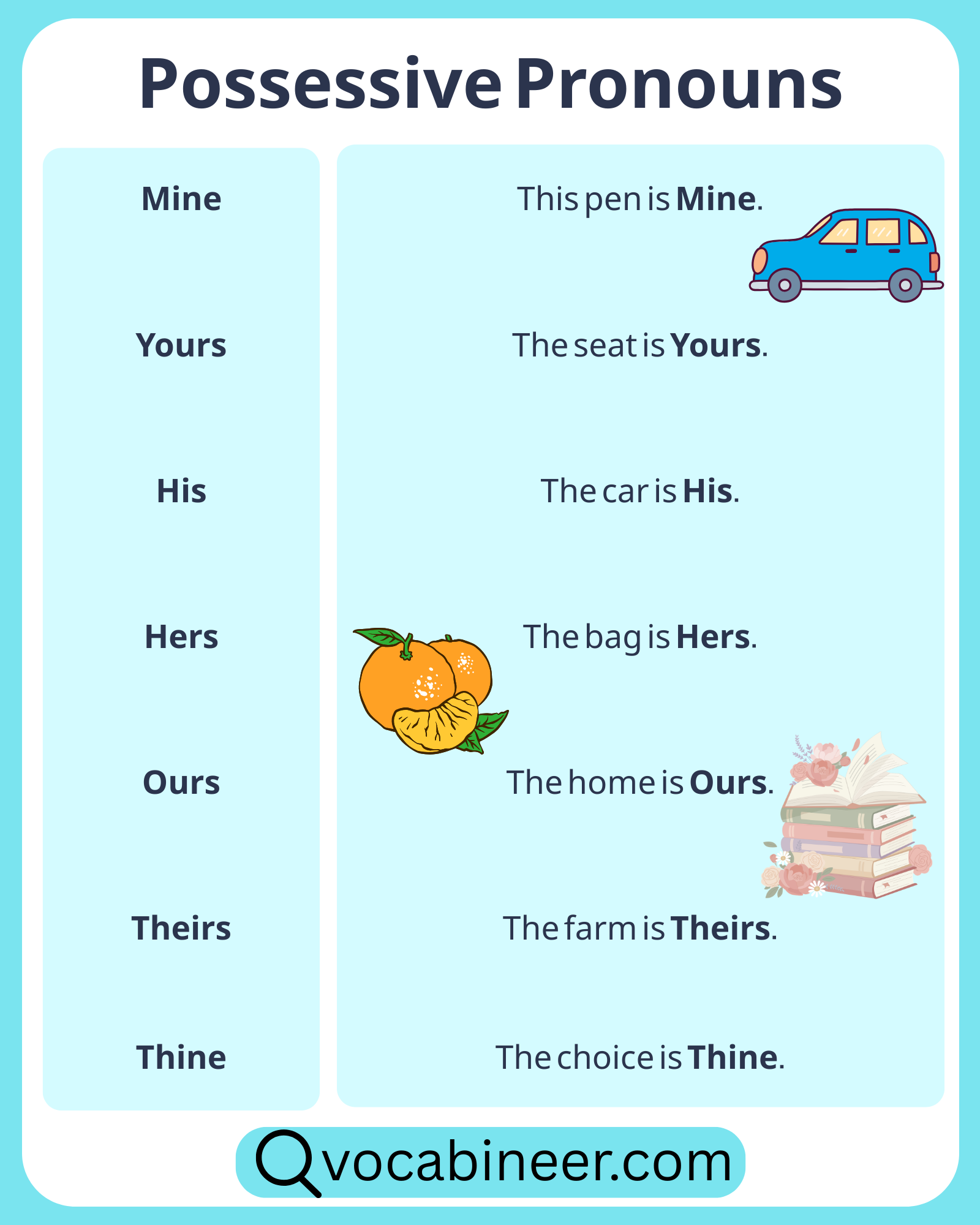
Possessive Pronouns Chart with Examples
| Subject | Possessive Pronoun | Example |
|---|---|---|
| I | mine | This book is mine. |
| You | yours | This seat is yours. |
| He | his | This bag is his. |
| She | hers | This pen is hers. |
| We | ours | This classroom is ours. |
| They | theirs | This house is theirs. |
This chart shows the main possessive pronouns and how they are used in sentences.
Examples of Each Possessive Pronoun
This section gives more examples for each possessive pronoun. These examples are useful for daily speaking, writing, and classroom practice.
Mine
Use mine when something belongs to the speaker.
Examples:
- This pencil is mine.
- The blue bag is mine.
- That seat is mine.
- The idea was mine.
- This notebook is not mine.
- Is the red folder mine?
- The small room near the window is mine.
- The final answer was mine.
Yours
Use yours when something belongs to the person or people you are speaking to.
Examples:
- Is this book yours?
- The empty chair is yours.
- This umbrella must be yours.
- The final choice is yours.
- These keys are not yours.
- Is the blue pencil yours?
- The next turn is yours.
- The room on the left is yours.
His
Use his when something belongs to a male person or someone who uses he/him pronouns.
Examples:
- That jacket is his.
- The black phone is his.
- This desk is his.
- The last answer was his.
- Is this bicycle his?
- The green notebook is his.
- The mistake was his.
- The winning point was his.
His can come before a noun or stand alone.
Examples:
- This is his bag.
- This bag is his.
Hers
Use hers when something belongs to a female person or someone who uses she/her pronouns.
Examples:
- This red folder is hers.
- The small room is hers.
- That bicycle is hers.
- The winning drawing was hers.
- Is this notebook hers?
- The pink cup is hers.
- The final decision was hers.
- The seat near the door is hers.
Ours
Use ours when something belongs to a group that includes the speaker.
Examples:
- This classroom is ours.
- The victory is ours.
- That table is ours.
- The responsibility is ours.
- This project is ours.
- Are these seats ours?
- The larger room is ours.
- The final plan was ours.
Theirs
Use theirs when something belongs to other people.
Examples:
- The big house is theirs.
- The last turn is theirs.
- This project is theirs.
- The choice was theirs.
- Are those bags theirs?
- The blue car is theirs.
- The responsibility is theirs.
- The garden behind the house is theirs.
Possessive Pronouns in Questions
Possessive pronouns are often used in questions when we ask who owns something.
Examples:
- Is this book mine?
- Is that seat yours?
- Which bag is his?
- Which notebook is hers?
- Are these chairs ours?
- Which house is theirs?
- Is the blue pencil yours?
- Are these keys mine?
- Is this classroom ours?
- Are those bags theirs?
These questions are shorter and more natural than repeating the noun phrase.
Compare:
- Is this your book?
- Is this book yours?
Both are correct, but the second sentence uses a possessive pronoun.
Possessive Pronouns in Negative Sentences
Possessive pronouns can also be used in negative sentences.
Examples:
- This book is not mine.
- That seat is not yours.
- The black coat is not his.
- The red notebook is not hers.
- This classroom is not ours.
- The big house is not theirs.
- These keys are not mine.
- That idea was not hers.
- The final decision was not ours.
- The bags near the door are not theirs.
Negative sentences are useful when you want to say that something does not belong to someone.
Possessive Pronouns vs Possessive Adjectives
Possessive pronouns and possessive adjectives both show ownership, but they are used differently.
A possessive adjective comes before a noun. A possessive pronoun stands alone and replaces the noun.
| Possessive Adjective | Possessive Pronoun |
|---|---|
| my book | mine |
| your seat | yours |
| his bag | his |
| her pen | hers |
| our classroom | ours |
| their house | theirs |
Examples:
- This is my book.
- This book is mine.
- That is your seat.
- That seat is yours.
- This is her pen.
- This pen is hers.
- This is our classroom.
- This classroom is ours.
- That is their house.
- That house is theirs.
The main rule is simple: use my, your, his, her, our, and their before nouns. Use mine, yours, his, hers, ours, and theirs without nouns after them.
Common Mistakes with Possessive Pronouns
Learners often confuse possessive pronouns with possessive adjectives. The most common mistake is using a noun directly after a possessive pronoun.
| Incorrect | Correct |
|---|---|
| This is mine book. | This is my book. |
| This book is my. | This book is mine. |
| Is this your? | Is this yours? |
| That pen is her. | That pen is hers. |
| This room is our. | This room is ours. |
| The final choice is their. | The final choice is theirs. |
| This is yours seat. | This is your seat. |
| The red notebook is her. | The red notebook is hers. |
| Their house is big, but our is small. | Their house is big, but ours is small. |
| This bag is mine bag. | This bag is mine. |
Quick Rules to Remember
Here are the easiest rules for possessive pronouns:
| Rule | Example |
|---|---|
| Use possessive adjectives before nouns. | This is my book. |
| Use possessive pronouns alone. | This book is mine. |
| Do not put a noun after mine, yours, hers, ours, or theirs. | Not: mine book |
| His can come before a noun or stand alone. | his bag / The bag is his. |
| Its is usually used before a noun. | The dog wagged its tail. |
More examples:
- Correct: This is my bag.
- Correct: This bag is mine.
- Incorrect: This is mine bag.
- Correct: This is their house.
- Correct: This house is theirs.
- Incorrect: This is theirs house.
Summary
Possessive pronouns show ownership without repeating the noun. The main possessive pronouns are mine, yours, his, hers, ours, and theirs.
Use possessive pronouns when the noun is already clear, as in This book is mine or That house is theirs. Do not place a noun after possessive pronouns. Learning these examples will help you write clearer sentences and avoid common mistakes like mine book, this book is my, and the final choice is their.
FAQs
Possessive pronouns examples include “This book is mine,” “That seat is yours,” “The bag is his,” “The notebook is hers,” “This classroom is ours,” and “The house is theirs.”
Here are 10 examples: This pencil is mine. The seat is yours. The jacket is his. The red bag is hers. This room is ours. That house is theirs. Is this book mine? Are these keys yours? The choice was hers. The responsibility is ours.
Use my before a noun, as in “my book.” Use mine without a noun after it, as in “This book is mine.”
Yes, his can be a possessive pronoun when it stands alone, as in “This bag is his.” It can also come before a noun, as in “This is his bag.”
No. Possessive pronouns such as mine, yours, hers, ours, and theirs do not come before nouns. Use possessive adjectives before nouns, such as my book, your seat, her pen, our room, and their house.
Read More
- Parts of Speech in English
- Nouns in English with Examples
- Common and Proper Nouns
- Countable and uncountable nouns
- Collective nouns
- Abstract and concrete nouns
- Gender nouns
- Compound nouns
- Possessive nouns
- Singular and plural nouns
- Plural noun rules