A pronouns chart is a simple table that shows how pronouns change in English. It helps you compare forms like I, me, my, mine, myself and he, him, his, himself in one place.
Pronouns make sentences shorter, clearer, and more natural. For example, instead of saying “Emma is here. Emma has Emma’s book,” we can say “Emma is here. She has her book.” Here, she replaces Emma, and her shows that the book belongs to Emma.
This guide uses clear charts and simple examples to help you understand pronoun forms quickly, so you can choose the right word when writing or speaking English.
In This Page
Complete Pronouns Chart in English
| Pronoun Type | Meaning | Common Pronouns | Example |
|---|---|---|---|
| Personal Pronouns | Refer to people, animals, things, or groups. | I, you, he, she, it, we, they, me, him, her, us, them | She is reading. / I called him. |
| Subject Pronouns | Do the action in a sentence. | I, you, he, she, it, we, they | They are playing. |
| Object Pronouns | Receive the action or come after prepositions. | me, you, him, her, it, us, them | Please help me. |
| Possessive Adjectives | Come before nouns to show ownership. | my, your, his, her, its, our, their | This is my book. |
| Possessive Pronouns | Stand alone to show ownership. | mine, yours, his, hers, ours, theirs | This book is mine. |
| Reflexive Pronouns | Refer back to the subject. | myself, yourself, himself, herself, itself, ourselves, yourselves, themselves | I made it myself. |
| Demonstrative Pronouns | Point to people, places, or things. | this, that, these, those | This is my bag. |
| Interrogative Pronouns | Ask questions. | who, whom, whose, which, what | Who is calling? |
| Relative Pronouns | Connect a noun to more information. | who, whom, whose, which, that | The girl who won is happy. |
| Indefinite Pronouns | Refer to people, things, or amounts generally. | someone, anyone, everyone, nobody, something, anything, nothing, all, many, few, both, each | Everyone is ready. |
| Reciprocal Pronouns | Show a two-way action. | each other, one another | They helped each other. |
| Intensive Pronouns | Add emphasis to a noun or pronoun. | myself, yourself, himself, herself, itself, ourselves, yourselves, themselves | I myself opened the door. |
This pronouns chart helps you quickly compare pronoun forms and use them correctly in sentences.
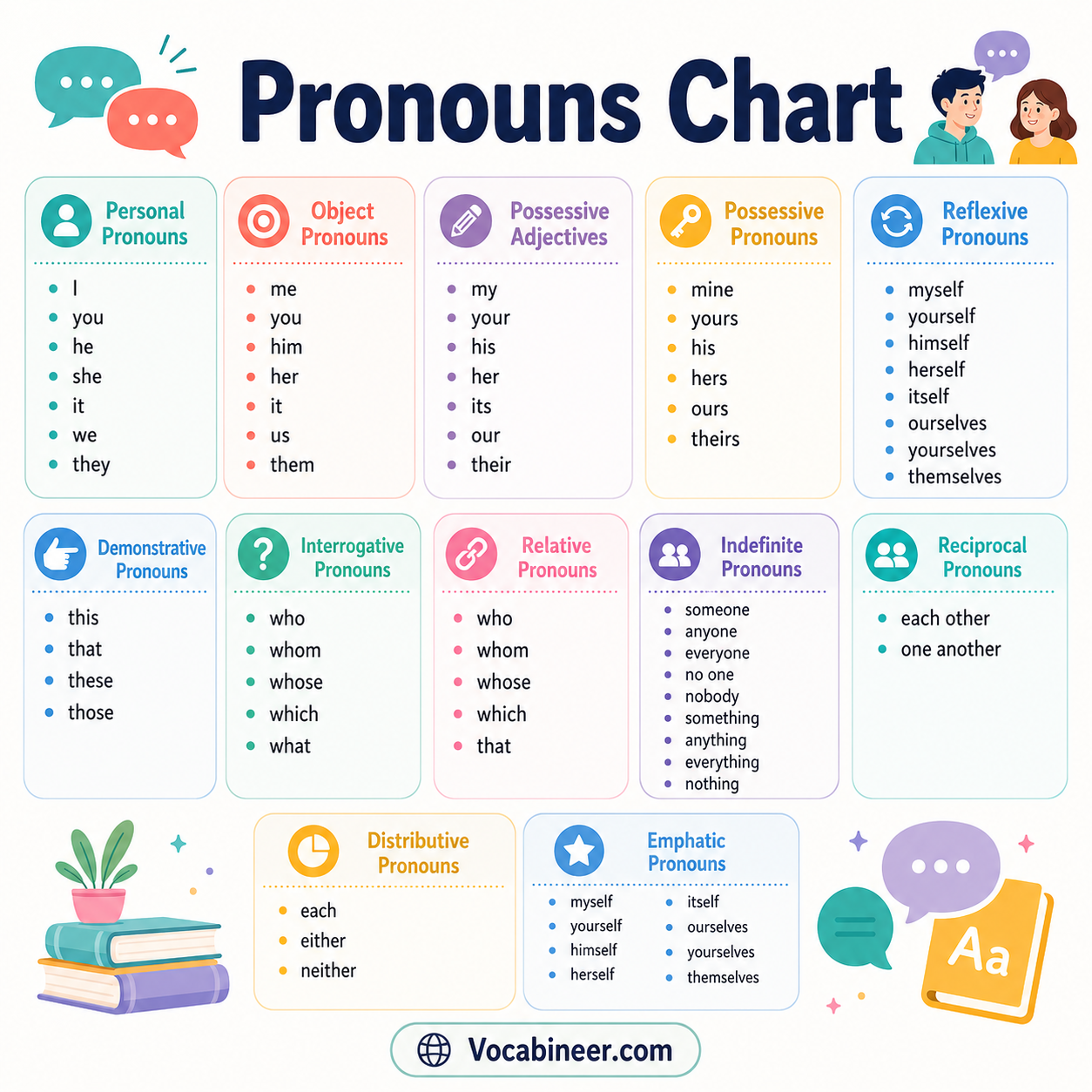
How to Read a Pronouns Chart
A pronouns chart becomes easy when you understand what each column means.
| Column | Meaning | Example |
|---|---|---|
| Subject pronoun | Does the action | She is reading. |
| Object pronoun | Receives the action | I called her. |
| Possessive adjective | Comes before a noun | This is her book. |
| Possessive pronoun | Shows ownership alone | This book is hers. |
| Reflexive pronoun | Refers back to the subject | She made it herself. |
In simple words, use subject pronouns before actions, object pronouns after verbs or prepositions, and possessive forms to show ownership.
Pronouns Chart by Type
Pronouns can also be grouped by type. This chart shows the main types of pronouns with examples.
| Pronoun Type | Common Pronouns | Example |
|---|---|---|
| Personal pronouns | I, you, he, she, it, we, they | They are ready. |
| Possessive pronouns | mine, yours, his, hers, ours, theirs | This bag is mine. |
| Reflexive pronouns | myself, yourself, himself, herself, itself, ourselves, themselves | I made it myself. |
| Demonstrative pronouns | this, that, these, those | This is new. |
| Interrogative pronouns | who, whom, whose, which, what | Who is calling? |
| Relative pronouns | who, whom, whose, which, that | The girl who won is happy. |
| Indefinite pronouns | someone, anyone, everyone, nothing, many, few | Someone is here. |
| Reciprocal pronouns | each other, one another | They helped each other. |
| Intensive pronouns | myself, yourself, himself, herself, themselves | I myself checked it. |
Personal Pronouns Chart
Personal pronouns refer to people, animals, things, or groups. They can be used as subjects or objects.
| Person | Subject | Object | Example |
|---|---|---|---|
| First person singular | I | me | I called him. |
| Second person singular/plural | you | you | I called you. |
| Third person singular masculine | he | him | He helped me. |
| Third person singular feminine | she | her | I helped her. |
| Third person singular neutral | it | it | It is broken. |
| First person plural | we | us | We invited them. |
| Third person plural | they | them | They invited us. |
More examples:
- I am ready.
- Please help me.
- She is my friend.
- I called her yesterday.
- They are outside.
- We invited them.
Possessive Pronouns Chart
Possessive words show ownership. Some come before nouns, while others stand alone.
| Possessive Adjective | Possessive Pronoun | Example |
|---|---|---|
| my | mine | This is my pen. / This pen is mine. |
| your | yours | This is your seat. / This seat is yours. |
| his | his | This is his bag. / This bag is his. |
| her | hers | This is her book. / This book is hers. |
| its | no separate form | The cat cleaned its paws. |
| our | ours | This is our house. / This house is ours. |
| their | theirs | This is their room. / This room is theirs. |
Use my, your, his, her, its, our, and their before nouns. Use mine, yours, his, hers, ours, and theirs when the noun is not repeated.
Examples:
- This is my notebook.
- This notebook is mine.
- That is their classroom.
- That classroom is theirs.
Reflexive Pronouns Chart
Reflexive pronouns refer back to the subject of the sentence. They are used when the subject and object are the same person or thing.
| Subject | Reflexive Pronoun | Example |
|---|---|---|
| I | myself | I taught myself. |
| You | yourself / yourselves | You should trust yourself. |
| He | himself | He introduced himself. |
| She | herself | She made it herself. |
| It | itself | The door closed by itself. |
| We | ourselves | We cleaned the room ourselves. |
| They | themselves | They prepared it themselves. |
More examples:
- I made the card myself.
- She looked at herself in the mirror.
- We solved the problem ourselves.
- They cleaned the hall themselves.
Demonstrative Pronouns Chart
Demonstrative pronouns point to people, places, or things. They show whether something is near or far.
| Pronoun | Number | Distance | Example |
|---|---|---|---|
| this | Singular | Near | This is my notebook. |
| that | Singular | Far | That is your bag. |
| these | Plural | Near | These are my shoes. |
| those | Plural | Far | Those are old books. |
Simple rule:
- Use this for one thing near you.
- Use that for one thing far from you.
- Use these for more than one thing near you.
- Use those for more than one thing far from you.
Interrogative Pronouns Chart
Interrogative pronouns are used to ask questions.
| Pronoun | Use | Example |
|---|---|---|
| who | Person as subject | Who is at the door? |
| whom | Person as object | Whom did you call? |
| whose | Ownership | Whose bag is this? |
| which | Choice | Which do you prefer? |
| what | Thing or information | What is your name? |
In everyday English, who is more common than whom. However, whom is still used in formal writing.
Relative Pronouns Chart
Relative pronouns connect a noun to more information about it.
| Pronoun | Use | Example |
|---|---|---|
| who | People | The boy who won is happy. |
| whom | People as object | The man whom we met was kind. |
| whose | Ownership | The student whose bag was lost is here. |
| which | Animals or things | This is the book which I bought. |
| that | People, animals, or things | The house that has a red gate is mine. |
Examples:
- The girl who answered is my sister.
- This is the phone that I bought.
- The dog which barked is outside.
- The student whose notebook was lost is here.
Indefinite Pronouns Chart
Indefinite pronouns refer to people, things, or amounts in a general way. They do not name a specific person or thing.
| Group | Pronouns | Example |
|---|---|---|
| People | someone, anyone, everyone, no one, nobody | Someone is calling. |
| Things | something, anything, everything, nothing | Nothing is missing. |
| Amounts | all, some, many, few, several, both | Many were invited. |
| Choices | each, either, neither | Neither is correct. |
More examples:
- Everyone is ready.
- Anything is possible.
- Few arrived early.
- Both are correct.
- Nobody answered the phone.
Singular and Plural Pronouns Chart
Some pronouns refer to one person or thing, while others refer to more than one.
| Singular Pronouns | Plural Pronouns |
|---|---|
| I | we |
| me | us |
| my | our |
| mine | ours |
| myself | ourselves |
| he | they |
| him | them |
| she | they |
| her | them |
| it | they |
| itself | themselves |
The pronoun you can be singular or plural depending on the sentence.
Examples:
- You are my friend.
- You are all invited.
The pronoun they can also be used for more than one person or for one person when gender is unknown or when someone uses they/them pronouns.
Examples:
- The students are here. They are ready.
- Someone left their bag here.
Pronouns from the Chart in Sentences
Here are simple sentences using pronouns from the charts:
- I am ready.
- Please help me.
- This is my notebook.
- The blue pen is mine.
- I wrote it myself.
- She is reading.
- I called her yesterday.
- This is her bag.
- The red bag is hers.
- She cleaned it herself.
- They are waiting.
- We invited them.
- This is their classroom.
- The final answer is theirs.
- They prepared it themselves.
- This is my chair.
- Who is speaking?
- Someone left a message.
- The child who smiled is my cousin.
- The two friends helped each other.
These examples show how pronouns work as subjects, objects, possessive forms, reflexive forms, question words, and connecting words.
Common Pronoun Mistakes
Learners often make mistakes when they confuse subject, object, possessive, and reflexive pronouns.
| Incorrect | Correct |
|---|---|
| Me am ready. | I am ready. |
| Him is my friend. | He is my friend. |
| Her is reading. | She is reading. |
| They invited we. | They invited us. |
| She helped I. | She helped me. |
| This is mine book. | This is my book. |
| This book is my. | This book is mine. |
| The dog wagged it’s tail. | The dog wagged its tail. |
| Me and John went home. | John and I went home. |
| I saw me in the mirror. | I saw myself in the mirror. |
To avoid these mistakes, check the job of the pronoun in the sentence. Ask yourself: Is it doing the action, receiving the action, showing ownership, or referring back to the subject?
How to Use a Pronouns Chart
Use a pronouns chart as a quick reference when you are not sure which form to choose.
| Need | Use | Example |
|---|---|---|
| The pronoun does the action | Subject pronoun | She called me. |
| The pronoun receives the action | Object pronoun | I called her. |
| The pronoun comes before a noun | Possessive adjective | This is her phone. |
| The pronoun shows ownership alone | Possessive pronoun | This phone is hers. |
| The pronoun refers back to the subject | Reflexive pronoun | She fixed it herself. |
Quick examples:
- He helped me.
- I helped him.
- This is his book.
- This book is his.
- He made it himself.
FAQs
A pronouns chart is a table that shows pronouns and their different forms, such as subject, object, possessive, and reflexive forms.
The main pronouns include I, you, he, she, it, we, they, me, him, her, us, them, my, mine, your, yours, and their.
Subject pronouns do the action, such as I, he, and they. Object pronouns receive the action, such as me, him, and them.
Use my before a noun, as in “my book.” Use mine without a noun after it, as in “This book is mine.”
A pronouns chart is useful because it helps learners quickly compare pronoun forms and choose the correct word in sentences.
Summary
A pronouns chart helps you learn pronoun forms quickly and clearly. The most useful chart shows subject, object, possessive adjective, possessive pronoun, and reflexive forms.
Pronouns such as I, me, my, mine, myself, he, him, his, she, her, hers, they, them, their, and theirs are common in everyday English. Learning these forms with charts and examples will help you write clearer sentences, avoid common grammar mistakes, and speak English more naturally.
Read More
- List of Pronouns in English
- First Person Pronouns in English
- Distributive Pronouns in English
- Possessive Pronouns Chart in English