

Gender pronouns are words people use when talking about someone, such as he, she, or they. These pronouns help us refer to people clearly and respectfully without repeating their names.
For example, instead of saying “Mia is here. Mia brought Mia’s book,” we can say “Mia is here. She brought her book.” In this guide, you will learn common gender pronouns, their forms, simple examples, and how to use them correctly in English.
In This Page
What Are Gender Pronouns?
Gender pronouns are personal pronouns used to refer to a person. They often relate to a person’s gender identity or how that person wants to be referred to.
Examples:
- He is my teacher.
- I spoke to her yesterday.
- They are joining us later.
- This notebook is theirs.
- Ze shared zir idea.
In simple terms, gender pronouns are the words we use instead of a person’s name when talking about them.
Gender Pronouns List
Here is a simple list of common gender pronouns grouped by set:
- He/Him forms: he, him, his, himself.
- She/Her forms: she, her, hers, herself.
- They/Them forms: they, them, their, theirs, themself, themselves.
- Other pronouns: ze, zir, zirs, zirself.
The most common gender pronoun sets in English are he/him, she/her, and they/them. Other pronoun sets, such as ze/zir, are less common but are used by some people.
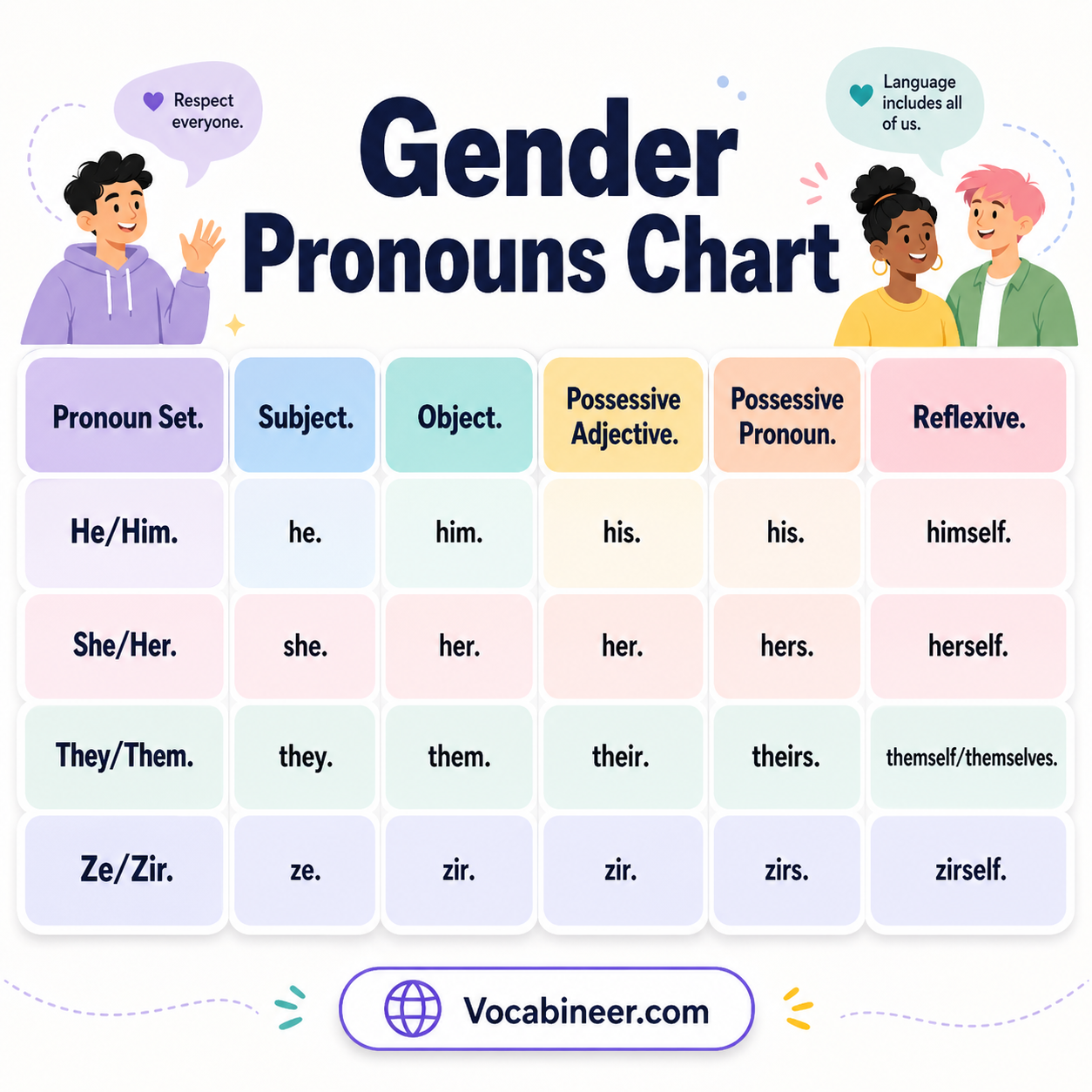
Gender Pronouns Chart
| Pronoun Set | Subject | Object | Possessive Adjective | Possessive Pronoun | Reflexive |
|---|---|---|---|---|---|
| He/Him | he | him | his | his | himself |
| She/Her | she | her | her | hers | herself |
| They/Them | they | them | their | theirs | themself/themselves |
| Ze/Zir | ze | zir | zir | zirs | zirself |
This chart shows how each pronoun set changes according to its role in a sentence.
Common Gender Pronoun Sets
Gender pronouns are often written as sets. A pronoun set shows the main forms someone uses.
Common examples:
- He/Him/His
- She/Her/Hers
- They/Them/Theirs
- Ze/Zir/Zirs
For example, if someone says their pronouns are she/her, you can use she, her, and hers when speaking about that person.
He/Him Pronouns
He/him pronouns are often used for men and boys, but the best rule is to use them for anyone who tells you these are their pronouns.
Forms:
- He
- Him
- His
- Himself
Examples:
- He is reading a book.
- I called him yesterday.
- This is his bag.
- The blue notebook is his.
- He introduced himself.
She/Her Pronouns
She/her pronouns are often used for women and girls, but again, use them for anyone who shares these pronouns.
Forms:
- She
- Her
- Hers
- Herself
Examples:
- She is my friend.
- I helped her with the project.
- This is her pencil.
- The red folder is hers.
- She made the card herself.
They/Them Pronouns
They/them pronouns can be used for one person or more than one person. Many people use they/them as gender-neutral pronouns.
Forms:
- They
- Them
- Their
- Theirs
- Themself
- Themselves
Examples:
- They are my classmate.
- I spoke to them after class.
- This is their notebook.
- The seat near the window is theirs.
- They introduced themself.
- They completed the work themselves.
For one person, both themself and themselves are used, but themselves is more common in general English.
Gender-Neutral Pronouns
Gender-neutral pronouns do not refer only to male or female gender. The most common gender-neutral pronouns in English are they/them.
Examples:
- They are coming soon.
- Please give this paper to them.
- This is their seat.
- The decision is theirs.
Some people also use neopronouns, such as:
- Ze/Zir/Zirs
- Xe/Xem/Xyrs
- Ey/Em/Eirs
These are less common than he/him, she/her, and they/them, but some people use them as their personal pronouns.
Gender Pronouns Examples
Here are quick examples of gender pronouns in short sentences:
- He finished his work.
- I spoke to her after class.
- They shared their idea.
- This notebook is theirs.
- Ze brought zir folder.
These examples show how gender pronouns can appear as subjects, objects, possessive forms, and reflexive forms.
Singular They Pronouns
Singular they means using they/them for one person. It is common when a person’s gender is unknown, not important, or when someone uses they/them pronouns.
Singular they is widely accepted in modern English for both everyday and formal use.
Examples when gender is unknown:
- Someone left their bag here.
- A student should bring their notebook.
- If anyone calls, tell them I am busy.
Examples for one known person:
- Alex said they will arrive soon.
- I gave them the message.
- This jacket is theirs.
Singular they is useful because it keeps sentences clear without assuming someone’s gender.
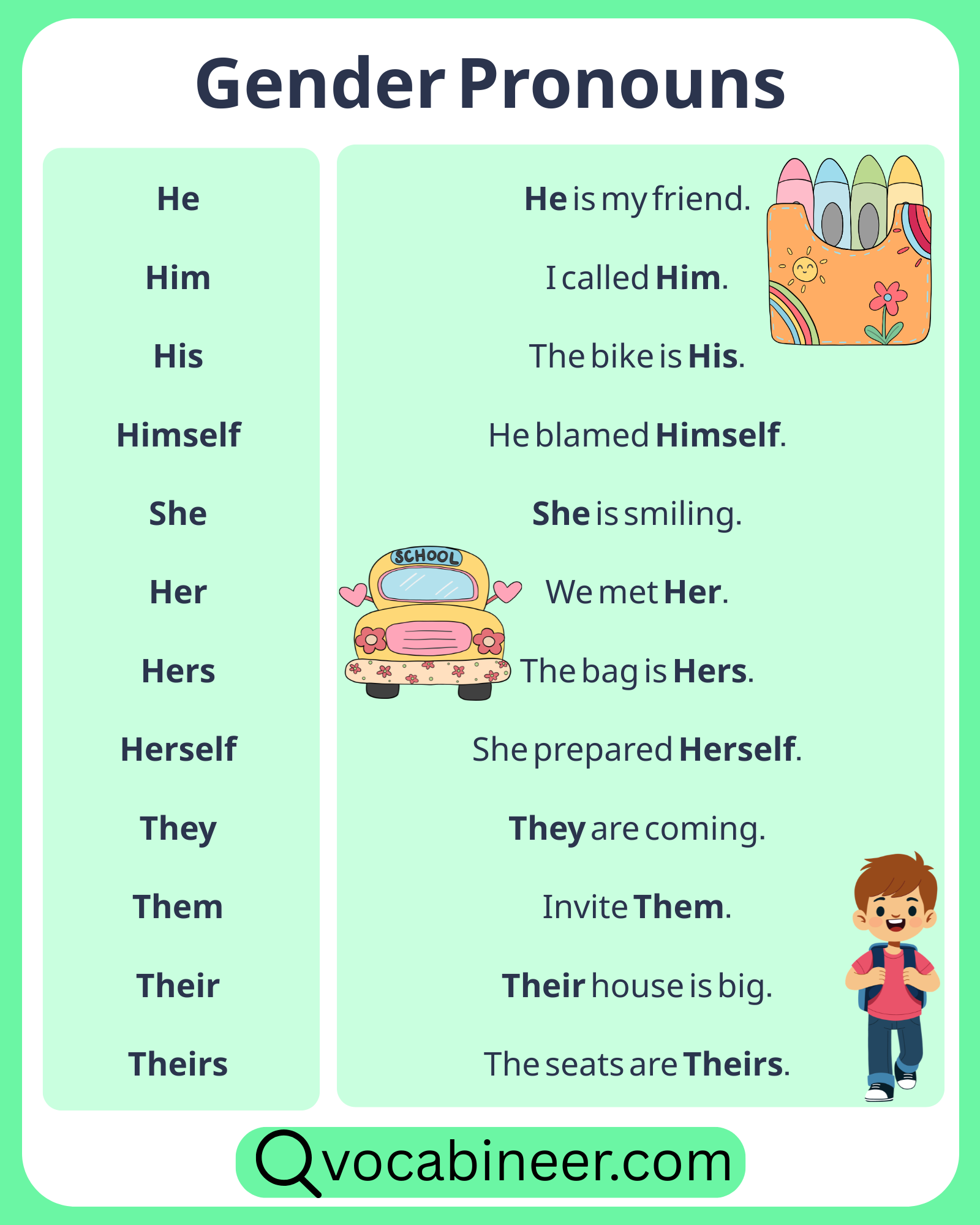
Gender Pronouns vs Personal Pronouns
Gender pronouns are a type of personal pronoun. Personal pronouns refer to people, animals, things, or groups. Gender pronouns refer to people and may connect to gender identity.
All gender pronouns are personal pronouns, but not all personal pronouns refer to gender.
| Term | Meaning | Examples |
|---|---|---|
| Personal pronouns | Pronouns used for people, animals, things, or groups | I, you, he, she, it, we, they |
| Gender pronouns | Pronouns used for a person, often connected to gender identity | he/him, she/her, they/them |
| Gender-neutral pronouns | Pronouns that do not point only to male or female gender | they/them, ze/zir |
In simple words, gender pronouns are personal pronouns used to refer to people.
Gender Pronouns in Sentences
These examples show how different gender pronouns work in real sentences.
- He is going to the library.
- I gave the book to him.
- This is his pencil.
- The blue bag is his.
- He finished the task himself.
- She is working on a project.
- I called her this morning.
- This is her desk.
- The red notebook is hers.
- She painted the picture herself.
- They are joining the meeting.
- Please send the file to them.
- This is their idea.
- The final choice is theirs.
- They introduced themself politely.
These examples show subject, object, possessive, and reflexive forms.
How to Use Gender Pronouns Respectfully
Using gender pronouns respectfully means using the pronouns a person shares for themselves.
Helpful tips:
- Use the pronouns someone gives you.
- Do not guess a person’s pronouns from appearance.
- Share your own pronouns first if appropriate.
- Use the person’s name if you are unsure.
- Correct yourself briefly if you make a mistake.
Example:
- “She is joining—sorry, they are joining us soon.”
A short correction is usually enough. You do not need to over-apologize or make the moment uncomfortable.
Gender Pronouns in Writing and Introductions
Gender pronouns are often used in introductions, email signatures, social media profiles, and workplace or classroom settings.
Examples:
- My name is Jordan, and my pronouns are they/them.
- I’m Mia. I use she/her pronouns.
- Daniel Lee, he/him.
- Alex Carter, they/them.
- Sam Rivera, ze/zir.
In writing, pronouns can help readers know how to refer to someone correctly.
Example:
- Jordan is presenting today. They will explain the first topic.
- Mia sent the report. Please reply to her by Friday.
- Daniel finished his part of the project.
Common Mistakes with Gender Pronouns
Here are common mistakes and corrected examples:
| Incorrect | Correct |
|---|---|
| She said he uses they/them pronouns. | They said they use they/them pronouns. |
| Alex forgot his notebook. | Alex forgot their notebook. |
| I gave the file to she. | I gave the file to her. |
| This is them book. | This is their book. |
| The choice is their. | The choice is theirs. |
| They introduced themselves. | They introduced themself. |
| Ze brought zirs bag. | Ze brought zir bag. |
Note: They introduced themselves is also common and acceptable in many cases. Themself is often used when clearly referring to one person. In modern English, singular they is widely accepted and preferred in many situations.
Quick Rules to Remember
| Rule | Example |
|---|---|
| Use the pronouns a person shares. | Alex uses they/them. |
| Use subject forms before actions. | She is speaking. |
| Use object forms after verbs or prepositions. | I called him. |
| Use possessive adjectives before nouns. | This is their book. |
| Use possessive pronouns without nouns. | This book is theirs. |
| Use reflexive pronouns when the subject and object are the same. | He introduced himself. |
| Use a person’s name if you are unsure. | Jordan will join later. |
FAQs
Gender pronouns are the pronouns used to refer to a person, such as he/him, she/her, and they/them.
Examples of gender pronouns include he, him, his, she, her, hers, they, them, their, theirs, ze, zir, and zirs.
Yes, they/them can be gender pronouns. They are often used as gender-neutral pronouns for one person or a group.
Gender-neutral pronouns are pronouns that do not refer only to male or female gender. Common examples include they/them and sometimes ze/zir.
Gender pronouns are important because they help us refer to people clearly and respectfully without making assumptions about them.
Summary
Gender pronouns are pronouns people use when others talk about them. Common gender pronouns include he/him, she/her, and they/them. Some people also use gender-neutral pronouns or neopronouns, such as ze/zir.
Learning gender pronouns helps you write clearer sentences, use correct grammar forms, and refer to people respectfully. Use the pronouns a person shares, avoid guessing, and correct mistakes briefly when needed.
Read More
- List of Pronouns in English
- First Person Pronouns in English
- Distributive Pronouns in English
- Pronouns Chart Table in English