Third person pronouns are words we use when talking about someone or something that is not the speaker or the listener. Common third person pronouns include he, him, she, her, it, they, them, his, hers, their, and theirs.
For example, instead of saying “Mia is reading. Mia likes the book,” we can say “Mia is reading. She likes it.” Here, she replaces Mia, and it replaces the book, making the sentence shorter and smoother.
These pronouns help us avoid repeating names and nouns again and again. This guide explains third person pronouns with a clear list, chart, examples, singular and plural forms, and common mistakes to avoid.
In This Page
What Are Third Person Pronouns?
Third person pronouns are pronouns used to talk about a person, animal, thing, or group that is not directly speaking or being spoken to.
Examples:
- He is my brother.
- I called him yesterday.
- She is reading a story.
- The teacher praised her.
- It is raining.
- They are outside.
- We invited them.
- This bag is theirs.
In simple words, third person pronouns are used when we talk about someone else or something else.
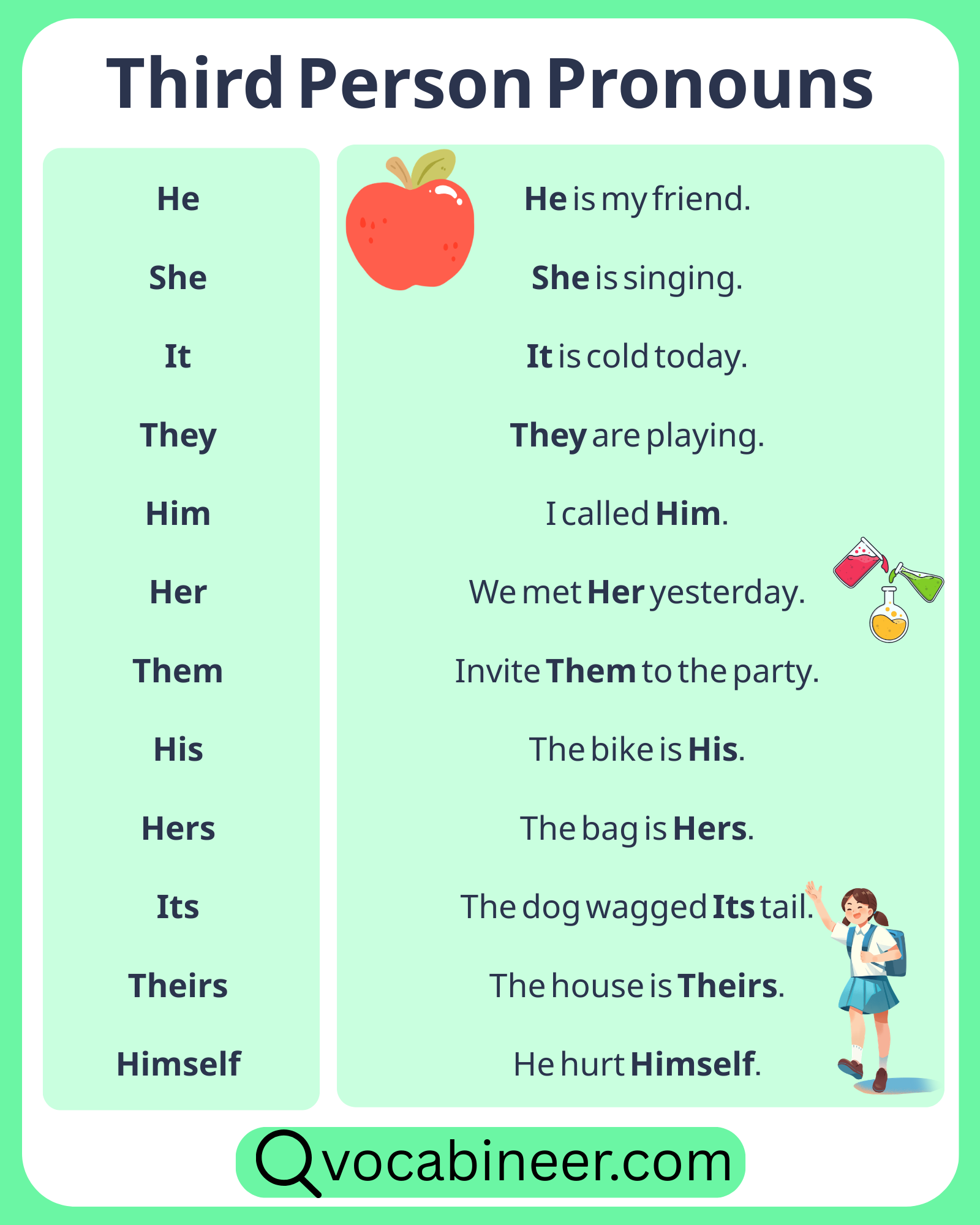
Third Person Pronouns List
Here is a complete list of common third person pronouns in English:
- He
- Him
- His
- Himself
- She
- Her
- Hers
- Herself
- It
- Its
- Itself
- They
- Them
- Their
- Theirs
- Themself
- Themselves
These pronouns can be used as subjects, objects, possessive forms, or reflexive forms.
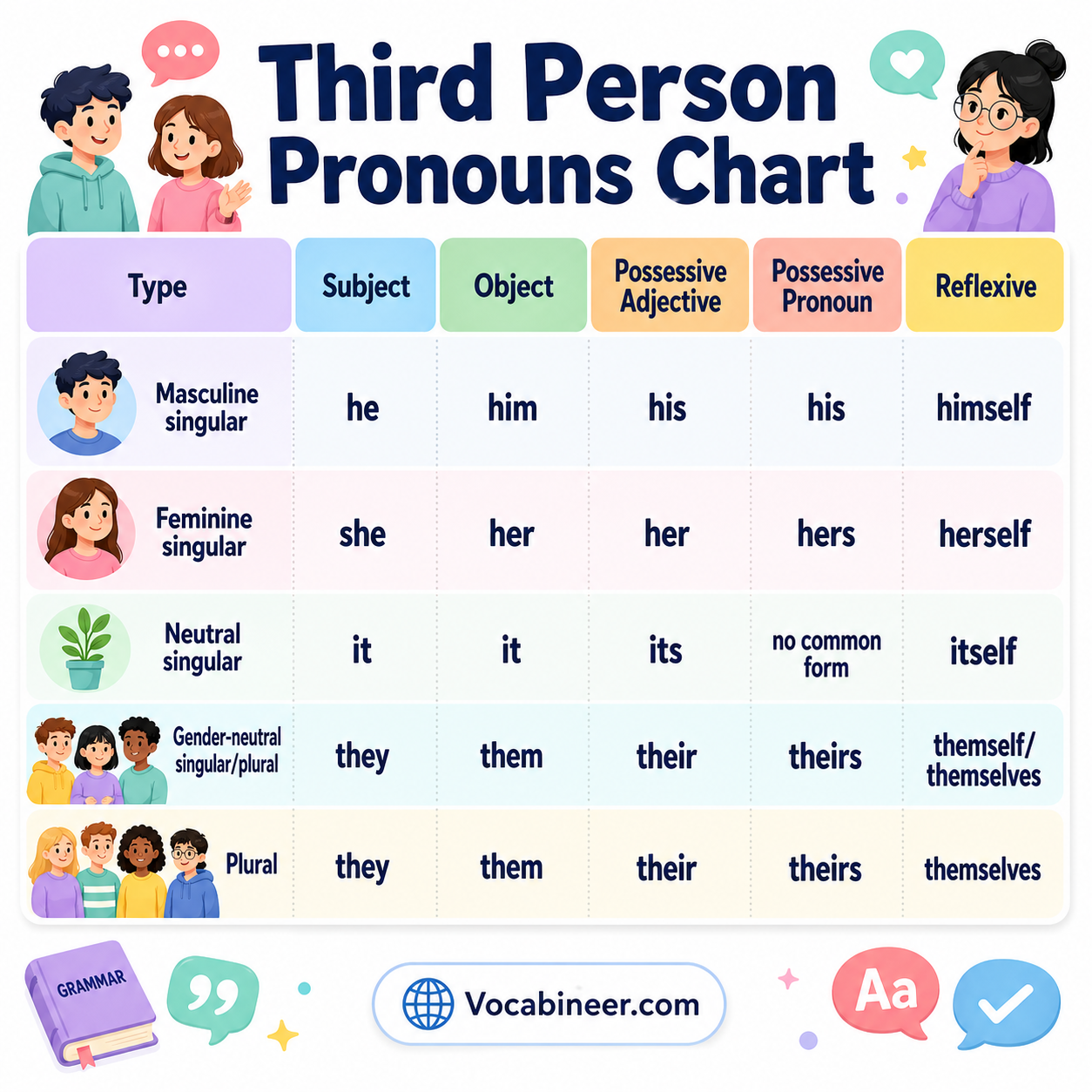
Third Person Pronouns Chart
| Type | Subject | Object | Possessive Adjective | Possessive Pronoun | Reflexive |
|---|---|---|---|---|---|
| Masculine singular | he | him | his | his | himself |
| Feminine singular | she | her | her | hers | herself |
| Neutral singular | it | it | its | no common form | itself |
| Gender-neutral singular/plural | they | them | their | theirs | themself/themselves |
| Plural | they | them | their | theirs | themselves |
This chart shows how third person pronouns change according to their job in a sentence.
How to Use the Third Person Pronouns Chart
The third person pronouns chart is easier to understand when you know what each column means.
| Column | Meaning | Example |
|---|---|---|
| Subject | Does the action | She is reading. |
| Object | Receives the action | I called her. |
| Possessive adjective | Comes before a noun | This is her book. |
| Possessive pronoun | Shows ownership alone | This book is hers. |
| Reflexive | Refers back to the subject | She made it herself. |
A simple rule is:
- Use he, she, it, and they as subjects.
- Use him, her, it, and them as objects.
- Use his, her, its, and their before nouns.
- Use his, hers, and theirs when the noun is not repeated.
- Use himself, herself, itself, themself, or themselves when the action refers back to the subject.
Third Person Pronouns by Set
Third person pronouns are often easier to learn in sets. Each set shows subject, object, possessive, and reflexive forms.
| Pronoun Set | Forms |
|---|---|
| He/Him/His | he, him, his, himself |
| She/Her/Hers | she, her, hers, herself |
| It/Its | it, its, itself |
| They/Them/Their | they, them, their, theirs, themself, themselves |
These sets help you choose the correct form in a sentence.
He/Him/His Pronouns
Use he, him, his, and himself to refer to a male person or someone who uses he/him pronouns.
Forms:
- He
- Him
- His
- Himself
Examples:
- He is reading a book.
- I called him yesterday.
- This is his bag.
- The blue notebook is his.
- He introduced himself.
- He cleaned the room himself.
In these examples, he is the subject, him is the object, his shows ownership, and himself refers back to the same person.
She/Her/Hers Pronouns
Use she, her, hers, and herself to refer to a female person or someone who uses she/her pronouns.
Forms:
- She
- Her
- Hers
- Herself
Examples:
- She is my friend.
- I helped her with the project.
- This is her pencil.
- The red folder is hers.
- She made the card herself.
- She looked at herself in the mirror.
In these examples, she is the subject, her can be an object or a possessive adjective, hers is a possessive pronoun, and herself is reflexive.
It/Its Pronouns
Use it, its, and itself to refer to one animal, thing, place, idea, or situation when gender is not important or not known.
Forms:
- It
- Its
- Itself
Examples:
- It is raining.
- It looks beautiful.
- I fixed it yesterday.
- The dog wagged its tail.
- The bird opened its wings.
- The door closed by itself.
The word its is usually used before a noun. English does not commonly use its alone as a possessive pronoun.
Example:
- Natural: The dog wagged its tail.
- Less common: The tail is its.
They/Them/Their Pronouns
Use they, them, their, theirs, themself, and themselves for plural groups. These forms can also be used for one person in singular they usage.
Forms:
- They
- Them
- Their
- Theirs
- Themself
- Themselves
Examples for a group:
- They are playing outside.
- We invited them to the party.
- This is their project.
- The final choice is theirs.
- They cleaned the room themselves.
Examples for one person:
- Alex said they will arrive soon.
- I gave them the message.
- This jacket is theirs.
- Alex introduced themself.
Both themself and themselves are used for singular they, but themselves is more common in general English.
Singular and Plural Third Person Pronouns
Third person pronouns can be singular or plural.
| Singular Third Person | Plural Third Person |
|---|---|
| he | they |
| him | them |
| his | their |
| himself | themselves |
| she | they |
| her | them |
| hers | theirs |
| herself | themselves |
| it | they |
| its | their |
| itself | themselves |
Examples:
- He is ready. (one male person)
- She is ready. (one female person)
- It is ready. (one thing or animal)
- They are ready. (more than one person or thing)
The word they can also refer to one person in modern English, depending on context.
Gender-Neutral Third Person Pronouns
Gender-neutral third person pronouns do not refer only to male or female gender. The most common gender-neutral third person pronouns are they, them, their, theirs, themself, and themselves.
Examples:
- They are my classmate.
- I spoke to them after class.
- This is their notebook.
- The seat near the window is theirs.
- They introduced themself.
- They completed the work themselves.
Some people also use other gender-neutral pronoun sets, such as ze/zir, but they/them is the most common gender-neutral set in modern English.
Singular They Pronoun
Singular they means using they/them for one person. It is common when a person’s gender is unknown, not important, or when someone uses they/them pronouns.
Examples when gender is unknown:
- Someone left their bag here.
- A student should bring their notebook.
- If anyone calls, tell them I am busy.
Examples for one known person:
- Jordan said they will arrive soon.
- I sent them the email.
- This folder is theirs.
Singular they helps keep sentences clear without guessing someone’s gender.
Third Person Pronouns in Sentences
Here are useful examples of third person pronouns in sentences.
He/Him/His
- He is my cousin.
- I called him after school.
- This is his notebook.
- The green bag is his.
- He fixed the chair himself.
She/Her/Hers
- She teaches English.
- We helped her yesterday.
- This is her desk.
- The red pencil is hers.
- She painted the picture herself.
It/Its
- It is cold today.
- I found it under the table.
- The cat cleaned its paws.
- The machine turned itself off.
They/Them/Their/Theirs
- They are waiting outside.
- I saw them at the park.
- This is their classroom.
- The final decision is theirs.
- They prepared the food themselves.
These examples show subject, object, possessive, and reflexive forms.
Third Person Pronouns in Writing
Third person pronouns are common in stories, reports, descriptions, essays, and formal writing. They help writers talk about people, animals, things, or groups without using names again and again.
Examples:
- She walked into the room.
- He opened the window.
- They completed the project on time.
- It was a difficult task.
- The student said they needed more time.
In storytelling, third person pronouns help describe characters from an outside point of view.
Examples:
- Maria picked up the letter. She opened it slowly.
- The dog barked loudly. It ran toward the gate.
- The children smiled. They waved at their teacher.
First Person vs Second Person vs Third Person Pronouns
Pronouns can show who is speaking, who is listening, and who is being discussed.
| Person | Meaning | Common Pronouns | Example |
|---|---|---|---|
| First person | The speaker or writer | I, me, we, us, my, our | I am speaking. |
| Second person | The listener or reader | you, your, yours, yourself | You are listening. |
| Third person | Someone or something else | he, she, it, they, him, her | They are playing. |
Third person pronouns refer to someone or something that is not the speaker and not the listener.
Examples:
- First person: I am ready.
- Second person: You are ready.
- Third person: She is ready.
Common Mistakes with Third Person Pronouns
Learners often confuse subject, object, possessive, and reflexive forms. Here are common mistakes and correct forms.
| Incorrect | Correct |
|---|---|
| Him is my friend. | He is my friend. |
| Her is reading. | She is reading. |
| I called he. | I called him. |
| I helped she. | I helped her. |
| This book is her. | This book is hers. |
| The dog wagged it’s tail. | The dog wagged its tail. |
| They forgot his notebook. (they/them pronouns) | They forgot their notebook. |
| He introduced hisself. | He introduced himself. |
| She made it her self. | She made it herself. |
| I saw they yesterday. | I saw them yesterday. |
A simple way to avoid mistakes is to check the pronoun’s job in the sentence. Ask yourself whether the pronoun is doing the action, receiving the action, showing ownership, or referring back to the subject.
Quick Rules to Remember
| Rule | Example |
|---|---|
| Use he, she, it, they as subjects. | She is reading. |
| Use him, her, it, them as objects. | I called him. |
| Use his, her, its, their before nouns. | This is their room. |
| Use his, hers, theirs without nouns after them. | The room is theirs. |
| Use reflexive forms when the action returns to the subject. | He hurt himself. |
| Use singular they for one person when needed. | Alex said they are coming. |
Simple reminders:
- Use he, not him, as a subject.
- Use she, not her, as a subject.
- Use him and her after verbs or prepositions.
- Use her before a noun, but hers without a noun.
- Use their before a noun, but theirs without a noun.
FAQs
Third person pronouns are pronouns used to talk about someone or something that is not the speaker and not the listener. Examples include he, she, it, they, him, her, them, his, hers, and theirs.
Examples of third person pronouns include he, him, his, himself, she, her, hers, herself, it, its, itself, they, them, their, theirs, and themselves.
Yes, they is a third person pronoun. It can refer to more than one person or thing, and it can also refer to one person in singular they usage.
Third person singular pronouns refer to one person or thing, such as he, she, and it. Third person plural pronouns refer to more than one, such as they, them, their, and theirs.
Gender-neutral third person pronouns do not refer only to male or female gender. The most common examples are they, them, their, theirs, themself, and themselves.
Summary
Third person pronouns are used to talk about someone or something other than the speaker or listener. Common third person pronouns include he, him, his, she, her, hers, it, its, they, them, their, and theirs.
These pronouns can work as subjects, objects, possessive forms, or reflexive forms. Learning third person pronouns helps you write clearer sentences, avoid repetition, and use correct forms when talking about people, animals, things, or groups.
Read More
- List of Pronouns in English
- Subject Pronouns in English
- First Person Pronouns in English
- Possessive Pronouns in English
- Second Person Pronouns in English