Second person pronouns are words we use when speaking or writing directly to someone. The main second person pronoun is you, but other forms include your, yours, yourself, and yourselves.
For example, instead of using a person’s name again and again, we can say “You are ready,” “This is your book,” or “This book is yours.” These pronouns help make sentences direct, clear, and natural.
In This Page
What Are Second Person Pronouns?
Second person pronouns are pronouns that refer to the person or people being spoken to. They are used when the speaker or writer directly addresses the listener or reader.
Examples:
- You are kind.
- I called you yesterday.
- This is your notebook.
- The blue bag is yours.
- Please introduce yourself.
- Please introduce yourselves.
In simple words, second person pronouns are used when we speak or write directly to you, the listener or reader.
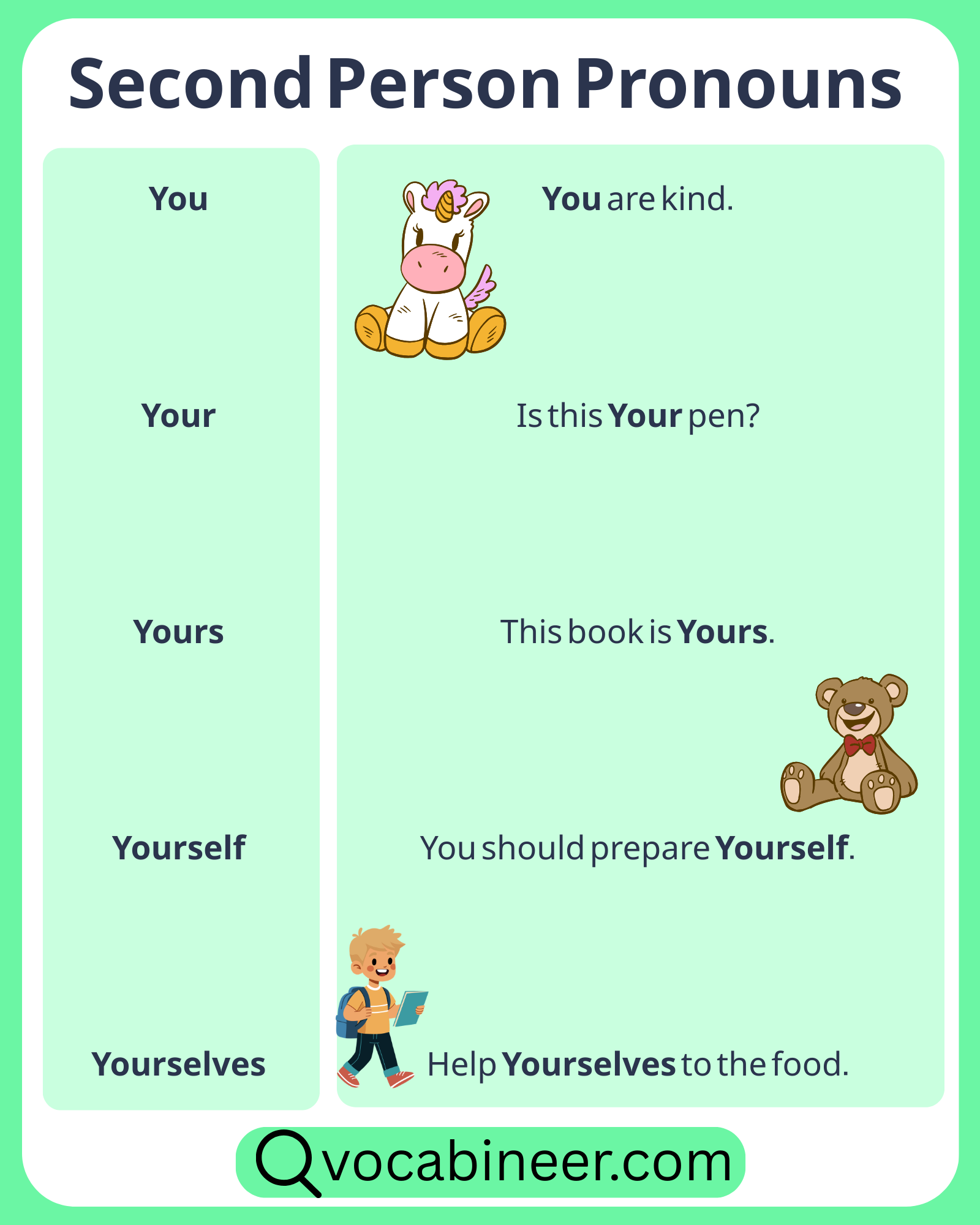
Second Person Pronouns List
Here is the complete list of common second person pronouns in English:
- You
- Your
- Yours
- Yourself
- Yourselves
These words are used for both singular and plural meaning. The word you can refer to one person or more than one person, depending on the context.
Examples:
- You are my friend.
- You are all invited.
In the first sentence, you means one person. In the second sentence, you means more than one person.
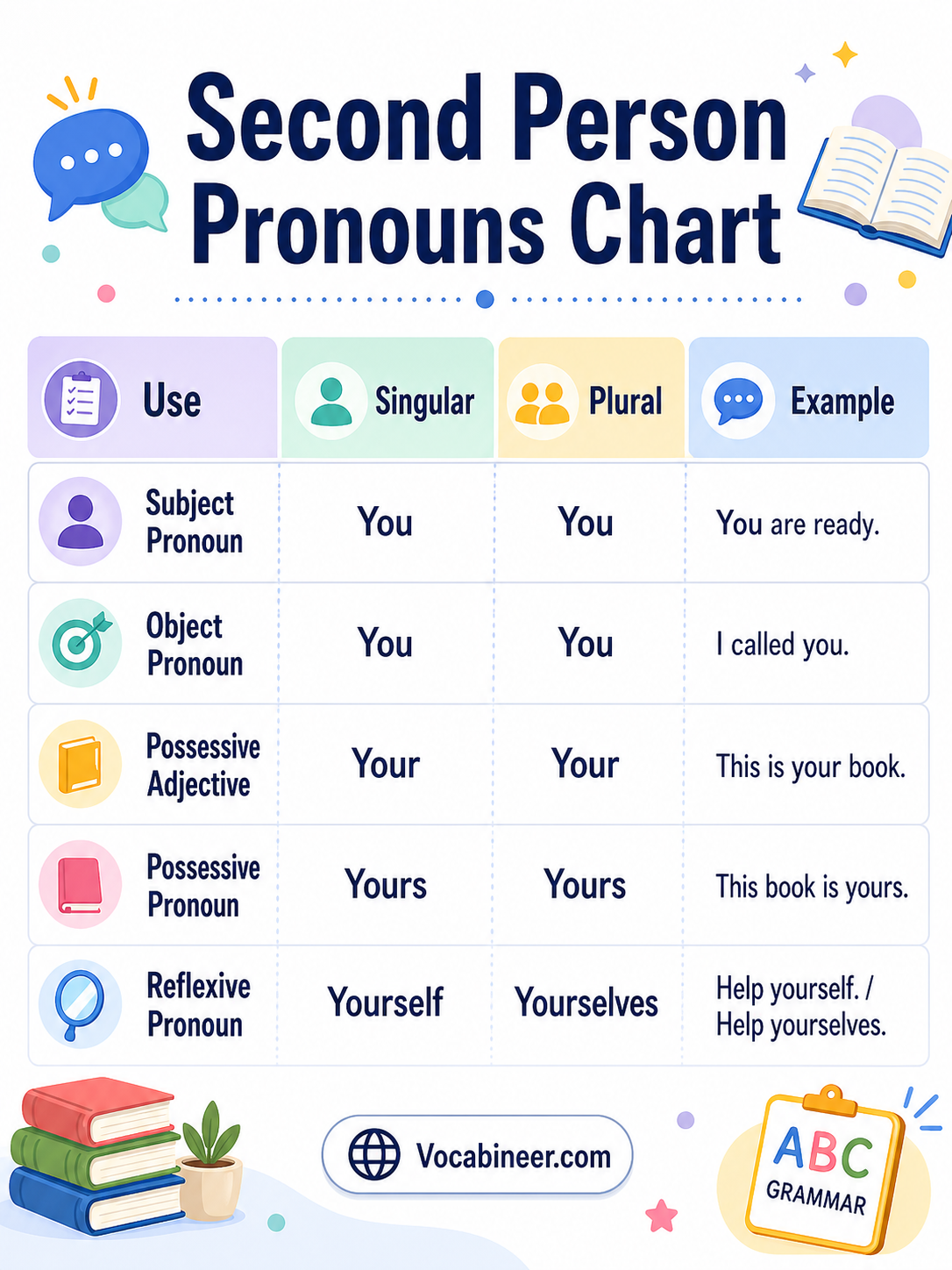
Second Person Pronouns Chart
| Use | Singular | Plural | Example |
|---|---|---|---|
| Subject pronoun | you | you | You are ready. |
| Object pronoun | you | you | I called you. |
| Possessive adjective | your | your | This is your book. |
| Possessive pronoun | yours | yours | This book is yours. |
| Reflexive pronoun | yourself | yourselves | Help yourself. / Help yourselves. |
This chart shows the main second person pronouns and how they work in sentences. The forms you, your, and yours stay the same for singular and plural use. The reflexive form changes: use yourself for one person and yourselves for more than one person.
How to Use Second Person Pronouns
Second person pronouns are used when we talk directly to someone. The form you choose depends on the job of the pronoun in the sentence.
| Pronoun | Use | Example |
|---|---|---|
| You | Subject or object | You are ready. / I called you. |
| Your | Before a noun | This is your book. |
| Yours | Shows ownership alone | This book is yours. |
| Yourself | Refers to one person | Please introduce yourself. |
| Yourselves | Refers to more than one person | Please introduce yourselves. |
In daily English, these pronouns are common in questions, instructions, advice, emails, and direct conversation.
You as a Subject and Object Pronoun
The word you can be both a subject pronoun and an object pronoun.
Use you as a subject when it does the action.
Examples:
- You are ready.
- You speak clearly.
- You wrote a good answer.
- You helped the team.
Use you as an object when it receives the action or comes after a preposition.
Examples:
- I called you.
- She helped you.
- This gift is for you.
- The teacher spoke to you.
The form does not change. The same word you can work in both positions.
| Use | Example |
|---|---|
| Subject | You called me. |
| Object | I called you. |
Singular and Plural You
In modern English, you can refer to one person or more than one person.
| Meaning | Example |
|---|---|
| One person | You are my best friend. |
| More than one person | You are all welcome. |
Context usually tells us whether you means one person or a group.
Examples:
- You are sitting beside me. (one person)
- You are all sitting in the front row. (more than one person)
- You should bring your notebook. (one person or more than one person)
- You should all bring your notebooks. (more than one person)
The clearest difference appears in reflexive pronouns:
| Singular | Plural |
|---|---|
| yourself | yourselves |
Examples:
- Please introduce yourself. (one person)
- Please introduce yourselves. (more than one person)
Your vs Yours
Your and yours both show ownership, but they are used differently.
Use your before a noun. Use yours when the noun is not written after it.
| Word | Use | Example |
|---|---|---|
| Your | Comes before a noun | This is your book. |
| Yours | Stands alone | This book is yours. |
More examples:
- This is your seat.
- This seat is yours.
- Your answer is correct.
- The correct answer is yours.
- Is this your bag?
- Is this bag yours?
Common mistake:
- Incorrect: This book is your.
- Correct: This book is yours.
Another common mistake:
- Incorrect: This is yours book.
- Correct: This is your book.
Yourself vs Yourselves
Use yourself when speaking to one person. Use yourselves when speaking to more than one person.
| Word | Use | Example |
|---|---|---|
| Yourself | One person | Please introduce yourself. |
| Yourselves | More than one person | Please introduce yourselves. |
More examples:
- You should believe in yourself.
- Please help yourself to some water.
- You should all believe in yourselves.
- Please help yourselves to some snacks.
Compare:
- One student: Please prepare yourself.
- Many students: Please prepare yourselves.
This is one of the main places where second person pronouns show a clear singular/plural difference.
Second Person Pronouns in Sentences
Here are useful examples of second person pronouns in sentences.
You
- You are very helpful.
- You should drink some water.
- I saw you at the library.
- The teacher praised you.
Your
- This is your notebook.
- Your handwriting is clear.
- Please bring your book.
- Is this your phone?
Yours
- The blue pencil is yours.
- This answer is yours.
- Is this phone yours?
- The final choice is yours.
Yourself and Yourselves
- Please introduce yourself.
- You should take care of yourself.
- Please introduce yourselves to the class.
- You can help yourselves after the lesson.
- Did you finish the work yourself?
These examples show how second person pronouns work in statements, questions, possessive forms, and reflexive forms.
Second Person Pronouns in Writing
Second person pronouns are common in writing that directly speaks to the reader, such as instructions, advice, guides, emails, and tutorials. They make writing feel direct and personal.
Examples:
- Open your book to page ten.
- Save your work before closing the file.
- You should check your answer carefully.
- This guide helps you understand pronouns.
- If you need help, ask your teacher.
- Choose the option that works best for you.
Second person pronouns are especially common in instructions because the writer is telling the reader what to do.
Examples:
- First, write your name.
- Then, check your spelling.
- Finally, review the answer yourself.
First Person vs Second Person vs Third Person Pronouns
Pronouns can show who is speaking, who is listening, and who is being discussed.
| Person | Meaning | Common Pronouns | Example |
|---|---|---|---|
| First person | The speaker or writer | I, me, we, us, my, our | I am speaking. |
| Second person | The listener or reader | you, your, yours, yourself | You are listening. |
| Third person | Someone or something else | he, she, it, they, him, her | They are playing. |
Second person pronouns are different because they directly address the listener or reader.
Common Mistakes with Second Person Pronouns
Learners often confuse you, your, yours, yourself, and yourselves. Here are common mistakes and correct forms.
| Incorrect | Correct |
|---|---|
| This is you book. | This is your book. |
| This book is your. | This book is yours. |
| Is this yours bag? | Is this your bag? |
| Is this your? | Is this yours? |
| I gave your the book. | I gave you the book. |
| Please introduce yourselves. (one person) | Please introduce yourself. |
| Please introduce yourself. (many people) | Please introduce yourselves. |
| You should believe in you. | You should believe in yourself. |
| This seat is you. | This seat is yours. |
| Bring yours notebook. | Bring your notebook. |
A simple way to avoid mistakes is to check the word after the pronoun. If a noun comes after it, use your. If no noun comes after it, use yours.
Examples:
- Your book is here.
- This book is yours.
FAQs
Second person pronouns are pronouns used for the person or people being spoken to. Common second person pronouns are you, your, yours, yourself, and yourselves.
Examples of second person pronouns include you, your, yours, yourself, and yourselves. Example sentences are “You are ready,” “This is your book,” and “This book is yours.”
You can be singular or plural in English. It can refer to one person, as in “You are my friend,” or more than one person, as in “You are all invited.”
Use your before a noun, as in “your book.” Use yours when the noun is not repeated, as in “This book is yours.”
Use yourself for one person. Use yourselves for more than one person. For example, “Please introduce yourself” is for one person, while “Please introduce yourselves” is for a group.
Summary
Second person pronouns are used when speaking or writing directly to someone. The main second person pronouns are you, your, yours, yourself, and yourselves.
Use you as both subject and object, your before nouns, yours without a noun after it, yourself for one person, and yourselves for more than one person. Learning these forms will help you write clearer sentences, avoid common mistakes, and speak directly to readers or listeners in natural English.
Read More
- List of Pronouns in English
- First Person Pronouns in English
- Possessive Pronouns in English
- Possessive Pronouns Chart in English