

Singular pronouns are words that refer to one person, animal, thing, or idea. Words like I, me, he, she, it, this, that, someone, and anyone are common singular pronouns.
For example, instead of saying “Mia is here. Mia is reading,” we can say “Mia is here. She is reading.” Here, she replaces the singular noun Mia and makes the sentence shorter and clearer.
In This Page
What Are Singular Pronouns?
Singular pronouns are pronouns that replace singular nouns. A singular noun names one person, one animal, one thing, one place, or one idea.
Examples:
- I am ready.
- Please help me.
- He is my brother.
- She is reading.
- It is raining.
- This is my bag.
- Someone is calling.
- Nobody answered.
In simple words, singular pronouns are used when we talk about one person or thing.
Singular Pronouns List
Here is a useful list of singular pronouns in English:
- I
- Me
- You
- He
- Him
- She
- Her
- It
- My
- Mine
- Your
- Yours
- His
- Hers
- Its
- Myself
- Yourself
- Himself
- Herself
- Itself
- This
- That
- Someone
- Anyone
- Everyone
- No one
- Nobody
- Somebody
- Anybody
- Everybody
- Something
- Anything
- Everything
- Nothing
- Each
- Either
- Neither
- Who
- Whom
- Whose
- Which
- What
Some of these pronouns, such as you, who, which, and that, can be singular or plural depending on the sentence. However, they are often used with singular meaning.
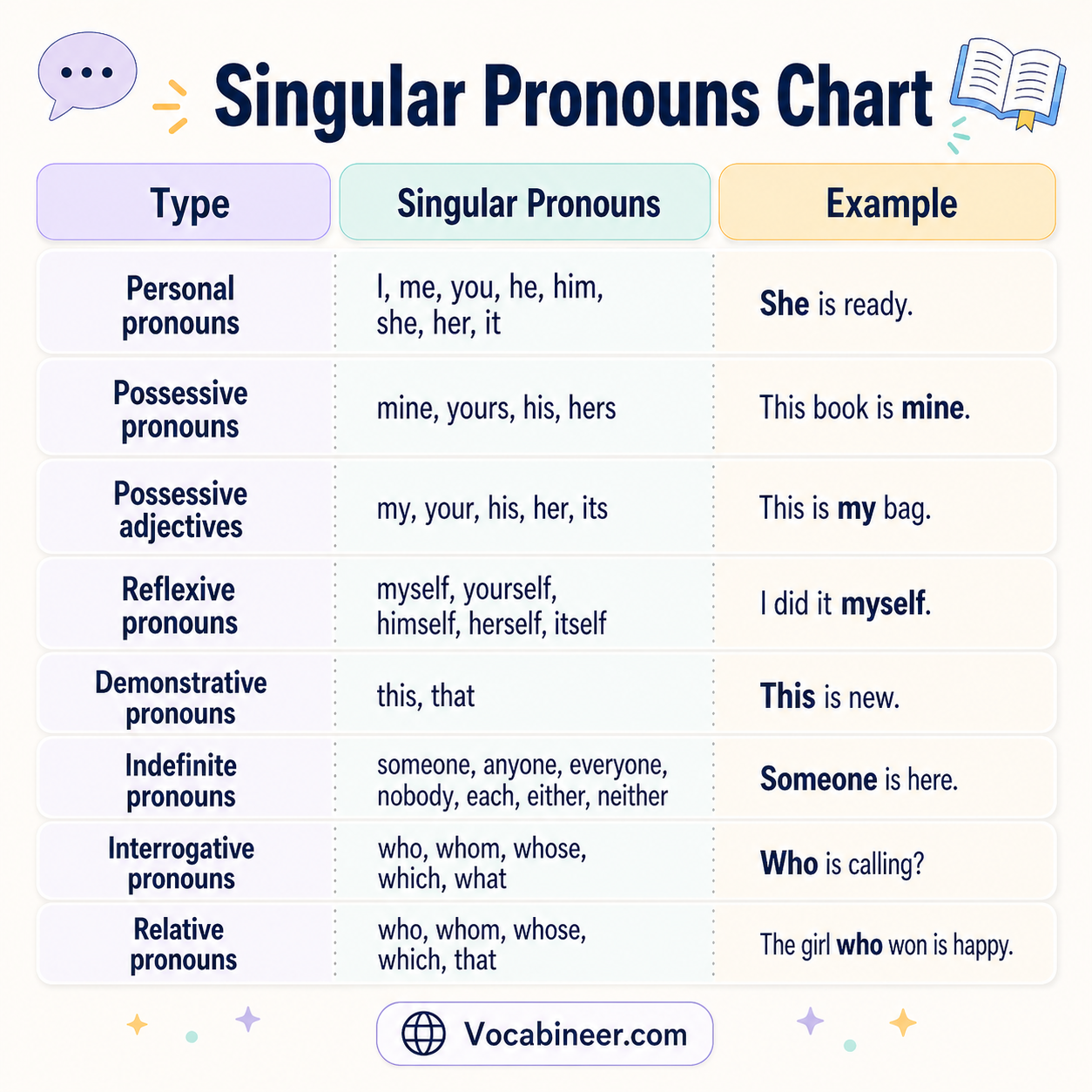
Singular Pronouns Chart
| Type | Singular Pronouns | Example |
|---|---|---|
| Personal pronouns | I, me, you, he, him, she, her, it | She is ready. |
| Possessive pronouns | mine, yours, his, hers | This book is mine. |
| Possessive adjectives | my, your, his, her, its | This is my bag. |
| Reflexive pronouns | myself, yourself, himself, herself, itself | I did it myself. |
| Demonstrative pronouns | this, that | This is new. |
| Indefinite pronouns | someone, anyone, everyone, nobody, each, either, neither | Someone is here. |
| Interrogative pronouns | who, whom, whose, which, what | Who is calling? |
| Relative pronouns | who, whom, whose, which, that | The girl who won is happy. |
This chart shows that singular pronouns can belong to different pronoun groups. Some refer to specific people or things, while others refer to unknown or general people, things, or ideas.
Singular Personal Pronouns
Singular personal pronouns refer to one specific person, animal, thing, or speaker.
Common singular personal pronouns include:
- I
- Me
- You
- He
- Him
- She
- Her
- It
Examples:
- I like English.
- Please call me.
- You are helpful.
- He is my friend.
- I saw him yesterday.
- She is my teacher.
- The coach praised her.
- It is cold today.
Personal pronouns can work as subjects or objects.
| Subject Pronoun | Object Pronoun |
|---|---|
| I | me |
| you | you |
| he | him |
| she | her |
| it | it |
Examples:
- I helped him.
- She called me.
- It surprised her.
- You invited me.
Singular Possessive Pronouns
Singular possessive pronouns show ownership and stand alone. They do not need a noun after them.
Common singular possessive pronouns include:
- Mine
- Yours
- His
- Hers
Examples:
- This pencil is mine.
- Is this seat yours?
- The black jacket is his.
- The red notebook is hers.
Possessive adjectives also show ownership, but they come before nouns.
| Possessive Adjective | Possessive Pronoun |
|---|---|
| my book | mine |
| your seat | yours |
| his bag | his |
| her pen | hers |
Examples:
- This is my book.
- This book is mine.
- That is her bag.
- That bag is hers.
Singular Reflexive Pronouns
Singular reflexive pronouns refer back to the subject of the sentence. They are used when the subject and object are the same person or thing.
Common singular reflexive pronouns include:
- Myself
- Yourself
- Himself
- Herself
- Itself
Examples:
- I made it myself.
- You should trust yourself.
- He introduced himself.
- She looked at herself in the mirror.
- The door closed by itself.
Reflexive pronouns are useful when the action returns to the same person or thing.
Examples:
- I hurt myself.
- He blamed himself.
- She taught herself French.
- The machine turned itself off.
Singular Demonstrative Pronouns
Singular demonstrative pronouns point to one person, place, thing, or idea.
The two main singular demonstrative pronouns are:
- This
- That
| Pronoun | Use | Example |
|---|---|---|
| This | One thing near | This is my bag. |
| That | One thing far | That is your chair. |
Examples:
- This is delicious.
- That looks expensive.
- This is my favorite book.
- That was a good idea.
Use this for one thing near you. Use that for one thing farther away.
Singular Indefinite Pronouns
Singular indefinite pronouns refer to one unknown, general, or unspecified person or thing.
Common singular indefinite pronouns include:
- Someone
- Somebody
- Anyone
- Anybody
- Everyone
- Everybody
- No one
- Nobody
- Something
- Anything
- Everything
- Nothing
- Each
- Either
- Neither
Examples:
- Someone is at the door.
- Anybody can join the class.
- Everyone is ready.
- Nobody answered the phone.
- Something is missing.
- Nothing is impossible.
- Each has a different answer.
- Neither is correct.
Many singular indefinite pronouns usually take singular verbs.
Examples:
- Everyone is ready.
- Someone has called.
- Nobody knows the answer.
- Each is different.
- Neither is available.
Singular Personal vs Singular Indefinite Pronouns
Singular personal pronouns and singular indefinite pronouns are both singular, but they are used differently.
| Type | Meaning | Examples |
|---|---|---|
| Singular personal pronouns | Refer to one specific person or thing | I, me, he, she, it |
| Singular indefinite pronouns | Refer to one unknown or general person or thing | someone, anyone, nobody, each |
Examples:
- She is my sister.
- Someone is at the door.
In the first sentence, she refers to a specific person. In the second sentence, someone refers to an unknown person.
More examples:
- He called me. (specific person)
- Nobody called me. (general/unknown person)
- It is broken. (specific thing)
- Something is broken. (unknown thing)
Singular They Pronoun
They is often used as a plural pronoun, but it can also be used as a singular pronoun in modern English.
Singular they is used when:
- the person’s gender is unknown
- the person’s gender is not important
- a person uses they/them pronouns
Examples when gender is unknown:
- Someone left their bag here.
- A student should bring their notebook.
- If anyone calls, tell them I am busy.
Examples for one known person:
- Alex said they will arrive soon.
- I gave them the message.
- This jacket is theirs.
Singular they helps avoid guessing someone’s gender and is common in both everyday English and modern writing.
Singular vs Plural Pronouns
Singular pronouns refer to one person, animal, thing, or idea. Plural pronouns refer to more than one.
| Singular Pronouns | Plural Pronouns |
|---|---|
| I | we |
| me | us |
| he | they |
| him | them |
| she | they |
| her | them |
| it | they |
| myself | ourselves |
| yourself | yourselves |
| himself | themselves |
| herself | themselves |
| itself | themselves |
| this | these |
| that | those |
Examples:
- She is reading. (one person)
- They are reading. (more than one person)
- This is my notebook. (one thing)
- These are my notebooks. (more than one thing)
- That is a chair. (one thing)
- Those are chairs. (more than one thing)
The words you, they, which, who, and that can depend on context, so always check the sentence meaning.
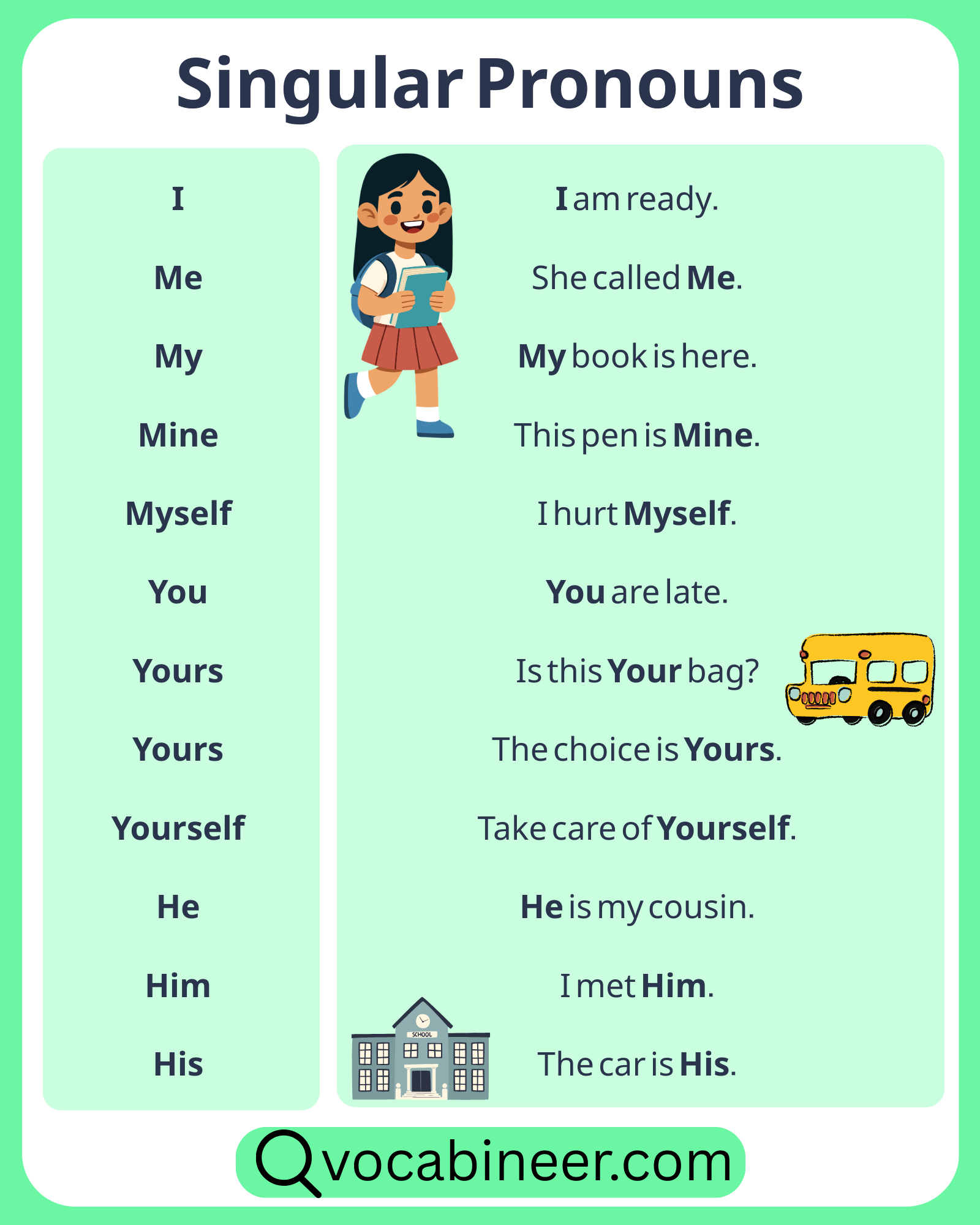
Singular Pronouns in Sentences
Here are useful examples of singular pronouns in sentences.
Personal pronouns
- I am learning English.
- Please help me.
- He is my cousin.
- I called him yesterday.
- She likes music.
- The teacher praised her.
- It is raining outside.
Possessive pronouns
- This book is mine.
- That seat is yours.
- The blue bag is his.
- The red folder is hers.
Reflexive pronouns
- I made this card myself.
- You should believe in yourself.
- He fixed the chair himself.
- She prepared the meal herself.
- The door closed by itself.
Demonstrative pronouns
- This is my favorite song.
- That was a smart answer.
Indefinite pronouns
- Someone is waiting outside.
- Everyone is excited.
- Nobody knows the answer.
- Something feels strange.
- Each has a different color.
Singular Pronouns in Questions
Singular pronouns are also common in questions.
Examples:
- Is he your brother?
- Did she call you?
- Is it working now?
- Is this book mine?
- Is that seat yours?
- Who is at the door?
- Whose bag is this?
- Is someone waiting outside?
- Did anyone answer?
- Which is correct?
- Is this your pencil?
- Is that your house?
Questions with singular pronouns help ask about one person, one thing, or one unknown subject.
Common Mistakes with Singular Pronouns
Learners often confuse singular pronouns with object forms, possessive forms, or plural verbs. Here are common mistakes and correct forms.
| Incorrect | Correct |
|---|---|
| Me am ready. | I am ready. |
| She helped I. | She helped me. |
| Him is my friend. | He is my friend. |
| Her is reading. | She is reading. |
| This book is my. | This book is mine. |
| This is mine book. | This is my book. |
| Everyone are ready. | Everyone is ready. |
| Each student have a book. | Each student has a book. |
| This are my bag. | This is my bag. |
| That are your chair. | That is your chair. |
To avoid these mistakes, check whether the pronoun is singular or plural and whether it is working as a subject, object, possessive form, or reflexive form.
Quick Rules to Remember
| Rule | Example |
|---|---|
| Singular pronouns refer to one person, thing, or idea. | She is here. |
| Use subject forms before the action. | He called me. |
| Use object forms after verbs or prepositions. | I called him. |
| Use singular verbs with many singular indefinite pronouns. | Everyone is ready. |
| Use this and that for one thing. | This is new. |
| Use singular reflexive pronouns for one person or thing. | He hurt himself. |
| Singular they can refer to one person in modern English. | Alex said they are coming. |
Simple reminders:
- Use I, not me, before a verb when talking about yourself as the doer.
- Use me, not I, after a verb or preposition.
- Use this and that for one thing.
- Use these and those for more than one thing.
- Use everyone is, not everyone are.
FAQs
Singular pronouns are pronouns that refer to one person, animal, thing, or idea. Examples include I, me, he, she, it, this, that, someone, anyone, and nobody.
Examples of singular pronouns include I, me, you, he, him, she, her, it, mine, yours, himself, herself, this, that, someone, anyone, everyone, and nothing.
Yes, they can be singular in modern English. It can refer to one person when gender is unknown, not important, or when someone uses they/them pronouns.
Singular pronouns refer to one person or thing, such as he, she, it, this, and someone. Plural pronouns refer to more than one, such as we, us, they, them, these, and those.
Many singular pronouns use singular verbs, especially singular indefinite pronouns. For example, we say everyone is, someone has, nobody knows, and each is.
Summary
Singular pronouns refer to one person, animal, thing, or idea. Common singular pronouns include I, me, you, he, she, it, this, that, someone, anyone, everyone, nobody, myself, himself, and herself.
These pronouns can be personal, possessive, reflexive, demonstrative, indefinite, interrogative, or relative. Learning singular pronouns helps you choose correct verbs, avoid common mistakes, and write clearer English sentences.
Read More
- List of Pronouns in English
- First Person Pronouns in English
- Possessive Pronouns in English
- Second Person Pronouns in English
- Possessive Pronouns Chart in English