Subject pronouns replace the person, animal, thing, or group doing the action in a sentence. The main subject pronouns in English are I, you, he, she, it, we, and they. These words help sentences sound clear.
For example, instead of saying “Mia is reading. Mia is happy,” we can say “Mia is reading. She is happy.” Here, she replaces Mia, so the sentence sounds shorter, smoother, and more natural.
Learning subject pronouns helps you write simple, natural sentences and avoid common mistakes like me am ready or him is my friend. This guide explains subject pronouns with easy examples, charts, and practical rules.
In This Page
What Are Subject Pronouns?
Subject pronouns are pronouns used as the subject of a sentence. The subject is the person, animal, thing, or group that does the action or is being described.
Examples:
- I am ready.
- You are kind.
- He is my brother.
- She likes music.
- It is raining.
- We are learning English.
- They are playing outside.
In these sentences, the subject pronouns come before the verb and show who or what the sentence is about.
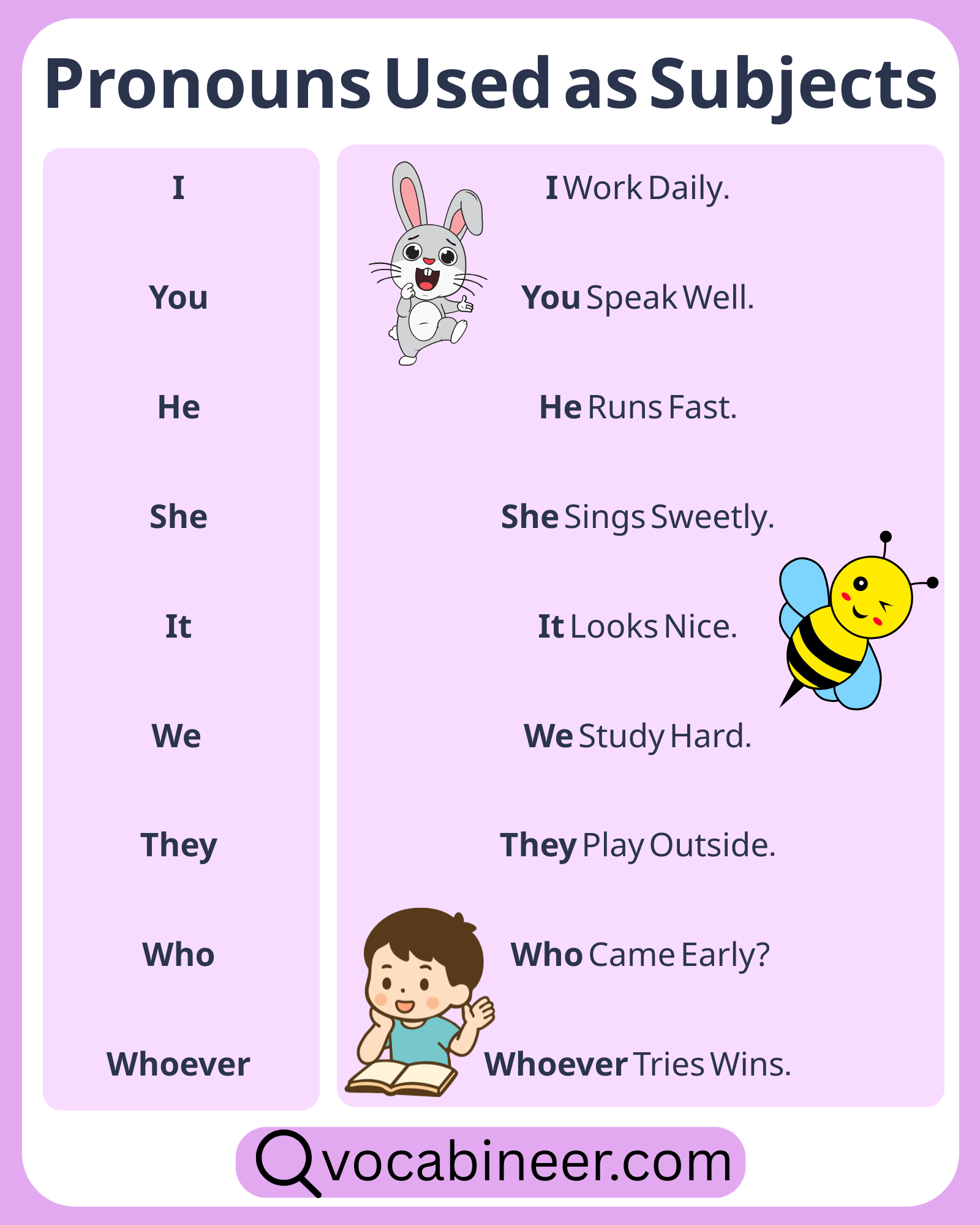
Subject Pronouns List
Here is the main list of subject pronouns in English:
- I
- You
- He
- She
- It
- We
- They
The word who can also work as a subject pronoun in questions.
Examples:
- Who is calling?
- Who wrote this answer?
- Who wants tea?
For beginners, the most important subject pronouns to learn first are I, you, he, she, it, we, and they.
Subject Pronouns Chart
| Person | Singular | Plural | Example |
|---|---|---|---|
| First person | I | we | I am ready. / We are ready. |
| Second person | you | you | You are kind. |
| Third person | he, she, it | they | She is reading. / They are playing. |
This chart shows subject pronouns by person and number. I and we refer to the speaker, you refers to the listener, and he, she, it, and they refer to someone or something else.
How to Use Subject Pronouns
Use subject pronouns when the pronoun is the subject of the sentence. In many simple English sentences, the subject pronoun comes before the verb.
Examples:
- I write every day.
- You speak clearly.
- He plays football.
- She reads books.
- It works well.
- We study together.
- They live nearby.
A simple way to find the subject is to ask: Who or what is doing the action?
Examples:
- She is singing.
Who is singing? She. - They are running.
Who is running? They. - It is broken.
What is broken? It.
Subject Pronouns as the Doer of the Action
Subject pronouns often show the doer of the action. They tell us who is doing something in the sentence.
Examples:
- I opened the door.
- You answered the question.
- He cleaned the room.
- She cooked dinner.
- It made a loud noise.
- We joined the class.
- They finished the work.
Each bold word is the subject because it does the action.
Subject pronouns can also describe someone or something with verbs like am, is, are, was, and were.
Examples:
- I am happy.
- He is tired.
- She was late.
- We are ready.
- They were excited.
Subject Pronouns vs Object Pronouns
Subject pronouns do the action. Object pronouns receive the action or come after a verb or preposition.
| Subject Pronoun | Object Pronoun |
|---|---|
| I | me |
| you | you |
| he | him |
| she | her |
| it | it |
| we | us |
| they | them |
Examples:
- I called him.
- She helped me.
- We invited them.
- They saw us.
- He thanked her.
In these examples, the subject pronouns do the action, and the object pronouns receive the action.
Common Subject and Object Pronoun Pairs
Some subject and object pronouns are easy to confuse. This table shows the most common pairs.
| Pair | Difference | Examples |
|---|---|---|
| I vs Me | I does the action; me receives the action. | I called Anna. / Anna called me. |
| He vs Him | He does the action; him receives the action. | He helped us. / We helped him. |
| She vs Her | She does the action; her receives the action. | She saw me. / I saw her. |
| We vs Us | We does the action; us receives the action. | We joined them. / They joined us. |
| They vs Them | They do the action; them receive the action. | They invited us. / We invited them. |
A simple rule is: use the subject form before the verb when it does the action.
Examples:
- Correct: I am ready.
- Incorrect: Me am ready.
- Correct: He is my friend.
- Incorrect: Him is my friend.
You and It as Subject and Object Pronouns
The words you and it can be both subject pronouns and object pronouns. Their forms do not change.
| Pronoun | Subject Example | Object Example |
|---|---|---|
| You | You are kind. | I called you. |
| It | It is broken. | I fixed it. |
More examples:
- You helped me.
- I helped you.
- It surprised us.
- We saw it.
The meaning depends on the pronoun’s job in the sentence, not its spelling.
Who as a Subject Pronoun
The word who can work as a subject pronoun in questions. It asks about the person doing the action.
Examples:
- Who is calling?
- Who opened the door?
- Who wants to join?
- Who wrote this story?
- Who helped you?
In these questions, who is the subject because it asks who is doing the action.
Compare:
- Who called you?
Who is the subject. - Whom did you call?
Whom is the object.
In everyday English, many people use who instead of whom, but who is the correct subject form.
Subject Pronouns in Sentences
Here are useful examples of subject pronouns in sentences.
I
- I like English.
- I finished my homework.
- I need some help.
You
- You are a good friend.
- You answered correctly.
- You can sit here.
He
- He is my cousin.
- He plays cricket.
- He opened the window.
She
- She is reading a story.
- She teaches English.
- She helped the class.
It
- It is cold today.
- It works well.
- It looks beautiful.
We
- We are classmates.
- We joined the meeting.
- We cleaned the room.
They
- They are outside.
- They opened the door.
- They finished the project.
These examples show how subject pronouns usually come before the verb and tell who or what the sentence is about.
Subject Pronouns in Questions
Subject pronouns are also common in questions. In many questions, the helping verb comes before the subject pronoun.
Examples:
- Am I late?
- Are you ready?
- Is he your brother?
- Is she your teacher?
- Is it working?
- Are we going now?
- Are they coming?
- Did you call me?
- Did he answer?
- Did they finish?
The subject pronoun still shows who is doing or being something, even when the word order changes in a question.
Common Mistakes with Subject Pronouns
Learners often confuse subject pronouns with object pronouns. Here are common mistakes and correct forms.
| Incorrect | Correct |
|---|---|
| Me am ready. | I am ready. |
| Him is my friend. | He is my friend. |
| Her is reading. | She is reading. |
| Us are going home. | We are going home. |
| Them are outside. | They are outside. |
| John and me went home. | John and I went home. |
| Me and Sara are classmates. | Sara and I are classmates. |
| Him and I are friends. | He and I are friends. |
| Her and Emma helped us. | She and Emma helped us. |
| Them and we played together. | They and we played together. |
A useful trick is to remove the other person from the sentence.
Example:
- Incorrect: John and me went home.
- Test: Me went home. ❌
- Correct: John and I went home.
- Test: I went home. ✅
Quick Rules to Remember
| Rule | Example |
|---|---|
| Use subject pronouns as the doer. | She is reading. |
| Subject pronouns usually come before verbs. | They are playing. |
| Use I, not me, before a verb. | I am ready. |
| Use he, not him, as a subject. | He is my friend. |
| Use she, not her, as a subject. | She is singing. |
| Use we, not us, as a subject. | We are ready. |
| Use they, not them, as a subject. | They are outside. |
| Use who as a question subject. | Who called you? |
Simple reminder:
If the pronoun is doing the action or being described, use a subject pronoun.
Examples:
- I called him.
- She is happy.
- They are ready.
FAQs
Subject pronouns are pronouns used as the subject of a sentence. They show who or what is doing the action or being described. Examples include I, you, he, she, it, we, and they.
Examples of subject pronouns are I, you, he, she, it, we, and they. Example sentences include “I am ready,” “She is reading,” and “They are playing.”
Subject pronouns do the action, such as I, he, and they. Object pronouns receive the action, such as me, him, and them.
Yes, who can be a subject pronoun in questions. For example, in “Who called you?” the word who is the subject.
Subject pronouns are important because they help avoid repetition and make sentences shorter, clearer, and more natural.
Summary
Subject pronouns replace the subject of a sentence. The main subject pronouns in English are I, you, he, she, it, we, and they. The word who can also work as a subject pronoun in questions.
Use subject pronouns when the pronoun is doing the action or being described. Learning subject pronouns helps you avoid common mistakes like me am ready, him is my friend, and John and me went home.
Read More
- List of Pronouns in English
- First Person Pronouns in English
- Possessive Pronouns in English
- Second Person Pronouns in English
- Possessive Pronouns Chart in English