Possessive pronouns are words that show ownership without repeating the noun. Words like mine, yours, his, hers, ours, and theirs are possessive pronouns.
For example, instead of saying “This is my book. That is your book,” we can say “This book is mine. That book is yours.” This makes the sentence shorter, clearer, and more natural.
This guide uses a clear possessive pronouns chart, simple examples, and common mistakes to help you use these words correctly in English.
In This Page
What Are Possessive Pronouns?
Possessive pronouns are pronouns that show something belongs to someone. They stand alone in a sentence and do not need a noun after them.
Examples:
- This pencil is mine.
- That seat is yours.
- The blue bag is his.
- The red notebook is hers.
- This classroom is ours.
- The final decision is theirs.
In these sentences, the possessive pronouns show ownership. For example, mine means “my pencil,” and hers means “her notebook.”
A possessive pronoun replaces a noun phrase that shows ownership.
Example:
- This is my bag.
- This bag is mine.
Here, mine replaces my bag.
Possessive Pronouns List
Here is the main list of possessive pronouns in English:
- Mine
- Yours
- His
- Hers
- Ours
- Theirs
These words are used when the noun is already clear from the sentence.
Examples:
- This book is mine.
- Is this pen yours?
- The black coat is his.
- The green folder is hers.
- This house is ours.
- The last turn is theirs.
Possessive pronouns are useful because they help you avoid repeating the same noun again and again.
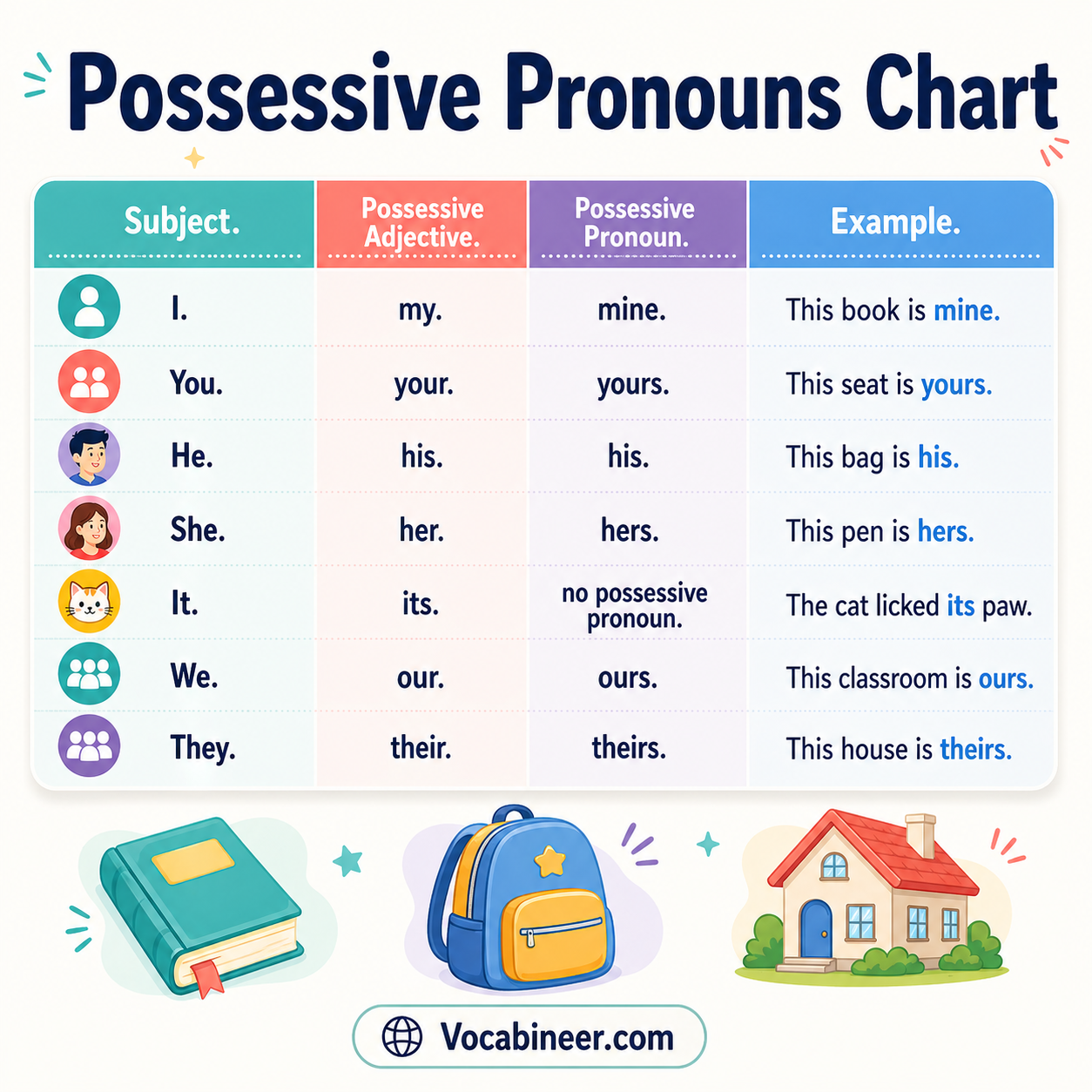
Possessive Pronouns Chart
| Subject | Possessive Adjective | Possessive Pronoun | Example |
|---|---|---|---|
| I | my | mine | This book is mine. |
| You | your | yours | This seat is yours. |
| He | his | his | This bag is his. |
| She | her | hers | This pen is hers. |
| It | its | no common possessive pronoun | The cat licked its paw. |
| We | our | ours | This classroom is ours. |
| They | their | theirs | This house is theirs. |
This chart shows the difference between possessive adjectives and possessive pronouns. Possessive adjectives come before nouns, while possessive pronouns stand alone.
How to Read the Possessive Pronouns Chart
The possessive pronouns chart is easy to read when you understand the role of each column.
| Column | Meaning | Example |
|---|---|---|
| Subject | The person or group connected to ownership | I, you, he, she, we, they |
| Possessive adjective | Comes before a noun | This is my book. |
| Possessive pronoun | Stands alone without a noun | This book is mine. |
| Example | Shows the possessive pronoun in a sentence | The seat is yours. |
A simple rule is:
- Use my, your, his, her, its, our, and their before nouns.
- Use mine, yours, his, hers, ours, and theirs without nouns after them.
Examples:
- This is my pencil.
- This pencil is mine.
- That is your bag.
- That bag is yours.
- This is our classroom.
- This classroom is ours.
The noun comes after a possessive adjective, but it does not come after a possessive pronoun.
Possessive Pronouns vs Possessive Adjectives
Possessive pronouns and possessive adjectives both show ownership, but they are used differently.
A possessive adjective comes before a noun. A possessive pronoun stands alone and replaces the noun.
| Possessive Adjective | Possessive Pronoun |
|---|---|
| my book | mine |
| your seat | yours |
| his bag | his |
| her pen | hers |
| our classroom | ours |
| their house | theirs |
Examples:
- This is my book.
- This book is mine.
- That is your seat.
- That seat is yours.
- This is her pen.
- This pen is hers.
- That is their house.
- That house is theirs.
The main difference is simple: possessive adjectives need a noun after them, but possessive pronouns do not.
Correct:
- This is my book.
- This book is mine.
Incorrect:
- This is mine book.
- This book is my.
Common Possessive Pronoun Pairs
Some possessive forms are easy to confuse because they look similar. The table below shows the most common pairs.
| Pair | Difference | Examples |
|---|---|---|
| My vs Mine | My comes before a noun; mine stands alone. | This is my bag. / This bag is mine. |
| Your vs Yours | Your comes before a noun; yours stands alone. | Is this your seat? / Is this seat yours? |
| His vs His | His can come before a noun or stand alone. | This is his coat. / This coat is his. |
| Her vs Hers | Her comes before a noun; hers stands alone. | This is her pen. / This pen is hers. |
| Our vs Ours | Our comes before a noun; ours stands alone. | This is our room. / This room is ours. |
| Their vs Theirs | Their comes before a noun; theirs stands alone. | This is their car. / This car is theirs. |
Important note about “his”
The word his can work in two ways.
It can be used before a noun:
- This is his jacket.
- I found his notebook.
It can also stand alone:
- This jacket is his.
- The notebook is his.
So, his is both a possessive adjective and a possessive pronoun.
Important note about “its”
The word its is usually used before a noun.
Examples:
- The dog wagged its tail.
- The bird opened its wings.
- The cat cleaned its paws.
English does not usually use its alone as a possessive pronoun in everyday speech.
Less natural:
- The tail is its.
Better:
- The tail belongs to the dog.
- It is the dog’s tail.
Possessive Pronouns in Sentences
Here are useful sentences with possessive pronouns.
Mine
- This pencil is mine.
- The blue bag is mine.
- That seat is mine.
- The idea was mine.
Yours
- Is this notebook yours?
- The final choice is yours.
- This umbrella must be yours.
- The empty chair is yours.
His
- That jacket is his.
- The black phone is his.
- This desk is his.
- The last answer was his.
Hers
- This red folder is hers.
- The small room is hers.
- That bicycle is hers.
- The winning drawing was hers.
Ours
- This classroom is ours.
- The victory is ours.
- That table is ours.
- The responsibility is ours.
Theirs
- The big house is theirs.
- The last turn is theirs.
- This project is theirs.
- The choice was theirs.
These examples show that possessive pronouns stand alone. They do not need a noun directly after them.
Possessive Pronouns in Questions
Possessive pronouns are also common in questions. They help ask who owns something.
Examples:
- Is this book mine?
- Is that seat yours?
- Which bag is his?
- Which notebook is hers?
- Are these chairs ours?
- Which house is theirs?
- Is the blue pencil yours?
- Are these keys mine?
- Is this classroom ours?
- Are those bags theirs?
Possessive pronouns make questions shorter and more natural.
Compare:
- Is this your book?
- Is this book yours?
Both are correct, but the second sentence avoids repeating the noun phrase after the possessive word.
Common Mistakes with Possessive Pronouns
Learners often confuse possessive pronouns with possessive adjectives. The most common mistake is putting a noun after a possessive pronoun.
| Incorrect | Correct |
|---|---|
| This is mine book. | This is my book. |
| This book is my. | This book is mine. |
| Is this your? | Is this yours? |
| That pen is her. | That pen is hers. |
| This room is our. | This room is ours. |
| Their house is big, but our is small. | Their house is big, but ours is small. |
| This is yours seat. | This is your seat. |
| The red notebook is her. | The red notebook is hers. |
| The final choice is their. | The final choice is theirs. |
| This bag is mine bag. | This bag is mine. |
Quick Rules to Remember
Here are the easiest rules for possessive pronouns:
| Rule | Example |
|---|---|
| Use possessive adjectives before nouns. | This is my book. |
| Use possessive pronouns alone. | This book is mine. |
| Do not put a noun after mine, yours, hers, ours, theirs. | Not: mine book |
| His can come before a noun or stand alone. | his bag / The bag is his. |
| Its is usually used before a noun. | The dog wagged its tail. |
More simple rules:
- Use my, not mine, before a noun.
- Use your, not yours, before a noun.
- Use her, not hers, before a noun.
- Use our, not ours, before a noun.
- Use their, not theirs, before a noun.
Examples:
- Correct: This is my bag.
- Correct: This bag is mine.
- Incorrect: This is mine bag.
- Correct: This is their house.
- Correct: This house is theirs.
- Incorrect: This is theirs house.
FAQs
Possessive pronouns are words that show ownership and stand alone in a sentence. Examples include mine, yours, his, hers, ours, and theirs.
Examples of possessive pronouns are mine, yours, his, hers, ours, and theirs. Example sentences include “This book is mine” and “That house is theirs.”
Use my before a noun, as in “my book.” Use mine without a noun after it, as in “This book is mine.”
Yes, his can be a possessive pronoun when it stands alone, as in “This bag is his.” It can also be a possessive adjective before a noun, as in “This is his bag.”
Its is normally used before a noun, so English does not commonly use its alone. For example, we usually say “The dog wagged its tail,” not “The tail is its.”
Summary
Possessive pronouns show ownership without repeating the noun. The main possessive pronouns are mine, yours, his, hers, ours, and theirs.
Use possessive adjectives like my, your, her, our, and their before nouns. Use possessive pronouns like mine, yours, hers, ours, and theirs when the noun is already understood. Learning the difference will help you write clearer sentences and avoid common mistakes like mine book, this book is my, or the final choice is their.
Read More
- List of Pronouns in English
- First Person Pronouns in English
- Distributive Pronouns in English
- Possessive Pronouns in English