

Singular and plural pronouns help us talk about one person, animal, thing, or group, or more than one. Words like I, he, she, it, this, and that are singular pronouns, while we, they, us, them, these, and those are plural pronouns.
For example, we say “She is reading” when we mean one person, but “They are reading” when we mean more than one person. Learning singular and plural pronouns helps you choose the right words in clear English sentences.
In This Page
What Are Singular and Plural Pronouns?
Singular pronouns refer to one person, animal, thing, or idea. Plural pronouns refer to more than one person, animal, thing, or idea.
Examples:
- He is my friend.
- They are my friends.
- This is my book.
- These are my books.
- It is broken.
- They are broken.
In simple words, use singular pronouns for one and plural pronouns for more than one.
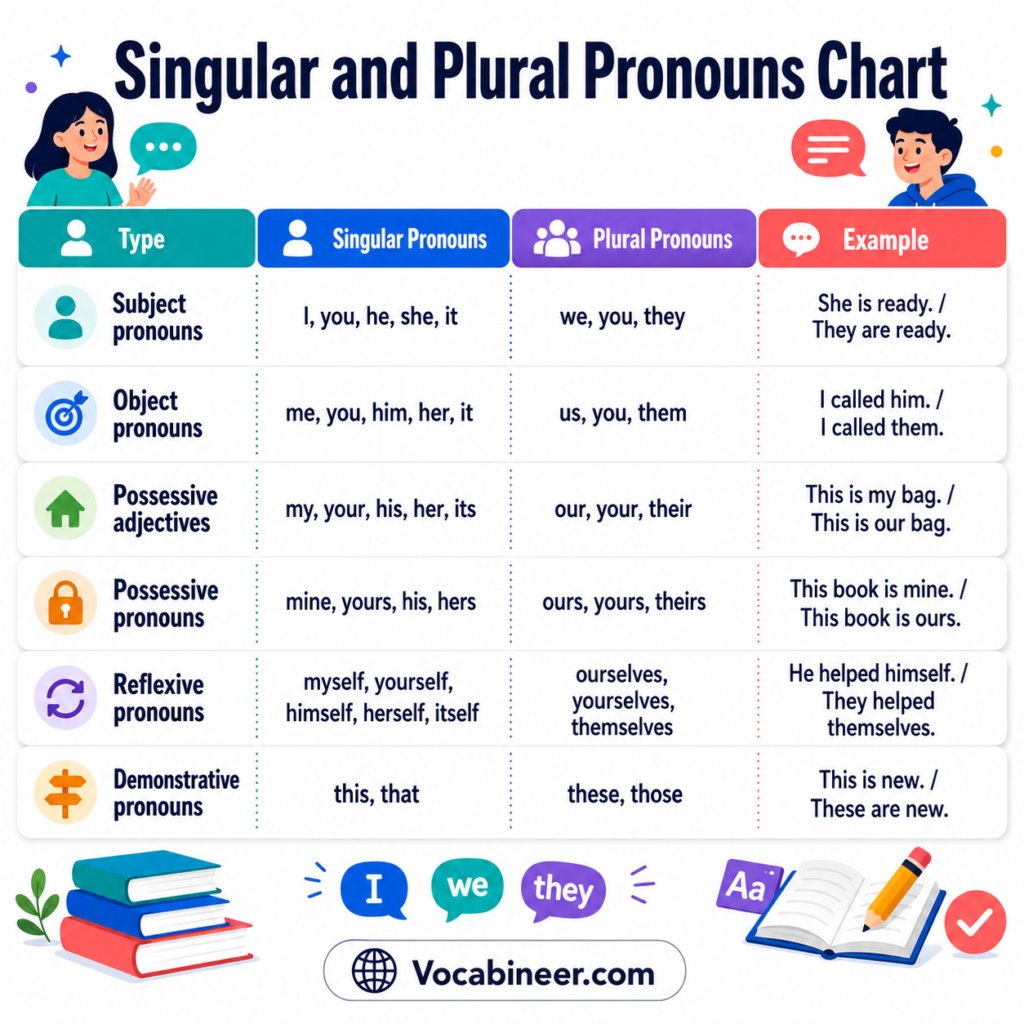
Singular and Plural Pronouns Chart
| Type | Singular Pronouns | Plural Pronouns | Example |
|---|---|---|---|
| Subject pronouns | I, you, he, she, it | we, you, they | She is ready. / They are ready. |
| Object pronouns | me, you, him, her, it | us, you, them | I called him. / I called them. |
| Possessive adjectives | my, your, his, her, its | our, your, their | This is my bag. / This is our bag. |
| Possessive pronouns | mine, yours, his, hers | ours, yours, theirs | This book is mine. / This book is ours. |
| Reflexive pronouns | myself, yourself, himself, herself, itself | ourselves, yourselves, themselves | He helped himself. / They helped themselves. |
| Demonstrative pronouns | this, that | these, those | This is new. / These are new. |
This chart shows how pronouns change when we talk about one person or thing compared with more than one.
Singular and Plural Pronouns List
Here is a simple list of common singular and plural pronouns in English.
| Singular Pronouns | Plural Pronouns |
|---|---|
| I | we |
| me | us |
| my | our |
| mine | ours |
| myself | ourselves |
| you | you |
| your | your |
| yours | yours |
| yourself | yourselves |
| he | they |
| him | them |
| his | their |
| himself | themselves |
| she | they |
| her | them |
| hers | theirs |
| herself | themselves |
| it | they |
| its | their |
| itself | themselves |
| this | these |
| that | those |
Some pronouns, such as you, your, and yours, can be singular or plural depending on the sentence.
Singular vs Plural Pronouns
The main difference between singular and plural pronouns is number.
| Singular Pronouns | Plural Pronouns |
|---|---|
| Refer to one person or thing. | Refer to more than one person or thing. |
| Often use singular verbs. | Often use plural verbs. |
| Examples: he, she, it, this, that. | Examples: we, they, us, them, these, those. |
Examples:
- He is ready.
- They are ready.
- This is my pencil.
- These are my pencils.
- That is a chair.
- Those are chairs.
Use singular pronouns when you mean one. Use plural pronouns when you mean more than one.
Singular and Plural Pronoun Pairs
Some singular and plural pronouns are easy to compare as pairs.
| Singular | Plural | Example |
|---|---|---|
| I | we | I am learning. / We are learning. |
| me | us | Help me. / Help us. |
| my | our | This is my book. / This is our book. |
| mine | ours | This book is mine. / This book is ours. |
| myself | ourselves | I did it myself. / We did it ourselves. |
| he | they | He is here. / They are here. |
| him | them | I called him. / I called them. |
| his | their | This is his bag. / This is their bag. |
| himself | themselves | He helped himself. / They helped themselves. |
| she | they | She is reading. / They are reading. |
| her | them | I helped her. / I helped them. |
| hers | theirs | This seat is hers. / These seats are theirs. |
| herself | themselves | She taught herself. / They taught themselves. |
| it | they | It is broken. / They are broken. |
| this | these | This is new. / These are new. |
| that | those | That is old. / Those are old. |
These pairs help you see how pronouns change from singular to plural.
Singular and Plural You
The word you can be singular or plural in English.
Use you for one person:
- You are my friend.
- I called you yesterday.
- This is your notebook.
- This notebook is yours.
- Please introduce yourself.
Use you for more than one person:
- You are all invited.
- I called you yesterday.
- Please bring your books.
- These seats are yours.
- Please introduce yourselves.
The clearest difference is in the reflexive forms:
| Singular | Plural |
|---|---|
| yourself | yourselves |
Examples:
- Please help yourself. (one person)
- Please help yourselves. (more than one person)
Subject and Object Singular and Plural Pronouns
Subject pronouns do the action. Object pronouns receive the action or come after a verb or preposition.
| Use | Singular | Plural |
|---|---|---|
| Subject | I, you, he, she, it | we, you, they |
| Object | me, you, him, her, it | us, you, them |
Examples:
- I called him.
- We called them.
- He helped me.
- They helped us.
- She invited you.
- They invited you.
A simple rule is: use subject pronouns before the action and object pronouns after verbs or prepositions.
Possessive Singular and Plural Pronouns
Possessive pronouns and possessive adjectives show ownership.
| Use | Singular | Plural |
|---|---|---|
| Possessive adjectives | my, your, his, her, its | our, your, their |
| Possessive pronouns | mine, yours, his, hers | ours, yours, theirs |
Examples:
- This is my book.
- This is our book.
- This book is mine.
- This book is ours.
- That is her bag.
- Those are their bags.
- The red seat is hers.
- The front seats are theirs.
Use possessive adjectives before nouns. Use possessive pronouns without nouns after them.
Reflexive Singular and Plural Pronouns
Reflexive pronouns refer back to the subject. They are used when the subject and object are the same person or group.
| Singular Reflexive Pronouns | Plural Reflexive Pronouns |
|---|---|
| myself | ourselves |
| yourself | yourselves |
| himself | themselves |
| herself | themselves |
| itself | themselves |
Examples:
- I made it myself.
- We made it ourselves.
- You should trust yourself.
- You should all trust yourselves.
- He hurt himself.
- They hurt themselves.
- The door closed by itself.
- The doors closed by themselves.
Demonstrative Singular and Plural Pronouns
Demonstrative pronouns point to people, places, or things. They also show whether something is near or far.
| Singular | Plural | Use | Example |
|---|---|---|---|
| this | these | Near | This is my pen. / These are my pens. |
| that | those | Far | That is your chair. / Those are your chairs. |
Use this and that for one thing. Use these and those for more than one thing.
Examples:
- This is my notebook.
- These are my notebooks.
- That is a tall tree.
- Those are tall trees.
Singular and Plural Pronouns in Sentences
Here are useful examples of singular and plural pronouns in sentences.
Subject pronouns
- I am ready. / We are ready.
- He is my friend. / They are my friends.
- She is reading. / They are reading.
- It is working. / They are working.
Object pronouns
- Please help me. / Please help us.
- I called him. / I called them.
- The teacher praised her. / The teacher praised them.
- I fixed it. / I fixed them.
Possessive pronouns
- This book is mine. / This book is ours.
- The seat is hers. / The seats are theirs.
- That pencil is his. / Those pencils are theirs.
Reflexive pronouns
- I did it myself. / We did it ourselves.
- He helped himself. / They helped themselves.
- She prepared herself. / They prepared themselves.
Demonstrative pronouns
- This is new. / These are new.
- That is old. / Those are old.
Common Mistakes with Singular and Plural Pronouns
Learners often confuse singular and plural pronouns with verb forms, possessive forms, or reflexive forms.
| Incorrect | Correct |
|---|---|
| Me are ready. | I am ready. |
| Us are going home. | We are going home. |
| Them are outside. | They are outside. |
| This are my books. | These are my books. |
| These is my book. | This is my book. |
| This book is our. | This book is ours. |
| He did it theirselves. | They did it themselves. |
| Please introduce yourself. (many people) | Please introduce yourselves. |
| Those is my bags. | Those are my bags. |
| That are my chair. | That is my chair. |
To avoid these mistakes, check whether the pronoun refers to one person or thing, or more than one.
Quick Rules to Remember
| Rule | Example |
|---|---|
| Singular pronouns refer to one. | She is here. |
| Plural pronouns refer to more than one. | They are here. |
| Use this and that for one thing. | This is my bag. |
| Use these and those for more than one. | These are my bags. |
| Use yourself for one person. | Help yourself. |
| Use yourselves for more than one. | Help yourselves. |
| Use plural verbs with plural pronouns. | They are ready. |
| Use singular verbs with singular demonstratives. | This is correct. |
Simple reminders:
- Use he is, not he are.
- Use they are, not they is.
- Use this is for one thing.
- Use these are for more than one thing.
- Use mine and ours without nouns after them.
FAQs
Singular pronouns refer to one person, animal, thing, or idea. Plural pronouns refer to more than one. Examples include he for singular and they for plural.
Examples of singular pronouns include I, me, he, she, it, my, mine, myself, this, and that.
Examples of plural pronouns include we, us, they, them, our, ours, their, theirs, ourselves, themselves, these, and those.
You can be singular or plural. It can refer to one person, as in “You are my friend,” or more than one person, as in “You are all invited.”
Use this for one thing near you. Use these for more than one thing near you. For example, “This is my pen” and “These are my pens.”
Summary
Singular pronouns refer to one person, animal, thing, or idea. Plural pronouns refer to more than one. Common singular pronouns include I, me, he, she, it, this, and that, while common plural pronouns include we, us, they, them, these, and those.
A singular and plural pronouns chart helps you compare subject, object, possessive, reflexive, and demonstrative forms. Learning these forms will help you write clearer sentences and avoid common mistakes in English.
Read More
- List of Pronouns in English
- Subject Pronouns in English
- First Person Pronouns in English
- Possessive Pronouns in English
- Second Person Pronouns in English