Relative pronouns are words that connect extra information to a noun. The main relative pronouns in English are who, whom, whose, which, and that. They help us describe people, animals, things, or ideas more clearly in one sentence.
For example, instead of saying “The girl won the race. The girl is happy,” we can say “The girl who won the race is happy.” Here, who connects the extra information won the race to the girl.
Relative pronouns help us join short sentences and avoid repeating the same noun again and again. They make writing smoother, clearer, and more natural in English, especially when we want to add useful details about a person, thing, or idea.
In This Page
What Are Relative Pronouns?
Relative pronouns are pronouns that introduce extra information about a noun. They usually come after the noun they describe.
Examples:
- The boy who helped me is kind.
- The man whom we met was polite.
- The student whose bag was lost is here.
- The car which stopped is old.
- The book that I bought is new.
In these sentences, the relative pronouns connect more information to nouns like boy, man, student, car, and book.
Relative Pronouns List
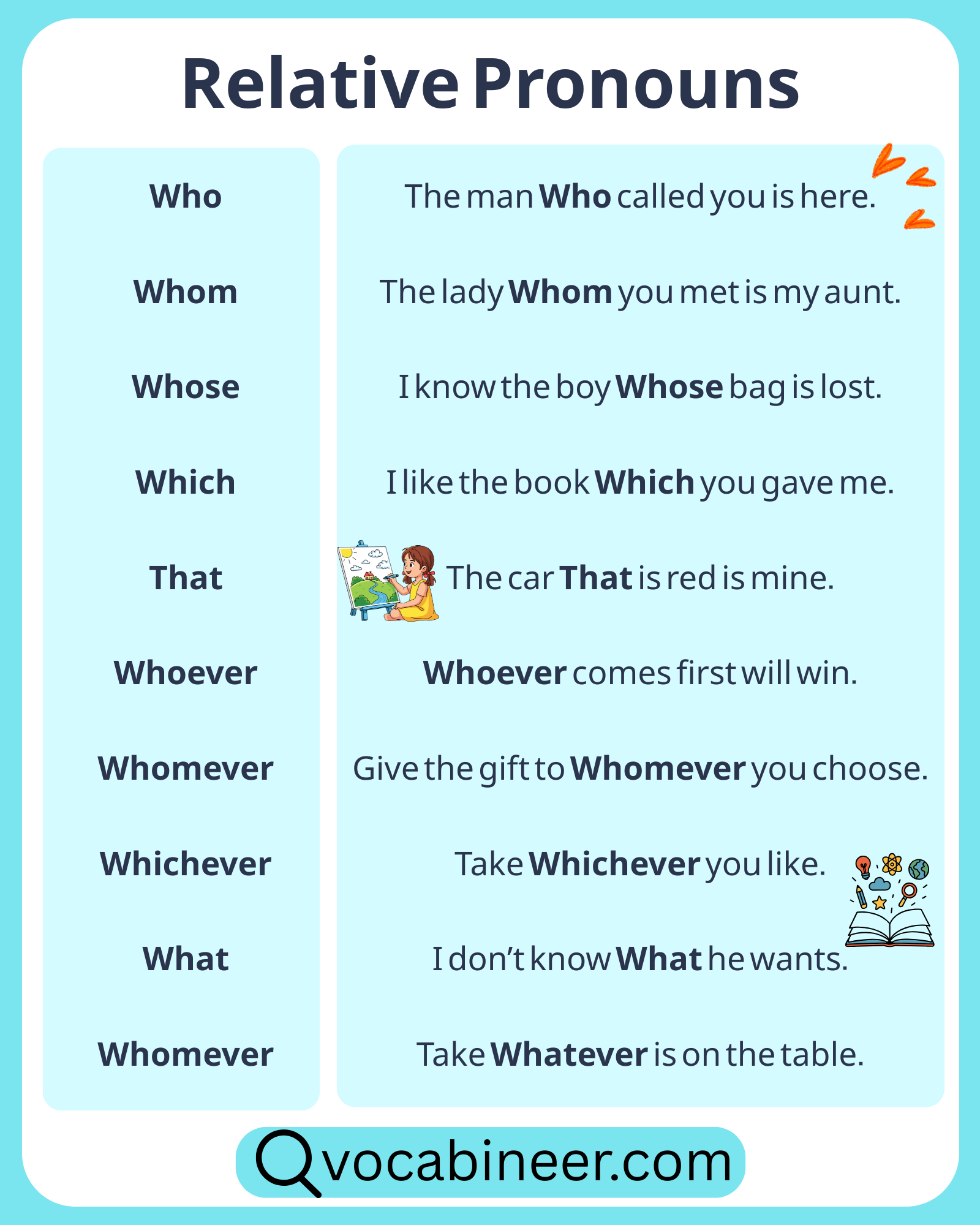
Here is the main list of relative pronouns in English:
- Who
- Whom
- Whose
- Which
- That
These are the most common relative pronouns. Some grammar lessons also discuss words like where, when, and why because they can introduce relative information, but the core relative pronouns are who, whom, whose, which, and that.
Relative Pronouns Chart
| Relative Pronoun | Use | Example |
|---|---|---|
| Who | People as subject | The girl who won is happy. |
| Whom | People as object | The man whom we met was polite. |
| Whose | Ownership | The student whose bag was lost is here. |
| Which | Animals or things | The car which stopped is old. |
| That | People, animals, or things | The book that I bought is new. |
This chart shows the basic use of each relative pronoun. The best choice depends on what the pronoun refers to and what job it has in the sentence.
How Relative Pronouns Work
Relative pronouns connect two ideas by adding more information about a noun.
Example:
- I met a girl.
- The girl won the prize.
- I met the girl who won the prize.
In the final sentence, who connects the information won the prize to the girl.
More examples:
- I bought a book.
- The book was interesting.
- I bought a book that was interesting.
- She found a phone.
- The phone was lost.
- She found a phone which was lost.
Relative pronouns help avoid short, repeated sentences and make writing smoother.
Who as a Relative Pronoun
Use who for people when the relative pronoun is the subject of the extra information.
Examples:
- The girl who won the race is happy.
- The teacher who helped me is kind.
- The boy who called you is outside.
- The woman who lives next door is friendly.
- The student who answered the question was correct.
In these sentences, who refers to a person and does the action in the relative clause.
Example:
- The girl who won the race is happy.
Here, who refers to the girl, and who is the one who won the race.
Whom as a Relative Pronoun
Use whom for people when the relative pronoun is the object of the extra information. Whom is more common in formal writing than in everyday speech.
Examples:
- The man whom we met was polite.
- The person whom I called did not answer.
- The teacher whom they invited arrived early.
- The woman whom we helped thanked us.
- The speaker whom the audience liked was confident.
In everyday English, many people use who instead of whom, especially in conversation.
Examples:
- Formal: The man whom we met was polite.
- Common: The man who we met was polite.
Both may be understood, but whom is the more formal object form.
Whose as a Relative Pronoun
Use whose to show ownership or relationship. It can refer to people, animals, or sometimes things.
Examples:
- The student whose bag was lost is here.
- The girl whose phone rang apologized.
- The man whose car broke down called a mechanic.
- The dog whose collar was red ran away.
- The house whose roof was damaged needs repair.
In these sentences, whose connects ownership to the noun before it.
Example:
- The student whose bag was lost is here.
Here, whose shows that the bag belonged to the student.
Which as a Relative Pronoun
Use which for animals, things, places, or ideas. It connects extra information to a non-person noun.
Examples:
- The car which stopped is old.
- The phone which broke was new.
- The book which I bought is interesting.
- The movie which we watched was funny.
- The idea which she shared was useful.
In many sentences, that can also replace which, especially when the information is needed to identify the noun.
Examples:
- The book which I bought is new.
- The book that I bought is new.
Both are possible, but that is often used for essential information.
That as a Relative Pronoun
Use that for people, animals, or things, especially when the information is essential to identify the noun.
Examples:
- The book that I bought is new.
- The house that has a red gate is mine.
- The dog that barked is outside.
- The teacher that helped us was kind.
- The movie that we watched was exciting.
That is very common in everyday English. It can often replace who or which in defining relative clauses.
Examples:
- The girl who helped me is kind.
- The girl that helped me is kind.
- The phone which broke was new.
- The phone that broke was new.
Who vs Whom
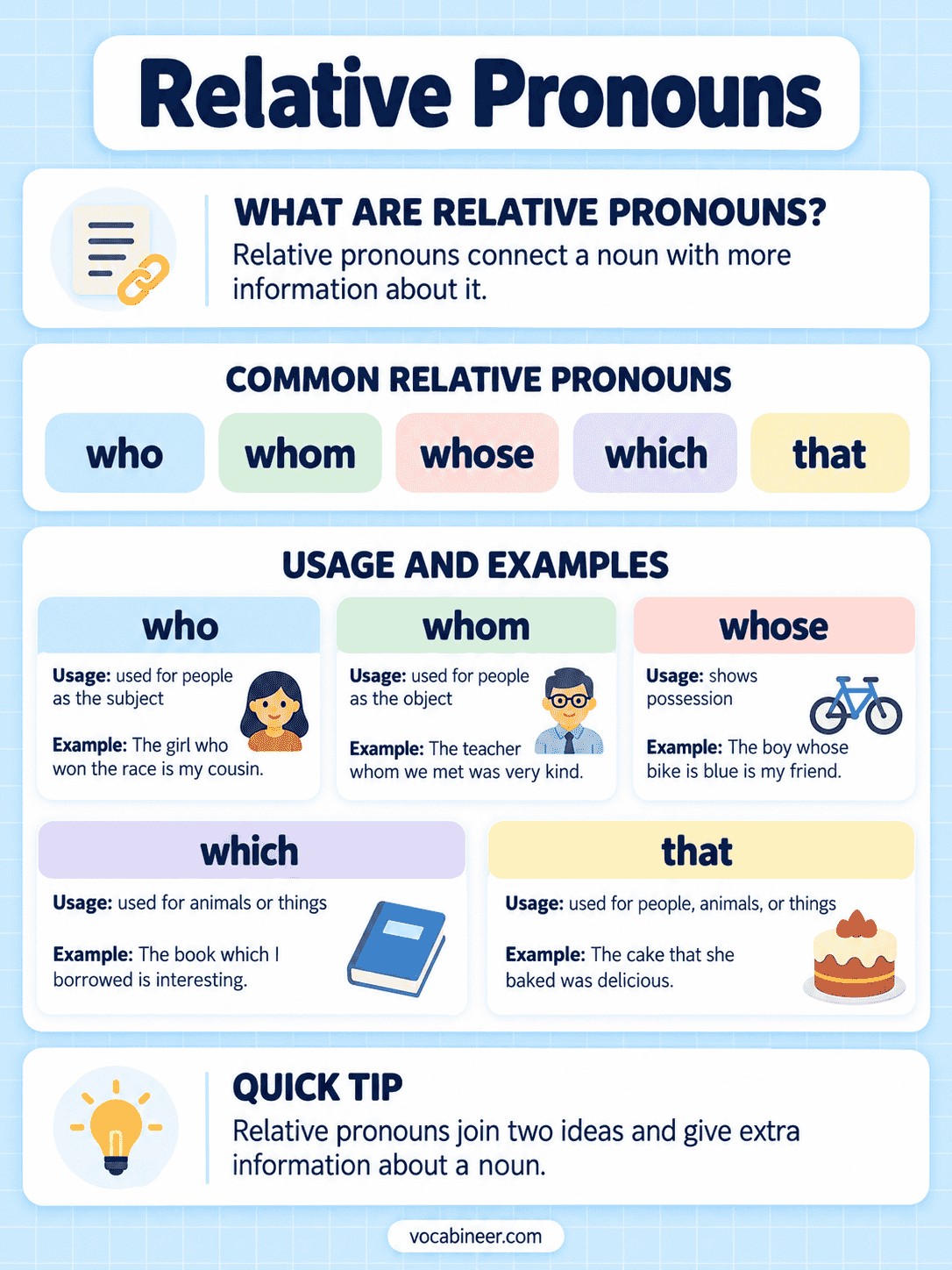
Who and whom both refer to people, but they are used differently.
| Word | Use | Example |
|---|---|---|
| Who | Subject | The girl who called is here. |
| Whom | Object | The man whom we invited arrived. |
A simple test:
- Use who if the meaning matches he, she, or they.
- Use whom if the meaning matches him, her, or them.
Examples:
- The girl who called is here.
Test: She called. - The man whom we invited arrived.
Test: We invited him.
In everyday English, who is often used instead of whom, but whom is still useful in formal writing.
That vs Which
That and which can both refer to things, animals, or ideas, but they are often used differently.
| Word | Common Use | Example |
|---|---|---|
| That | Essential information | The book that I bought is new. |
| Which | Extra information, often with commas | My bike, which is red, is outside. |
Use that when the information is needed to identify the noun.
Example:
- The bag that has a blue tag is mine.
This tells us which bag.
Use which when the information adds extra detail.
Example:
- My bag, which has a blue tag, is mine.
Here, the blue tag is extra information.
Relative Pronouns vs Interrogative Pronouns
Some words can be relative pronouns or interrogative pronouns. The difference depends on their job in the sentence.
| Interrogative Use | Relative Use |
|---|---|
| Who is calling? | The girl who called is here. |
| Which is yours? | The book which I bought is new. |
| Whose bag is this? | The student whose bag was lost is here. |
Interrogative pronouns ask questions. Relative pronouns connect extra information to a noun.
Examples:
- Who helped you? (question)
- The boy who helped me is kind. (relative pronoun)
- Which do you like? (question)
- The pen which I lost was blue. (relative pronoun)
Defining and Non-Defining Relative Clauses
Relative pronouns often introduce relative clauses. A relative clause gives more information about a noun.
There are two common types: defining and non-defining relative clauses.
| Clause Type | Meaning | Example |
|---|---|---|
| Defining relative clause | Gives needed information | The student who won is happy. |
| Non-defining relative clause | Adds extra information | Sara, who won the prize, is happy. |
A defining relative clause tells us exactly which person or thing we mean.
Example:
- The book that I bought is new.
This tells us which book.
A non-defining relative clause gives extra information and usually uses commas.
Example:
- My car, which is red, is outside.
This gives extra detail about the car.
Relative Pronouns in Sentences
Here are useful examples of relative pronouns in sentences.
Who
- The girl who helped me is kind.
- The student who answered is correct.
- The man who lives nearby is friendly.
Whom
- The person whom I called answered quickly.
- The teacher whom we invited arrived early.
- The guest whom they welcomed smiled.
Whose
- The boy whose bike was stolen is sad.
- The teacher whose class ended early left the room.
- The woman whose car broke down called for help.
Which
- The phone which broke was new.
- The song which we heard was beautiful.
- The road which leads to the village is closed.
That
- The book that I bought is new.
- The house that has a red gate is mine.
- The movie that we watched was funny.
Common Mistakes with Relative Pronouns
Learners often confuse relative pronouns because some words are used for people, while others are used for things or ownership.
| Incorrect | Correct |
|---|---|
| The boy which won is happy. | The boy who won is happy. |
| The book who I bought is new. | The book that/which I bought is new. |
| The student which bag was lost is here. | The student whose bag was lost is here. |
| The car who stopped is old. | The car which/that stopped is old. |
| The man which helped me was kind. | The man who helped me was kind. |
| The house who has a red gate is mine. | The house that/which has a red gate is mine. |
| The girl whose won is happy. | The girl who won is happy. |
| The person which I called answered. | The person whom/who I called answered. |
To avoid these mistakes, check what the relative pronoun refers to. Use who for people, which for things or animals, whose for ownership, and that for people, animals, or things when the information is essential.
Quick Rules to Remember
| Rule | Example |
|---|---|
| Use who for people as subjects. | The girl who won is happy. |
| Use whom for people as objects. | The man whom we met was polite. |
| Use whose for ownership. | The student whose bag was lost is here. |
| Use which for animals or things. | The car which stopped is old. |
| Use that for essential information. | The book that I bought is new. |
| Use commas with extra information. | My bike, which is red, is outside. |
Simple reminders:
- Who = people.
- Whom = people as object.
- Whose = ownership.
- Which = animals or things.
- That = people, animals, or things, often for essential information.
FAQs
Relative pronouns are words that connect extra information to a noun. The main relative pronouns are who, whom, whose, which, and that.
Examples of relative pronouns include who, whom, whose, which, and that. Example sentences are “The girl who won is happy” and “The book that I bought is new.”
Use who when the pronoun is the subject, as in “The girl who called is here.” Use whom when the pronoun is the object, as in “The man whom we invited arrived.”
Use that for essential information, as in “The book that I bought is new.” Use which for extra information, often with commas, as in “My bike, which is red, is outside.”
Yes, that can be a relative pronoun. It can refer to people, animals, or things, especially when the information is needed to identify the noun.
Summary
Relative pronouns connect extra information to a noun. The main relative pronouns in English are who, whom, whose, which, and that. Use who for people as subjects, whom for people as objects, whose for ownership, which for animals or things, and that for people, animals, or things when the information is essential. Learning these forms will help you write smoother and clearer English sentences.
Read More
- List of Pronouns in English
- Subject Pronouns in English
- First Person Pronouns in English
- Possessive Pronouns in English
- Second Person Pronouns in English