

Reciprocal pronouns show a two-way action or relationship between two or more people, animals, or things. English has two main reciprocal pronouns: each other and one another. They help us avoid repeating the same names or actions in a sentence.
For example, instead of saying “Sara helped Emma, and Emma helped Sara,” we can say “Sara and Emma helped each other.” Here, each other shows that both people did the same action toward the other person.
In This Page
What Are Reciprocal Pronouns?
Reciprocal pronouns are pronouns that show a mutual action or relationship. They are used when two or more people or things do the same action to one another.
Examples:
- The two friends helped each other.
- The students supported one another.
- The brothers blamed each other.
- The team members trusted one another.
- The dogs chased each other.
In simple words, reciprocal pronouns mean that person A does something to person B, and person B does something back to person A.
Example:
- Sara helped Emma.
- Emma helped Sara.
- Sara and Emma helped each other.
Reciprocal Pronouns List
English has two main reciprocal pronouns:
- Each other
- One another
Both show mutual action or relationship.
Examples:
- The two sisters hugged each other.
- The classmates helped one another.
- The players encouraged one another.
- The two cats chased each other.
Traditional grammar often says each other is used for two people or things, while one another is used for more than two. In modern English, however, many speakers use them interchangeably.
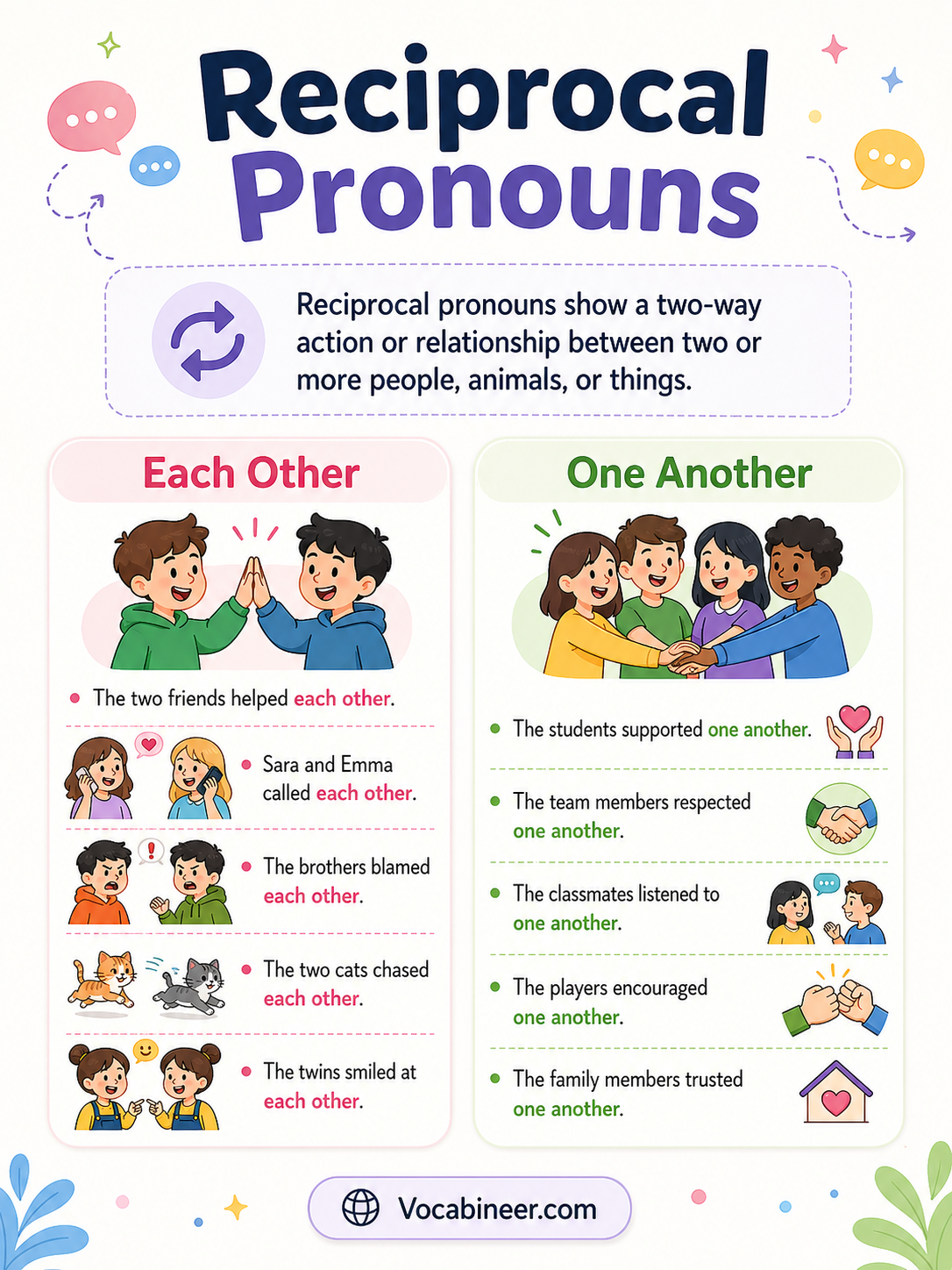
Reciprocal Pronouns Chart
| Reciprocal Pronoun | Common Use | Example |
|---|---|---|
| Each other | Usually two people or things | The two friends helped each other. |
| One another | Usually more than two people or things | The team members supported one another. |
This chart shows the common difference. For beginners, it is helpful to use each other for two and one another for more than two, but both are often used in similar ways in everyday English.
How Reciprocal Pronouns Work
Reciprocal pronouns show that an action goes both ways.
Example:
- A helps B.
- B helps A.
- A and B help each other.
Full sentence example:
- Sara called Emma.
- Emma called Sara.
- Sara and Emma called each other.
More examples:
- The two boys smiled at each other.
- The girls talked to one another.
- The players congratulated one another.
- The two dogs looked at each other.
Reciprocal pronouns usually need a plural subject because the action happens between two or more people or things.
Correct:
- They helped each other.
- The students supported one another.
Incorrect:
- He helped each other.
Better:
- He helped himself.
- They helped each other.
Each Other
Each other is a reciprocal pronoun often used when two people, animals, or things do something mutually.
Examples:
- The two friends helped each other.
- Anna and Mia called each other.
- The brothers blamed each other.
- The two cats chased each other.
- The couple looked at each other.
- The two teams respected each other.
In many everyday sentences, each other is also used for more than two people.
Examples:
- The students helped each other.
- The team members encouraged each other.
- The children shared toys with each other.
This use is common and natural, especially in spoken English.
One Another
One another is a reciprocal pronoun often used when more than two people, animals, or things do something mutually.
Examples:
- The students helped one another.
- The team members supported one another.
- The players encouraged one another.
- The family members trusted one another.
- The classmates listened to one another.
- The employees respected one another.
One another can sound slightly more formal than each other, especially in writing.
Example:
- The group members shared ideas with one another.
This sentence sounds natural in school, work, or formal writing.
Each Other vs One Another
Each other and one another are very similar. Both show a mutual action or relationship.
| Phrase | Traditional Use | Example |
|---|---|---|
| Each other | Two people or things | The two sisters hugged each other. |
| One another | More than two people or things | The classmates helped one another. |
Traditional rule:
- Use each other for two people or things.
- Use one another for more than two people or things.
Examples:
- The two friends texted each other.
- The three friends supported one another.
Modern usage:
Many speakers use each other and one another interchangeably.
Examples:
- The students helped each other.
- The students helped one another.
Both sentences are natural. For learners, the traditional rule is still a useful guide.
Possessive Reciprocal Pronouns
Reciprocal pronouns can also show possession. The possessive forms are:
- Each other’s
- One another’s
Examples:
- The two friends borrowed each other’s books.
- The sisters wore each other’s jackets.
- The students checked one another’s answers.
- The players learned one another’s names.
- The classmates read one another’s stories.
Use each other’s or one another’s before a noun.
Examples:
- Each other’s books
- Each other’s ideas
- One another’s names
- One another’s answers
Important correction:
| Incorrect | Correct |
|---|---|
| each others’ | each other’s |
| one anothers’ | one another’s |
Even though the meaning is plural, the possessive form is written as each other’s and one another’s.
Reciprocal Pronouns vs Reflexive Pronouns
Reciprocal pronouns and reflexive pronouns are different.
Reciprocal pronouns show action between two or more people or things. Reflexive pronouns show that the action returns to the same person or group.
| Meaning | Pronoun Type | Example |
|---|---|---|
| Mutual action | Reciprocal pronoun | They helped each other. |
| Action returns to the same subject | Reflexive pronoun | They helped themselves. |
Compare:
- They looked at each other.
Meaning: Person A looked at person B, and person B looked at person A. - They looked at themselves.
Meaning: Each person looked at their own self.
More examples:
- The boys blamed each other.
Meaning: Each boy blamed the other. - The boys blamed themselves.
Meaning: Each boy blamed himself. - The students corrected one another’s work.
Meaning: Students corrected other students’ work. - The students corrected themselves.
Meaning: Each student corrected their own work.
Reciprocal Pronoun Sentence Patterns
These patterns can help you use reciprocal pronouns correctly.
| Pattern | Example |
|---|---|
| Plural subject + verb + each other | They helped each other. |
| Plural subject + verb + one another | The students supported one another. |
| Plural subject + verb + each other’s + noun | They borrowed each other’s books. |
| Plural subject + verb + one another’s + noun | They checked one another’s answers. |
| Plural subject + preposition + each other | They talked to each other. |
| Plural subject + preposition + one another | They learned from one another. |
More examples:
- The girls smiled at each other.
- The employees listened to one another.
- The players learned one another’s names.
- The friends shared each other’s snacks.
Reciprocal Pronouns in Sentences
Here are useful examples of reciprocal pronouns in different contexts.
Friendship
- The two friends trusted each other.
- They always helped each other.
- The friends shared secrets with each other.
- They respected each other’s choices.
Family
- The brothers blamed each other.
- The sisters borrowed each other’s clothes.
- The family members supported one another.
- The cousins sent messages to one another.
School
- The students helped one another with homework.
- The classmates listened to one another.
- The two students corrected each other’s mistakes.
- The group members read one another’s answers.
Work
- The employees respected one another.
- The team members shared one another’s ideas.
- The two workers helped each other finish the task.
- The managers trusted one another.
Animals
- The two cats chased each other.
- The dogs followed one another.
- The birds called to one another.
- The horses stood beside each other.
Common Mistakes with Reciprocal Pronouns
Learners often confuse reciprocal pronouns with reflexive pronouns or write the possessive forms incorrectly.
| Incorrect | Correct |
|---|---|
| He helped each other. | They helped each other. |
| The two friends helped themselves. (mutual meaning) | The two friends helped each other. |
| They used each others’ books. | They used each other’s books. |
| The students checked one anothers’ answers. | The students checked one another’s answers. |
| The boys blamed himself. | The boys blamed each other / themselves, depending on meaning. |
| Sara and Emma looked at themselves. (mutual meaning) | Sara and Emma looked at each other. |
| The team supported himself. | The team members supported one another. |
| The children shared one another toy. | The children shared one another’s toys. |
A simple way to avoid mistakes is to check the meaning. If the action goes both ways between people or things, use each other or one another. If the action returns to the same subject, use a reflexive pronoun like himself, herself, or themselves.
Quick Rules to Remember
| Rule | Example |
|---|---|
| Use reciprocal pronouns for two-way action. | They helped each other. |
| Use each other often for two people or things. | The twins hugged each other. |
| Use one another often for more than two. | The players supported one another. |
| Use each other’s for possession. | They borrowed each other’s books. |
| Use one another’s for possession. | They checked one another’s answers. |
| Do not use reciprocal pronouns with a singular subject. | Not: He helped each other. |
| Do not write each others’. | Write each other’s. |
Simple reminders:
- Each other and one another show mutual action.
- Reciprocal pronouns usually need a plural subject.
- Each other’s and one another’s show possession.
- Each other is common for two people or things.
- One another is common for more than two people or things.
FAQs
Reciprocal pronouns are pronouns that show a two-way action or relationship between two or more people, animals, or things. The two main reciprocal pronouns are each other and one another.
Examples of reciprocal pronouns are each other and one another. Example sentences include “The two friends helped each other” and “The students supported one another.”
Traditionally, each other is used for two people or things, while one another is used for more than two. In modern English, many speakers use both forms interchangeably.
Yes. The possessive forms are each other’s and one another’s. Examples include “They borrowed each other’s books” and “The students checked one another’s answers.”
Reciprocal pronouns show mutual action, as in “They helped each other.” Reflexive pronouns show the action returns to the same subject, as in “They helped themselves.”
Summary
Reciprocal pronouns show a two-way action or relationship. English has two main reciprocal pronouns: each other and one another.
Use each other often for two people or things and one another often for more than two. Use each other’s and one another’s to show possession. Learning reciprocal pronouns will help you write clearer sentences about mutual actions, relationships, and shared actions.
Read More
- List of Pronouns in English
- Subject Pronouns in English
- First Person Pronouns in English
- Possessive Pronouns in English
- Third Person Pronouns in English