

A microscope is an important instrument used in schools, science labs, and biology classes. It helps people see very small objects that cannot be seen clearly with normal eyes. Learning microscope parts names helps students, beginners, and English learners understand science vocabulary in simple English.
In this article, you will learn microscope parts names in English in a clear and organized way. You will also learn the parts of a microscope, their simple functions, and the most important compound microscope parts students often study.
In This Page
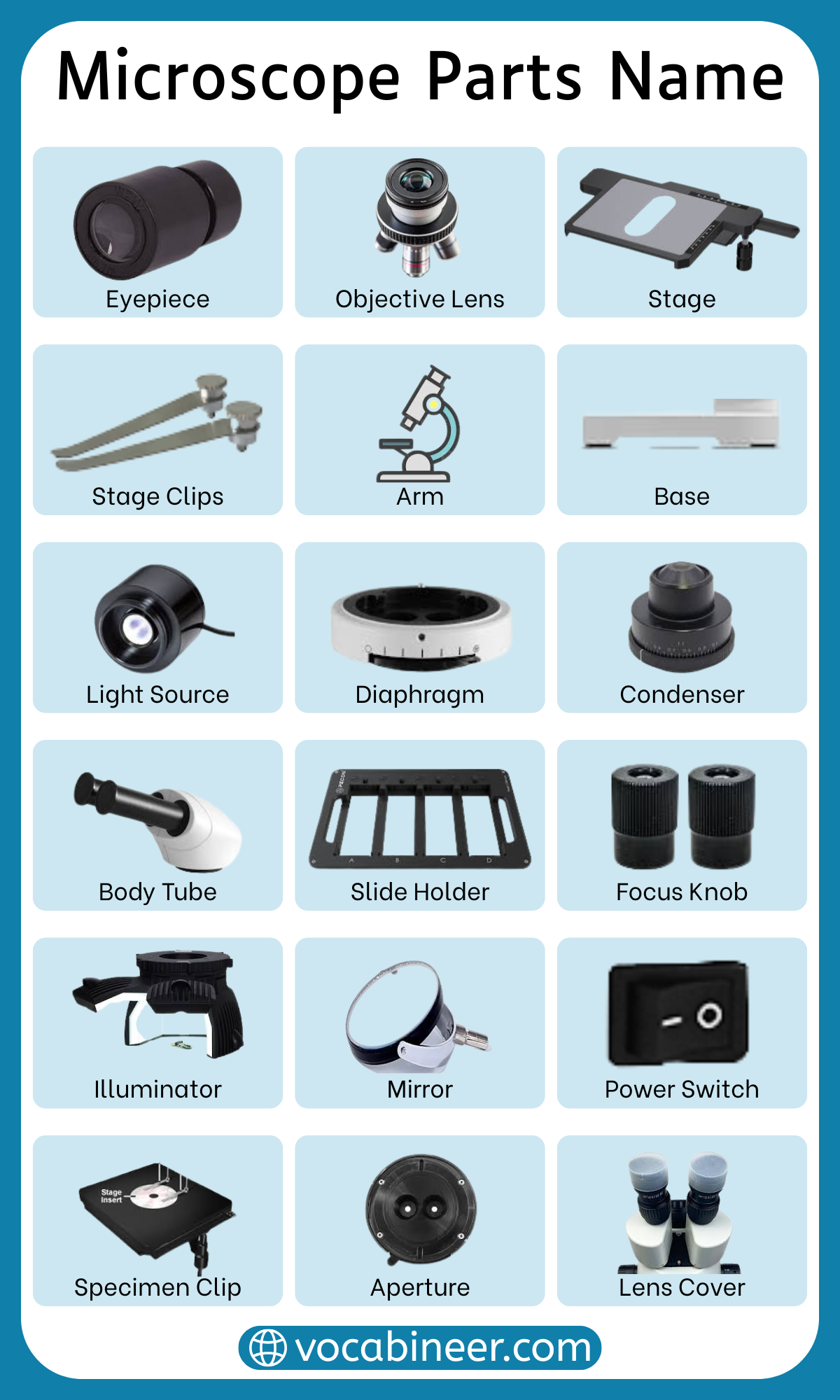
Common Microscope Parts
These are the main microscope parts students usually learn first in science classes. They are basic, important, and often shown in school diagrams, lab lessons, and exam questions.
- Eyepiece
- Body Tube
- Revolving Nosepiece
- Objective Lenses
- Stage
- Stage Clips
- Diaphragm
- Condenser
- Illuminator
- Mirror
- Arm
- Base
- Coarse Adjustment Knob
- Fine Adjustment Knob
- Rack Stop
- Inclination Joint
Main Parts of a Microscope
A microscope has several main parts that work together to help users see tiny objects clearly. Each part has a special job in viewing and magnifying.
- Eyepiece: the part you look through
- Body tube: the tube that connects the eyepiece to the lenses below
- Revolving nosepiece: the rotating part that holds the objective lenses
- Objective lenses: the lenses near the specimen that magnify it
- Stage: the flat platform where the slide is placed
- Stage clips: clips that hold the slide in place
- Diaphragm: the part that controls the amount of light
- Condenser: the part that focuses light onto the specimen
- Illuminator: the built-in light in many microscopes
- Arm: the part used to support and carry the microscope
- Base: the bottom part that supports the microscope
- Coarse adjustment knob: used for rough focusing
- Fine adjustment knob: used for sharp and clear focusing
Optical Parts
Optical parts are the parts that help form and magnify the image. These parts are directly related to seeing the specimen more clearly through lenses.
- Eyepiece lens: the lens inside the eyepiece that you look through
- Objective lenses: the lenses close to the specimen that provide magnification
- Low-power objective: a lens used for lower magnification
- Medium-power objective: a lens used for medium magnification
- High-power objective: a lens used for higher magnification
- Oil immersion lens: a special objective used for very high magnification
- Body tube: keeps the correct distance between the eyepiece and objective lenses
- Head: the upper part that holds the eyepiece in some microscopes
Stage and Slide Holding Parts
These parts hold the slide in place and help position it correctly. They make it easier to view the specimen without movement during observation.
- Stage: the flat part where the slide is placed
- Stage clips: clips that keep the slide from moving
- Mechanical stage: a movable stage used in many modern microscopes
- Slide holder: a part that keeps the slide steady
- Stage control knob: used to move the slide left, right, forward, or backward
- Aperture: the hole in the stage through which light passes
Focusing Parts
Focusing parts help make the image clear and sharp. They are used to adjust the microscope so the specimen can be seen more accurately.
- Coarse adjustment knob: a large knob used for rough focusing
- Fine adjustment knob: a small knob used for exact focusing
- Focus control: the system that helps adjust image clarity
- Rack stop: a safety part that stops the objective lens from hitting the slide
Light and Illumination Parts
These parts provide and control the light needed for viewing. Good lighting is important because it helps the specimen appear brighter and easier to examine.
- Mirror: reflects outside light upward in some microscopes
- Illuminator: a built-in bulb or lamp in modern microscopes
- Diaphragm: controls how much light passes through the specimen
- Iris diaphragm: a more exact light-control part in many microscopes
- Condenser: focuses light onto the slide
- Filter: used in some microscopes to improve or change light
Mechanical and Support Parts
Mechanical and support parts hold the microscope together and help it work properly. They give stability, movement, and support while the microscope is being used.
- Arm: the curved support part used to hold and carry the microscope
- Base: the bottom support of the microscope
- Pillar: the upright supporting part in some microscope models
- Inclination joint: allows the microscope to tilt in some types
- Frame: the main supporting structure of the microscope
- Revolving nosepiece: turns to change objective lenses
- Joint: connects moving parts in some microscopes
Compound Microscope Parts for Students
These are the most important compound microscope parts students usually study first. They are common in textbooks, classroom diagrams, science exams, and laboratory lessons.
- Eyepiece
- Objective lenses
- Body tube
- Revolving nosepiece
- Stage
- Stage clips
- Diaphragm
- Condenser
- Mirror or illuminator
- Arm
- Base
- Coarse adjustment knob
- Fine adjustment knob
Summary
A microscope has many important parts that help people view very small objects clearly. Common microscope parts names include eyepiece, objective lenses, body tube, revolving nosepiece, stage, stage clips, diaphragm, condenser, arm, base, and adjustment knobs.
Learning the parts of a microscope, their simple functions, and the main compound microscope parts helps students understand science vocabulary in easy English. It also makes biology lessons, lab work, and school study easier.
FAQs
The main parts of a microscope include eyepiece, body tube, objective lenses, nosepiece, stage, stage clips, diaphragm, condenser, arm, base, and adjustment knobs.
The eyepiece is the part at the top of the microscope that a person looks through to see the magnified image.
The stage is the flat part of the microscope where the slide is placed for viewing.
The coarse adjustment knob is used for rough focusing, while the fine adjustment knob is used for more exact and sharp focusing.
The optical parts include the eyepiece, objective lenses, body tube, and other viewing parts that help magnify the specimen.
Read More